#Kuge — Houses of Rank and Court Office
Contents
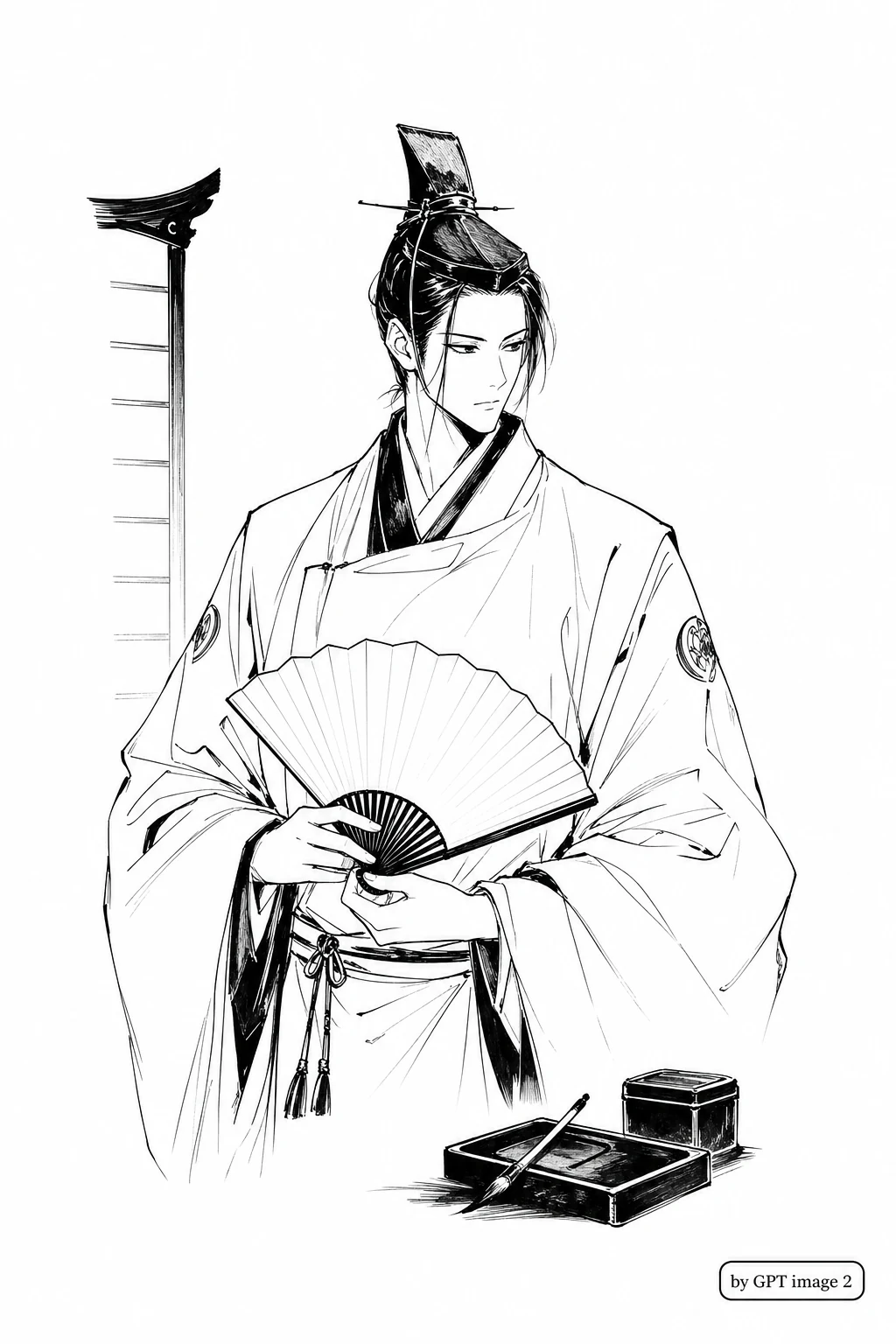
This document belongs to front. Its structure follows real history. The Scent is Fiction-Only.
#Brief — What Is a Kuge?
A kuge (court-noble house) is a hereditary noble line serving the imperial court in Kyoto. If buke (warrior houses) stand on land and military force, kuge stand on house rank, court rank, and family vocation. What they hold is neither army nor castle — only the formality of bloodline, the position of being near the emperor, and the arts handed down for generations.
The core principle is the opposite of the buke. The buke say "the house outlives the blood," but the kuge say "the rank you are born into decides your whole life." Which house you are born into sets in advance the ceiling of the office you can reach. However able you are, a low-ranked house cannot become a minister; however incapable you are, if you are born into a sekke (regent house), the path of regent stands open.
#Commentary — Rank Is Destiny
The kuge order is fixed by house rank. From the top down:
- Sekke (regent houses) — the five highest houses. The only rank that can produce a regent or a kampaku.
- Seiga houses — the rank that rises to minister and grand minister.
- Daijin houses — the rank that reaches minister.
- Urin and meika houses — middle tojo kuge. The mainstay of practical office.
- Hanke — the lowest of the tojo. Often they get by on a single family vocation.
This rank is set at birth and almost never changes. So the ambition of a kuge does not flow toward "widening the land" like a buke, but toward marrying a daughter into a higher rank, continuing the rank through an adopted heir, and receiving one more step of court rank.
And one more thing that feeds the kuge: the family vocation — the art that one house monopolizes for generations. This vocation connects directly to the other issues of Konsei Reiyotan.
- Onmyodo — the onmyoji houses (the historical Abe and Tsuchimikado). Monopoly over the court's astronomy, calendar, and divination.
- Song and Dance and Waka — the vocation of the Arts. The houses that carry kemari, waka, and gagaku.
- jingi — the vocation of Shinto rites. It governs the court's rituals and the appointment of shrine officials.
#Table — Kuge Rank and Court Office
| Rank | Kanji | Ceiling One Can Reach | Atmosphere |
|---|---|---|---|
| sekke | 攝家 | regent and kampaku (the summit among subjects) | Only five houses. The highest houses that assist the emperor |
| seiga house | 淸華家 | grand minister, ministers of the left and right, and other minister-rank posts | A prestigious house that produces ministers |
| daijin house | 大臣家 | inner minister candidate, usually major-counselor rank | A rank that can reach minister but whose seats are few |
| urin and meika | 羽林・名家 | tojo offices, up to major counselor | The backbone of the court's practical work |
| hanke | 半家 | lower offices tied to the family vocation | A house that lives on a single vocation |
| jige | 地下 | cannot rise to the tojo | Lower officials and functionaries without the right of ascent to the presence |
| Grade Axis | Kanji | Meaning |
|---|---|---|
| court grade | 位階 | the grades from Senior First Rank down to Initial Rank. A person's rank |
| office | 官職 | actual posts such as the Grand Council of State and the Eight Ministries |
| tojo/jige | 堂上/地下 | the line of whether one may ascend to the imperial presence before the emperor |
The buke too received this court office as an honor. A daimyo styling himself with a provincial-title name like "...no Kami" is just that (
03). An impoverished kuge could even come to make a living from brokering that court office and formality — the reality below.
#Commentary — The Reality of Sengoku-Period Kuge
Since the Onin War, Kyoto had burned and the kuge's manorial estates were devoured by provincial warriors. The Sengoku-period kuge were in a position of high rank but empty purse. And so:
- Provincial shelter — going down to a daimyo's castle town and living by selling poetry, calligraphy, etiquette, and the brokering of court office.
- Brokering court office — receiving from the court the offices and grades a daimyo covets and handing them over, then taking a reward.
- Intermarriage — marrying a daughter into a powerful buke to continue the house, and bringing buke blood into the kuge. Buke and kuge connect this way.
In other words, the Sengoku kuge are another face of the "fallen noble" — running the PC Fallen Noble background not as a buke but as an impoverished kuge fits exactly. It is only that what they hold is not a blade but a name and formality.
#Scent — A Hearing: Calligraphy for Sale
Editor's note: a story heard from a young man of a hanke house in Kyoto.
Under a leaking eave, he wrote his characters again today. The descendant of a house that had once risen to Senior First Rank was, at the request of a warrior come up from the provinces, ghostwriting the house's genealogy chart. The warrior wished to tie his ancestors to the Genji. He needed rank.
"My house's vocation was originally waka," he said, grinding his ink. "But these days — writing out another's bloodline convincingly has become the vocation." It was self-mockery, yet his hand did not waver. With each line his brush drew, one country warrior became a descendant of nobility.
"Is it amusing?" He set down his brush. "Yet what has endured a thousand years in this capital is not the blade but this brush. Castles may crumble, but the rank of a name — that, we hold." Rainwater fell beside the ink. He was poor, but his back was straight.
Buke and kuge alike prove themselves in the end by their name. Of what layers that name is made →
03 Names and Houses