#Names and Crests — The Six-Layer Name
Contents
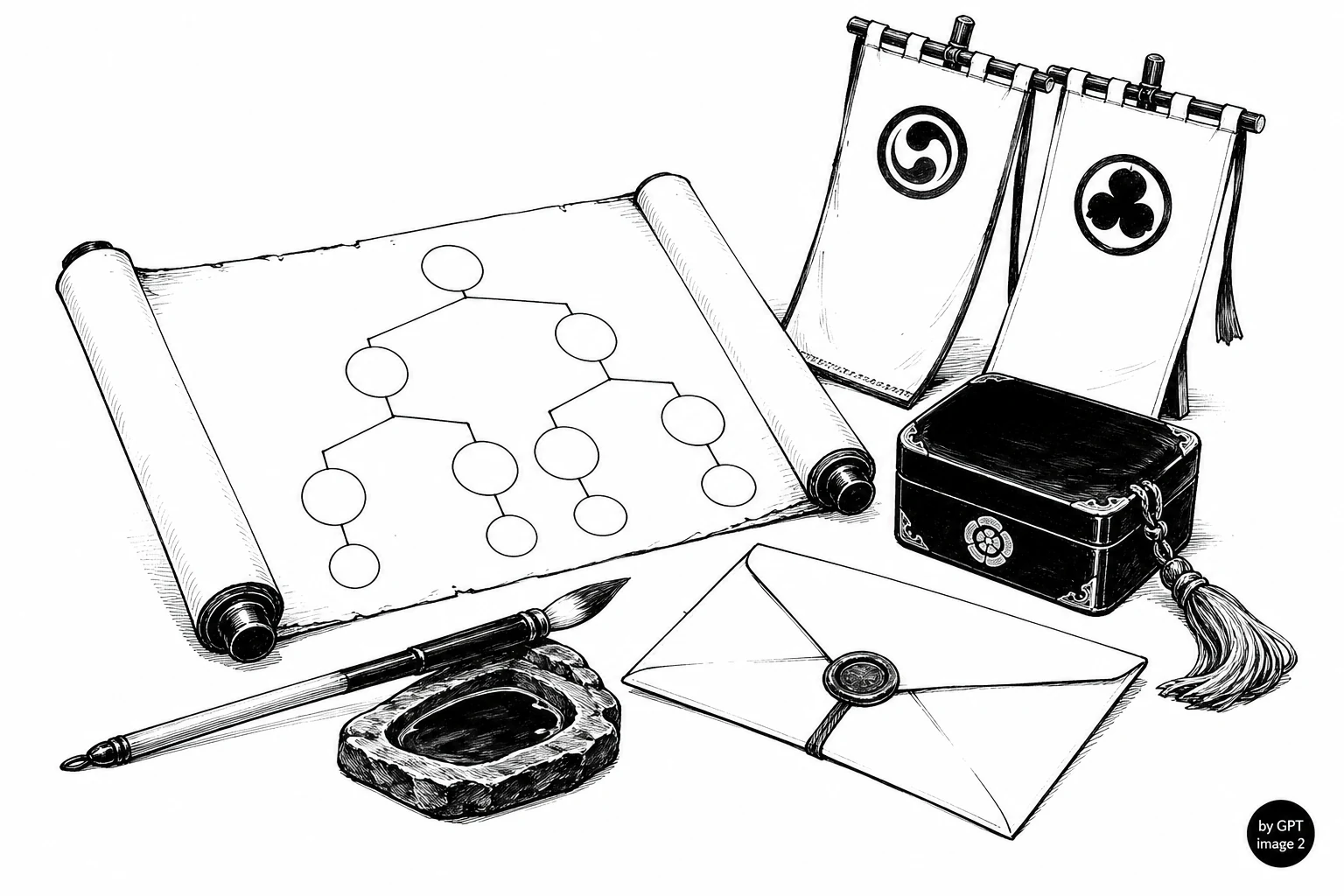
This document belongs to the front. The form of names follows a real historical system. The character examples are illustrative inventions.
#Commentary — The Name You Are Called and the Real Name Are Different
A Sengoku-period person's name is not just one. The name called in daily life, the name written in documents, and the real name that must not be spoken are all separate. Spread out the full formal name of a single warlord and six layers appear. Thinking of it as a modern "surname + given name" will surely confuse you — here the key is to separate the layers and look.
The core first: in daily life one is called by "family name + common name" (e.g. Oda Kazusanosuke), and the real name, the imina (諱), is not spoken lightly (Nobunaga is not a name those who serve him may utter carelessly).
#Table — The Six Layers of a Name
| Layer | Kanji | What It Is | Example | Use |
|---|---|---|---|---|
| 1. clan name (uji) | 氏 | Ancient bloodline of origin. 源・平・藤原・橘 (the Genpeitokitsu clans) are the representative great uji | 「平」 | The most official documents. Court appointment |
| 2. kabane | 姓 | Hereditary title attached to the uji | 「朝臣 (Ason)」 | Almost wholly formal. Only in formal signatures |
| 3. family name | 苗字・名字 | Everyday surname. Mostly drawn from land or place names | 「織田」 | The ordinary name pointing to a person |
| 4. true name (imina) | 諱 | The real name. To call it lightly is rude (hence "imina") | 「信長」 | Self, lord, records only. Inherited via the tsuji |
| 5. common name (kana / office name) | 通称・官途名 | The name called in daily life. Birth order (太郎), office (彈正忠), provincial title (上總介) | 「上總介」 | The body of daily address |
| 6. go / dharma name | 号・法名 | Name of retirement, taking the cloth, or the arts (藝) | 「總見院」 | Tea masters, the retired, monks |
Assembly. Written out fully in formal order, it becomes [family name] + [common name] + [uji][kabane] + [imina].
Example (invented): Kageyama Danjonojo Minamoto no Ason Munekata (影山 彈正丞 源朝臣 宗方)
- Daily address: Kageyama Danjonojo (family name + common name)
- Real name (imina): Munekata — those who serve do not call it
- Documents and appointment: Minamoto no Ason Munekata (uji + kabane + imina)
#Commentary — Tsuji and Henki: Bloodline and Loyalty Carved into the Name
The imina (諱) holds two important devices.
- tsuji (通字 / 系字) — One house passes down the same character in the imina generation after generation. As an invented example, if the Kageyama house uses "宗 (Mune)" as its tsuji — Munekata, Munehisa, Munetoki… one knows the bloodline at a glance from the name alone. The tsuji is the signature of the house.
- henki (偏諱) — A lord takes one character from his own imina and grants it to a retainer or son. As an invented example, if the domain lord "Mune" grants "宗" to an able retainer, that retainer carries the lord's character in his name for life. This is a visible knot of loyalty (the "thickness of loyalty" in
01 Buke).
Staging hook. If a retainer who received a henki betrays, he must discard the granted character (he changes his name). A house whose tsuji is cut off — its bloodline has been cut off. A single character of a name holds an entire story.
#Table — Branches of the Common Name
The "common name" called in daily life splits again into three.
| Branch | Kanji | What It Is | Invented Example |
|---|---|---|---|
| birth-order name | 排行名 | Order of birth | Taro (太郎, eldest) · Jiro (次郎) · Saburo (三郎) |
| office-style name | 官途名 | Title modeled on a court office | Danjonojo (彈正丞) · Hyogonosuke (兵庫助) |
| provincial-title name | 受領名 | Title modeled on a provincial official | Kazusanosuke (上總介) · Higonokami (肥後守) |
Office and provincial-title names are, in most cases, titles rather than actual postings. A daimyo received them as an honor from the court, or simply styled himself with one (the mediation of court rank in
02 Kuge).
#Table — Names That Differ by Person
| Status | Form of the Name |
|---|---|
| Buke man | All six layers above. Family name + common name is daily |
| Kuge | Family name + court grade and office is the rank itself. Imina is valued |
| Miko / women | Often family name + given name. The family name changes through political marriage. A miko may use a priestly name separately |
| Monks / retired | Live by dharma name or go (the same grain as an artist's go, zn01) |
| Artisans / commoners | Mostly no family name, common name only. May use a "○○ya (屋)" shop name |
#Commentary — The Family Crest (家紋): The Picture Board of the Name
If the name is something heard, then the family crest (家紋, kamon) is something seen. The crest is an emblem that announces a single house at a glance, carved onto banners (幟・旗), camp curtains, clothing, roof tiles, and tools.
- primary crest (定紋) — The house's official crest. One.
- alternate crest (替紋) — An informal, secondary crest. There may be several.
- The designs come from plants (melon flower, wisteria, bellflower), nature (moon, waves), figures (lozenge, well-curb), implements, and so on.
- Granting and inheritance — A lord may bestow a crest, and a branch house may use the main house's crest slightly altered (the picture board of the henki).
On the battlefield the crest is both a marker and a target. Raise the banner high and allies gather, but the enemy's arrows gather there too. The fall of one house's banner — that is the picture of one house collapsing.
Now that you know the layers and the devices, it is time to shape a single house. →
04 Building a House