#Tale of the Bamboo Cutter — Synopsis
Contents
This document belongs to front. The synopsis and historical notes are a real monogatari (Reference); the atmospheric fragments are Fiction-Only. There are no new rules or numbers — the data is handled in
02,03, and04.
#Scent — The Shining Bamboo
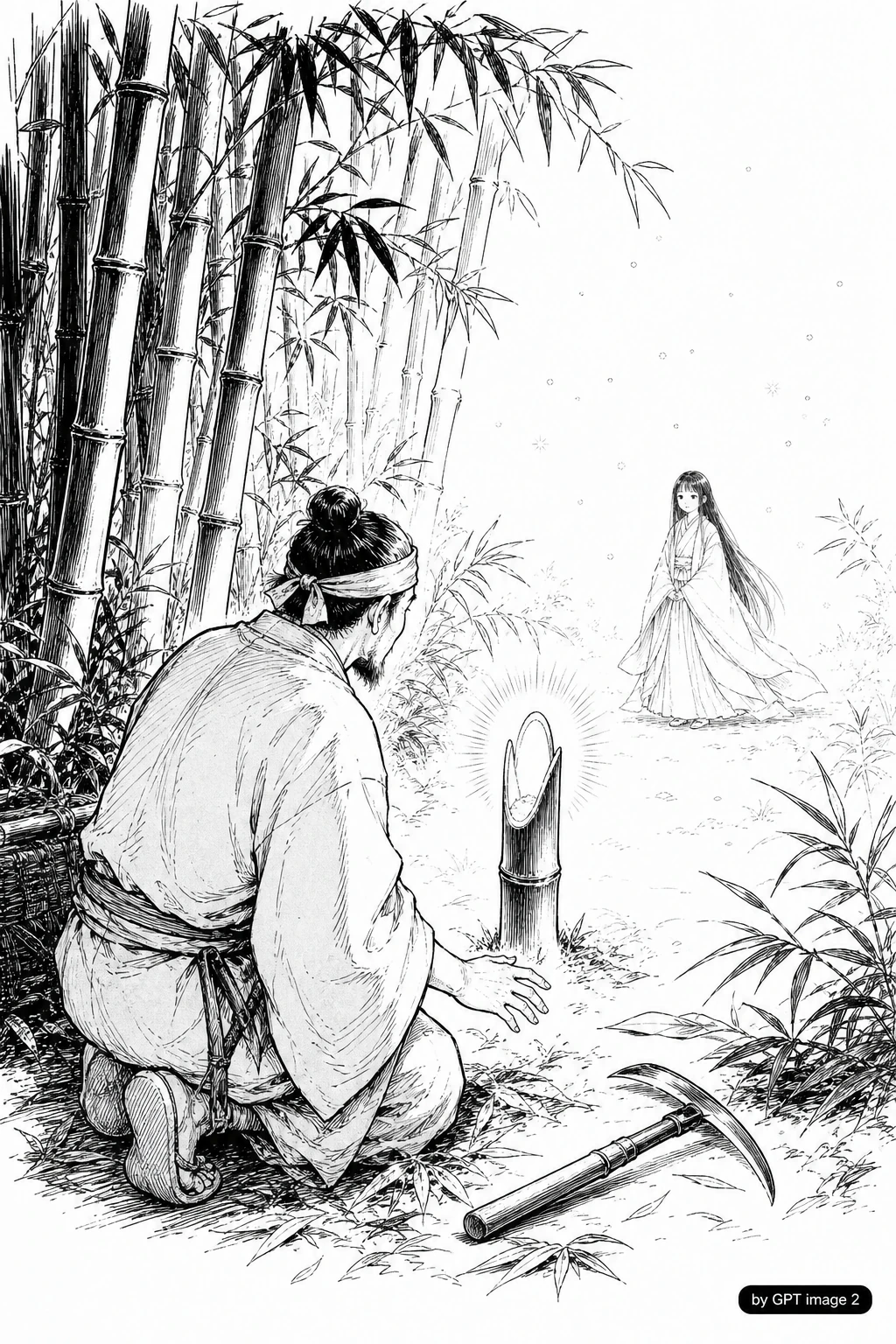
In a bamboo grove, a single joint glowed. When old Taketori (the bamboo cutter) cut it open, a child barely three sun (about three inches) tall was sitting neatly inside. The old man took the child in his arms and returned home.
From that day on, every time the old man cut bamboo there was gold inside the joint. The once-poor house grew rich. But what the old couple treasured as their true treasure was not the gold — it was that child.
When three months had passed, the child had grown to an adult's height. She shone. No lamp was needed in the room, and the old man's illness eased whenever he looked at her. Her hair was put up and she was given a name — Nayotake no Kaguya-hime, "the Shining Princess of the Supple Bamboo."
#Brief — The Five Noble Suitors and the Five Impossible Tasks
Kaguya's beauty spread all the way to the capital. Countless suitors stayed up through the night outside the fence. Among them, five remained to the end — all renowned noble suitors.
Kaguya answered the five. "I will follow the one who fetches the treasure I wish to see." And she ordered a different treasure from each of the five. They were things that did not exist in the world, or that, even existing, lay beyond human reach.
| Noble Suitor | Treasure Ordered | Outcome |
|---|---|---|
| Prince Ishitsukuri (石作皇子) | Buddha's Stone Begging Bowl (仏の御石の鉢) | brought a counterfeit — exposed |
| Prince Kuramochi (車持皇子) | Jeweled Branch of Horai (蓬莱の玉の枝) | made an elaborate counterfeit — exposed by the artisans |
| Abe no Miushi, Minister of the Right (阿倍御主人) | Fire-Rat Robe (火鼠の裘) | bought a counterfeit at a high price — burned up in fire |
| Otomo no Miyuki, Major Counselor (大伴御行) | Five-Colored Jewel from the Dragon's Neck (龍の頸の五色の玉) | nearly died in a storm seeking the dragon — gave up |
| Isonokami no Marotari, Middle Counselor (石上麻呂足) | Swallow's Easy-Birth Shell (燕の子安貝) | fell and died while rummaging a swallow's nest |
The detailed specs of the five treasures are handled in 02 Treasures, and the beings that guard the treasures in 03 Guardians.
The core motif of these five impossible tasks is that "the genuine article cannot be obtained, and counterfeits run rampant." None of the five noble suitors reached the genuine article. Some tried to deceive with a counterfeit and were caught; some lost their lives. Kaguya may have known from the start — by ordering what could not be obtained, she turned refusal into a form that was not refusal.
#Scent — One Suitor's Counterfeit
Prince Kuramochi was clever. Knowing he could not go all the way to Mount Horai, he pretended to set off by boat — and hid within the capital. He summoned six of the finest engraving artisans of the day and had them make the Jeweled Branch of Horai out of jade and gold. He spent nearly a thousand days on it.
When he appeared at Kaguya's house with the false branch in hand, the old man rejoiced. The branch was perfect. Even Kaguya was at a loss for words for a moment. At the very instant the marriage was about to be settled — six artisans burst in from outside the gate. "The Prince has not paid us our wages." It came out that it was a branch they had made.
The most elaborate counterfeit crumbles at the smallest thing. Had it been a true branch of Horai, there could have been no artisans. What makes Kaguya's task fearsome is that no blade is needed to discern deceit. A counterfeit always brings its own origin along with it.
#Brief — The Emperor's Courtship
After all five had failed, the rumor reached the Mikado (the Emperor). The Emperor sent a messenger to summon Kaguya to the palace, but she did not comply. The Emperor himself, using a hunt as a pretext, stopped by the old man's house. The moment he saw Kaguya, the Emperor too had his heart stolen like the others.
But when the Emperor reached out to take her away — Kaguya's body became light and scattered like a shadow. The Emperor realized: this woman is not a being that can be seized by human hands. The Emperor gave up, and instead — exchanged letters with her. It was an unreachable love, joined only through waka and letters — and that letter, at the very end, once more leaves Kaguya's hand and reaches the Emperor.
How the Emperor's courtship differs from the courtship of the five noble suitors: the five failed seeking treasures, the Emperor failed seeking a person. Both scattered the moment they tried to grasp her. Kaguya becomes no one's possession — this is the skeleton of the story.
#Scent — The Spring of Gazing at the Moon
From that spring, Kaguya began to weep while gazing at the moon. At first softly, and the closer the full moon drew, the more deeply. Even when the old man asked the reason she would not answer, until at last she confessed.
"I am not a person of this land. I came from the Capital of the Moon (月の都). This eighth-month full moon, the people of that place come to fetch me. I must go."
The old man tried not to believe it. He informed the Emperor and asked for soldiers. On the night of the full moon, the old man's house was surrounded by two thousand warriors bearing bows. People stood on the roof and on the fence too. Kaguya was hidden deep in the inner room.
But when the moon rose to mid-sky — light came down from the heavens. It was brighter than broad daylight. Riding on clouds, the celestials descended. The warriors raised their bows, but the strength drained from their arms and they could not draw the strings. No one could loose an arrow. It was a sight beyond the reach of human force.
#Brief — Ascension, and the Robe of Forgetting
The leader of the celestials called Kaguya. Kaguya gave her last farewell to the old couple. She wept. Because she had come to know human feeling, leaving was sorrowful.
The celestials brought two things.
- Celestial Robe of Feathers (天の羽衣) — a robe that, once worn, makes one forget every earthly worry and feeling.
- Elixir of Immortality (不死の薬) — an elixir that, drunk in a single sip, lets one neither age nor die.
Just before donning the robe, Kaguya entrusted to the old man a single letter addressed to the Emperor and one vial of the Elixir of Immortality. She asked that they be delivered to the Emperor. Then she put on the robe — and in that instant, her feeling for the old couple and her memory of the human world vanished. Kaguya rose into the light and never came down again.
The Celestial Robe of Feathers and the celestials. That donning the robe makes one forget earthly feeling meshes exactly with the descent curve of the
co-04-07-34celestial. A celestial learns of humans while dwelling in the present world, but at the moment of returning to divine status (ascension) may be cut off from that experience. Kaguya's robe is the symbol of that severance — for the detailed alignment, see04.
#Commentary — The Burning Mountain, the Etymology of Fuji
The Emperor, who received the letter Kaguya left behind — grieved. "What use is immortality when she is gone?" The Emperor decided not to drink the Elixir of Immortality.
The Emperor commanded his vassal: burn that elixir and the letter atop the place nearest to Kaguya, the place nearest to heaven — the highest mountain. The vassals climbed the highest mountain of Suruga Province (駿河国) and, at the summit, burned the Elixir of Immortality.
That smoke — according to legend — still rises from that mountaintop even now. And so it became the name of the mountain.
| Etymology | Reading |
|---|---|
| Immortality (不死, fushi) | the Elixir of Immortality that could not be burned, or "deathlessness" |
| Fuji (富士, fuji) | the etymological tale that 不死 (fushi) was handed down as fuji — Mount Fuji (富士山) |
By another reading, because there were many soldiers (士) who climbed to burn the elixir, it is also read as "the mountain of many soldiers (士)."
It is an etymological tale where the scenery of an era when Mount Fuji raised smoke as a volcano overlaps with an unreachable love and a burned immortality. Herein lies the reason the 04 Elixir of Immortality of this issue carries strong restrictions and a heavy cost — even within the story, immortality was, in the end, burned.
#Commentary — Taketori as a Campaign Frame
The Tale of the Bamboo Cutter is a quest structure in itself. The GM can use this skeleton as a campaign frame just as it is.
| Story Stage | Campaign Use |
|---|---|
| discovery within the bamboo | the introduction where the PCs meet a transcendent client (Kaguya) |
| the five impossible tasks | a five-branched quest to obtain the five treasures — each facing one guardian (03) |
| genuine/counterfeit | the temptation to make or buy a counterfeit — a social/Negotiation scenario |
| the Emperor's courtship | political pressure as a power-holder targets Kaguya (or the treasures) |
| ascension | the deadline by which Kaguya departs — the campaign's time limit |
| the burning elixir | the final choice surrounding the elixir — drink it, or burn it |
The PCs may stand in the place of the five noble suitors (those who set off to obtain a treasure), in the place of those who protect Kaguya, or in the place of a 3rd party who targets the treasures. Keeping Kaguya herself as a client and transcendent being rather than an enemy is this issue's recommendation — see 04 Note.
The story is over. Now we enter the five impossible tasks she set. →
02 The Five Treasures