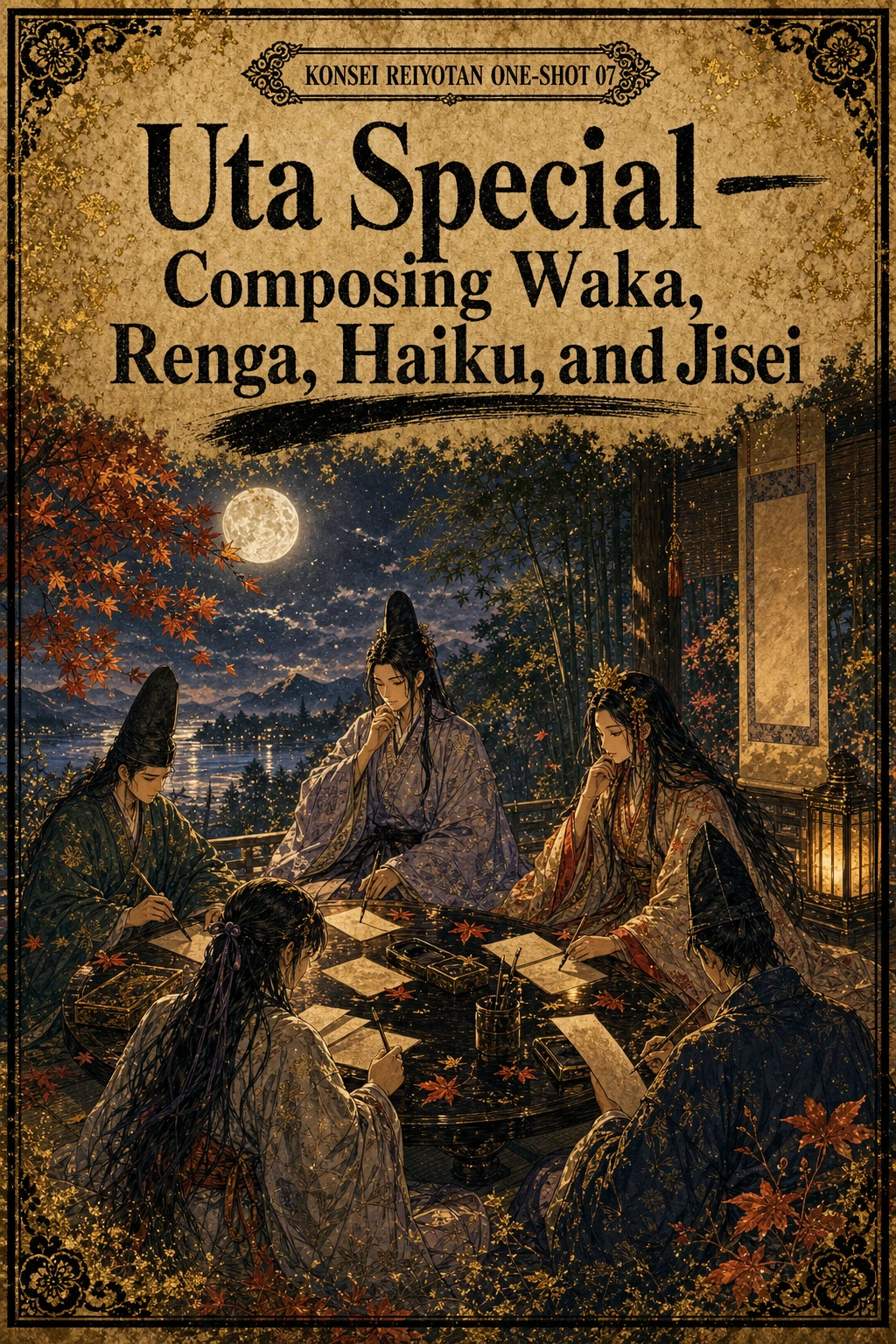
#Uta Special — Composing Waka, Renga, Haiku, and Jisei
Contents
Scope declaration / opt-in. This issue is knowledge and educational material. It adds no new rules, no sheets, no checks — it carries only material for understanding and composing poetry (uta). The explanation of forms and history rests on real Japanese literary history (Reference), and the actual poems quoted state author and era precisely. The sample poems (Scent) in the body are fiction of this setting, and are treated as a Variant of
co-99-01only when you bring them into a session. Before adoption there is no effect on the baseline, and there is no numeric conflict to begin with (this issue has no numbers).This issue continues the "renga and waka" item of the Arts issue and the court waka family trade (歌舞 · waka) of the House issue. The occasions for composing poetry that earlier issues only noted as having "existed" are here carried all the way to actually composing one.
#Brief — What This Issue Is
Wherever the Sengoku gathered, there were always poems. A daimyo recited a poem before marching out, lovers exchanged waka as they parted at dawn, and a warlord facing rebellion hid his intent in a single line of renga. And the one falling to the blade left, with his last breath, a death poem (jisei).
Yet the very question of "what that poem looks like, and how it is composed" had never been laid out anywhere. This issue fills that. And it goes one step further — to the point where you, the reader, compose a poem in your own words.
The core is simple. Japanese verse stands on the meter of syllable count. There is no need to cling to the rhyme or tonal patterns of kanshi. Counting and joining 5 and 7 sounds — that is all of it. Once you understand that counting, whether in Korean or English you can transpose and compose that meter with the syllables and rhythm of your own native tongue.
Three threads.
- How the forms are built — the syllable-count structure of waka (tanka), haiku, renga, and jisei, and kigo (season word) and kireji (cutting word). (
01) - When and why they were composed — social life, love, politics, death. And explanations of real celebrated poems (author and era precise). (
02) - How I compose a poem myself — practical guidance on transposing 5-7-5 into your native language, capturing one scene and one emotion, and trying your hand at a jisei. (
03)
This issue has no checks and no data. A pen and paper — and a single breath — are all you need.
#Commentary — One-Line Thesis
"Poetry is the work of shrinking fate. A whole life, a single parting, a single death — if you can hold them in just thirty-one sounds, you are already a poet."
#Meta Card
| Item | Value |
|---|---|
| Series | zn (one-shot series) Issue No. 07 |
| Title | Uta Special — Composing Waka, Renga, Haiku, and Jisei |
| Character | Purely educational, practice-oriented one-shot — verse forms and history, and composing for yourself (no rules) |
| Volume | 4 documents (front + forms + when/why + compose your own) · reading time about 19 minutes |
| Blocks | Brief · Commentary · Scent |
| Authority | Knowledge (Reference), Summary. Only sample poems are Fiction-Only/opt-in |
| Dependencies | co daily-life reference + zn01/zn03 linkage. No new rules or checks |
| Main-line version requirement | co >= 1.2 |
| Current version | v1.5 (zn07-VERSION) |
#Contents
| Document | Type | Contents |
|---|---|---|
01 Forms | Commentary · Table | waka/tanka (5-7-5-7-7) · haiku (5-7-5) · renga (serial) · jisei + kigo and kireji + transposing syllable-count meter into one's own language |
02 When and Why | Commentary · Example · Scent | uta-awase, love, politics, travel, death occasions + explanations of real celebrated poems (Komachi, Narihira, Saigyo, Basho, Mitsuhide, Ota Dokan, Garasha) |
03 Compose Your Own | Example | transposing 5-7-5 into native-language syllables · choosing a season word · the one-scene principle · how to write a jisei + Korean/English composition examples |
99 Closing Fiction | Scent | "The Song Contest" — a sweet, comedic waka romance in which a young man who always loses the song contest slips his love into a single poem, and the rival girl wildly misreads it |
Reading order: front → 01 → 02 → 03. If you want to compose a poem right now, you can just follow the 5 steps in 03.
Closing fiction. At the end of this issue is "The Song Contest" (a pure Scent story) —
99.
#Production Notice
This issue is No. 7 of the Konsei Reiyotan zn (one-shot) series. The forms and history of verse, and the celebrated poems quoted with their authors and eras, rest on real Japanese literary history — waka dates from the Heian era onward, renga from the medieval period, and the maturing of haiku is a matter of the Edo era (these period distinctions are stated precisely in 01 and 02). The fiction of this setting is only the sample poems and atmospheric description, and is unrelated to character rules or checks.
#AI Use Notice
A considerable part of this material was produced with the help of generative AI (LLM) in the processes of planning, drafting, prose tidying, and proofreading. The GPT Image 2 model was used in the image-generation process. Claude Code and Codex were used for the Japanese and English translations. Final editing and the responsibility for publication rest with the producer.
If there are changes in domestic or international law concerning AI-assisted works, that law is followed.
#Scent — One Sentence
"A blade ends with a single cut, but a poem makes that one breath be drawn in again even after the one who composed it has died."