#Kirishitan — History and an Alien Faith
Contents
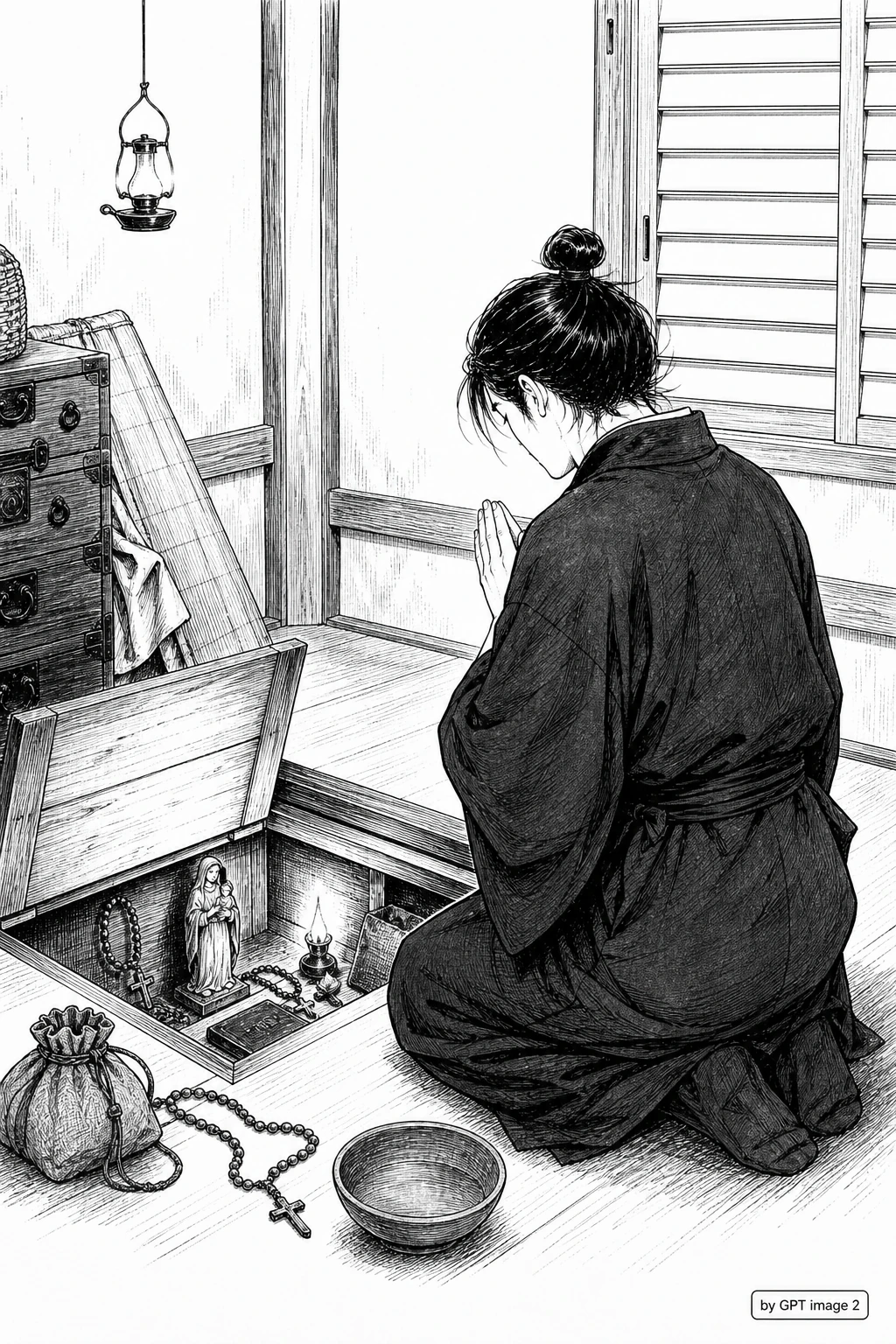
This document belongs to the front. The historical account is based on the real 16th-century Japan (Reference), and the passages where the alien faith touches yoma and the Spirit Realm are this setting's fiction (Fiction-Only). The real religion is treated with respect, within the frame of the historical Kirishitan.
#Brief — What Came with the Gunpowder
What the Nanban ships carried to Japan was three things — raw silk and gunpowder, and a god. The first two the daimyo coveted; the third the daimyo feared. Yet the three came loaded on one deck, were set down together at one harbor, and could not be pried apart for a long time. To buy teppo you had to receive a missionary; to open trade you had to build a chapel. That is why the gaijin is called the interpreter of gunpowder and faith.
This chapter briefly traces one century of that faith. If a gaijin PC has chosen the "Prayers and Hymns" path (02), here is where he came from and what he carries on his back.
#Commentary — One Century of the Kirishitan
#1549, the Arrival of Xavier
In 1549, the Jesuit missionary Francisco Xavier set foot in Kagoshima. What he brought was the Kirishitan faith (切支丹, Kirishitan — a word from the Portuguese cristão) entering Japan for the first time. Xavier is said to have judged the Japanese superior to any people he had met until then. Soon, passing through Yamaguchi and Bungo, he gained believers, and even after he left, the Jesuit Order remained.
| Date (approx.) | Event |
|---|---|
| 1549 | Xavier lands at Kagoshima. The start of the Japan mission |
| 1550s~ | Mission expands into Yamaguchi, Bungo, and Kinai |
| 1563 | Omura Sumitada converts — the first Kirishitan daimyo |
| 1570~1571 | Omura Sumitada and the Jesuit Order agree on the development of Nagasaki, and in 1571 Nagasaki opens as a hub of Nanban trade and mission |
| 1580s | Believers number in the hundred-thousands range (several hundred thousand by the late period). Seminaries (seminario), collegio, and the like are established |
| 1587 | Bateren Expulsion Edict — order to expel missionaries. The first sign of persecution |
| 1597 | Martyrdom of the 26 of Nagasaki |
| 1610s~ | The edict banning Christianity goes nationwide. The faith goes underground — Kakure Kirishitan |
#The Jesuit Order and Nanban Trade
The Jesuit Order (Society of Jesus) was no mere evangelizing band. They were also brokers of trade. They influenced which harbor a Portuguese merchant ship (nau ship) would anchor at, and the trade in raw silk, gunpowder, and silver that a single such ship carried could change a daimyo's fortune. So the daimyo, indifferent as they were to the faith, were kind to the missionaries. For trade was wealth, and wealth was teppo.
The missionaries founded schools. The seminario (preparatory school of theology) taught Latin, theology, and music; the higher learning of medicine and astronomy was handled by the collegio (college) and the mission enterprise as a whole; and movable-type printing (Kirishitan-ban) came in and ran in the 1590s. The gaijin's class trait of being "versed in foreign texts" comes from here — he did not merely handle gunpowder; he is one who has sat at the desks of that school.
#The Conversion of the Kirishitan Daimyo
Omura Sumitada, Otomo Sorin, Arima, Takayama Ukon — these are the daimyo who converted. Their motives diverged. Some truly believed in Deus; some aimed at the profits of trade; some chose the faith as a political lever to suppress the Buddhist powers (the Ikko-ikki and the temples). A converted daimyo would sometimes order the destruction of idols in his domain — and a Kirishitan daimyo who tore down temples and burned shrines becomes, in this setting, one hated by both the kami of the shrines and the buddhas of the temples. It was a choice whose ripples reached even into the politics of the Spirit Realm.
#Persecution and the Kakure Kirishitan
As the realm tilted toward unification, the unifying power saw a faith with two loyalties as dangerous. The pressure that began with the Bateren Expulsion Edict (1587) hardened into the edict banning Christianity. The efumi (踏み絵) that made people trample the cross, the terauke (寺請) that made them register at temples — the devices for ferreting out the faith grew dense.
So the faith went underground. The Kakure Kirishitan (hidden Kirishitan). Outwardly they enshrined Buddhist statues while hiding Maria within them (Maria Kannon); without priests, the faithful carried on baptism among themselves, and passed Latin prayers from mouth to mouth. Over the hundred years that the priests were gone, the prayer texts deformed little by little into a recitation mingling Japanese and Latin — like a holy incantation that had lost its meaning and kept only its sound.
#Orasho and Deus
- Orasho — a word from the Latin oratio (prayer). It is the collective name for the prayer texts the Kakure Kirishitan recited. To leave them in writing would mean discovery, so they were passed only by mouth, and across generations the sound wore down and the meaning blurred. The prayers and hymns of
03in this issue are a transposition of this orasho tradition into a game. - Deus — Latin for god. In the early interpreting stage of Xavier (1549~1551, interpreted by Yajiro), it was rendered as "Dainichi (大日 — Dainichi Nyorai)," but when this was confused with the Dainichi Nyorai honzon, Xavier changed it to a transliteration of the Latin Deus. A name the same as no kami and no buddha of this land. That strangeness itself is the core of this issue.
#Scent — When the Alien Faith Touches the Darkness
The following is this setting's fiction (Fiction-Only). It is true only when the table adopts it.
The mysteries of this land are native. The onmyoji's Sorcery commands the five elements, the esoteric monk's mudra (印) calls Fudo Myoo, and the Barrier of the kannushi and miko borrows the order of the kami. The yoma know this grammar — for they have fought a thousand years against the same forest, the same shrine, the same sutra passage. The oni knows to withdraw when it hears a mantra, and the onryo knows the meaning of the sacred rope.
But the name of Deus lies outside that grammar.
When a gaijin recites a Latin orasho, the yoma is bewildered by a sound it hears for the first time. It is neither Fudo Myoo nor a kami. The form of the seal is different, the direction of the purification is different, and above all — that god has no grave in this land. The native mysteries are bound to land and bloodline, but Deus is said to be everywhere while bound to nowhere. To the yoma this is strangeness, and strangeness is a momentary gap. Here lies why the Exorcism Hymn weakens the yoma — it knows to ward off a familiar foe, but it does not know how to ward off a prayer it sees for the first time.
But strangeness is double-edged. The kami of this land see the servant of Deus as a guest and an intruder. The Barrier of the shrine is slightly cold even to the Kirishitan, and it is hard to borrow the cooperation of the native spirits. In the domain of a Kirishitan daimyo who broke the idols, a night comes when the hated kami at last turns its back. The deepest loneliness of the gaijin-missionary is not the loneliness of being ahead of his age — it is the loneliness that his own god is a guest in this land. The god he calls is far away, and the god of the people he protects hates him.
The orasho of the Kakure Kirishitan is heavier for it. Latin that has lost its meaning, a prayer with only its sound remaining — a holy word that has become a form like an incantation that calls a spirit. At some GM's table, that worn prayer, passed from mouth to mouth over a hundred years, comes to harbor, by chance, a power the original theology has forgotten. Whether that is a blessing or a corruption — that is for the story of that table to decide.
The way to shape a gaijin through faith is in the next chapter. →
02 Alternate Path