#Ma and Blade — Distance Engine, Guard, and Hit Location
Contents
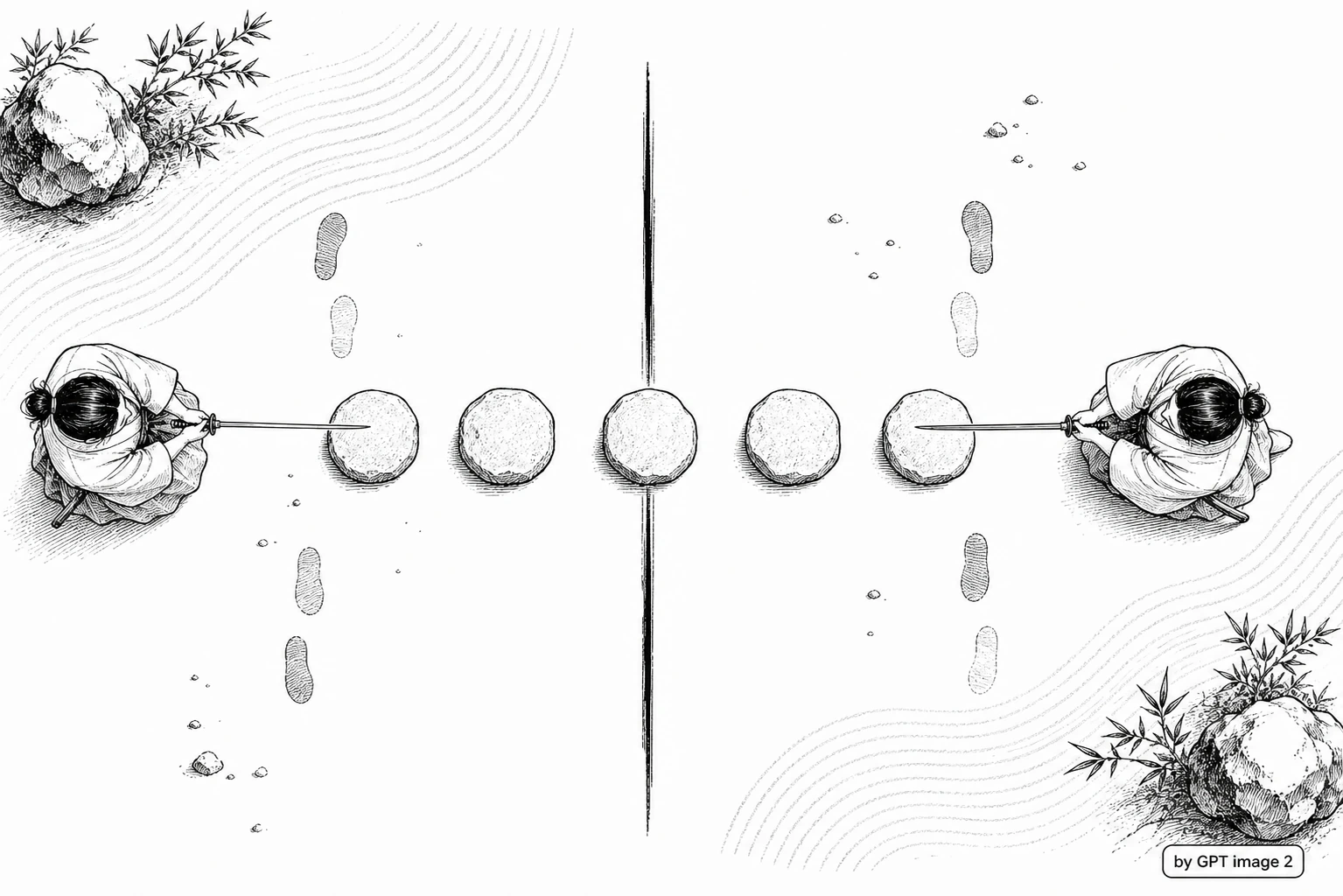
This document belongs to the front. Term caution: the canon's 間合 is the round (the unit of the Energy reset,
co-03-06). To avoid confusion, this issue's distance is called "間 (ma), aiming distance." Energy, one breath (≤5), count, stance, and reservation stay exactly as in canon. * The actual swordsmanship term ma-ai (間合い) corresponds to this issue's 間 (aiming distance), but this series inherits the canon co-03 rule name (間合 = round) as is.
#Rule — 間: The Aiming-Distance Ladder [Variant · Duel]
Set the distance between the two duelists as a ladder of five rungs. This whole set of five rungs is a zoom-in on one rung of the canon "range: adjacent" (front note).
far range ─ issoku itto ─ near range ─ close fighting ─ tsubazeriai
far ← one half-step per rung → closing in| Rung | Kanji | What It Is |
|---|---|---|
| far range | 遠間 | The blades do not reach each other. You measure, you watch for the chance. |
| issoku itto | 一足一刀 | The deciding distance. One step in and one cut reaches. The heart of the duel. |
| near range | 近間 | A distance where the blade already reaches. A long sword begins to feel cramped. |
| close fighting | 接戦 | Too close to swing a long sword properly. The place of short arms, Unarmed Combat, and grappling. |
| tsubazeriai | 鍔迫り合い | A deadlock of two blades locked together. No one can cut just like that. |
- Starting 間 of a duel: an ikkiuchi broken off from a pitched battle starts at issoku itto (by mutual agreement of both sides or by the one with initiative); a formal hatashiai (exchange of letters of challenge) often starts at far range, each side measuring the other.
- 間 is shared. If one person closes it, the distance of both closes together. If the two sides want different 間, settle it with a half-step contest (below).
#Rule — Half-Step (半步): The Move That Changes Distance [Variant · Duel]
- Half-step (move) — for Energy 1 within one breath (a cost that is a zoom-in of canon walking to the unit of one rung = a half-step; do not confuse it with canon walking = Energy 2), close or open the 間 by one rung.
- Half-step contest — when chasing an opponent who retreats to keep distance, or stopping an opponent trying to drive in: the side with initiative (higher Energy) tries the half-step first (action count order). If there is resistance, settle success or failure with a
2d10 + Finesse + Footworkcontest, and the winner sets the 間. If Energy is tied, settle straight away with this roll. The half-step seized is itself the hit of the first cut. - Step-in cut — bundle the half-step move and an attack into one breath (Energy total ≤5) and it becomes "one step in, one cut." It is sharpest at issoku itto.
#Table — Ideal Range by Weapon (理想間)
Each weapon has a different distance where it reaches well. At its ideal range it is normal; one rung off is attack -2; two or more rungs off is no attack (you must fix your stance or take the distance again).
| Weapon | Ideal Range | Notes |
|---|---|---|
| nodachi / long sword (Monohoshizao) | far range ~ issoku itto | reach advantage. Neutralized if closed to near range or below |
| yari (in 1:1) | far range ~ issoku itto | dominates thrusting spacing. Weak if driven in on |
| uchigatana (standard sword) | issoku itto ~ near range | the standard of the duel. Most balanced |
| kodachi / wakizashi | near range ~ close fighting | lives by driving in |
| tanto / kaiken / Unarmed Combat / grappling | close fighting ~ tsubazeriai | stronger the closer it gets. The distance that kills a long sword |
- The longer range overpowers the shorter. A weapon whose ideal range is one or more rungs longer than the opponent's neutralizes the shorter weapon's stance, reach, and initiative-advantage modifiers (since reach is decided by length, the initiative modifier attached to that reach premise also loses its basis). This is the basis for the side with the longer sword taking the first half-step.
The half-step of whether the blade reaches. Kojiro's Monohoshizao dominates far range — if you cannot break that 間, you are cut without even reaching. Musashi broke its ideal range with an oar bokuto (commonly held to be longer than the Monohoshizao) and the breath (timing) of the half-step (
03Ganryujima).
#Rule — Close Fighting and Tsubazeriai [Variant · Duel]
- Close fighting — a long sword or yari cannot attack (at GM discretion, -2 if there is an opening to swing). Short arms, Unarmed Combat (kumi, the jujutsu of grappling, throwing, and pinning), a headbutt, and hidden weapons shine. For the long-sword wielder, opening a half-step is the first priority.
- Tsubazeriai — a deadlock of two blades locked together. No ordinary cut. Ways to break it:
- Push-out: win a
2d10 + Physiquecontest → push the opponent one rung and open the 間. - Slip-away: win a
2d10 + Finessecontest → slip to the side and return to issoku itto (+counterattack chance). - Empty-hand move: drawing a dagger, a foot-trip, a headbutt — even if the damage is small, it rattles the guard badly (below).
- Tsubazeriai is the place of strength and nerve. The side being pushed has its guard shaved down.
#Rule — Guard (警戒): Break Them Even When One Cut Cannot [Variant · Duel]
In a duel a person does not die from a single cut alone. Small cuts, missed threats, and the pressure of tsubazeriai pile up until the calm of the mind breaks — and in that broken instant the real blade goes in. Handle this with the guard (警戒) track (separate from Wounds, duel-only).
- Maximum guard = 5 + (the higher of Finesse or Wisdom). Whether the reaction at the blade's edge (技) or the insight that reads the foe (智), that person's depth of mind holds up the calm (the reason a skill modifier like Swordsmanship is not used is to avoid that modifier, already entering the attack check, being applied twice). A Master swordmaster's deep guard is expressed separately as a sheet modifier (
03fc03 conversion). - When guard is shaved:
| Event | Guard |
|---|---|
| A feint/probe attack lands (damage 0~1) | -1 |
| Pushed in a tsubazeriai contest / an empty-hand move lands | -1 ~ -2 |
| A hit location is threatened (a miss, but it was close) | -1 |
| A Critical Hit (会心) is allowed | -2 (separate from damage) |
| Losing the half-step contest repeatedly (loss of distance initiative) | -1 |
- Guard break (崩れ) = reaching 0: an opening for 1 round. An attack taken during it is [Direct 2], and the opponent gets 1 Critical window (the Wounds effect is the same as the canon Critical — 2 Wounds, only the double requirement waived). The moment a duel ends is usually here. (For a 1:1 duelist not in armor or a held stance, the Defense-reduction effect of [Direct 2] is small, so in practice the Critical window is the finishing blow.)
- Recovery: if you catch your breath during a Lull Phase, guard +(the higher of Finesse or Wisdom) (minimum +1). If you retreat a half-step to far range and sever the distance, an additional +1 (but it cannot exceed maximum guard). Guard lives by distance.
So even a weak cut has meaning. A cut that did not sever shaves the guard, and the shaved guard lets the next cut sever.
#Rule — Hit-Location Attacks and Wounds [Variant · Duel]
Turn the idea of canon Aimed Focus (extra Energy → tag scaling) toward hit location (部位). But in this variant the canon Aimed Focus permitted gate is released, and every attack in a duel can carry a location designation (this is an opt-in extension limited to 1:1 duels). It also simplifies, using a fixed cost instead of the canon N-step scaling.
- Declaration: spend extra Energy 1 (one breath ≤5) on an attack to designate a hit location. On a hit, the location effect below + (if a shinken shobu) a persistent injury.
| Location | Kanji | Hit Effect |
|---|---|---|
| wrist | 小手 | On a failed 2d10+Physique >= 11 by the target, weapon dropped. Even on success, weapon attack check -1 (persistent, Swordsmanship etc.) |
| arm | 腕 | attack technique -2 (persistent) |
| leg | 足 | half-step move cost +1, loss of distance initiative (persistent) |
| torso | 胴 | additional 1 Wound reduced + bleeding (1 Wound reduced each lull, disable on 2d10+Physique >= 13 or 2d10+Wisdom+Medicine >= 11 — canon bleeding) |
| face/eyes | 面・目 | all checks -2 (persistent, vision). But read as the most cowardly and cruel (regard risk) |
- Shinken shobu: wounds are persistent — they do not heal in a lull and need Medicine. Hit-location wounds pile up to break guard and Wounds together ("even when one cut cannot sever").
- Sparring match: convert it into points and guard without real wounds (counted as a valid strike, the body unharmed).
#Rule — When You Need a Zone: Terrain Import [Variant · Duel]
A duel discards zones, but the terrain of the stage remains. If it matters to the scene, bring in only one terrain effect from co-03-08 as a scene modifier.
| Stage | Imported Effect |
|---|---|
| riverside sandbar / poor footing | -1 to the half-step contest (footing slips) |
| narrow path / indoors | far range unusable (the ladder starts at issoku itto) |
| high ground / stairs | the upper side gets +1 to the first half-step contest |
| sunset / backlight | -1 to one side's check (glare) — a fight over positioning |
Do not draw the whole zone; lay down only this one line. The stage of a duel is a backdrop, not a grid.
#Scent — One Sentence
"The winning blade is not seen from afar — within a half-step, it merely reaches one breath sooner."