#Majin Reincarnation
Contents
One-player (solo) high-difficulty adventure. 6~8 sessions. A structure where one PC sequentially defeats 5 legendary swordsmen and 1 wicked sorcerer, all revived as heroic spirit and majin hybrids. No support or squad combat. A pure duel series.
- Recommended party: 1 PC (7th~9th dan). A single build specialized in Swordsmanship or martial arts is recommended.
- Difficulty: Extreme.
- Rules Covered: duel-only play / heroic spirit x majin hybrid / school secret arts / divine-item acquisition chain / 1-person economy / Master advancement between sessions / Renown Title foreshadowing
#Novel Homage
This adventure is built on a concept from the late Sengoku period, the age of legendary swordsmen: legends who lived through that age are "revived by the forbidden magic of a wicked practitioner." Each swordsman carries both their original sword art (heroic-spirit resonance) and a corrupted soul (the special nature of a majin class). The original power remains intact, and majin deviation is layered on top.
The PC's goal is only one thing: cut them down one by one, from the front, in one-on-one combat. This adventure does not allow flight, ambush, or squad-based bypasses. Every duel touches both heroic-spirit honor and majin hunger. If the PC refuses to take part, the swordsman goes out to hunt nearby villages. If the PC takes part, it becomes a fight to the death.
#Background
#World Context
Late Sengoku period. In the high mountains east of Kagura Domain stands Toyoura Abandoned Mountain Temple. 200 years ago, it was a Shingon esoteric temple, but it was used as the sealing site of a great evil dragon, and collapsed when the sealing mantra broke. It has since been left alone. The trace of the sealing mantra -- spirit-soul medium meridians -- remains underground.
#The Sorcerer's Appearance
3 months ago, one wicked onmyoji, Shikome-no-Tsukai, and Yorijin (combined career 7th dan), Aburatsuka Genzo, occupied this abandoned mountain temple. By combining the Spirit Realm Gate rules with the Apostle of Izanami rite, he developed a forbidden sorcery that summons heroic spirits of past swordsmen and majin-transforms them at the same time.
Aburatsuka's goal is simple: "to make the most complete swordsman into my tool." He carries both reverence and jealousy toward swordsmanship. His frame was sickly and could not hold a sword well, but he wants the heroic spirits' martial force under his control. For that purpose, he is summoning and testing five swordsmen in sequence. His final target is Miyamoto Musashi -- the last swordsman who will become his "completed work."
#Principle of the Hybrid
The swordsmen Aburatsuka summons can use their lifetime relics and techniques as-is through heroic spirit automatic resonance. However, the majin-transformation rite performed at the same time brands their souls with the mark of corruption. Each swordsman is revived with the core nature of a specific majin class (the madness of Shurado, Kekka's craving for an audience, etc.) overlaid onto them. Differences from the originals:
- Original heroic-spirit conditions (for example, Relic maintenance) remain unchanged.
- Majin deviation is added (for example, an impulse that cannot stop killing, weakening without an audience, healing reversing into harm, etc.).
- The sorcerer's thread (the Shikome-no-Tsukai's chain). The swordsmen cannot break it themselves. They become free only if the sorcerer dies, or the PC's sword grants release.
#Request
Three villages in Kagura Domain are massacred in succession. All survivor testimony is the same: "Samurai in white appeared at night and cut everyone down." 1 heroic spirit per village. Over 3 months, 5 heroic spirits are active in different directions. After a council, the domain lord decides on a solo mission. The basis is simple: even if they are faced by many, they want duels. In a melee, they vanish. A single swordsman is needed.
The PC is that one person.
#Scent (香)
#Sense of the First Scene
The mountain path up to Toyoura Abandoned Mountain Temple smells of oil. The black candle oil used in the sealing mantra 200 years ago is still soaked into the soil. It sticks to the soles with every step.
Inside the main hall, candle smoke and the smell of dried blood are mixed together. Five summoning circles burn in different colors: white light, blue light, gold, blood-red, and a gray circle not yet lit. If four of them remain as extinguished ash, it means those four heroic spirits have already awakened and gone out.
In the ears of a swordsman facing a heroic spirit, only two sounds remain: their own heartbeat and the direction in which the opponent's sword cuts the air. Here there are no squads, no command, no support. There is only maai (間合).
From the heroic spirit's form, black majin ichor runs thinly from the eyes and mouth. A film of corruption over a hero's face: that is the image this scenario sets.
#Voices of Key NPCs
Aburatsuka Genzo (first encounter -- cold honorific speech mixed with joy and observation):
"...Oh, you came back alive. You passed the four swordsmen I made and reached this place. As an artist, I am honored. The final summoning is worth showing you. If you stay still -- I will finish calling Lord Musashi for you."
Ito Ittosai (duel opening -- short, heavy low voice):
"Your blood is still warm. Stand. I will end this in one cut."
Tsukahara Bokuden (eyes closed in zazen -- deep resonance inside stillness):
"...Come close. I do not move. You must come and cut me. This is the fight of no-victory."
Sasaki Kojiro (provocation with hair blowing in the wind):
"There is no audience. A pity. Even so, I dance -- without the dance, I am no flower."
Miyamoto Musashi (overwhelming, half-substantial state -- speaks slowly, but every word falls heavy):
"Are you the last enemy I have met, or the first? One of the two. I will cut and confirm the answer."
#Mood Turns
- Prologue: the domain lord's map. Heroic spirits in five directions. The first moment the weight of "it is only you" lands.
- First heroic spirit (Ittosai): beginning of a 1-person drama. The PC feels a rhythm of breath different from party play.
- Around the third heroic spirit: accumulated victories + accumulated wounds. A growth curve where the PC discovers the swordsmen's "majin weaknesses" personally.
- Entering the abandoned mountain temple: the light of five summoning circles. Four have gone out. The last one remains. The center of choice.
- Musashi's eyes: from this moment, the PC is no longer merely carrying out a request. They are a swordsman just before becoming a legend of the age.
#Gloom of Toyoura Abandoned Mountain Temple
- Ground: the ink from the sealing mantra 200 years ago seeped into the mountain soil and hardened as black stains.
- Walls: the marks of burned-away Buddhist statues remain as incised silhouettes. Even without the statues, the posture of prayer is carved into the stone.
- Ceiling: instead of spiderwebs, silver threads hang down in long strands. The chains of the Shikome-no-Tsukai. If cut, they regrow.
- Sound: where there is no heroic-spirit presence, there is silence -- not even wind enters the mountain temple. The PC's footsteps echo only once against the stone walls, then are swallowed.
- Smell: not a metal smell, but the scent after iron has melted. The remnants of two rites: sealing and summoning.
#Color Tones of the 5 Heroic Spirits
Each heroic spirit's duel site has its own color palette. The GM should repeat these colors in description.
- Ittosai's abandoned dojo: old brown and dust colors. Sun-burned wooden boards on all four walls.
- Nobutsuna's shrine ruin: blue-green moss + white stone steps. Cool enough for breath to show.
- Bokuden's mountain altar: gray-white stone + cloudy sky blue. A motionless landscape.
- Kojiro's riverside plain: silver-gray sandbar + yellow reeds. Only the wind dances.
- Musashi's abandoned mountain temple main hall: black + golden summoning circle + blood-red. The three colors of the rite.
#1-Person Play Rules
#PC Prerequisites
- Dan: 7th~9th dan (8th dan recommended).
- Main attribute: Courage or Finesse +3 required. 1 corresponding core skill should be Master (4 points).
- Class: choose 1 from samurai / ronin / shinobi / shugenja / gaijin. Scholar, merchant, and onmyoji are not recommended (squad-dependent).
- School: must have at least 1 license. Ideally has a secret art.
- Equipment: 1 masterwork blade recommended. If the PC has the Dual-Wield trait, 2 masterwork blades are possible (Principle 3, Exception 1).
- Relic: may begin with 1 item (additional acquisitions during the scenario).
#Recovery Interval
Between sessions, there is a "Return" phase. The PC returns to the domain castle and:
- recovers to maximum Wounds (with physician and Pure Land Monk NPC support).
- recovers to maximum Energy.
- [Variant · Mahoujin Return Growth] Only during the first four Returns, once per Return, the PC may invest +1 skill point in one class core skill. Obey both the current dan's skill cap and the cap on skills held at Licensed rank or above. If no legal target exists, the opportunity is lost; it cannot be stored or converted into another reward. Standard advancement growth applies separately as normal.
- may buy or replace 1 piece of new equipment.
During sessions, natural recovery is impossible. Once a duel begins, it must be resolved to the end without external support or mid-fight return.
#1-Person Combat Balance
Each heroic spirit ranges from upper Elite-grade to lower lord-grade (Wounds 4~8). Normally, 1 PC facing one Elite-grade opponent is unfavorable, but:
- this adventure applies the duel principle (both sides gain +2 technique modifier).
- every heroic spirit has a "majin weakness." Studying how to beat them is required.
- recovery and growth between duels strengthen the PC gradually.
#Survival Check
PC reaches Wounds 0 = combat defeat. But in this scenario, the PC does not die:
- the heroic spirits, following the courtesy of swordsmen, let defeated opponents live (09-09 Yoshitsune pattern).
- instead, that heroic spirit is strengthened by +1 Wound in the next duel (using the PC's defeat as its tool).
- if the PC suffers 3 consecutive defeats against one heroic spirit, the scenario fails (the heroic spirit abandons the PC, moves to another region, and village massacres accelerate).
#5 Heroic Spirits -- Stat Blocks
Use the Wounds printed in the boss blocks below exactly: Ito Ittosai 5, Kamiizumi Nobutsuna 5, Tsukahara Bokuden 7, Sasaki Kojiro 6, and Miyamoto Musashi 8. Do not recalculate them from resonance or class descriptions.
School Authority: Historical school names are retained for each figure and their inheritance narrative. Actual school techniques use the current
co-04-04 School Data. The unique Ito Itto-ryu and Ganryu techniques belong only to these scenario boss blocks and do not create new PC schools.
#Heroic Spirit 1. Ito Ittosai x Jikiniki -- "Hungry Two-Blade Sword"
Ito Ittosai (伊東 一刀齋) x Jikiniki (食人鬼)
Wounds: 5 | Defense: 13 | Energy: 11
Attributes: Finesse +3, Courage +2, Physique +2, Wisdom +1
Skills: Swordsmanship Master (4)
School: Ito Itto-ryu (historical name; the techniques below are scenario-only)
Weapon: Ittoryu is "one-sword style" that holds only one blade, but this majin-transformed version uses 2 short wakizashi as dual swords (corrupted version)
Heroic-Spirit Aspect:
- One Cut, Instant Kill (一刀即殺) [scenario-only boss technique]: 4 Energy, 1 time per duel. Resolve the first Swordsmanship attack as an automatic-hit Critical Hit for
[Pierce all]3 Wounds. Damage-negating or damage-reducing defenses may be used normally. It cannot be learned outside this block. - Speed of the Draw [scenario-only boss aptitude]: first-round initiative modifier +3 (first breath only). The inheritance token does not grant this value.
Majin Corruption -- Jikiniki Element:
- Hunger: 1/round, when an attack hits a Bleeding PC, cancel all Wound damage from that attack and recover 1 Wound up to the printed maximum. If the fight runs long, he "eats" the PC's blood to restore himself.
- Weakness to Exploit: Hunger can trigger only against a target shedding blood. At each lull, if Hunger did not trigger at all during the preceding round, Ittosai's self-gnawing side effect reduces his Wounds by 1(minimum 0). Apply this loss even if a PC is Bleeding when Ittosai failed to hit and therefore could not trigger Hunger.
First duel. The easiest of the set. If the PC plays defensively, odds are good.
#Heroic Spirit 2. Kamiizumi Nobutsuna x Tatarigami -- "Backlash of No-Thought"
Kamiizumi Ise-no-Kami Nobutsuna (上泉 伊勢守 信綱) x Tatarigami (祟り神)
Wounds: 5 | Defense: 15 | Energy: 12
Attributes: Finesse +3, Wisdom +2, Courage +1, Presence +2
Skills: Swordsmanship Master (4)
School: retains the historical name as founder of Shinkage-ryu; rules use Yagyu Shinkage-ryu's licensed `Muto` and secret art `Life-Giving Sword`
Weapon: uchigatana (masterwork -- "Saketeki" (酒滴), symbol of Shinkage-ryu)
Heroic-Spirit Aspect:
- Muto (無刀) [form]: 3 Energy, 1 time per round.
2d10+Finesse+Swordsmanshipversus the enemy's2d10+Courage. On success, disarm the enemy and immediately attack once with that weapon. - Life-Giving Sword (活人劍) [form]: 2 Energy, 1 time per combat. Declare nonlethal intent against one target. For this combat, techniques used against that target inflict Defenseless and loss of fighting will (cannot act next round) instead of Wounds.
Majin Corruption -- Tatarigami Element:
- Backlash [aptitude]: During a duel, automatically react just before a healing or blessing effect that the PC applies to themself resolves. Choose one numeric effect: invert Wound recovery N into Wound loss N, or invert a
+Nbonus into a-Npenalty to the same target for the same duration. Do not invert nonnumeric effects or create a new condition. - Barrier Absorption: 1/round, react when a new Barrier is created in Nobutsuna's zone; cancel that Barrier and recover 1 Wound up to the printed maximum.
- Weakness to Exploit: The principle of the majin corruption is "denial of faith." If the PC faces him with pure martial skill without faith (a build with no Pure Land Monk or arahitogami line), Backlash becomes meaningless. Also, a suicidal charge (an attack that disregards one's own frame) leaves Backlash without a "thing to return."
Second duel. Harsh for PCs who rely on recovery and defense. Continuous-offense builds are favored.
#Heroic Spirit 3. Tsukahara Bokuden x Kaibutsu -- "The Unmoving Move"
Tsukahara Bokuden (塚原 卜傳) x Kaibutsu (怪佛)
Wounds: 7 | Defense: 17 | Energy: 10
Attributes: Wisdom +3, Physique +3, Courage +1, Finesse +0
Skills: Swordsmanship Master (4)
School: Katori Shinto-ryu (source line -- licensed `Attitude of Sen`, secret art `Heaven-Earth-Man`)
Weapon: tachi (masterwork -- "Ichino-Tachi," one blade)
Heroic-Spirit Aspect:
- Attitude of Sen (先の態度) [stance]: maintain for 2 Energy. The first attack while in the stance gains +3. On release, Defense -2 for 1 breath.
- Heaven-Earth-Man (天地人) [form]: 4 Energy, 1 time per round. Check the high, middle, and low strikes separately as
2d10+Courage(1)+Swordsmanship(4)>=Defense. Each hit deals 1 Wound; if all three hit, deal 2 additional Wounds.
Majin Corruption -- Kaibutsu Element:
- Immovable (不動): This heroic spirit does not move. Fights while seated at the altar. Cannot move zones. Domination +5.
- Sanctified Zone: The zone where he sits is treated as the Core Zone. Every unit there pays +1 Energy to each cost. Apply this increase only once per technique, and do not stack it with the same effect.
- Weakness to Exploit: This one is vulnerable to area attacks and ranged attacks. Also, because he does not move, mobility can force attack timing. Hasso-tobi (if Yoshitsune has joined) / shinobi ambush / gaijin teppo are all strong.
Third duel. A type whose difficulty fully reverses based on the PC's approach. Very hard for a pure melee swordsman. Easy if long-range or ambush options exist.
#Heroic Spirit 4. Sasaki Kojiro x Kekka -- "Dance of the Swallow"
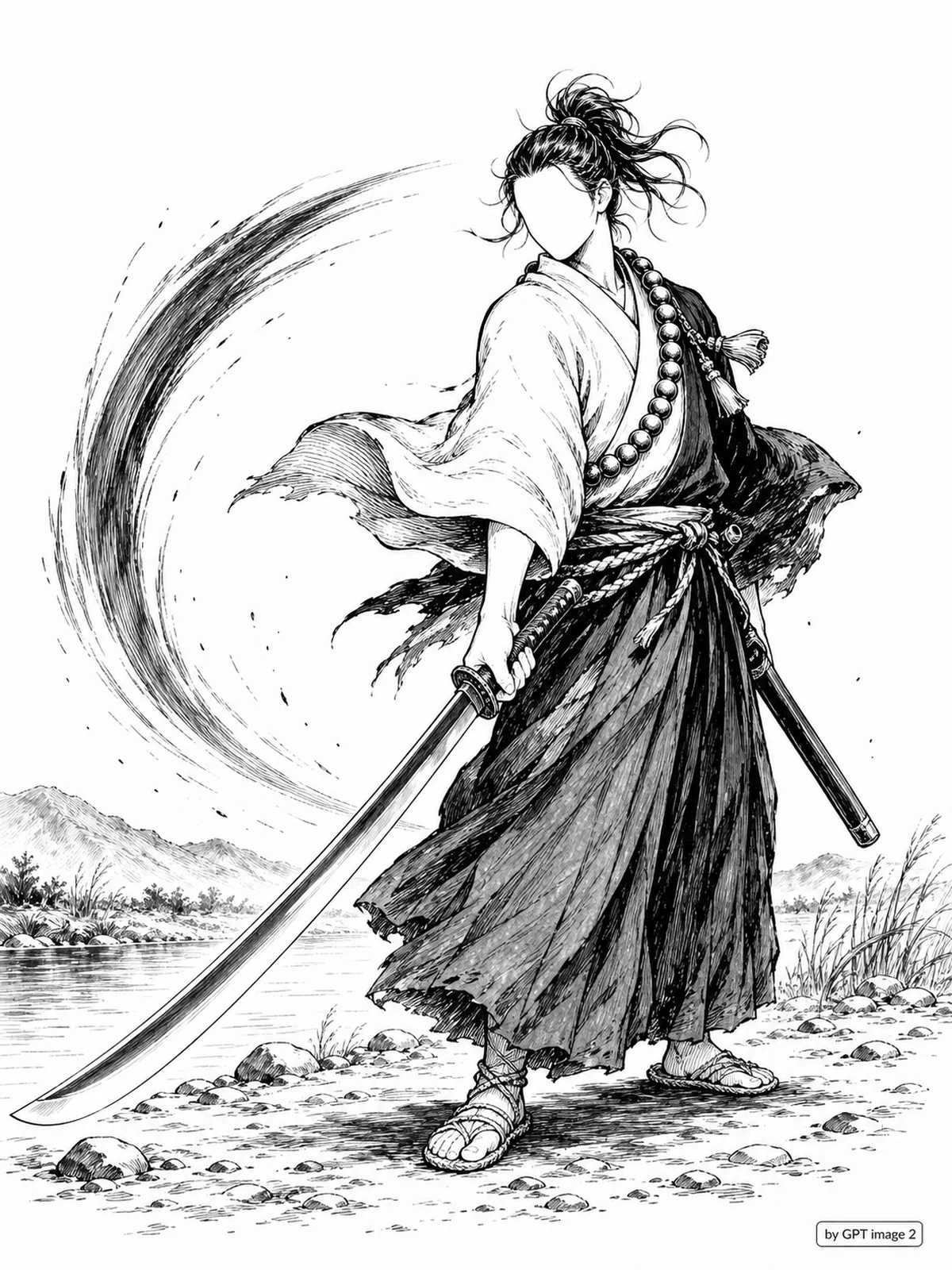
Sasaki Kojiro (佐々木 小次郎) x Kekka (血花)
Wounds: 6 | Defense: 14 | Energy: 13
Attributes: Finesse +3, Presence +3, Courage +2, Fate +1
Skills: Swordsmanship Master (4)
School: Ganryu (historical name; the techniques below are scenario-only)
Weapon: nodachi "Monohoshizao" (long sword, treated as divine-item grade -- 2.5m greatsword)
Heroic-Spirit Aspect:
- Hien Technique (Tsubame-gaeshi) [scenario-only boss technique]: 5 Energy, 1 time per combat. Make two separate
2d10+Finesse(3)+Swordsmanship(4)>=Defensechecks. Each hit is a Critical Hit for 2 Wounds, and the second hit gains[Pierce all]. It cannot be learned outside this block. - Reach of the Long Sword [scenario-only boss aptitude]: when attacking an enemy in the same zone, the PC's counterattack check -2. The inheritance token does not grant this value.
Majin Corruption -- Kekka Element:
- Blood-Red Dance: Treat the battlefield as a "stage." Each time one Kojiro effect causes the PC to lose at least 1 Wound, gain 1 stack (maximum 5). On reaching 5 stacks, immediately deal 2 Wounds to the PC if it is within 1 zone, then reset the stacks to 0.
- No Audience = Weakened: This fight happens in an isolated place. If there is no audience (NPCs or squad), the Kekka dance cannot be completed, so all attack checks -1. That is this one's weakness. The PC must not call an audience.
- Weakness to Exploit: The long sword's reach can be broken by zone movement. If the PC leaves the same zone, this one must approach, and while approaching loses counterattack rights. Kekka stacks do not build if the PC is not hit -- a perfect-defense build can win.
Fourth duel. Requires both speed and defense. Usually the hardest mid-stage strong enemy.
#Heroic Spirit 5. Miyamoto Musashi x Shurado -- "Final Nito-ryu"
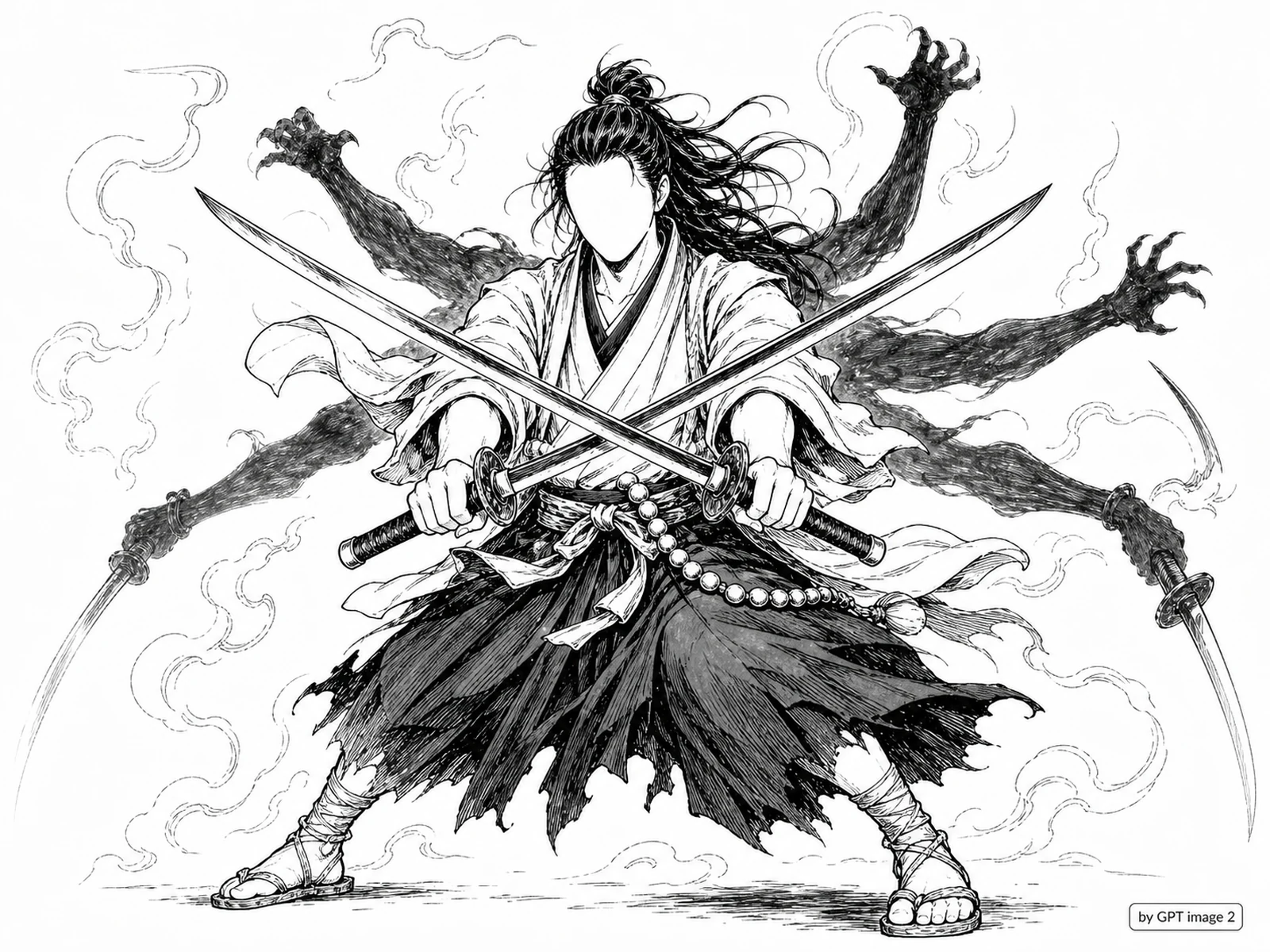
Miyamoto Musashi (宮本 武蔵) x Shurado (修羅道)
Wounds: 8 | Defense: 15 | Energy: 14
Attributes: Courage +3, Finesse +3, Physique +2, Wisdom +2
Skills: Swordsmanship Master (4)
School: Niten Ichi-ryu (二天一流, historical name); rules use the current two-sword licensed `Niten Ichi-ryu` and secret art `Ganryu`
Weapon: uchigatana "Musashi no Tachi" + wakizashi "Seijin" (dual-sword two-weapon style -- his own school, so Principle 3 Exception 1 is automatically satisfied)
Heroic-Spirit Aspect:
- Niten Ichi-ryu (二天一流) [aptitude]: while equipped with a katana and kodachi, may use the main-weapon and off-weapon techniques simultaneously in one breath. Add their Energy costs together and do not exceed the one-breath limit.
- Ganryu (巖流) [form]: 3 Energy, 1 time per round.
2d10+Courage+Swordsmanship+3 >= Defense. On success, 3 Wounds; on Critical Hit, 4 Wounds.
Five Rings Extremity is only the narrative name of this duel and its transmission manual. It creates no separate five-strike, automatic-Critical-Hit, or fixed-Wounds rule; use Ganryu above in combat.
- Experience of 60 Victories: [aptitude] after seeing each of the PC's school secret arts once, reads it (+2 Defense, limited to that school).
Majin Corruption -- Shurado Element:
- Berserker Rage: Recover 1 Energy after each attack that deals damage, up to 3 times per round and never above the printed maximum 14. If Musashi deals no damage during a round, the next round becomes Frenzy, and Musashi's first attack in that round is an automatic Critical Hit.
- Weakness to Exploit: At the end of a Frenzy round, if the PC is still combat-capable, Musashi loses 5 Energy and 1 Wound and Frenzy ends. A PC who holds an evasion reservation and survives makes Musashi exhaust his own momentum.
Final heroic-spirit duel. Outside the normal scale. The upper limit of a PC just before Renown Title.
#Sorcerer -- Aburatsuka Genzo
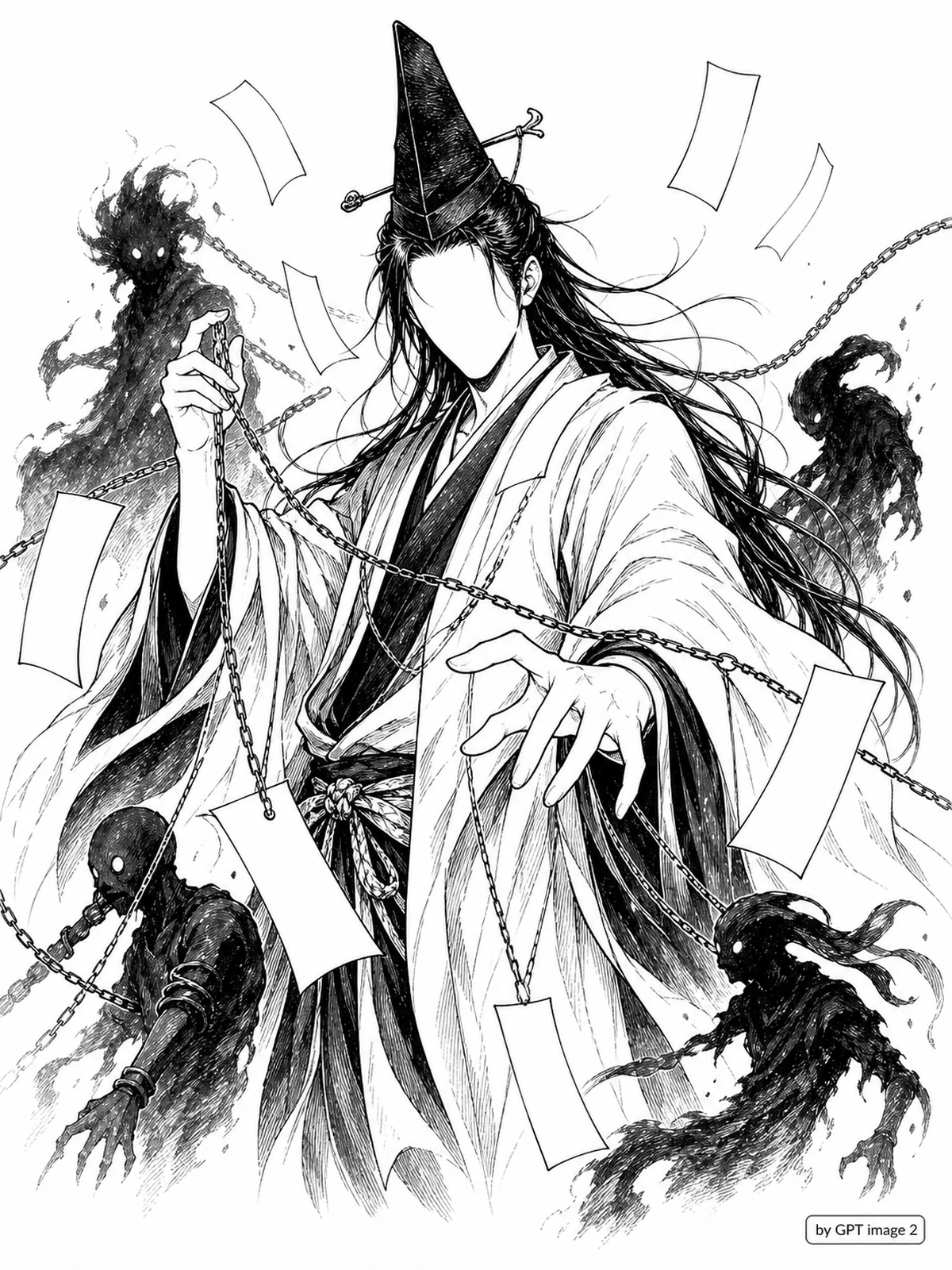
Aburatsuka Genzo (油塚 源蔵) -- onmyoji 4th dan x Shikome-no-Tsukai 5th dan x Yorijin 3rd dan
Wounds: 4 (main form) | Defense: 12 | Energy: 10
Attributes: Wisdom +3, Presence +2, Fate +2, Physique +0, Courage +0, Finesse +1
Main Fight Danger: lower Elite-grade. The main form is weak.
Methods:
- Vengeance-State Heroic Spirits: use only the fixed blocks below. A vengeance-state spirit cannot use a technique or passive not listed in its package.
| Heroic Spirit | Wounds/Defense/Energy | Retained Package |
|---|---|---|
| Ittosai | 3/13/11 | One Cut, Instant Kill; Hunger and its weakness |
| Nobutsuna | 3/15/12 | Muto; Backlash |
| Bokuden | 4/17/10 | Heaven-Earth-Man; Immovable |
| Kojiro | 3/14/13 | Hien Technique; No Audience |
- Deployment Count: Branch A begins with 2 different vengeance spirits, Branch B with 0, and Branch C with all four. They are individual units that use their own Energy. No additional resummoning or swapping occurs during combat.
- Chain Manipulation: 2 Energy, 1/round. Move one vengeance spirit to any zone. If it enters an ongoing duel, the PC rolls
2d10+Courage>=13; on failure, the PC's next check is -1, ending at the start of the next round. - Surgical-Blade Attack [technique]: 2 Energy. Against a PC in the same zone, roll
2d10+Wisdom+Stratagem>=Defense; on hit, deal 1 Wound. - Anatomy Diagram [aptitude]: 1/round, when Genzo's own Surgical-Blade Attack hits, change that attack's Wound loss from 1 to 2.
Approach to Defeat:
- If handling the heroic spirits first: once every vengeance spirit deployed at combat start is defeated, only the main form remains. The main form can be defeated within 1 round.
- If striking the sorcerer directly first: the sorcerer uses already summoned heroic spirits as his defensive wall. The heroic spirits refuse simultaneous duel demands (by the sorcerer's command) and join the melee. The PC is driven into many against 1. Extreme difficulty.
This choice is the scenario's philosophical decision point.
#Scenario Flow -- Session-by-Session Structure
#Prologue -- Request and First Traces
- Receive the request at Kagura Domain castle. The domain lord marks the appearance points of the 5 swordsmen on a map -- the PC can freely choose the order.
- Map:
- Ittosai appearance point: abandoned dojo near Shimoya village in the east.
- Nobutsuna appearance point: ruins of Kamizumi Shrine in the north.
- Bokuden appearance point: shrine altar in the central mountains.
- Kojiro appearance point: isolated plain by the Karanuki riverside in the west.
- Musashi appearance point: southern Toyoura Abandoned Mountain Temple (where the sorcerer is -- reached last).
Recommended attack order: Ittosai -> Nobutsuna -> Bokuden -> Kojiro -> Musashi (+ sorcerer). Difficulty rises gradually.
#Session 1 -- Ittosai (Hungry Two-Blade Sword)
Location: abandoned dojo. There is a legend that Ittosai actually trained in this region. Now the old wooden dojo is full of spiderwebs.
Entry Scene: The PC opens the dojo door -- in the middle of the dojo sits Ittosai, holding wakizashi in both hands. He stands and says:
"Anyone will do. Stand. Your blood is still warm."
Duel. One-on-one.
Spoils on Victory:
- Ito Itto-ryu Inheritance Token: a transmission certificate and narrative resource for historical lineage and rebuilding the dojo. It grants no separate license, secret art, or numeric effect. To learn an actual school, the PC must choose one normally from the current school list and pay its slot and skill requirements.
- Wakizashi "Kuihana": ordinary weapon grade, but a narrative symbol.
- Count 1 epic milestone (one of the advancement conditions, GM discretion). See Advancement Conditions §Rules.
On Defeat: Ittosai says, "Recover and return," and lets the PC live. The PC returns to the domain castle, recovers, and challenges again.
#Session 2 -- Nobutsuna (Backlash of No-Thought)
Location: ruins of Kamizumi Shrine. On moss-covered stone steps.
Entry Scene: Inside the ruined main hall. Nobutsuna sits in zazen with his sword placed beside his ankle. He opens his eyes and says:
"...Do you have recovery techniques? If so, seal them and come. If not, come."
Duel. One-on-one. The PC's recovery and defense resources proceed under automatic reversal.
Spoils on Victory:
- Shinkage-ryu Inheritance Token: a transmission certificate that can provide a narrative teacher or contact for Yagyu Shinkage-ryu. Actual training follows the normal slot and skill requirements.
- Saketeki (酒滴) masterwork uchigatana: originally Nobutsuna's possession. PC gains it. Attack checks +1; on Critical Hit, enemy Defenseless for 1 round.
- Count 1 epic milestone.
#Session 3 -- Bokuden (The Unmoving Move)
Location: mountain altar. Circular stone space. Bokuden sits in zazen at the exact center of the altar.
Entry Scene: When the PC emerges from the forest into the clearing, Bokuden is already seated. Without opening his eyes:
"...Come close. I do not move. You must come and cut me."
Duel. One-on-one. Zone movement is possible, but Bokuden is immovable. Ranged weapons, ambush, and Hasso-tobi make the battle favorable.
Spoils on Victory:
- Katori Shinto-ryu Inheritance Token: narrative standing and a contact with a Katori dojo. Actual training follows the normal slot and skill requirements.
- Ichino-Tachi masterwork tachi: attack checks +1. Once per combat, immediately after executing one tachi attack technique on your first breath, you may execute the same technique once more at its normal Energy cost. This extra execution may exceed that technique's 1/round limit only once; the per-breath limit and Combo Fatigue still apply.
- Count 1 epic milestone.
- Special: immediately after victory, Bokuden's released last words -- "One who can realize the fight of no-victory has appeared." This becomes a narrative record of the PC choosing mercy and survival, but does not automatically change Three Ways and Six Hearts or add a Tatsujin bonus. Changes of heart use the normal transition procedure.
#Session 4 -- Kojiro (Dance of the Swallow)
Location: isolated plain by the Karanuki riverside. Reed beds and sandbar by the river.
Entry Scene: Kojiro stands on the sandbar, leaning on a nodachi like a staff. Long hair scatters in the wind.
"...There is no audience. A pity. Even so, I dance. Without the dance, I am no flower."
Duel. One-on-one. Since there is no audience, all Kojiro checks are -1 (PC advantage). However, the PC must recognize that this weakness comes from the PC's own judgment -- if the PC brought villagers or a squad along during the scenario, this modifier disappears.
Spoils on Victory:
- Ganryu Founder Transmission: a narrative resource for reconstructing Ganryu and naming a successor. It does not transfer Hien Technique or the long-sword modifier to the PC, nor does it automatically grant the right to found a new school.
- Monohoshizao Greatsword: divine-item-grade nodachi. Once [Understanding] is met, nodachi Attack A and Attack B may attack into an adjacent zone. That is the entire range bonus and grants no separate technique. Without the [Understanding] path, treat it as an ordinary nodachi (Principle 3 devotion-technique rules).
- Count 1 epic milestone.
#Session 5 -- Entering Toyoura Abandoned Mountain Temple
Location: abandoned mountain temple at the summit of Toyoura Mountain. The mountain path grows narrower, and yin energy thickens in the surrounding air.
Entry Scene: Entrance to the mountain temple's main hall. When the PC opens the door, 5 summoning circles shine inside the main hall, and 4 are already extinguished. In the final summoning circle, Musashi is mid-rite, half-substantial. Beside him, Aburatsuka Genzo chants.
The moment the PC enters, Aburatsuka turns.
"...Ha. You made it here alive. You are real. To have defeated all those swordsmen -- you too are a kind of heroic spirit. A living heroic spirit.
Good. Make a choice. If you interrupt Musashi's summoning, destroy the rite, and kill me first -- the incomplete summoning's bindings will break and Musashi will be released. Or, if you do not interrupt the summoning and instead duel the completed Musashi -- I will not interfere with your battle. Whether you kill me first or kill Musashi first, you decide the order."
#Session 6 (Climax) -- Choice and Decisive Battle
Choice A -- Disrupt the Rite, Then Kill the Sorcerer -> Musashi Released
- PC destroys the summoning circle (3 Energy attack x 1 round, Defense 10, Wounds 3, no Energy (inactive structure)). Rite fails.
- Half-substantial Musashi enters a painless state -- because his spirit form is unstable, he is instead released. Musashi gives thanks and releases himself. "My 60 victories are meager before your victory. Please protect this age." As his spirit disperses, he leaves a transmission manual titled
Five Rings Extremity. It is a setting resource and grants no separate secret art or numeric effect. - Then the final battle with Aburatsuka. The main form is weak (Wounds 4). At combat start, deploy 2 different fixed vengeance-state heroic spirits with him.
Aburatsuka Final Battle (Choice A):
- Sorcerer main form. Lower Elite-grade. Defense 12.
- 2 fixed vengeance-state heroic spirits. Each is an individual unit using its own Energy; no additional resummoning occurs.
- The PC must process them in sequence. However, instead of the duel principle, group combat is allowed (heroic spirits under the sorcerer's command).
- On victory: count 1~2 completed combats + count 1 epic milestone (GM discretion). Gain Aburatsuka's Notes -- a forbidden book recording the whole majin-class summoning rite (campaign inheritance at GM discretion).
Choice B -- Allow the Rite, Duel Musashi, Then Kill the Sorcerer
- Aburatsuka completes the summoning. Completed Musashi appears -- upper Elite-grade (Wounds 8). Aburatsuka watches without ritual interference.
- Musashi duel. The hardest duel. But the reward is also greatest.
- Afterward, kill Aburatsuka alone. Branch B deploys 0 vengeance spirits.
Musashi Victory Spoils (Choice B):
Five Rings Extremitytransmission manual: a setting resource containing Musashi's thought and inheritance. It grants no technique slot or numeric effect. If the PC has normally trained in the current two-sword school, use the existingNiten Ichi-ryuandGanryueffects in combat.- Musashi no Tachi + Seijin Wakizashi: transmitted pair (male-female matched swords) -- Principle 3 Exception 2 applies, so they can be equipped together even without the Dual-Wield trait. See Principle 3.
- Musashi's release. His spirit fades with final words: "...You are the Musashi of this age."
- Count 1 completed combat + 1 epic milestone. Across this full scenario, the PC earns enough accumulation to justify 2 advancements from 8th dan to 10th dan (GM discretion; see Advancement Conditions §Rules). On reaching 10th dan, Renown Title choice is automatically unlocked (not conditional unlocking -- advancing to 10th dan itself grants Renown Title choice).
Choice C -- Strike the Sorcerer First (Extreme Difficulty)
- PC targets Aburatsuka before Musashi is completed.
- All 4 fixed vengeance-state heroic spirits intrude at the same time. PC faces 1 vs 5. The duel principle breaks; no additional resummoning or swapping occurs.
- This is effectively a failure path. On an extreme victory, gain the full spoils pool + multiple completed-combat counts + multiple epic milestone counts (several advancements possible at GM discretion). But this is almost impossible in practice -- only with extreme campaign builds and extreme luck.
#Step-by-Step Progression Guide
#Prologue Progression Guide -- Request and Map
| Checkpoint | Timing | What the GM Does | What the Player Does | Signal (to Next Step) |
|---|---|---|---|---|
| Request briefing | Prologue opening | Present map of the 5 heroic-spirit appearance points. Declare "it is only you." | Final PC sheet check (Swordsmanship, school, masterwork). | Confirm 1-person play rules |
| Visit school master | 10~15 minutes | Provide partial heroic-spirit school information (incomplete). | Review techniques and plan approach. | First target selected |
| Choose first target | End of prologue | Explain recommended difficulty order + free choice. | Decide route (recommended: Ittosai first). | Session 1 begins |
- Success Branch: PC accepts the recommended order -> gradual difficulty curve remains.
- Failure Branch: PC tries to strike Musashi or the sorcerer first -> GM blocks gently once with "the rite is incomplete, so the site cannot be reached." If the PC tries to bypass 3 times, move to Choice C route.
- GM Control: Preparing physical pins for the five points on the map doubles immersion. Repeatedly emphasize the PC's solitary nature through dialogue tone.
#Session 1 Progression Guide -- Ittosai (Hungry Two-Blade Sword)
| Checkpoint | Timing | What the GM Does | What the Player Does | Signal (to Next Step) |
|---|---|---|---|---|
| Enter abandoned dojo | Session start | Spiderwebs, old wooden boards, heroic spirit seated in the center. | Choose stance and weapon. | Ittosai stands |
| First round | 10 minutes | Observe timing of One Cut, Instant Kill secret art. | Decide defense-first or first strike. | Experience Hunger trigger |
| Discover Hunger weakness | 2~3 rounds | If the PC does not shed blood, Ittosai shows self-loss -1. | Evasion and defense-centered combat. | Weakness understood |
| Resolution | 15~25 minutes | Duel ends. Dialogue by result. | Declare victory or accept defeat. | Ittosai released or return |
| Return phase | End of session | Domain castle recovery. Skill point +1 opportunity. | Growth for next heroic spirit. | Wait for Session 2 |
- Success Branch: victory + Kuihana wakizashi + Ito Itto-ryu Inheritance Token + 1 epic milestone.
- Failure Branch: Ittosai lets the PC live. After returning to the domain castle, rematch (+1 Wound strengthened). 3 consecutive defeats cause scenario failure.
- GM Control: Put the weight of "your blood is warm" onto the first heroic spirit to set the mood. If the PC is a defensive build, this session is easy -- hint that this ease is a trick.
#Session 2 Progression Guide -- Nobutsuna (Backlash of No-Thought)
| Checkpoint | Timing | What the GM Does | What the Player Does | Signal (to Next Step) |
|---|---|---|---|---|
| Enter shrine ruin | Session start | Mossy stone steps and Nobutsuna in zazen. Warning: "seal your recovery techniques and come." | Check recovery and barrier resources. | Duel begins |
| First experience of Backlash | First round | Self-healing attempt converts to harm. | Decide whether to shift to offense. | Abandon recovery-dependent strategy |
| Handle Life-Giving Sword | Nobutsuna Wounds 2 or lower | 2 Energy, 1 time per combat: declare nonlethal intent against one target. | Maintain pressure while accounting for the next round lost to loss of fighting will. | Decisive round |
| Resolution | 20~30 minutes | Duel ends. | Declare victory or accept defeat. | Nobutsuna released or return |
| Return phase | End of session | Physician NPC line: "This sword cuts you every day." | Growth investment + next weakness clue. | Wait for Session 3 |
- Success Branch: victory + Saketeki masterwork uchigatana + Shinkage-ryu token + 1 epic milestone.
- Failure Branch: recovery-dependent PCs are likely to fail the first attempt. On rematch, recommend sealing the recovery skill itself and re-entering.
- GM Control: Deliver the Backlash mechanism as a warning, not a rules lecture. Dramatically present the first moment the PC tries self-healing -- the blood spreads backward.
#Session 3 Progression Guide -- Bokuden (The Unmoving Move)
| Checkpoint | Timing | What the GM Does | What the Player Does | Signal (to Next Step) |
|---|---|---|---|---|
| Reach mountain altar | Session start | Circular stone, Bokuden seated in the exact center. First line with eyes closed. | Decide approach (melee / ranged / ambush). | Duel begins |
| Feel the immovable | First round | No movement. Defense 17. Energy costs +1. | Recognize melee limits. | Tactical shift |
| Handle Heaven-Earth-Man | Midpoint | 4 Energy, 1 time per round: 3 strikes, with an additional 2 Wounds if all hit. | Allocate defense reservations across the strikes. | Decisive chance |
| Resolution | 25~35 minutes | Duel ends + release last words. | Declare victory or accept defeat. | Epic milestone recorded |
| Return phase | End of session | Domain lord pressure: "One heroic spirit is massacring people." | Recognize time pressure. | Wait for Session 4 |
- Success Branch: victory + Ichino-Tachi masterwork tachi + Katori Shinto-ryu token + 1 epic milestone.
- Failure Branch: a pure melee PC must prepare ranged options (teppo, ambush, school secret art) for the rematch.
- GM Control: Keep Bokuden's Zen exchanges short. Do not let him talk much. Make silence itself threatening.
#Session 4 Progression Guide -- Kojiro (Dance of the Swallow)
| Checkpoint | Timing | What the GM Does | What the Player Does | Signal (to Next Step) |
|---|---|---|---|---|
| Reach riverside plain | Session start | Sandbar, reeds, Kojiro leaning on the nodachi like a staff. | Decide whether to bring an audience (recommended: do not). | Duel begins |
| Experience reach advantage | First round | Monohoshizao 2.5m. Same-zone PC counterattack -2. | Break reach with zone movement. | Manage Kekka stacks |
| Control Kekka stacks | Midpoint | +1 per hit (maximum 5). At 5, area 2 Wounds. | Avoid being hit as top priority. | 5-stack threshold |
| Handle Hien Technique | Kojiro Wounds 2 or lower | Two 2d10+Finesse(3)+Swordsmanship(4)>=Defense checks; each hit is a Critical Hit for 2 Wounds and the second gains [Pierce all]. | Evasion reservation or direct response. | Decisive round |
| Resolution | 30~40 minutes | Duel ends. | Declare victory or accept defeat. | Ganryu inheritance narrative |
- Success Branch: victory + Monohoshizao greatsword + narrative of reconstructing Ganryu + 1 epic milestone.
- Failure Branch: if an audience was brought, Kekka modifier -1 disappears -> difficulty spikes. Rematch must be solo.
- GM Control: Maintain Kojiro's aesthetic provocation. Repeat the metaphor of dance. Whenever the PC succeeds at defense or evasion, describe the loneliness of a "dance without an audience."
#Session 5 Progression Guide -- Entering Toyoura Abandoned Mountain Temple
| Checkpoint | Timing | What the GM Does | What the Player Does | Signal (to Next Step) |
|---|---|---|---|---|
| Climb mountain path | Session start | Yin energy thickens. Oil scent and silver threads. | Check resources for final battle. | Reach main hall |
| First main-hall scene | 10~15 minutes | 4 of 5 summoning circles are extinguished. Musashi half-substantial. Aburatsuka chanting. | Observe and build strategy. | Aburatsuka dialogue |
| Present 3 choices | 15 minutes after entry | Choice A (destroy rite -> Musashi released) / B (duel Musashi) / C (strike sorcerer directly -- extreme warning). | Philosophical decision. | Choice fixed |
| Truce interval | Immediately after choice | Aburatsuka swears not to interfere in the duel, or declares interference. | Final recovery-resource check. | Session 6 climax |
- Success Branch: choose A or B -> formal Session 6 climax. Duel principle preserved.
- Failure Branch: choose C -> 4 heroic spirits in vengeance state immediately intrude. Effectively an extreme failure path.
- GM Control: Aburatsuka's speech is polite but hypocritical. The arrogance of an artist. Make the PC want to cut him first.
#Session 6 Climax Progression Guide -- Choice and Decisive Battle
| Checkpoint | Timing | What the GM Does | What the Player Does | Signal (to Next Step) |
|---|---|---|---|---|
| Choice A branch: destroy rite | Session start (if A chosen) | Attack summoning circle (3 Energy, Defense 10, Wounds 3, no Energy). Musashi half-substantial release. | Focus attacks. | Musashi self-release |
| Musashi release scene | Right after A | Five Rings Extremity transmission scene. Spirit vanishes. | Receive a setting-resource transmission manual. | Sorcerer battle |
| Sorcerer battle (A) | Mid-late A | Main form Wounds 4 + 2 different fixed vengeance spirits. Group combat allowed; no additional summons. | Handle in sequence. | Sorcerer killed |
| Choice B branch: Musashi completed | Session start (if B chosen) | Summoning completion scene. Upper Elite-grade Musashi appears. Aburatsuka watches without interfering. | Duel stance. | Musashi duel |
| Handle Ganryu | Mid B | 3 Energy, 1 time per round: 3 Wounds on hit, 4 on Critical Hit. | Defense reservation or leave the engagement distance. | Decisive round |
| Musashi release scene (B) | Musashi Wounds 0 | "...You are the Musashi of this age." Transfer matched pair swords. | Declare victory. | Sorcerer battle |
| Sorcerer battle (B) | Late B | Main form alone; Branch B deploys 0 vengeance spirits. Can be defeated within 1 round. | End quickly. | Scenario ends |
| Final report | Climax end | Apply reward table. Calculate advancement count. Unlock Renown Title if 10th dan reached. | Choose Renown Title path (if 10th dan reached). | Epilogue |
- Success Branch (A): Musashi self-release +
Five Rings Extremitytransmission manual + sorcerer's forbidden book. Count multiple epic milestones. - Success Branch (B): defeat Musashi + matched pair swords +
Five Rings Extremitytransmission manual (setting resource). Add 1 epic milestone. - Failure Branch: on defeat, pause the scenario -- keep a long-term rematch hook in the campaign. On total failure, massacres spread through Kagura Domain.
- GM Control: A is victory of wisdom, B is victory of the sword. Both branches end as "legend of the age." Do not belittle either. The GM adjusts advancement counts to the PC's growth curve -- arrange it so that reaching 10th dan feels natural by the rules.
#Scenario Reward Summary
#Spoils (Class-Independent)
- 4 inherited weapons: Kuihana wakizashi(ordinary), Saketeki masterwork uchigatana, Ichino-Tachi masterwork tachi, and Monohoshizao greatsword(divine-item grade).
- Matched pair swords: Musashi no Tachi + Seijin Wakizashi (gained in Choice B/C. Principle 3 Exception 2 applies, so they can be equipped together even without the Dual-Wield trait).
- Transmission manual
Five Rings Extremity: gained in any of Choices A, B, or C as a setting resource. It grants no separate technique or numeric effect. - Sorcerer's forbidden book (Choice A): majin-class summoning rite archive. For campaign inheritance.
#School Inheritance Tokens (5 Types, Setting Resource)
| Heroic Spirit | Historical Inheritance Name | Connection to Current Rules |
|---|---|---|
| Ittosai | Ito Itto-ryu | Narrative inheritance only; its boss technique is scenario-only |
| Nobutsuna | Shinkage-ryu | If trained normally, use Yagyu Shinkage-ryu's Muto and Life-Giving Sword |
| Bokuden | Katori Shinto-ryu | If trained normally, use Attitude of Sen and Heaven-Earth-Man |
| Kojiro | Ganryu | Narrative inheritance only; Hien Technique is scenario-only |
| Musashi | Niten Ichi-ryu | If trained normally, use the current two-sword Niten Ichi-ryu and Ganryu |
Rules Note: all tokens are setting resources. They do not themselves grant a skill stage, trait slot, school, technique, or numeric bonus. When a PC learns a school, apply the normal cost and the limit of one school per skill under the school rules.
#Advancement and Growth Effects (Rules-Compatible Wording)
Konsei Reiyotan has no XP point-accumulation system. Advancement is judged by the GM from one of the following conditions: complete 2~3 combats / narrative milestone / realization through skill use / GM milestone declaration. This scenario contributes to advancement conditions as follows:
| Achievement | Advancement Contribution (GM discretion basis) |
|---|---|
| Defeat each of the 5 heroic spirits | 1 completed combat each (total 5 counts possible -> satisfies the basic "2~3 times" condition multiple times) |
| Process of understanding each heroic spirit's "majin weakness" | realization through skill use 1 time each (total 5 times) |
| Gather 3 or more tokens | 1 narrative milestone |
| Resolve the sorcerer (Choice A or B) | 1 narrative milestone (campaign climax) |
| Defeat Musashi (Choice B) | additional 1 narrative milestone |
By accumulated basis, 2 advancements for a PC starting at 8th dan (8->9->10th dan) can be fully justified. On reaching 10th dan, automatically choose 1 of the 3 Renown Title paths (co-04-05-prestige.md:63). A separate unlock-condition concept does not exist in the rules.
#Even Advancement Growth Values (9th Dan -> 10th Dan)
On advancing to 10th dan, apply standard even-dan fundamental growth:
- Attribute +1 (observe maximum +3 cap).
- Skill +2 points freely distributed (follow Licensed 3-point and Master 4-point slot rules, and class Master cap of 6).
Distribute the 2 skill points among actual skills such as Swordsmanship, Footwork, and Perception. Fate is an attribute, not a skill, so it can be raised only with the even-dan Attribute +1 choice.
#GM Tips
#Psychology of 1-Person Play
1-person play is an intimate format where PC and GM are the only two people at the table. Each heroic spirit's portrayal is the scenario's greatest asset. Clearly distinguish each swordsman's speech, philosophy, and fighting style.
- Ittosai: short and blunt. "Your blood is warm."
- Nobutsuna: gentle, philosophical. "Gather your spirit. When you empty yourself, I see."
- Bokuden: still, Zen exchange. "How can not moving be anything other than a fight?"
- Kojiro: provocative, aesthetic. "Watch my dance. You are audience and partner."
- Musashi: overwhelming, concise. "Are you the last enemy I met, or the first?"
#Recovery Between Sessions -- Tension in the Gap
In 1-person play, make full use of the Return Phase between sessions. The PC speaks with NPCs (domain lord, physician, school master) at the domain castle while preparing for the next duel. This rest time amplifies tension. NPC roles:
- Domain lord -- political pressure. If one heroic spirit is not handled, a neighboring village is massacred.
- Physician -- the PC's wounds and price. "This sword cuts you little by little every day."
- School master -- hints about the next heroic spirit's weakness. But incomplete.
#Giving Hints Manually
The GM should not directly explain each heroic spirit's majin-corruption weakness. Lead the PC to discover it during combat:
- Ittosai: after the PC completes the first 3 rounds without bleeding, the moment Ittosai shows Wounds -1.
- Nobutsuna: the moment the PC tries self-healing and is reversed.
- Bokuden: the moment the PC leaves the zone and Bokuden becomes powerless.
- Kojiro: the moment Kojiro's check actually misses because there is no audience.
- Musashi: the moment Musashi self-destructs when the PC endures a frenzy round by avoiding hits.
#Narrative of Failure
If the PC loses 2 times to one heroic spirit, then wins on the 3rd challenge, that becomes the scenario's emotional climax. A much better memory than a simple defeat. Avoid excessive walls with difficulty adjustment, but encourage the first defeat.
#Related Items
- co-09-05. Class Solo Scenarios -- basic principles of 1-person play.
- co-09-09. Onryo of the Minamoto House -- single heroic-spirit duel pattern (for prior-step learning).
- Episode 15: Battle of the Hannyakai -- combat demonstrations for 4 majin classes.
- Heroic Spirit Class -- heroic spirit mechanism rules.
- Majin Class Group -- range 04-07-20~31.
- Core Interpretive Principles -- directly applies Principle 2 (unit autonomy, spirit duel cap) and Principle 3 (dual-wielding, paired transmissions, heroic spirit automatic resonance).
- Masterwork Catalog -- for registering Ichino-Tachi, Saketeki, and Monohoshizao (new additions at GM discretion).
- Renown Titles -- completing this scenario can serve as the narrative milestone for reaching 10th dan and choosing a Renown Title.
The 5 swordsmen never met each other across the ages. Only one PC gathers them into one place. And after this scenario, that PC is no longer "just a swordsman." Bearing the tokens of 5 sword lineages and having released 5 revived heroic spirits, they begin to realize that they are the new legend of Sengoku.