#Sugawara no Michizane (菅原道真)
Contents
Fiction-Only + Canon (fc04-internal only). The living-character sheet and the posthumous onryo NPC sheet in this document are fc04-internal Canon. The post-deification Tenman-Tenjin (天満天神) sheet uses the Middle God (3rd rank) Tenjin sheet of
fc01-02-03-chushin.mdas-is — this volume does not build a new divinity sheet on top of it.
#Opening Fragment — The Name the Plum Knew
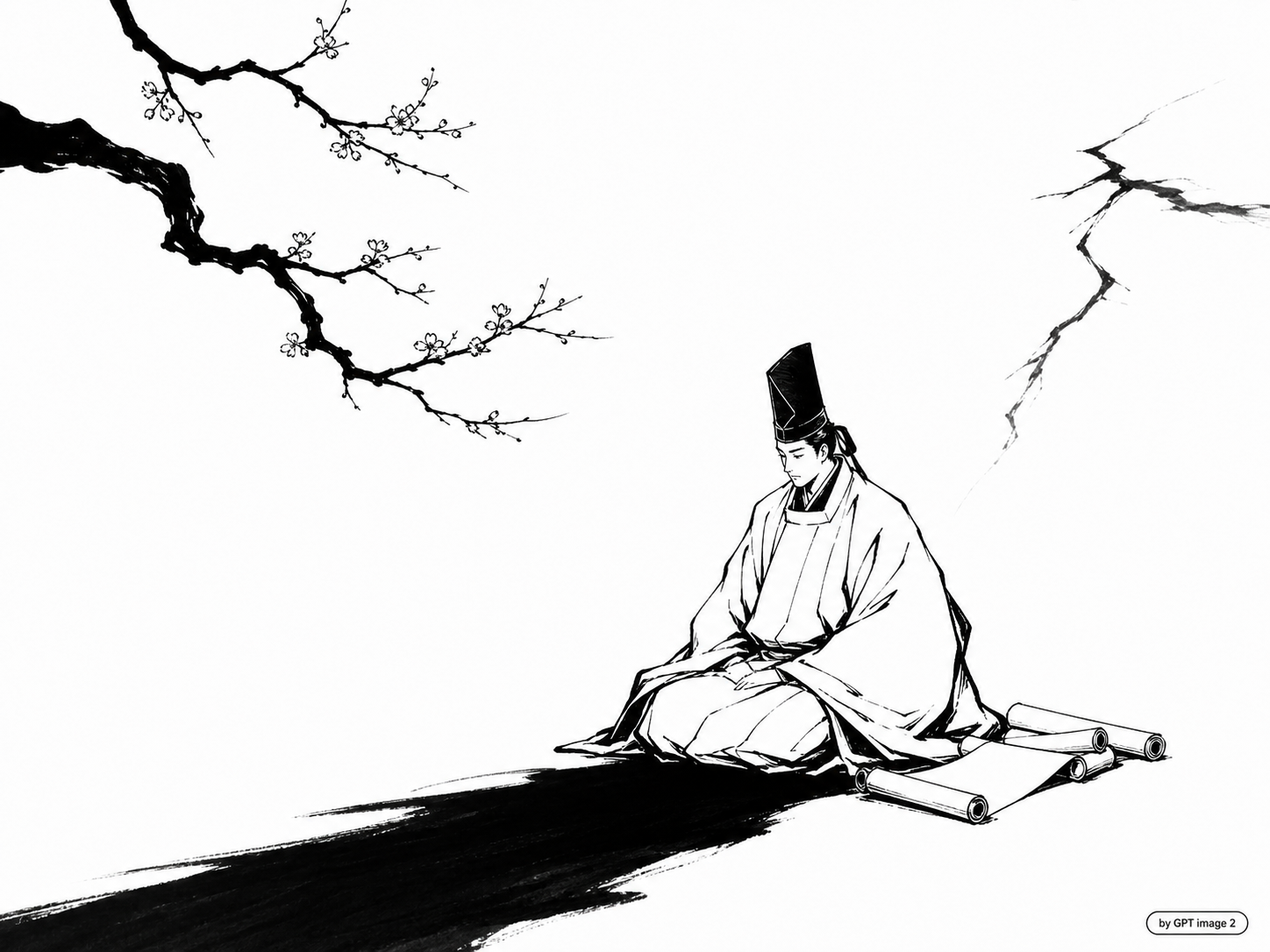
As the demoted ox-cart drew away, the plum tree said nothing. People wept, some turned their faces away, and some had already learned the name of the next man in power.
From within the cart, Michizane looked back at his mansion one last time. "When the east wind blows, send me your fragrance." He murmured it low, as if speaking to the tree.
A young attendant asked, "Can a tree hear?"
Michizane smiled faintly. "There are things that listen longer than people. Records on paper burn, and a man's excuses change. But a flower remembers in the direction it blooms."
Some years later, when lightning struck the capital and men fell, some called it politics and some called it chance. But one old lady-in-waiting caught the scent of plum and was suddenly reminded of the day the cart departed.
An onryo sometimes returns as a flower before it returns as lightning. A wronged name, before it reaches Heaven, is first remembered by the old things of the earth.
#Scent — When the East Wind Comes
Spring of Engi 2. A thatched hut in Dazaifu. An old man looks at the plum blossoming in the garden of his dwelling. The plum in the garden is smaller than his memory, its fragrance fainter than his memory. He sets a poem to his heart.
Kochi fukaba / nioi okoseyo / ume no hana
Aruji nashi tote / haru na wasure so
When the east wind comes, send forth your fragrance, plum blossoms
Though your master is gone, do not forget the spring
The name of the old man who wrote this poem is Sugawara no Michizane. One year earlier he was Udaijin (Minister of the Right) — the highest seat a man of scholarly origin could reach. A conspiracy sent him to Dazaifu. In this place a thousand li from the capital, he looks at the plum and paints the plum of his own garden. One year later, he dies.
Sixteen more years pass, and one day lightning falls on the Seiryoden of the capital. The men who had framed Michizane die one by one. The commoners say — "Lord Michizane has returned."
This is the greatest case of Heian onryo culture.
#Core Data
| Item | Value |
|---|---|
| Name | Sugawara no Michizane (菅原道真) |
| Lifespan | 845~903 (age 59) |
| Era | The transition from the end of the early Heian to the start of the middle period (the age of Emperors Uda and Daigo) |
| Court Rank | Udaijin (Minister of the Right) — highest for one of scholarly origin |
| Exile | Demoted to Dazaifu in 901 |
| Death | 903, at his place of exile in Dazaifu |
| Posthumous Deification | 947, the founding of Kitano Tenmangu (北野天満宮) → Tenman-Tenjin (天満天神) |
#Life — From Scholar to Statesman
#The Sugawara House — A House of Scholars
The Sugawara house was a house of scholars (Monjo Hakase). Just as a warrior house produces warriors, the Sugawara house produced scholars. Michizane was the most brilliant scholar of that house.
#Passing the Monjosho Exam at 18
Michizane passed the Monjosho (文章生) examination at 18, and rose to Monjo Hakase (文章博士) in 877. He was a genius versed in Chinese letters, poetry, history, and politics alike.
#Confidant of Emperor Uda
He was selected as a confidant of Emperor Uda (reigned 887~897). Emperor Uda appointed men of scholarly origin to check the Fujiwara house's monopoly on power, and Michizane was the core of that policy. It was also Michizane who, in 894, advised the abolition of the embassies to Tang China.
#As Far as Udaijin — The Summit
In the age of Emperor Daigo (reigned 897~930), Michizane rose as far as Udaijin. The highest seat a man of scholarly origin could reach. In reaching that seat, he became the greatest enemy of the Fujiwara house.
#Clash with Fujiwara no Tokihira
Sadaijin (Minister of the Left) Fujiwara no Tokihira (藤原時平) framed Michizane. The false charge: "Michizane plots to depose the Emperor." In January 901, Michizane was demoted to Dazai Gon no Sochi (大宰権帥, Dazai no Gon no Sochi) — in effect, exile.
#Exile in Dazaifu — Poems of Longing for Home
These two years in Dazaifu were Michizane's final time. The poems he left then — including "Kochi fukaba" quoted above — are counted among the saddest works of Japanese Chinese-style literature.
#Death in 903
In the 2nd month of Engi 3 (903), Michizane died in Dazaifu. Amid anger and loneliness. His grave is at the Tenmangu of Dazaifu.
#Posthumous Onryo (御霊)
#919~ Calamity in Kyoto
Beginning in 919, 16 years after Michizane's death, calamity begins in Kyoto. Tokihira died suddenly at 39 in 909. The others who had framed Michizane died in turn. Emperor Daigo's crown prince died in 923. The commoners said — "It is the onryo of Lord Michizane."
#The Seiryoden Lightning Strike of 930
The 26th day of the 6th month of Encho 8. On a day of heavy rain over the capital, lightning struck the Seiryoden (清涼殿), the Emperor's dwelling. Several Fujiwara-side figures died instantly. Emperor Daigo, shaken by the blow, abdicated three months later and died.
This event decisively engraved upon the people of Heian the perception that "Michizane = the Thunder God (雷神)." Not a mere onryo — one who summons natural calamity.
#The Founding of Kitano Tenmangu in 947 — The Pacification Rite
The court enshrined him as a god to relieve Michizane's grievance. In 947, Kitano Tenmangu (北野天満宮) was founded at Kitano in Kyoto. Michizane received the divine title of Tenman-Tenjin (天満天神).
This is the greatest case of Heian enshrinement-as-deity (祭神化) — a rite where a dead man's grievance is so great that the man is enshrined as a god and his grievance relieved. For details, see fc04-02-02-onryo-aristocracy.md.
#The Posthumous Promotion of 993 — Posthumous Restoration of Honor
In 993, Michizane was posthumously granted Shoichii (Senior First Rank) and Daijo-daijin (Chancellor of the Realm) — the highest offices one could receive after death. He received after death the seat he could not receive while alive. An irony of Heian politics.
#Tenman-Tenjin — Deification
Michizane began as a god of calamity and was gradually transformed into a god of learning. From the Kamakura period onward, he settled as the "god of study," and the sight of modern Japan's examinees going to Tenmangu to pray for success is the result of those thousand years.
In this volume, Michizane is treated in three stages:
- In Life (845~903) — scholar and statesman. The character sheet of this document.
- Posthumous Onryo (919~947) — the threatening onryo before deification as Tenman-Tenjin. The onryo NPC sheet of this document.
- After Deification (947~) — Tenman-Tenjin. No sheet in this document. Uses the Middle God (3rd rank) Tenjin sheet of
fc01-02-03-chushin.mdas-is.
#Character Sheet — In Life (Canon, fc04-internal only)
Canon (fc04-internal only). Michizane in life (based on his prime, around 880).
Sugawara no Michizane (in life, prime) — Main class Scholar 10-dan + poetry build
Wounds: 4 (3 + Physique 0 + Tough 1)
Defense: 11 (court robes)
Energy: 12 (10 + Finesse 2)
Attributes: Courage +0, Finesse +2, Physique +0, Wisdom +3, Presence +2, Fate +1
School: Sugawara Chinese Letters (lineage · Licensed)
Domination contribution: +3 (politics · eloquence)#Main Traits
- Divine Calculation and Ghostly Strategy (Scholar 1-dan automatic) — Energy Transfer · Squad Command · weakness analysis
- Chinese Letters Erudition (Sugawara lineage) — Chinese letters · divination · history checks +2
- Diplomatic Eloquence (Scholar 5-dan choice) — Negotiation +2, core of social scenarios
- Court Connections (Sugawara lineage) — 1/scenario, automatically obtain NPC information
- Accuracy of Divination (Scholar 7-dan choice) — 1/session, GM information by 1 step
#Signature — Words, Not the Sword
This volume's character only. Michizane has almost no martial force. His signature is not combat but language and politics.
| Technique | Type | Energy | Effect |
|---|---|---|---|
| Memorial to the Throne (上奏) | upkeep | Energy 4 | 1 scenario, 1 time. A memorial to the Emperor or a power-holder — bypass 1 scenario decision point by the Emperor's command. GM's discretion. |
| A Single Waka | Kata (Presence) | Energy 2 | A single waka quells the enemy's killing intent. For 1 breath the enemy does not attack (Target Number: 2d10+Presence+Bearing ≥ enemy Courage). |
#NPC Sheet — Posthumous Onryo (Canon, fc04-internal only)
Canon (fc04-internal only). Michizane's active period after death, between 919~947. The pre-deification stage — a threatening onryo.
Sugawara no Michizane (posthumous onryo, 919~947) — Incorporeal / onryo / Lord-grade
Wounds: 8 (Incorporeal stability. 7 Wounds + Tough 1)
Defense: 16 (Incorporeal protection)
Energy: 14 (10 + Finesse 4)
Attributes: Courage +0, Finesse +4, Physique +0, Wisdom +3, Presence +2, Fate +3
Domination contribution: +5#Majin Matching — Applying the Tatarigami Structure
This NPC is a posthumous onryo form applying the mechanism of the Tatarigami class of co-04-07-27-villain-tatarigami.md. As a "wrathful god," it possesses the abilities of Faith absorption and Barrier reversal.
#Signature — Natural Calamity
| Technique | Type | Energy | Effect |
|---|---|---|---|
| Wrath of Lightning | Kata (area) | Energy 6 | Area (1 entire zone). All PCs evade with 2d10+Finesse ≥ Target Number 17 (extreme). On failure, 3 Wounds. (Seiryoden lightning motif) |
| Shadow of Pestilence | Kata (Curse effect) | Energy 5 | Permanent for 1 scenario. At the start of every breath, 1 NPC among all NPCs in the capital withers away (scenario-progress pressure). |
| Divination of Calamity | aptitude | Energy 3 | Twist the scenario's ending by 1 step (GM's discretion). 1 campaign, 1 time. |
#The NPC's Weakness — The Pacification Rite
Michizane's onryo cannot be destroyed by direct assault. Only the enshrinement-as-deity rite pacifies him.
- Rite resources — shrine grounds at Kitano + a formal imperial posthumous promotion + an orthodox onmyoji (Seimei or his disciple)
- Rite procedure — a scenario arc spanning one season (3 months). The PCs gather the resources and perform the rite.
- On rite success — Michizane is deified as Tenman-Tenjin. The NPC sheet concludes in this document, and thereafter transitions to the Tenjin sheet of
fc01-02-03-chushin.md.
#Scenario Use
#To Fight Michizane
Michizane in life has almost no martial force. To "fight" him means political strife — PC builds on either side, framing him or defending him.
The posthumous onryo Michizane cannot be destroyed by direct assault. The enshrinement-as-deity rite is the only solution.
#To Take Michizane as a Master
Possible only during his lifetime. A scenario in which a Scholar PC receives his teaching. Conditions:
- Main class Scholar — other classes are refused.
- Poetry or Chinese-letters ability — a poetry build, or Chinese-letters proficiency +2 or higher.
- A recommendation — Michizane in his Udaijin period is hard to meet directly. A recommendation from Emperor Uda or another scholar.
On success: a PC of Scholar 7-dan or higher can acquire the "Diplomatic Eloquence" or "Court Connections" maneuver through Michizane's teaching (1 narrative milestone).
#In One Line
"In life he rose to Udaijin, and in death he became Tenman-Tenjin."
#References
#co — Classes
co-04-character/co-04-07-classes/co-04-07-09-scholar.md— Scholar classco-04-character/co-04-07-classes/co-04-07-27-villain-tatarigami.md— Tatarigami (Majin matching for the posthumous onryo NPC)
#ex2 — Scholar · Divination Spells
ex2-35-spell-system/ex2-35-03~ex2-35-08— Onmyo 1-dan~Tatsujin (divination · Sorcery. Scholars borrow some too)ex2-35-spell-system/ex2-35-16-prophecy-spells.md— Prophecy · divination
#fc — Preceding Volumes
fc01-02-03-chushin.md— Middle God (Tenman-Tenjin/Tenjin sheet — confirmed. The home of the post-deification NPC)fc01-04-00-divine-regalia-and-rites.md— Divine Artifacts · Sorcery (Tenjin-related)
#Within fc04
fc04-02-02-onryo-aristocracy.md— Onryo culture (the enshrinement-as-deity rite)fc04-06-01-aristocratic.md— Aristocratic scenario (Seed 7 "Spirit of the Maternal Kin" — a Michizane-type onryo)
The east wind shakes the flowers, and a wronged name shakes the heavens.