#Aristocratic Yoma — Ikiryo and Onryo
Contents
Fiction-Only + Scene Tool. This document treats the ikiryo/onryo culture of Heian aristocratic society. The "ikiryo scenario guide" is a scene tool limited to fc04 internally, and does not conflict with the conditions of
co(co-11-02-conditions.md).
#Opening Fragment — The Shadow at the Foot of the Bed
The lamp of the rear palace did not go out. The ailing woman could not sleep, and the lady-in-waiting pretended not to see the shadow at the foot of the bed. The shadow had the shape of a person, but matched no one in the room.
"Who is there?" the woman whispered.
The lady-in-waiting could not answer. The onmyoji beyond the door said quietly, "Do not call its name. The ikiryo, hearing its name, draws nearer."
The woman gripped her quilt with trembling hands. "Does that person hate me?"
"Hatred sometimes comes before the body," the onmyoji said. "And in the court, even without the body coming, one can harm a person well enough."
The shadow moved a little. The lady-in-waiting finally broke into tears, and the woman closed her eyes. There was neither blade nor poison. Yet by nothing more than one person's heart hating another, the air in the room had already become a sickness.
#Scent — That One Person Hates Another
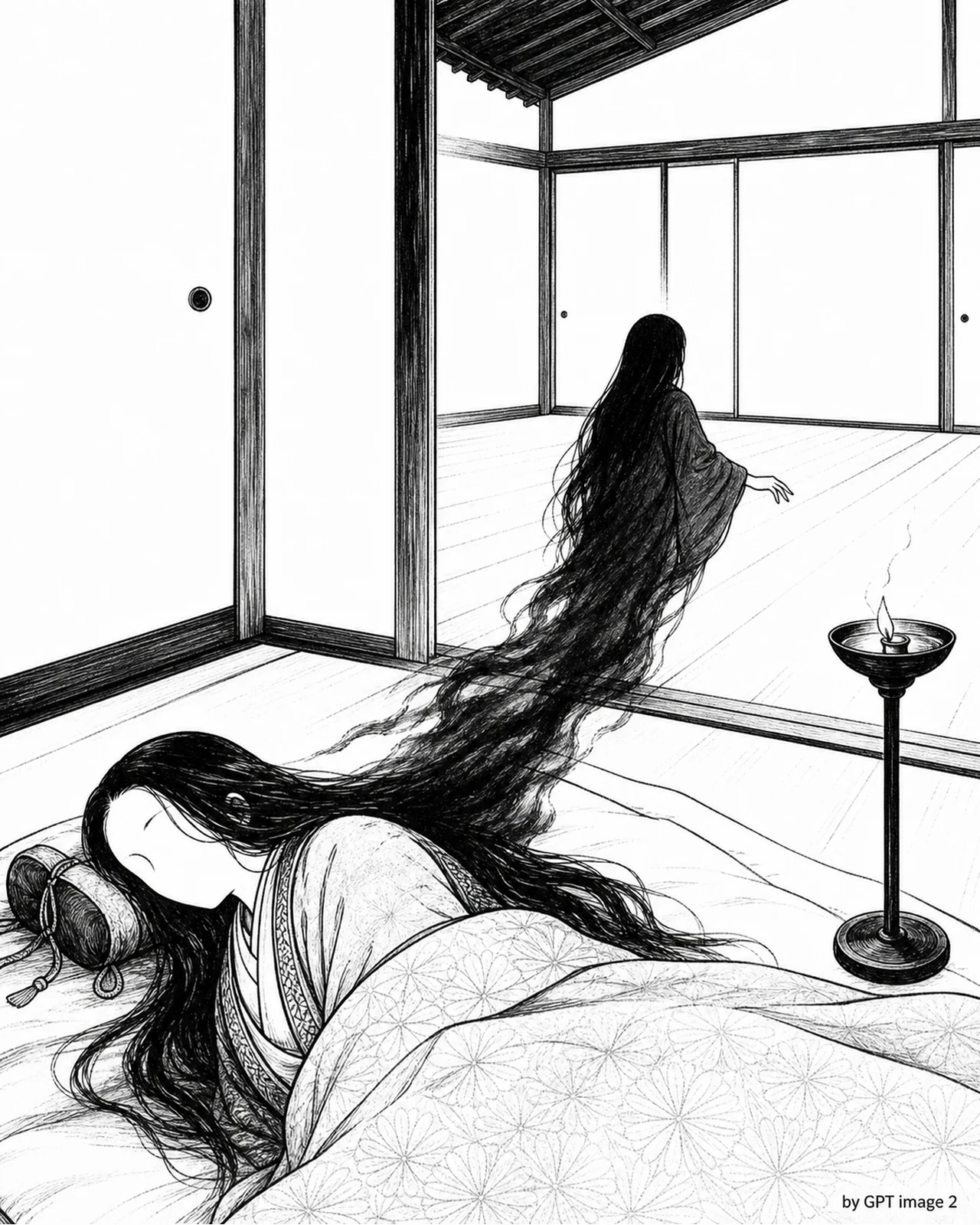
A certain rear palace of the imperial house. A new consort enters and monopolizes the emperor's favor. The old consort cannot sleep all night in her own quarters. Her hatred takes form — without her own awareness, while she sleeps, her shadow appears in the new consort's bedchamber. The new consort withers and dies within a few days. It was not someone else who killed her. The old consort herself killed her — only she does not know that she did.
This is the ikiryo (生霊). The hatred of a living person taking form. It was the darkest weapon of Heian aristocratic society.
On the other side there is the onryo (怨霊). The grudge of a dead person. Michizane, after his death, brought down lightning on Kyoto. Masakado's severed head flew to the eastern provinces. When a person dies and their resentment is too great, that resentment lingers even after death.
Ikiryo and onryo — the two shadows hidden behind the elegance of Heian.
#Ikiryo (生霊)
The strong grudge or attachment of the living taking form.
#Core Traits
- The source is a living person — both the one who emits the ikiryo and the one struck by it are alive.
- The person themselves may not know — in many cases one emits an ikiryo without knowing one is doing so. Rokujo-no-Miyasudokoro (六条御息所) in Murasaki Shikibu's The Tale of Genji is the archetype of this motif — she kills another woman without her own awareness.
- Activity is time-limited — usually it acts only while the source is asleep. If the source is awake, the ikiryo also halts.
- Resolution — if the source's feelings are released, it dissipates naturally. Resolved by letter, by meeting, by a confession of truth, and the like.
#Handling in Game — Scenario Guide
The ikiryo is handled in the form of a scenario guide. Full rules treatment is difficult.
#The Possibility of a PC Emitting an Ikiryo
If, during a campaign, a PC strongly hates a person, the GM can introduce, as a scenario event, that "the PC's ikiryo harmed that person." This is not a rule but a GM's narrative tool — a device that confronts the PC with the consequence of an action the PC themselves was not aware of.
#An NPC's Ikiryo
Consort A hates Consort B. A scenario in which B is withering. The PC's task is one of two — release A's hatred, or protect B.
#The One Struck by an Ikiryo — Effects
- Wounds -1 at the start of each scene, or
- Wounds -1 per breath (a strong ikiryo)
- The effect halts while the source is awake
- Once resolved, recovery is possible from the next breath (natural recovery or a Medicine build)
It can be expressed using the conditions of co-11-02-conditions.md ([Erosion]・[Curse], etc.) — do not create a new condition.
#Onryo (怨霊)
The grudge of the dead, lingering.
#Core Traits
- The source is a dead person — the onryo is the resentment of the dead taking form.
- A clear will — unlike the ikiryo, the person themselves knows "whom I have come to kill."
- Persistent — its activity is not time-limited. It acts both by day and by night.
- Resolution — usually deification (祭神化) — enshrining the dead as a god to release their resentment. Or sealing. Michizane → Tenman-Tenjin (天満天神) is the most famous case of deification.
#Representative Cases
- Sugawara no Michizane (after death) — natural disasters in Kyoto from 919 onward. The 930 lightning strike on the Seiryoden. Quelled by the founding of Kitano Tenmangu in 947. In detail:
fc04-03-03-michizane.md. - Taira no Masakado (after death) — the legend that his beheaded head flew to the eastern provinces. One motif of Kanda Myojin.
- The consorts of Emperor Saga — one woman's jealousy appears, after her death, as an apparition in another woman's bedchamber.
- The Heike clan (after death, 1185) — the onryo of the Seto Inland Sea after the naval battle of Dan-no-Ura. Leads on to the Heikegani (平家蟹) legend.
#Ikiryo vs Onryo — Comparison
| Axis | Ikiryo (生霊) | Onryo (怨霊) |
|---|---|---|
| Source | a living person | a dead person |
| Awareness | the person may not know | a clear will |
| Activity Time | limited (while the person sleeps) | persistent |
| Resolution | release of the person's feelings (letter, meeting, confession) | deification or sealing |
| Time Scale | usually one scenario | may cross over eras |
| This Volume's Figure Cases | Miyasudokoro (in the work) / Murasaki Shikibu's work | Michizane / Masakado / Heike |
#Murasaki Shikibu's Testimony
The Diary of Murasaki Shikibu and The Tale of Genji are the richest records of Heian spiritual events. Shikibu herself was neither an onmyoji nor a warrior, but she was the observer who saw the events that occurred in the court most closely. Spiritual events appear often in her writing.
It was an age in which one person hating another became, in itself, a weapon.
This single line summarizes the self-awareness of Heian aristocratic society. For details: fc04-03-04-murasaki.md.
#Tone
The reverse side of elegance. The black current beyond the smooth court. An age in which, beneath the surface of two consorts contending over the same incense, one consort is, without even knowing it, killing the other.
"Night after night the same incense flowed from that bedchamber. The next day, the mistress of that bedchamber withered. No one asked who had killed her. Because to ask was not the etiquette of that society."
#References
#co — Conditions・Classes
co-11-appendix/co-11-02-conditions.md— conditions (used when expressing ikiryo effects)co-04-character/co-04-07-classes/co-04-07-27-villain-tatarigami.md— Tatarigami (an enraged-god, onryo-affinity villain class)
#Within fc04
fc04-03-03-michizane.md— the model of the after-death onryofc04-03-04-murasaki.md— the author who depicted the ikiryofc04-06-01-aristocratic.md— aristocratic scenario (ikiryo/onryo seeds)fc04-05-06-alt-realm.md— Heian Spirit Realm model
#fc Other Volumes
fc02-01-03-realm-split.md— comparison with the Sengoku Spirit Realm
The grudge of the aristocrat holds no blade — it stands at the foot of the sleeping room.