#The Archetype of the Hyakki Yako
Contents
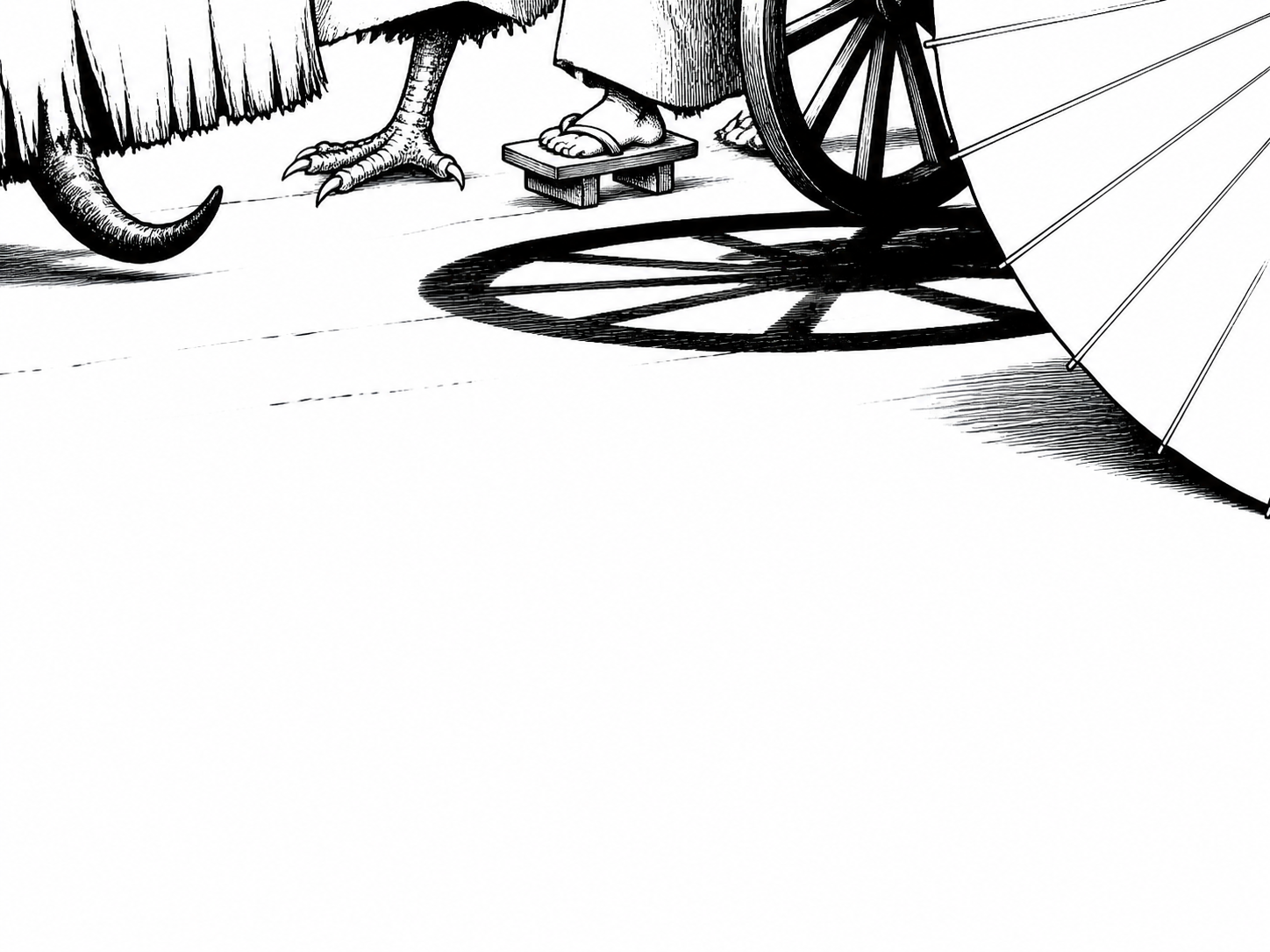
Fiction-Only. This document presents the cultural origin and atmosphere of the Heian Hyakki Yako (百鬼夜行) in prose. There is no stat sheet. Game rules follow the
co-09-11-hyakki-yagyo.mdscenario and the "Hyakki Yako" maneuver inco-11-11-maneuver-catalog.mdas-is — this document lays no new Canon on top of them.
#Opening Fragment — The Night the Road Is Cleared
In the dead of night, the sound of cartwheels came from the northern road. The watchman did not strike the bell. To strike it would make people open their gates and look, and if they looked, the procession would look back at the people.
A young soldier gripped his spear. "Should we not stop it? The road is the court's road."
The old watchman pressed down on his wrist. "Not tonight. The Hyakki Yako is sometimes not an intruder, but the old master of the road we merely borrowed for a while."
"Then we just let it pass?"
"Do not look, do not call out, do not give it a name." The old watchman put out the lamp. "The etiquette of this night is not courage but indifference."
The sound of cartwheels passed before the gate. The soldier held his breath, and in the darkness he heard someone laughing. When morning came there was not a single trace on the road. Only — the watchman's hair had turned white over the course of a single night.
#Scent — The Same Road, A Different Time
Kyoto deep in the night. Fog settles over Shijo Bridge, at the hour when every lamp of the capital's people has gone out. An honest old man whose name is unknown, late from his work, passes a crossroads on the outskirts of the capital. There — it goes by.
He does not know who the first one is. Nor the second. And the next, and the next. Ten, a hundred. They have the shape of people but are not people. One has a single eye, one has two heads. One has a mouth as large as a great jar, one rolls a cartwheel in place of feet. They talk among themselves, sing, and dance as they go out beyond the capital.
The old man lies flat in the grass beside the road. He tries not to look. One of them stops beside the old man and, tilting its head, peers into his face. The old man only recalls a single talisman and cries out one name — whether a Taoist's name, a god's name, or his own mother's name. That one goes on its way again.
The next morning, when the old man rose, his hair had all turned white.
This is the Hyakki Yako (百鬼夜行) — the throng of a different time, walking the same road as humans, that the people of Heian knew.
#What the Hyakki Yako Is
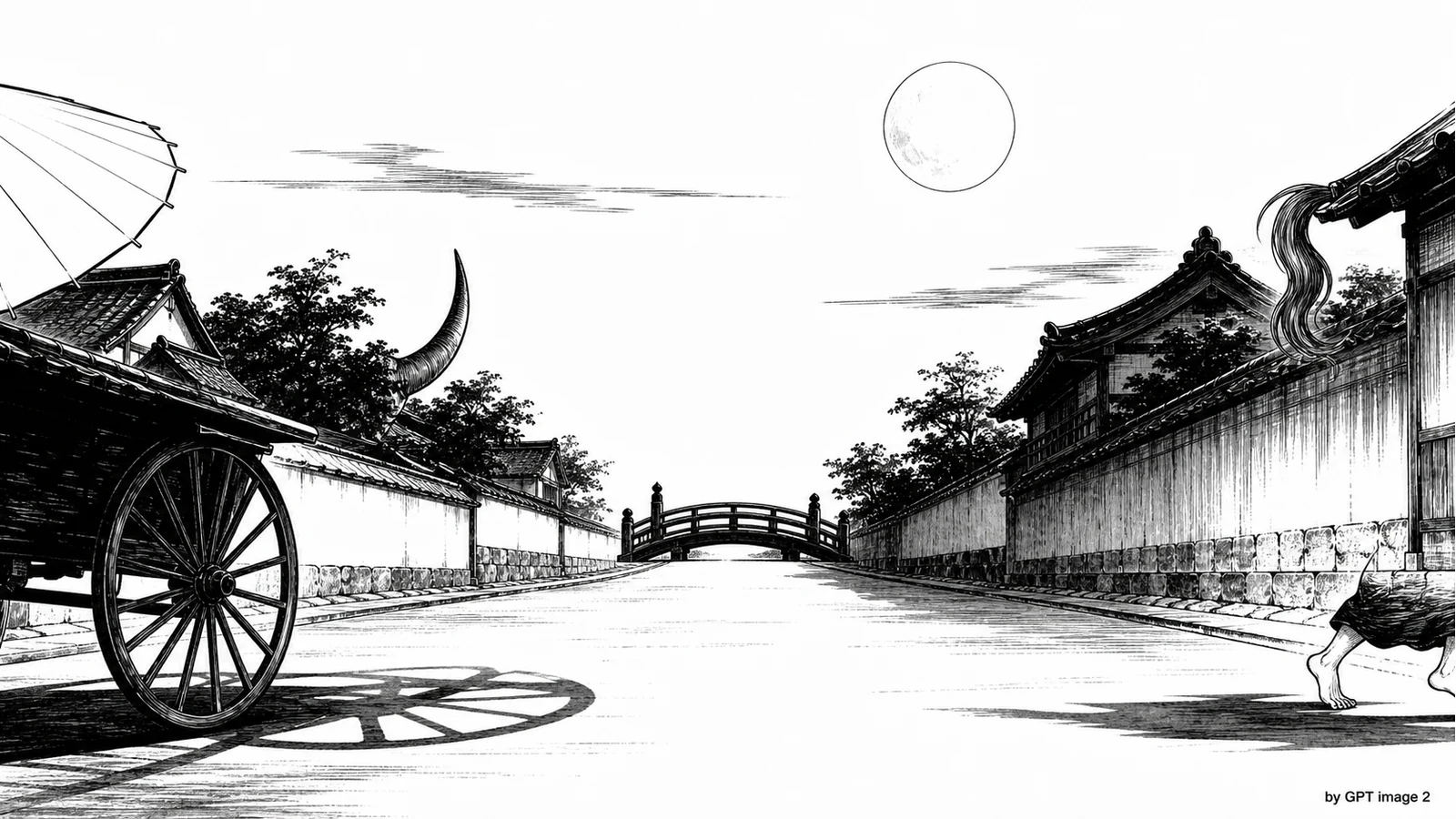
"The night procession of a hundred kinds of demons." It is the archetype of the yoma culture that took root in Heian Kyoto.
There are two core points. First, yoma do not live in another dimension; they walk the same road. Only the time is different. Second, if a human meets that road at that time, returning alive is difficult. Only by knowing the talisman, the stance, and the utterance can one survive.
The many later Japanese tales of yoma processions — the Hyakki Yako emaki, the tsukumogami-lineage procession tales, the Edo tradition of yokai picture books — inherited the motif of the Heian Hyakki Yako. This volume treats that Heian archetype.
#Five Tales
#The Cart at the Foot of Mount Oe
An honest old man sees a single cart at a crossroads of Mount Oe in the middle of the night. The one riding in the cart cannot be seen. The driver cannot be seen either. The cart alone is drawn along by itself. When the old man lies flat in the grass and keeps his mouth shut, after the cart passes a black mark is left in that spot.
#The Procession at Shijo Bridge
A guard warrior is stationed at Shijo Bridge in the middle of the night when he encounters the procession. The procession does not go over the water but crosses the bridge. When the guard warrior puts his hands together and chants "Namu Amida Butsu," the procession halts, looks at him once, then goes on again. The next day his hand was injured for life and he could no longer wield a sword.
#The Night Watch of the Palace Perimeter
A guard warrior of the imperial house encounters the procession on his night-watch round through the outer perimeter of the palace. He holds his family's bow, but he does not loose it — to loose a bow at the procession is the same as loosing it at oneself. He merely kneels and waits for the procession to pass.
#The Salvation of a Single Talisman
A man is surrounded by the procession. He takes out a single talisman his mother made for him. He chants the name written on the talisman as if mad — neither he nor the procession knows what that name is, but the procession sees the talisman and clears the way.
#The One Who Called a Name Wrong
A man asks the procession, "Who are you?" One among the procession stops and answers its own name. The man calls "who's" name wrong — and in that moment he is drawn into the procession and never returns.
#The Structure of the Procession
| Position | Appearing Yoma | Meaning |
|---|---|---|
| Vanguard | Leader-class (the rank of oni, tengu, nine-tailed fox) | Leads the procession. Usually ignores humans even on encounter. |
| Middle | Diverse yoma (tsukumogami, gaki, yoko, lesser evil spirits) | The main body of the procession. Loud and gaudy. |
| Rear | Yoma that seek to draw in humans (especially the transforming/charming lineage) | To seize those who have strayed from the procession. Dangerous. |
The vanguard are those already on their own road. The middle are in the midst of the feast. The dangerous part is the rear — if they draw a single human into the procession, the procession grows by one.
#Tone — Wonder Over Fear
Later Hyakki Yako paintings (emaki, ehon, and the like) emphasize terror, but the Heian Hyakki Yako has wonder in the ascendant. The sense that "yoma do not live in another dimension but walk the same road" — it is fear, yet at the same time a sign of coexistence. For the people of Heian, the procession was "something they must not meet night after night, yet could never entirely avoid meeting."
#Game Application
#This Volume's Treatment — Not Datafied
The procession as a whole is not made into a sheet. It is a collective phenomenon close to myth-grade, and this fc04's principle forbidding the datafication of myth-grade entities applies.
Instead it is handled in the form of a scenario seed — see the "Procession Across the River" seed in fc04-06-02 (mountain scenario). Other scenarios in which PCs directly meet the Hyakki Yako use the co-09-11-hyakki-yagyo.md scenario as-is — this volume lays no new sheet or rule on top of it.
#Maneuver Alignment
The "Hyakki Yako" maneuver is already defined in co-11-11-maneuver-catalog.md. This volume does not redefine that maneuver's effect. Situations in which PCs use that maneuver in a Heian campaign are left to GM discretion, but the effect values remain as in co.
#For a PC to Survive
If, in a scenario, a PC meets the procession — all three of the following must be satisfied to be safe.
- Stance — Step aside from the road, lie flat in the grass or kneel. Do not hold a bow.
- Utterance — Chant the name of a talisman, a god, or a Taoist. Never speak your own name.
- Gaze — Do not look directly at the procession. Do not meet the eyes of any one of them.
Break these three and the rear yoma come to seize the PC. A seized PC may not return until the scenario ends — this is handled not as immediate "Wounds 0" but as the scenario-ending result "joining the procession." For the detailed procedure, follow the scenario document.
#To the Following Volumes
The Hyakki Yako does not end with Heian. It continues through Kamakura and Muromachi to Edo, its form changing along the way. The connection points to the following volumes are as follows.
- fc02 (Sengoku) — As the gate of the Spirit Realm swings wide open, the Hyakki Yako occurs not at "night" but on the "battlefield" as well
- fc05 (Edo) — Transformation into the tsukumogami procession
- fc09・fc10 (modern) — The modern echo of the urban night procession
This volume treats the Heian archetype of all those transformations.
#In One Line
"We are always walking the same road as those things. We simply do not look."
#References
#co — Scenario・Maneuver (this document depends on)
co-09-adventures/co-09-11-hyakki-yagyo.md— Hyakki Yako scenario (usable in both Heian and Sengoku)co-11-appendix/co-11-11-maneuver-catalog.md— "Hyakki Yako" maneuver
#co — Classes (divinities/villains appearing in the procession)
co-04-character/co-04-07-classes/co-04-07-16-arahitogami.md— arahitogami (orthodox divinity)co-04-character/co-04-07-classes/co-04-07-27-villain-tatarigami.md— Tatarigami (the enraged god, a villain)
#fc Other Volumes
fc02-01-03-realm-split.md— Spirit Realm opening (Sengoku model comparison)fc01-02-04-shoshin.md— Minor Godsfc01-02-05-bishin.md— Lesser Gods
#Within fc04
fc04-04-01-shutendoji.md— Shuten-doji (one peak of the hundred demons)fc04-04-02-tsuchigumo-rashomon.md— Tsuchigumo・Ibarakifc04-04-03-tamamonomae.md— Tamamo-no-Maefc04-05-06-alt-realm.md— Heian Spirit Realm modelfc04-06-02-mountain.md— mountain scenario (seed 2, "Procession Across the River")
The Hyakki Yako is not a procession crossing the road, but the face of the night that people have decided not to look at.