#Villain Equipment — Weapons and Armor
Contents
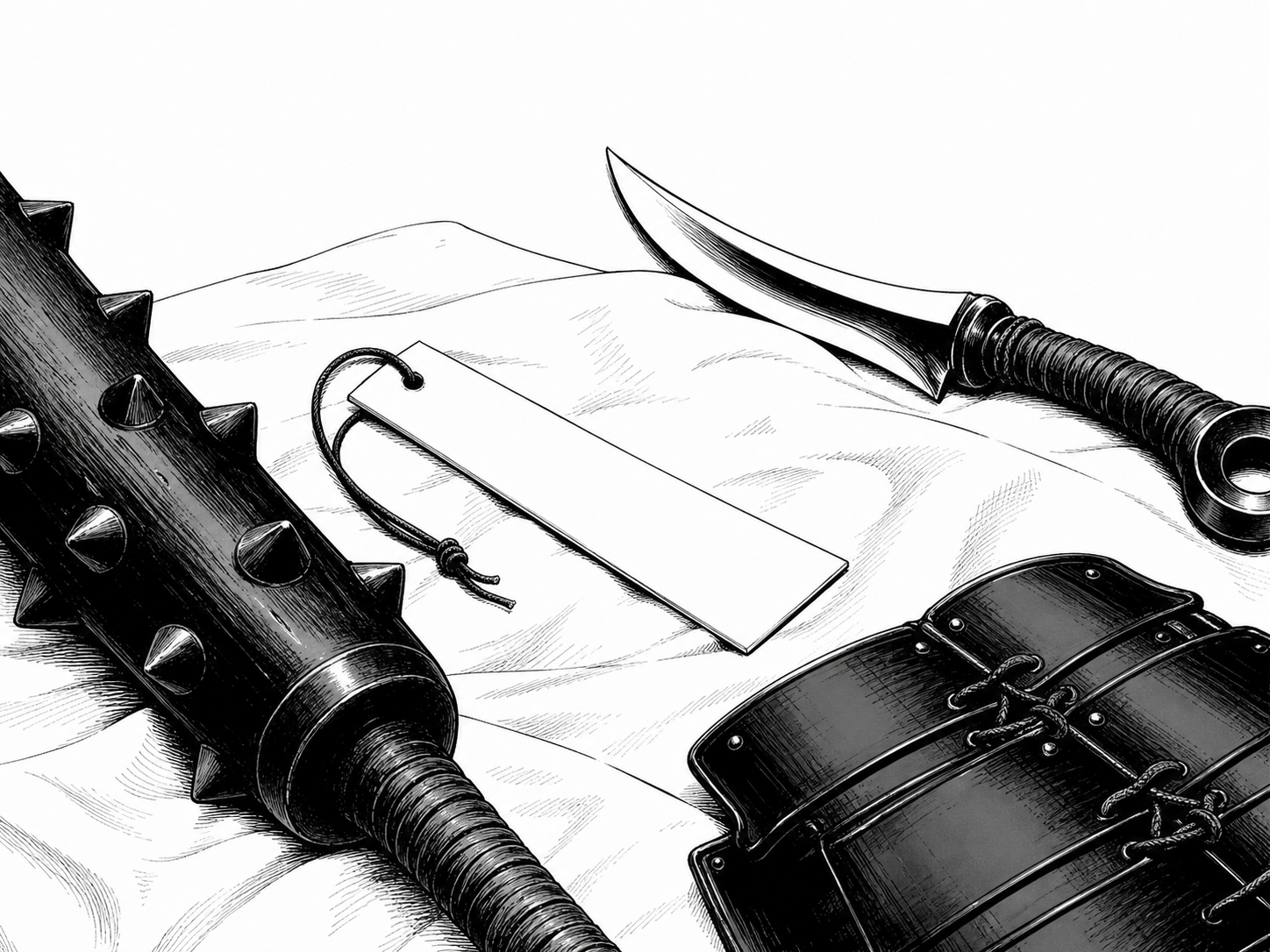
A villain's belongings are not fearsome because they are strong. They are fearsome when everyone knows where they came from.
#Opening Vignette — Not Spoils but Evidence
The Zakkasho drew back the black cloth.
The first item was a blade. Dozens of names were carved into the scabbard in tiny script. The second was a bow. Soil from an old execution ground clung to the string. The third was armor. Inside, the name of the one who had worn it was scratched out.
"Are they all masterworks?" the Shurado asked.
"Call them masterworks and the price goes up," the Zakkasho said. "But to be exact, they are evidence. Things that still remember who did what."
The Dokuchushi picked up the Plague-Bearing Kaiken. "Where did this come from?"
The Zakkasho smiled. "It's this price because you've agreed not to ask that question."
That day the villains had not divided spoils. Each had chosen which shape of sin to carry away.
#Principles of Use
This document is fc07 internal equipment data. It follows the equipment slots, weapon categories, and defense-bypass tags of co.
- It creates no new majin class, no new Sorcery, no new school.
- Weapon types are based on the existing types in the
weapon catalog. - Armor and accessories follow the slot sense of
equipment and consumables. - The notations
[Pierce N],[Direct N],[Incorporeal],Defense -N,[Break]followco's defense-bypass tags and auxiliary notations. - This equipment is used as villain PCs, villain NPCs, villain factions, cursed rewards, and evidence to be recovered.
The items in this document draw on motifs from real history and ghost tales, execution tools, evidence of war crimes, and cursed objects from cruel fiction. But they are organized not as descriptions reproducing procedures, but as equipment data and scenario hooks for use at the table.
#Grades and Acquisition
| Grade | Handling |
|---|---|
| Notorious masterwork | The same structure as co masterworks. Base weapon technique + masterwork technique. Most are scenario rewards or spoils. |
| Dark-side relic | A Divine Artifact-grade object originating from yoma, cults, vengeful spirits, or great wrongdoing. Has a blessing/curse and a devotion technique. |
| Evidence equipment | Armor and accessories whose scenario traces matter more than their numbers. They occupy an equipment slot. |
Even if a price is listed, these are not bought on the open market. They come from a villain faction's ledger, the black market, a cult's storehouse, execution-ground relics, and Spirit Realm wreckage.
#1. Blood-Name Blade (血名刀) — The Blade That Cuts Names
Motif of the executioner's blade, the death register, the cursed blade that kills by name. The more names recorded on the scabbard, the lighter the blade becomes.
Weapon type: Uchigatana Grade: Notorious masterwork Recommended villains: Shurado, Kekka, Zakkasho, Tesshin
Base technique: Same as Uchigatana.
| Technique | Type | Energy | Roll | Effect | Limit |
|---|---|---|---|---|---|
| [masterwork] Name Cut (名斬り) | Form | 3 | 2d10+Courage+Swordsmanship+2 >= Defense | 2 Wounds. If you learned the target's true name, office title, or house name in the same scenario, 1 additional Wounds. When the target is incapacitated, enemy squad Cohesion in the same zone -1. | 1/round |
Aptitude — Weight of the Death Register: When the bearer attacks an enemy whose name they have learned, Intimidation +2. When negotiating with an enemy whose name they do not know, -1.
Curse — The Empty Name Slot: If at the end of a session no new name was carved on the scabbard, initiative bonus -2 in the first combat of the next session.
Acquisition hook: A villain faction that has seized an execution ground uses the blade as a ceremonial treasure-sword. One of the names on the scabbard is a PC's old comrade.
#2. Gibbet Bow (梟示弓) — The Bow of Public Display
Motif of public execution, battlefield gibbeting, and rule by terror. Not a weapon that kills from afar, but a weapon that makes everyone watch.
Weapon type: Daikyu Grade: Notorious masterwork Recommended villains: Tatarigami, Kekka, Tengushi, Zakkasho
Base technique: Same as Daikyu.
| Technique | Type | Energy | Roll | Effect | Limit |
|---|---|---|---|---|---|
| [masterwork] Display Shot (梟示矢) | Form | 3 | 2d10+Finesse+Archery+2 >= Defense | 2 Wounds. If this attack incapacitates the target, the squad it belongs to has Cohesion -2. If a lone enemy, all enemies in the same zone make a Mental Save (Courage >= 13). | 1/battle |
Aptitude — The View From the High Stake: Archery attack +1 in a high or rampart zone.
Curse — Everyone Must See: Using this bow's masterwork technique while infiltrating immediately ends infiltration, and everyone on the battlefield knows the bearer's location.
Acquisition hook: After a Hegemony daimyo gibbeted the leader of a revolt, the bow chose a new master of its own accord.
#3. Plague-Bearing Kaiken (病毒懷劍) — The Dagger That Holds Sickness
Motif of the poison ring, the tainted dagger, the diseased sacred relic. The blade is small, but the rumor spreads before the wound.
Weapon type: Kaiken Grade: Notorious masterwork Recommended villains: Dokuchushi, Itako, Zakkasho, Yorijin
Base technique: Same as Kaiken.
| Technique | Type | Energy | Roll | Effect | Limit |
|---|---|---|---|---|---|
| [masterwork] Plague Stab (疫刺し) | Form | 2 | 2d10+Finesse+Poisoncraft+2 >= Defense | [Pierce 2]. 1 Wound + poison (2 rounds, 1 Wound per lull). If the target is already poisoned, 1 additional Wounds. | 1/round |
Aptitude — The Symptomless Sheath: The bearer has +2 on poison-detection and antidote checks.
Curse — Heat at the Fingertips: The first time per session that the bearer takes Wounds damage, all checks other than Poisoncraft are -1 for that round. The blade tests its master's body too.
Acquisition hook: It was found in the safe of a certain apothecary. The ledger records the names of those who could not pay their treatment fees.
#4. White-Bone Kanabo (白骨金棒) — The Kanabo That Pounds Bone
Motif of the oni's kanabo, the battlefield bludgeon, the club decorated with spoils. An object made for smashing.
Weapon type: Tetsubo Grade: Notorious masterwork Recommended villains: Shurado, Jikiniki, Tesshin
Base technique: Same as Tetsubo.
| Technique | Type | Energy | Roll | Effect | Limit |
|---|---|---|---|---|---|
| [masterwork] White-Bone Crush (白骨粉碎) | Form | 4 | 2d10+Physique+Unarmed Combat+2 >= Defense | [Pierce 2] + [Break]. 3 Wounds. If the target wears armor, its Defense -1 for the next breath. | 1/battle |
Aptitude — The Oni's Mass: Intimidation +2 in the Front Zone. Allied squads in the same zone also have Cohesion -1 in the first lull.
Curse — Cannot Find the Light Foe: When attacking an enemy of 1 Wound or less in combat, attack roll -2. Because it is not a blade but a stake of terror.
Acquisition hook: An oni's kanabo was shrunk to human size. During the shrinking, the bone decorations inside the kanabo began to speak.
#5. Confession Jumonji-yari (問招十文字槍) — The Spear That Draws Out Confession
Motif of the hook spear, the binding tool, the weaponized interrogation room. Specialized in dragging out rather than killing.
Weapon type: Jumonji-yari Grade: Notorious masterwork Recommended villains: Tatarigami, Tesshin, Zakkasho, Shikome-no-Tsukai
Base technique: Same as Jumonji-yari.
| Technique | Type | Energy | Roll | Effect | Limit |
|---|---|---|---|---|---|
| [masterwork] Hook of Confession (告白の鉤) | Form | 2 | 2d10+Finesse+Spearmanship vs enemy 2d10+Physique | No damage. On success, binding (1 round) + the next Negotiation or Intimidation check +2. If the target is already bound, 1 Wound. | 1/round |
Aptitude — Words Drawn Out: After combat, in the same scene, +1 on Negotiation/Intimidation checks to question a target who was bound.
Curse — Does Not Wait for an Answer: When trying to avoid combat through negotiation, the first Negotiation check -1.
Acquisition hook: It was a tool for suppressing revolts, but one day it drew out not a captive but a lord's secret.
#6. Nameless Execution Axe (無名處刑斧) — The Greataxe That Erases Names
Motif of the execution axe, the beheading block, the nameless grave. The power to cut the record is more fearsome than the edge.
Weapon type: Zanbato Grade: Notorious masterwork Recommended villains: Shurado, Tatarigami, Tesshin
Base technique: Same as Zanbato.
| Technique | Type | Energy | Roll | Effect | Limit |
|---|---|---|---|---|---|
| [masterwork] Record Severing (記錄斷ち) | Form | 4 | 2d10+Courage+Swordsmanship+2 >= Defense | 3 Wounds. If the target is incapacitated, immediately end one of the target's Command, Agitation, or tactics effects for that scene. | 1/battle |
Aptitude — The Nameless Grave: After combat, when an enemy squad surrenders, Intimidation +2.
Curse — The Void of Honor: The bearer feels revulsion when receiving a fame reward or public praise. Negotiation check -2 in that scene.
Acquisition hook: It came from beneath a record house where the names of executed heroes had all been erased.
#7. Black Robe Barrier (黑僧衣結界) — The Black Priestly Robe
Motif of the apostate monk, the defiled kasaya, the reversal of a temple barrier. A garment of protection, but it does not ask who is being protected.
Armor: Special priestly robe Grade: Evidence equipment Recommended villains: Kaibutsu, Shikome-no-Tsukai, Tatarigami, Itako
| Item | Value |
|---|---|
| Defense | 12 |
| Energy penalty | None |
| Infiltration penalty | None |
| Special | Defense +2 against yoma, vengeful-spirit, and dead-spirit techniques. Defense -1 against humans using Exorcism techniques. |
| Price | Temple ruins or a cult reward |
Defense technique — Black-Robe Wall (黑衣障壁): reservation 1/improvised 2. 2d10+Wisdom+Barrier >= enemy attack. On success, the hit is negated. If the attacker is a yoma or vengeful spirit, additionally Defense -1 (next breath).
Curse — The Sutra Turns Backward: Negotiation check -2 in an official temple or shrine.
Acquisition hook: It hung behind the principal Buddha image of an abandoned temple. The original owner is gone, but the robe still recites the owner's name.
#8. Iron-Heart Armor (鐵心甲冑) — The Armor That Covers the Heart
Motif of the iron mask, full-body armor, the emotion-removal experiment. Less armor than a coffin for emotion.
Armor: Heavy armor Grade: Evidence equipment Recommended villains: Tesshin, Shurado, Tatarigami
| Item | Value |
|---|---|
| Defense | 15 |
| Energy penalty | -1 (offset by Physique) |
| Infiltration penalty | -3 |
| Special | Immune to Fear. Cannot receive beneficial effects from Agitation or Bearing either. |
| Price | Scenario reward |
Defense technique — Numb Plating (無感覺裝甲): reservation 2/improvised 3. When hit, Defense +4. Regardless of success, Negotiation/Bearing checks -2 for the next breath.
Curse — The Absence of Expression: The first check is -2 in an emotional scene with family, an old comrade, or a follower.
Acquisition hook: Armor made by an artisan who believed that removing emotion would remove betrayal too. In the end the artisan was killed by the one who wore the armor.
#9. Blood-Dance Mask (血舞面) — The Mask of the Red Stage
Motif of the bloodstained Noh mask, the murder play, the villain who demands an audience. It gains power only when there are watchers.
Accessory: Mask Grade: Evidence equipment Recommended villains: Kekka, Zakkasho, Tatarigami
| Item | Value |
|---|---|
| Slot | Accessory |
| Special | If there is 1 or more enemy squad on the battlefield, Bearing/Intimidation +1. If there is only one enemy, no effect. |
| Price | Black market 20 gold or a scenario reward |
Masterwork technique — The Audience's Scream (觀客の悲鳴): Energy 3, 1/battle. Intimidation contest against all enemies in the same zone. Targets who fail are defenseless (1 breath). +2 to the roll if used by a Blood-Dance or entertainer-line character.
Backlash — Hunger for Applause: After using this technique, allied squad Cohesion in the same zone -1. If none of the targets made defenseless by this technique are incapacitated before the next lull, the user loses 1 Wound + the first Intimidation check of the next scene -2. The mask whispers to show the audience the ending.
Curse — Stage Dependence: In a scene with no audience, every introduction, declaration, and threat feels hollow. The first Intimidation check of that scene -2.
Acquisition hook: The last mask of a troupe from which one audience member vanished at every performance.
#10. Gibbet-Gate Shield (獄門盾) — The Shield That Became a Gate
Motif of the prison gate, the execution-ground door, the cruel symbolization of the shield wall. Not an object that blocks, but an object that confines.
Shield: Large shield Grade: Evidence equipment Recommended villains: Hegemony-line villains, Tesshin, Tatarigami
| Item | Value |
|---|---|
| Defense bonus | +2 |
| Condition | Shield only. Cannot attack. |
| Special | Allied squad Cohesion +1 in the same zone. Captive and civilian NPCs in the same zone have a -2 to their flight check. |
| Price | Scenario reward |
Defense technique — Closed Gate (閉門): reservation 2/improvised 3. Negate a breakthrough or a forced move. On success, the target cannot move on its next breath.
Curse — The Gatekeeper's Sin: When trying to help a fleeing ally, the first action's Energy +1. The shield tries to close the gate.
Acquisition hook: The gate of a prison that confined a rebel army was removed and made into a shield. Scratched names remain on the inside.
#GM Placement Advice
| Situation | Suitable equipment |
|---|---|
| Symbols of rule by terror | Blood-Name Blade, Gibbet Bow, Gibbet-Gate Shield |
| Poison and erosion | Plague-Bearing Kaiken, Black Robe Barrier |
| War-type villain rewards | White-Bone Kanabo, Nameless Execution Axe, Iron-Heart Armor |
| Performance, cult, and crowd scenes | Blood-Dance Mask, Gibbet Bow |
| Binding and information warfare | Confession Jumonji-yari, Gibbet-Gate Shield |
Do not put all the equipment into one campaign. It is stronger to pick only 2-4, matched to the villain group's larger purpose, and bring them back repeatedly.
A villain's weapon speaks of its origin before its damage.