#Observation 4 — Kii (紀伊)
Contents
Authority. The main text is Fiction-Only — the record of one outsider, in which fact, rumor, and misunderstanding are mixed. Only "At the Table" at the end is Scene Tool. This volume has no Law — if you need the numbers of this land's powers and yoma, go to the canonical Lands of the Sengoku. The promise of this whole book is in About This Book, and the one who wrote this diary is in The Narrator.
The old province covered: Kii (紀伊) — the peninsular part of the mainland belonging to the Nankaido (南海道). How it is bound by the same Road (道) as the several provinces of Shikoku across the sea is held by the cross-reference table.
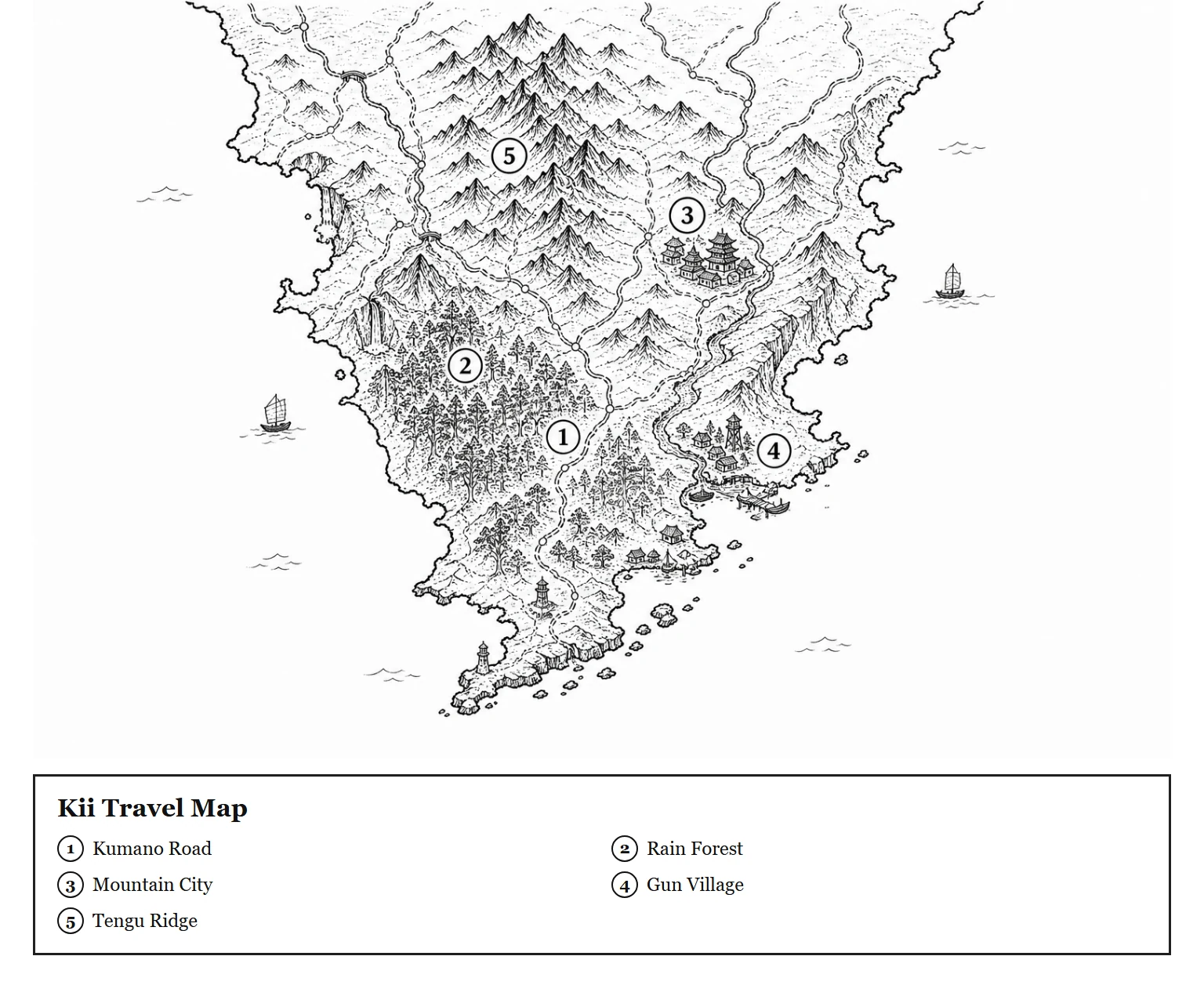
#The Road — The Third Day of Rain
From Pinto's diary. Five days since leaving Shikoku and entering the mountain road of Kii, the third day of rain.
The morning I left Shikoku, a black wall hung upon the eastern sea beyond the prow. To call it cloud, it did not move. "It is Kii (紀伊)," said the Tongue. "The land where the forest is deepest in this country."
At the harbor at the river's mouth I counted my road-companions. Nine pilgrims in white, two medicine-sellers, one salt-peddler, the three of our party and six porters — twenty-one. A number I noted by a merchant's habit, but the speed at which this number dwindled became, just so, the map of this land.
At the first day's fork the medicine-sellers slipped off onto the northern road. On the second day at the foot of the mountain two porters handed back half the wage that remained and went down. A porter who returns a wage I saw for the first time in this country.
"Why do you turn back?" The porter did not raise his head and answered shortly, and the Tongue carried it over. "From here on, they say, it is the mountain's."
From the third day the rain came. Rain that does not let up. The ink will not dry and the writing blots. The paper weeps, and I nearly wept too — on account of the ledger.
By the roadside shrines the height of a small child began to appear. They are called Oji (王子), they say. The pilgrims stopped and bowed at each, without missing a single one. There are ninety-nine along the road, I heard. I made to count them and gave it up — if I put even the time spent bowing into the reckoning, the reckoning never ends.
Only the sound of the bell on the pilgrim's staff was not wetted by the rain.
The Sword, since entering this mountain, has bound his sword to his back. When I asked why, he said only, "On this road one does not lead with the blade, I heard." That the Sword had listened to another man's words I heard for the first time.
In the evening we came to the mountain hut of the ascetics. As I dried my wet clothes by the hearth-fire, an old yamabushi (山伏) looked long at my face, then said something and laughed. The Tongue carried it over: "He says the mountain will be seeing a Nanban man for the first time."
That the mountain sees, I wrote down. My hand was numb and the writing crooked.
In the night, through the sound of the rain, something like the sound of a horn rang out. It is the hora blown on a conch shell, they say. When I asked who blows it and where, the yamabushi said it was "the sound of the mountain counting men," and the Tongue, having carried the words over, was without words for a while.
Before sleep I make the reckoning balance. Twenty-one at the harbor, seven at this hearthside tonight. The pilgrims went on ahead of us, and the rest turned back before entering the mountain. The deeper the forest grows, the fewer the road-companions — in terms of trade, it is the same as the way that the more dangerous the goods, the fewer the hands that handle them.
"In this mountain a god dwells." That is what the Tongue said today. By his manner I knew it was a word he said of himself, not an interpretation. Our God is in heaven, but the gods of this country have an address. They dwell — not as a tenant lodging, but as a master.
The mountains are deep, and gods are said to dwell there. For three days I heard nothing but the sound of rain.
Tomorrow we reach, they say, the god's house standing on a sandbar in the middle of a river. They called it Hongu (本宮).
#The Land of Fact — The Peninsula of Rain
#Forest and Rain
Kii is a mass of mountains that thrusts its head from the south of Miyako (Kyoto) into the southern sea. What might be called a field is only the narrow valleys of the northern riverside and the palm-sized gaps along the shore; the rest is all mountain, and the mountain is all forest. It is the land of most rain in this country, I heard — and as for the time I stayed, two days in three were rain, so I could find no reason to pare the saying down. The rain raises the forest and the forest calls the rain again, the mountain people say. The trees are straight and black and cover the sky, so that the forest road at high noon was like evening. This I saw.
The forest is this land's storehouse. Felled trees are floated down the rivers to the sea, and cargo-boats carry them to Miyako and Sakai. So too with charcoal. Unlike us, the people of this country call a good forest a storehouse and yet do not fell it carelessly — they bow before the tree they will fell, and pour wine over the place they have felled. The reason I set down in §The Land of the Uncanny.
And in this land's list of produce there is one line found in no other land. Charms. Charms of sealing, the mountain herbs that become the raw stuff of elixirs, the tools of asceticism — prayer beads and ritual implements and ritual robes — come out of this mountain and are sold to the whole country. A land where what is written with ink on paper becomes produce is, as far as I have seen, here alone. When I asked the price, the monk who sells them answered with a smile. "Efficacy follows not the price one names but the heart one uses." Let me say it as a merchant — goods sold that way are the dearest of all.
#The Pilgrimage Road — The Road Itself Is the Sanctuary
If Shikoku's pilgrimage circles the island like a ring, Kii's pilgrimage goes straight into the heart of the mountain. There is a road that circles the shore and a road that threads the mountainside, but on either the end is the same — Kumano (熊野). The road is harsh. The stone-laid slopes are covered in moss and slick, and the passes, cross one and two appear. And yet this road has something no other highway has. Order. The roadside Oji shrines run on like beads on a string, and the pilgrim walks moving his bows from shrine to shrine. If our road is a means of reaching the holy place, their road here is itself the holy place — the threshold, as it were, drawn out tens of ri long.
#The Three Gods' Houses — Hongu, Hayatama, Nachi
The god of Kumano has three houses. Together they are called the Three Mountains (三山), I heard. Hongu stands upon a sandbar where two rivers meet — they set the god's house in a place that floods when the great water comes, and when it floods they build it again, they say. Hayatama stands in the village at the river's mouth — which the people call Shingu (新宮) — the place where the pilgrim come down from the mountain first sees the sea again. And Nachi. Nachi's god is not a house but a waterfall. A single thread of white water falls from the mountainside, and from twenty cho (町) off the sound came out to meet me first — the sense of ri (里) and cho I leave to the Glossary & Weights and Measures. That white thread is seen even from the sea, and passing sailors slow their sails and bow. This I saw. We build the god's house and enshrine the god within it, but they add only a bow to the place where the god already is. Standing before the waterfall, one feels that reckoning was not mistaken.
#Koyasan — The City Upon the Mountain
In the north of the peninsula, in a highland basin that eight peaks ring like lotus petals, there is a city. It is Koyasan (高野山). A city with no fields — every grain of rice comes up from below the mountain on a man's back. Temples form the streets, and both sides of the streets are all temple gates. Pilgrims and travelers lodge at the temples. That temples double as inns I set down in another chapter too, but on this mountain the whole city was so.
At the temple gate the woman stops. On the outer road that rings the mountain there is a women's hall (堂), where mothers, they say, bow toward the side where their sons' temples lie and go back down. A tale I was told. Unlike us, the sanctuary of this country is closed not by a gate but by a line (線) — there is no wall, no bar, no spear to guard it, and yet none cross.
#People and Customs — The Road of White Robes
#Those Who Run the Mountain
White robe, black hood, a conch horn on the back — the yamabushi. Ascetics born on the mountain and grown old on the mountain, there is an austerity, I heard, of standing beneath a waterfall to pass the night, and of hanging head-down from a cliff's edge to question one's own sins. They do not sell prayer alone. They sell the road. They become the pilgrims' guides, carry over the passes the porters have given up, and at a village's request go to and fro between the things of the mountain and men. That my party crossed the mountain unharmed was half owed to them. The monks of our country cut themselves off from the world inside walls, but the ascetics of this country join the world upon the road.
On the mountain roads the monks one met were more than the peddlers. The monks of the esoteric teaching go up into the mountain, the monks of the Pure Land go down to the inlet villages — though they enshrine the same Buddha, the direction they go is opposite.
#Noble and Beggar on the Same Road
The white robe of the pilgrimage road is one with the shroud, I heard — a robe one can be buried in just as it is, should one fall on the road. That robe is the scale of this road. The noble lady who came borne in a palanquin gets down on the harsh stretches and walks on her own feet, and the leper and the beggar make the same bow at the same shrine. Unlike us, this country is a country where the line of rank is deep as a sword, yet upon this road alone that line is erased. Noble and beggar walk the same road — this I saw. An old pilgrim I met on the road said, "Before the gods, in forming a line, the crest of one's house was of no use." When it comes to standing in line, even I, a merchant, know something, and I set that word down long.
There is a village within the mountain where boiling water springs up, and the pilgrim, before entering Hongu, boils his body there and sheds the defilement. Our pilgrim confesses his sins and receives absolution, but their pilgrim washes his sins away — literally, with water. I saw, too, the nuns who beg alms with song upon the road spreading out picture-scrolls to show and preaching the efficacy of this road. This road feeds not only those who walk it, but those who make it walked.
#The Sea Where the Vast Thing Rises
I set down a tale I was told in an inlet village on the east of the peninsula. In their sea a vast thing rises, they say. Its back is like an island, and its breath pours down like rain. When it dies and is washed to the water's edge, it feeds the village for a whole season — the oil and the flesh and the bone, with nothing thrown away, they said. Only, they did not call it a windfall. They called it a thing the sea had granted, and after the flesh was taken they buried the bones and raised a small grave, they said. When at the hearthside a young fisherman said that one day he would gather boats and go out to take it, an old man shook his head. "One takes only what the sea grants." Which of the two will win — to a merchant's eye it was plain, but I do not set it down.
#The Land of Konsei — The Holy Ground That Bears Guns
#The Peninsula Without a Lord
This land has no great lord. The mountains are too deep and the fields too narrow, so it falls outside the reckoning of those who contend for the realm — so I set down at first. After half a month's walking I struck that line out. It is not that there is no lord; it is that other things sit divided in the lord's seat. The gods' houses and the great temples — that the monks of the Hiei League keep branches here and come and go I heard here too — and the villages that bear guns. The temple holds a storehouse, the storehouse feeds the warrior-monks, and the warrior-monks in turn guard the temple's line (線). That the realm's wars pass this peninsula by is not for the mountains alone. To strike here is not to strike one domain but to strike faith and mountain and gun all at once — to shorten into my own words a tale I was told, it comes to that.
#The Temples and Villages That Sell Guns
In a river valley to the northwest there is a great temple. Negoro (根來), I heard. The sound of the bell and the sound of the gun come from the same courtyard. The warrior-monks number in the thousands, they say, and within the temple precinct there is a forge, so that the hand that read the sutra in the morning shaves a gun-barrel at noon. When I said I had come not to buy silver but to look, the gate opened — the most valuable words I learned in this country. In the courtyard I saw the warrior-monks set their guns in a row and fire. A hundred pieces cried in one breath, and not a single pigeon took wing. It means the temple's birds are used to the sound. That was the most fearful of all I saw that day.
At the river's mouth there are the villages of the gun. Saiga (雜賀), I heard. There is a gun in every house, and the headmen of the village sit gathered and decide how many pieces to send to which battle. The lords' envoys come bearing silver and form a line. That the gunfire of Saiga sounded from both camps of the same pitched battle I heard from two men who did not know each other — a rumor heard twice I set at the end of the ledger, a rumor heard three times at the head of the ledger, and that is my law; but this one I set down at the head.
The teppo is a thing our ships brought into this country 40 years ago. That thing was breeding young at the foot of a mountain where a god is said to dwell. The feeling of one who sold the seed looking upon the field — there is no column in the ledger to set it down.
#A Strange Coexistence
At first the reckoning would not balance. On one side they enter the mountain barefoot to wash off defilement, and on the other side of the same peninsula they put a price on a thing that kills men and sell it. Yet as I walked, the two ledgers were one ledger. The pilgrims' alms and the trade in charms feed the temple, the temple's prestige guards the valley's calm, and within that calm the village of the gun strikes its bargains. The temple's gun will not take a war that runs against the teaching, they say — only, what runs against the teaching the temple reckons. The village's gun does not ask the cause but asks the price instead. Faith is the gate and the gun is the bar, as it were, and the gate and the bar did not find each other strange. The one who found it strange was I alone.
Editor's note: Saiga and Negoro are names of legend — they are not in the canon's roster of powers, and there are no numbers for them. Only, "Negoro" is the same name as the Negoro-ryu of the ninja schools. To bring these to the table as powers, borrow the frame of Powers of the Sengoku, and if you wish to treat the gun-bearing warrior-monks as a PC's school, read that Negoro-ryu together — this volume does not lean on that school, and sets down only the scene.
#The Land of the Uncanny — The Master of the Mountain
#An Ordered Darkness
In other lands I gathered tales of the yoma (妖魔) at every place where the road broke off — as I set down in the Overview. Yet in this mountain such tales are uncannily rare. The cairns by the roadside, and the shrines before the bridges, are fewer than elsewhere. At first I thought the mountain was clean. The yamabushi shook his head. "It is not empty; it is governed." The small things, he meant, cannot wander freely in this mountain — for there are the masters of the mountain.
Ask who the masters of the mountain are, and the answer that came back was all of a piece. Things that have wings, that wear the wind, that cannot bear the arrogance of men — the tengu (天狗). That the woodcutter bows before the tree he will fell, that there are valleys even the guides will not enter, are all the edges of that order. There are things that dwell in the trees, and in the deep ravine the old woman of the mountain dwells, they say, but that these do not come down as far as the road is because they watch the masters' faces, he said. A tale I was told — only, I heard the same tale at three mountain huts.
I set down a tale of trial too. A wandering warrior who, while borrowing the mountain to use it, made the master of the mountain a matter for jest was that night carried off by the wind, and after seven days was set down whole in a temple courtyard, they say. After that he does not bring the mountain's tales to his lips, they said. A tale I was told — those who say they saw that warrior are many. And there is one more tale that the old yamabushi at the hearthside told into the fire. Fifty years ago, the masters of the mountain sent an envoy to a temple of men, and the men's side drove it away, he said. "Since then the mountain does not speak to men first." In this country they also say that an arrogant monk dies and becomes a tengu — if so, that the mountain cannot bear arrogance might perhaps be because it is a sickness it suffered itself.
#The Guide Crow
The crow of this mountain is a god's messenger, they say. It alights before one who has lost the way and opens the road, they say, and it has three legs, they say. I saw that bird drawn on the pilgrims' packs and charms many times.
I set down my own tale. The day after I left Hongu a fog came down and I lost the road with my party, and on a rock a single crow sat watching me. It flew, alighted, looked back — and following it as I walked, in less than half a toki the sound of the bell was heard. That night the Tongue asked, "Did you count the legs?" I counted them. I do not set it down — at that time I was at the end of two days of sickness, and I cannot raise my own eyes onto the ledger. To set down apart what I saw and what I was told is my promise, but this one I cannot bring myself to set down on either side.
#The Mountain of the Dead
"When you reach Kumano, the boundary between the dead and the living grows thinnest." This word I heard many times upon the road. Among the pilgrims there are not only those who go to wash off defilement but those who go to meet the dead — if you sleep before the god of Hongu, the dead come in your dreams, they say. A tale I was told. That the face of the woman who said this was not sorrowful but bright, that is what I saw.
Koyasan goes one better. Within the city, in a forest of cedar that covers the sky, there is a burial ground. The dead of this whole country gather to this mountain, they say — people of far provinces wrap up the bones and hair of the dead and walk a road of months to climb up. There is a lamp that is said never to go out, and the graves of lords who in their lifetimes cut one another down stand side by side with a single road between them. This I saw. The city of the dead bustled more quietly than any city of the living. We lay the dead in a graveyard beside the village and the living keep watch beside them, but they gather the dead on a high mountain in the middle of the country and the living go to visit. Which of the two leaves the dead less lonely, I never managed to reckon to the end.
Go out the temple gate and down the northern pass, and the road enters the middle of the realm — Kinai. That it is a day and a little more from the city of the dead to the city of the living, this country does not find strange.
Editor's note: The council of the things Pinto set down as "the masters of the mountain" and their statutes are held by the Muhyeon Band entry in Powers of the Sengoku; the divinity of the three gods of Kumano and the authority of the "sacred road" are held by fc01 Chushin. The Heian prototype of the tradition that an arrogant monk becomes a tengu is in fc04's mountain chapter. And how this mountain comes to be counted among the candidate sites of a Spirit Realm rift, see the rift-candidate entry in the chronicle of the Sengoku — the campaign where the pilgrimage road is sealed off begins there.
#At the Table
Scene Tool. Only this section is a GM scene tool.
The scenes of Kii have four handles. Trial — if someone in the party shows arrogance, the mountain answers. Escort — keeping a road bound by a taboo of blood to the very end. Hire — the bargaining over guns, the tug-of-war between cause and price. Taboo — a party carrying something that cannot be brought into the sanctuary. This land's scenario-hook d10 and yoma encounter tendencies are already in the canonical Lands of the Sengoku — this volume, so as not to overlap, adds only three tales of the pilgrimage road and the gun. For small events to roll on the road, open Incidents of the Road.
The Pilgrimage Bearing Defilement. A client of high rank goes up the pilgrimage road to wash off a defilement — be it a curse, or blood spilled by his own hand — and the party is his escort. But there is one rule on this road. The one who has made blood flow, the road does not receive. Those who pursue him know this too, so they wait only where a sword can be used — at the ferry, on the side-paths off the road, on the road back after the pilgrimage is done. It becomes an escort fight won without drawing the sword, and the masters of the mountain watch over that restraint. If no blood was seen to the end, then before the Nachi waterfall, along with the scene of the client's defilement being washed away, reveal the true nature of that defilement.
The Bargaining over the Price of Guns. The envoys of two lords at war with each other arrive at the gun village on the same day, and the party is the bargainer for one side. The price is not settled by silver alone — the temple's gun weighs the cause, the village's gun weighs the reckoning. The other envoy's interference, the contriving of a cause (if a fabricated cause is exposed, the gun-muzzle turns), and the escort after the bargaining is done — three scenes come out without fighting even once.
The Apostate Gun-Captain. One of the temple's gun-captains broke his vow and vanished. The temple says to bring him back, and a certain lord seeks to carry him off first. He wears a white robe and hides among the pilgrims, going south down the pilgrimage road. On the road no blood can be seen, and the people on the road do not ask one another's histories. When the party at last finds him out, what is revealed is — not what he carried off in flight, but what he refused to make.
On a mountain where a god is said to dwell, men were selling guns — even now, two years gone, I have not settled which of the two was the stranger ware.