#Incidents of the Road (旅路の事件)
Contents
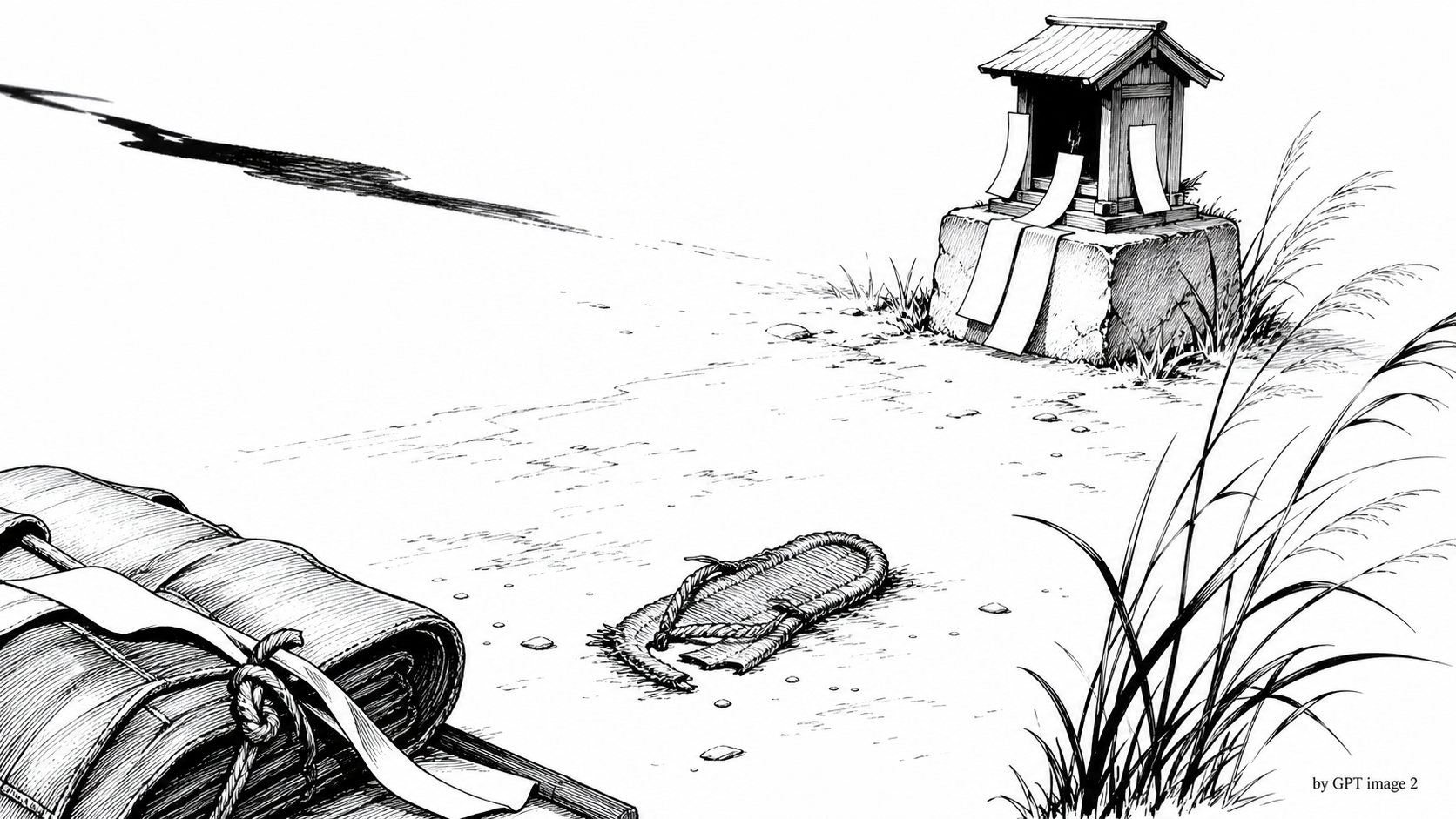
Authority. This document is a Scene Tool — the one document in this volume made, from beginning to end, to be spread out on the table. Only the diary excerpt at the head is Fiction-Only. The tables are the material of a scene, not Law (法) — this volume has no numbers, and if you need a roll and a target value, you go to the canonical Non-Combat Rules. The promise of this whole book is in About This Book; the one who wrote this diary is in The Narrator.
#The Road — The Reckoning of the Inn
From Pinto's diary. An inn before a great river — the second night, bound by rain.
The river had risen and the crossing was closed. To drain the water, some say two days, some say four. The boatman's reckoning and the innkeeper's reckoning differ, but the more the bound days mount, the one who profits is the innkeeper, so I resolve to buy the boatman's reckoning.
The inn is full. Two salt-peddlers, three pilgrims, one horse-trader, one warrior who would not say where he was going, and our own party. Travelers bound by rain stack up like sacks of grain — and unlike sacks, they have mouths.
Having nothing to do, I opened my ledger. Since I came ashore, the roads worth calling a journey number some twenty-odd. Counting them up, one strange reckoning comes out. In every journey there was, without fail, one "matter" worth setting down in the ledger. That there were two has been rare — that there were none, not once.
When I told that reckoning to the Sword, the Sword answered without lifting his eyes from the whetstone. "To wish that nothing befalls on the road is the same as a seaman wishing for no wind."
"Is the ship not at ease when there is no wind?"
"When there is no wind, the ship does not go."
The Tongue cut in, laughing. "It is so as not to be set down as a 'matter' in your lordship's ledger that everyone waits out the rain so meekly."
By the hearth a tale was going round. It is the law of an inn bound by rain, they say — the drink you buy and drink, but the tales you put out for one another. Were it us, we would have charged the price of the tale on top of the price of the drink.
It was the turn of the old salt-peddler. In his youth, on some pass, he met a pilgrim who asked to walk along with him, he said. They walked three days together, a man who laughed well and walked well, but only after they parted at a fork did he realize — for all three days, the bell on that pilgrim's staff had not once rung.
"You mean he was not a man?" the horse-trader asked.
"If that is what you ask — I do not know." The old man drained his cup. "Only, ever since, each time I cross that pass I leave a rice-cake behind. The twentieth year now — on that pass there has not once been a matter."
A tale I was told. Only, that at the tale's end the old man drew a rice-cake from his breast and showed it — that I saw. He said it was for the pass he would cross tomorrow.
The warrior never put out his own tale. Instead, when he left, he paid the drink-price of two men. The price of a tale, he said.
The night having deepened, I lay down and set down the rest of today's reckoning. The travelers of the inn were ten, and the tales put out by the hearth were ten. One to a person — the road is neither generous nor stingy.
Tomorrow, if the water drains, we cross the river. What waits on the road across, I do not know. Only that, whatever it is, one thing waits — that alone two years' worth of ledger guarantees.
Editor's note: The tables of this appendix are not Pinto's writing. From six bundles of diary the editor culled the incidents of the road and wove them into tables. The single line of twist appended to each cell came from the closing sentence of the diary that set down the same incident — the narrator did not know the tables, and the tables are in debt to the narrator.
#1. Operation — One Incident per Journey
The other chapters of this volume are writing to be read; this appendix is a table to be rolled. Only, before you roll, receive one principle first.
One incident per journey. Do not roll travel by the day — roll by the day and it is not the road that lengthens but the table. As Roads and Travel said, travel is shortened to its joints: the scene of departure, one incident on the road, the scene of arrival. To choose that one is the work of this table. As Pinto's ledger testifies, the road is neither generous nor stingy.
When do you roll. Choose, of three moments, the one that suits the table.
- Before departure. The way of the GM rolling ahead of time. You can bury the incident in the middle of the journey and reckon in foreshadowing and weather besides — it is a roll that becomes preparation.
- When crossing a border. A pass, a river, a barrier, a frontier — the joints of the road are the joints of incident. Roll on the table and the sound of the dice becomes the very sound of crossing the border.
- At camp and lodging. Roll at the place that closes a day, and let the incident come at night — or the next morning.
Which table do you spread. The road decides — a highway, the highway's table; a mountain path, the mountain path's table; aboard a boat or by the water, the sea-road's table. If one journey passes through all three, you do not roll the table three times but roll only the one table of the road walked longest. One incident per journey.
Use the diary as a door. Before you draw out the incident, read aloud a fragment of the narrator's diary — the §The Road at the head of each observation chapter — and the door of the scene opens in the narrator's voice. Reading out the rolled cell as "the Nanban Brush would have set it down thus" yields the same effect. If the same number comes up twice, do not take back the same incident — the next chapter of that incident has arrived.
The twist is a handle, not a duty. The single line of twist appended to each cell, if you do not adopt it, is simply that, and then the incident is merely a matter of the road. Even adopting it does not settle it as a yoma — most of the encounters of this country end at a sign. The twist becomes truth only at the moment the GM decides it does, and until that moment leave it, like the narrator's diary, with fact and misunderstanding mixed.
#What This Table Holds and Does Not Hold
- What befalls on the road — this document holds.
- What you fight — the canonical Yoma Encounter Table holds. If an incident calls the Sword, you go there. No cell of this table compels combat.
- The roll and the target value — the canonical Non-Combat Rules hold. This document has no numbers.
- Incidents where the cargo is the protagonist — the trade events of the canonical Trade Rules are separate. If the cargo is the protagonist, that side; if the road is the protagonist, this side.
- The Scent and grain of the road — Roads and Travel holds. That side is Scent, this side is table.
- After the twist becomes truth — the scenes of the things that wait at passes, forks, and bridges are held by Village, Road, and Mountain Yoma.
#2. Incident Tables — Three d10s
A cell is, at most, a sentence or two — the name and the circumstance, and one line of twist. The rest the table fills in. The sense of a hankoku (半刻) of time, of half a day, of a ri (里) and such, is left to the Glossary & Weights and Measures.
#Incidents of the Highway (d10)
| d10 | Incident | One line of twist |
|---|---|---|
| 1 | The paper falls short. The barrier's clerk finds fault with one line of the transit pass — that the seal is old, that the head-count of the party differs from the document. Document, money, time — which of the three to pay with, the party chooses. | The traveler in the next row who got the same fault passed too easily — who wrote out the paper he held out? |
| 2 | A procession comes. The spear-points are seen first, and everyone on the road prostrates. For the daimyo's procession to pass entire, one hankoku — to a party pressed for the road, that hankoku is the dearest tax. | The blind of the palanquin lifts for a moment — and the eye that looked out from within recognized one of the party. |
| 3 | A companion in white. A pilgrim hung with a bell asks to walk along only as far as the next pass. With a road-fellow more, the night is less fearsome and tales increase too. | The straw sandals are too new, and in the gait remains the cadence of one who wore a sword — the white of pilgrimage is also a garment that erases rank. |
| 4 | There is no bridge. The bridge that stood until yesterday has collapsed in the flood. The ferry is a calling price, the ford across the shallows a price the cargo and the rudder decide, waiting for the water to drain a day in the inn's keeping — a three-way haggle of time and money and danger. | The boatman is sparing of words — there was, they say, a party that crossed last before the bridge came down. |
| 5 | The courier's request. A courier who has sprained his ankle sits by the roadside. One letter, only as far as the next post-station — the pay, he says, the post-station will settle. A courier's letter is heavy in proportion as it is swift. | The crest (紋章) of the seal is not of the land ahead on this road but of the land the party departed just now. |
| 6 | A village strung with rope. At the village mouth a sacred rope hangs and charms are pasted. Plague, they say — the village neither takes people in nor lets them out, and the detour is half a day by mountain path. | After the sun has set, within the village a single lamp is seen going house by house in turn — though no house opens its door to it. |
| 7 | The rumor that silver goes. Everyone on the road says a silver train goes in the same direction. At every inn it is that tale alone, and the bandits will have heard that tale too. | Trace the rumor up and the source is the train itself — the real cargo goes by another road, and this road is the lure. |
| 8 | A levy with spears. A unit on the move blocks the road and levies porters and horses. A single military scrip is the whole of the price, and to protest you must haggle with a spear-point. | The levying officer looks long at the face of one of the party — "I have seen that face somewhere." |
| 9 | A past coming from the opposite side. The enemy of the party — or of the guard they hired — walks up from the opposite side. That side too has a party, that side too is in the middle of work. | The people on the road do not ask one another's history — the side that breaks that courtesy first turns the whole road into an enemy. |
| 10 | Money that splits. Having crossed the frontier, the money has weakened. The copper coins are taken by sorting and the silver they would weigh out, but the money-changer's scale and the party's scale differ. | The money-changer picks up one coin and his color changes — "This money, where did you take it?" |
#Incidents of the Mountain Path and Pass (d10)
| d10 | Incident | One line of twist |
|---|---|---|
| 1 | Fog. An inch ahead is erased and the party's intervals open out. There is nothing for it but to walk counting one another by voice. | At the crest of the pass, counting heads, there is one too many — counting again, it tallies. |
| 2 | The same rock. The road is lost. You pass again the rock you passed before — up to twice, anyone blames a miscount. | The third time you pass, on the rock is heaped a cairn that was not there before. |
| 3 | The mountain's barrier. Bandits block the road — only, not by the sword but a toll. They too must get through the winter, and the haggle works. | The chief, in place of the price, puts in a request — only one letter to a village down the mountain. The name of the receiver is somehow familiar. |
| 4 | An empty shrine. The shrine at the crest of the pass stands empty, its roof fallen in. A good place to wait out rain and light a fire. | Whether it is empty for being abandoned, or empty because what was enshrined has gone out — sleep inside and you will know, the people of the village below say. |
| 5 | The matagi's hand. A hunting band coming down the mountain raises a hand in silence and blocks the road. Do not cross this pass today, they say — the reason they do not say. | Among themselves they had been using the tongue of the mountain — the tongue of the mountain is a tongue used when there is an ear to hear. |
| 6 | A dead horse. A pack-horse lies fallen by the roadside. The load is untouched, just as it was — the owner is nowhere. | Undo the load and the things of worth are all there, only the charm that should have been pasted to the sedge-hat is not there, not a single one. |
| 7 | A pass whose reckoning was off. You can make the crest, but before the descent the sun sets. Turn back and you throw away half a day; sleep at the crest and you sleep with the wind; go down in the dark and — the night road is not a thing that compels but a thing that makes you choose. | Short of the crest a single light is seen. It is in a place too high to be a mountain hut. |
| 8 | A road broken down. A landslide took the road away entire. The detour on the cliff side is swift and dangerous, the detour on the valley side is slow and — the valley is not a road. | From beneath the fallen earth an old stone stairway has come to light. It is a road not in the porters' memory. |
| 9 | The kindness at the fork. Someone is standing at the fork and points out the road for you — before you ask, too kindly. | The road pointed to differs from the porter's memory. There is a saying in this country that ask the road at a fork and the road answers — and a saying, therefore, that one does not ask. |
| 10 | Early snow. Snow closes the pass. At the nearest mountain hut, three days waiting for the snow to cease — three days of provisions and firewood and fellow-lodgers. | On the morning of the second day, footprints that went once around the hut are on the snow. They are barefoot, and they did not go back the way they came. |
#Incidents of the Sea-Road and the Water's Edge (d10)
| d10 | Incident | One line of twist |
|---|---|---|
| 1 | Waiting for wind. A gale has bound the boat. The harbor's inn is full and the seamen watch only the sky — whether it be a day or seven days, the sky decides. | One traveler waiting for the same boat does not watch the sky — he watches only the way that comes in to the wharf. |
| 2 | The banner of the sea. At the mouth of a narrow channel a swift boat overtakes you — the navy. Pay the price of the banner and an escort and a pilot are attached; do not pay and — of the boats that did not pay, few have heard the tale. | The navy says it will take, in place of the price, a request. Only a word to a certain house at the next harbor — the word is short, and the meaning does not come to hand. |
| 3 | An object of unknown origin. On the shore a chest has washed up. It is of no harbor's making, and the letters carved on it are neither the Nanban script nor this country's script. It must have steeped in brine for years, yet on the iron fittings there is not one speck of rust — the people of the shore-village do not go near. | It is not that the one who picks it up becomes its master, but that it chooses its master, says the oldest fisherman of the village. |
| 4 | The sound of oars in the fog. In the fog the sound of rowing oars comes along abreast. Call and there is no answer; quicken on this side and it quickens together. | The seamen, though no one asked, begin a song — and toss, in silence, a single bottomless ladle into the sea. |
| 5 | The pilot's price. A mouth where the tide flows like a river — water you cannot enter without a pilot, yet his fee has become double last month's. | Ask the reason and they all turn their words aside — last month, one pilot vanished at the mouth together with his boat. |
| 6 | A seat taken away. A guest who paid extra took the boat-seat that had been promised. The next boat is three days off — the captain is not even sorry. | The guest who paid extra has no cargo. What he bought was not the seat but the three days the party cannot board that boat. |
| 7 | The shore-village's sacred rope. The village has strung a sacred rope toward the sea and puts out no boat today. A rite, they say — to leave, you must walk half a day to the next inlet. | It is not a rite but a day of sending back, a child blurts out — what came up in the net yesterday can only be guessed at from the speed with which the grown-ups stop the child's mouth. |
| 8 | A switched chest. Off the boat, undoing the load, one chest is not the party's — the same size, the same cord, inside it is stone. | The weight of the stone is exactly the same as the original load. It is the work of one who knows the scale — and of those who knew the weight of the party's load, there were not many on that boat. |
| 9 | A person in the hold. From beneath the matting a stowaway comes out. What he would offer in place of the boat-fare is not money but — which door of which storehouse of which harbor opens on which night. | He grows the less talkative the nearer the harbor draws. What he is fleeing from is not behind, but ahead. |
| 10 | Too good a wind. The fair wind is in its third day. The travelers laugh, but the old seamen do not laugh — a borrowed wind, they say, must be repaid. | At dawn of the fourth day, the captain casts a single piece of cargo into the sea in the middle of it. Whose cargo it was, it is better not to ask. |
#3. Regional Seasoning Tables — Same Incident, Different Flavor
Even when the same number comes up, a different land is a different incident. Cast the line of that province over the rolled cell — the ten observation chapters of this volume are the storehouse of that flavor.
| Region | In that land |
|---|---|
| Saikai | In any incident, let a Nanban good be involved and price and suspicion rise together — if there is an outsider in the party, the party is not the onlooker of the incident but the spectacle. |
| Sanyo and Sanin | To Sanyo's incidents the smell of silver clings — count entry 7 of the highway table double. The incidents of the Sanin-side roads come in by hearsay (傳聞) — try beginning with "I could not take that road." |
| Shikoku | On every road white robes are walking — entry 3 of the highway table is twice as frequent. Why they circle the island in the same direction, the tales told are several. |
| Kii | The incidents of the mountain happen before the eyes of the mountain's master — even the bandits keep the taboo, and whoever it is that draws blood on the road, the mountain sets down the reckoning first. |
| Kinai | The roads are short and the gates many — incidents are born not of terrain but of people, and behind any incident lie both the temple's ledger and the lord's ledger. |
| Omi | The lake is the highway — the incidents of the highway are born aboard a boat, and the incidents of the sea-road are born in a village at the water's edge. And wherever you land, the merchant of that land has come a step ahead. |
| Tokai | The road is good and everything is swift — count entries 2 and 8 of the highway table double. That the road is good means the army, too, is fond of that road. |
| Hokuriku and Shinetsu | The season is half the incident — in winter, append snow to the back of any cell. Snow erases the road, and an erased road raises the price of one who has the road by heart. |
| Kanto | The plain is broad and the horses swift, and the incident catches up to the party — rumor too and pursuer too ride horses. The rivers grow wider, and the bridges rarer still. |
| Ou | Throw away half the cells of the barrier and the post-station — their place is taken by winter and the mountain. And in this land, the line of twist may be not a twist but simply fact. |
The road puts out only one tale a day — the day you receive two is the day you must repay one of them.