#Observation of Tokai (東海見聞)
Contents
Authority. The main text is Fiction-Only — the observation of one outsider, in which fact, rumor, and misunderstanding are mixed. Only "At the Table" at the end is Scene Tool. This volume has no Law — if you need numbers, go to the canon
co. The promise of this whole book is in About This Book; the one who wrote this diary is in The Narrator.
The old provinces covered — Ise (伊勢) · Shima (志摩) · Owari (尾張) · Mikawa (三河) · Totomi (遠江) · Suruga (駿河) · Izu (伊豆). Mino (美濃) is a province belonging to the eastern mountain road (Tosando), but the journey grazed its edge — the table of assignment is held by the Cross-Reference.
Place in the journey — the seventh observation. Coming in over the pass from Omi — the Country of the Lake, and setting out for the mountain road of Hokuriku and Shinetsu — the North Country.
#The Road — The People Who Use the Same Road
From Pinto's diary. Some ten days after leaving the country of the lake and crossing the pass, upon the eastern sea-road.
Before the sun rose, the road had woken first. When I opened the shutters of the inn, the sound of bells passed through the dark. Not one but dozens.
"Pilgrims," said the Tongue, suppressing a yawn. "They go to Ise. Before the sun rises they would earn a ri (里)."
White robes and woven hats, a bell at the tip of the staff. There were the old, there were children, there were those who limped. Our pilgrims walk to atone for sin, but the pilgrims of this country — to my eye — walk as though going to a feast. They sang as they walked, and the refrain of the song was the name of a god.
The old woman of the teahouse said, setting down steaming rice-cakes, that she gives the pilgrims a discount. "They say if you are stingy with a guest bound for the shrine, the god sees it." Her reckoning I set down in my ledger — a discount that draws in a god is not a discount but a lure. The rice-cakes were good.
At high noon a drumbeat sounded. The dust at the road's end was seen first, and after that the spear-points.
The Sword silently pulled my sleeve and lowered me to the roadside. "Do not count the column," he said. "The eye that counts does not last long, they say."
It was an army. Spear-points passed like a forest. Horses passed, laborers bearing sacks of rice passed, and at the very rear a banner passed — a crest I did not know. I wished to ask, but resolved to buy the Sword's counsel instead.
A merchant's eye counts without being bidden. I was counting the spears inwardly, but stopped before I passed a hundred. A number not counted cannot be inflated either.
While the army passed, the pilgrims lay prostrate at the roadside. Only the bells rang now and then, of themselves. The soldiers gave the sound not so much as a glance.
When the tail of the column vanished, the road soon filled again. As water parts and joins back together, not even a trace remained. The pilgrims sang again, the peddlers hawked again, the old woman steamed rice-cakes again.
"They use the same road," said the Tongue. "The one who goes to the shrine, and the one who goes to the battlefield, and the one who goes to trade."
"Is the road not enough?" I asked.
"The road is enough," the Tongue answered. "What is not enough is the road's peace."
The inn that evening was lively. Few were those who spoke of the day's army; many were those who spoke of tomorrow's weather and the price of rice-cakes. Custom is the most commonly worn armor in this country.
I set it down in my ledger. The busiest road in this country is the eastern sea-road. The better the road, the more often armies pass. This I saw.
#The Land of Fact — The Eastern Sea-Road and the Sea of Rice
#The Busiest Road
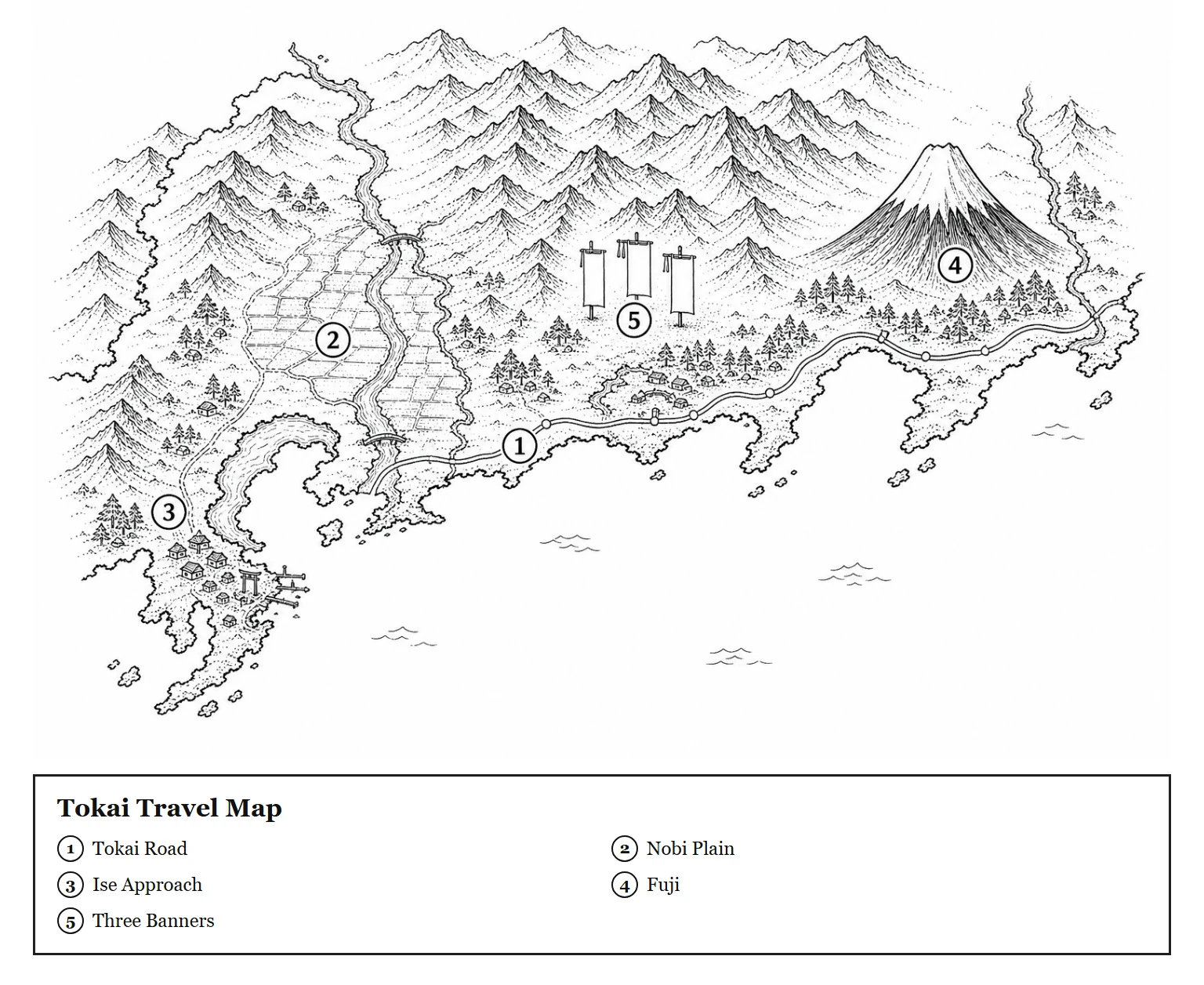
The great road that runs from Miyako (Kyoto) east toward the eastern plains is the spine of this region. Keeping the sea on the right, east and east — that it is the busiest of the seven roads I set down in Roads and Travel, and having come and seen it, the word "busy" fell short. Pilgrims and peddlers and post-riders and armies are upon one road, and post-towns are strung along the road one every few ri. Each town has its teahouse, each teahouse its boast of a famous rice-cake, and each rice-cake its boast. Whether the road feeds the trade or the trade feeds the road, I could not in the end tell apart while I walked.
The mouth by which one enters Ise from the country of the lake is the pass of Suzuka (鈴鹿). That a single pass eats a day is the same on any pass, but this pass, I heard, takes its price with a robber's name added on as well. We met no one — a tale of meeting no one yields no profit even set down in the ledger, so I cut it short here.
The hard passage (nansho) is the river. Between Totomi and Suruga, the Oigawa (大井川) has no bridge and no boat. The men of the riverside villages carry people across on their shoulders, and the fare is decided by that day's water — so much to the knee, so much to the waist, double when it reaches the armpit. Arriving after the rain, we lodged three days at the riverside waiting for the water to fall. The innkeeper had the air of one glad of the rain. The reason is just as I set down in Roads and Travel — because rain binds the traveler in place. Among the passes there is one where, they say, the stones cry by night — they called it Sayononakayama (小夜の中山). We crossed it by day.
#The Nobi Plain — The Sea of Rice
7-tenths of this country's land is mountain, I heard. So when one meets a plain like this, the eye rests first. Passing the coastal plain of Ise and turning north, the mountains withdraw and the plain opens like a sea — taking the "no" of Mino and the "bi" of Owari, it is called the Nobi (濃尾) plain, I heard. Paddies stretch to the horizon, and great rivers part the plain and enter the sea. The northern half across the river is Mino — a province belonging to the eastern mountain road, so I only gazed at it across the water.
How much this plain yields. From the one province of Owari the rice exceeds five hundred thousand koku, I heard — I did not count it myself. Ise rivals it, I heard, and Mino across the river does not fall far below either, I heard. How much rice a koku (石) is, one need only keep the Glossary & Weights and Measures at hand; cut short to a merchant's reckoning it runs thus — a plain of this size is rare anywhere in this country. And what is rare, in this country someone will surely take up a sword to covet.
#Fuji — The Most Beautiful Mountain in the World
It was the morning I entered Suruga. The road bent as it came out of the coastal pine wood, and at the end of the bent road — a white mountain stood cutting the sky.
I stopped my steps. The porters did not stop. To them it was a mountain seen daily; to me it was a mountain seen for the first time in my life. The summit is snow, below the snow it is blue, and the mountain stands alone, lending its shoulder to no other mountain. I have set down many a tale of mountains in this diary, but I set it down anew — Fuji (富士) is the most beautiful mountain in the world. This I saw.
Sailors know their own position by this mountain from far out at sea, they say. Where the plain is wide, the mountain follows however many days you walk. Half the reason one finds it hard to lose one's way on the roads of this region is this mountain.
#The Sea Side — Harbors and Capes and the Peninsula
Wherever the plain meets the sea there is a harbor. Boats laden with rice and timber and pilgrims ply busily within the bay (wan), and the great sea beyond the bay is rough, so the boats crawl along the shore. It is not, I heard, a sea of navies that sell banners as the Seto Inland Sea is — here it is not man but the wave that sets the boat-fare. And the old folk of the inlets hold one fear older than the wave — that in a great shaking in their father's day the water withdrew a long while and came back like a mountain and swallowed the shore village. A tale I was told. That when the water withdraws you should not gather but run for high ground is the first reckoning the children of this shore learn, they said.
Beyond the eastern cape of Ise is Shima (志摩). The fields are narrow, so the sea is the field, they said. On the shore I saw women enter the water on a single breath and bring up abalone — this I saw. The country where the one with the longest breath grows rich must be here alone.
East of the sea of Suruga, the peninsula of Izu (伊豆) enters the sea mountain and all. There are many valleys where hot water wells up, I heard, and the islands off it are islands to which criminals are sent, I heard. I went only as far as the mouth of the peninsula — because there my road turned north.
#People and Customs — Once in a Lifetime
#The Ise Pilgrimage
Ask the people of this country where they wish to go, and the same answer comes back, high and low alike, I heard — Ise. To bow at the shrine once in a lifetime is the dream of the farmer and the dream of the maidservant, and by the tale I was told, the dream of the robber too.
The cost of the dream is paid by the village together. Each village gathers a fund and draws lots, and sends a few each year as representatives, I heard. The chosen one walks bearing the prayers of the whole village on his back, and on returning bears charms and matter for tales as many as the village's heads. One walks and a hundred bow — a reckoning. That a country sets up a proxy even for prayer, I, who make my trade of proxies, cannot but salute.
I heard something stranger still. A servant or child who slips away unknown to the master and sets out on the pilgrim road, they say, there is a custom of not punishing even on return. That going to the god is not flight, is the reasoning. Were it us, we would have reckoned the days the hands were empty and docked it from the wages — yet the masters of this country close the ledger before the god.
#The Onshi — The People Who Sell the Pilgrimage
In the town below the shrine there are houses that make a trade of the pilgrimage. They are called onshi (御師). In winter they go round the provinces handing out the shrine's charms and almanacs, set down in a ledger who in which village is their own customer, and when that customer comes to Ise once in a lifetime, lodge and feed him at their own house and guide him as far as the shrine. They offer the prayer in his stead, receive and convey the offering, and send the departing customer off with, on his back, even the rumor they will sell next winter.
I met, for the first time in this country, a trade I wished to learn. They do not sell faith — they sell the road that goes toward faith. The price of the road is, in any country, a safer trade than faith. When I asked at the onshi's house where I lodged to be shown the ledger, the master smiled and declined. He who shows no one his ledger is the true merchant. That this ledger must be the longest ledger in this country, I set down in earnest.
#The Towns of the Highway
The towns of the highway live leaning upon the road. At dawn they hire out porters and horses, by day they sell rice-cakes and tea, by evening they sell a bed. Before the inns the young girls pull at the travelers' sleeves and cry the boasts of their own house, and the sound was so quick and high, like the cry of birds, that even the Tongue could not carry all of it over. Unlike us, the highway towns of this country have no wall — the village's wall is the traveler's footfall, and the day the footfall ceases is the day the village falls.
#The Farmers of the Plain — The Cost of Plenty
If the plain is rich, are the farmers rich too? Cut short, the answer of the several days I went about asking — no. The richer the plain, the more often the banner changes, and each time the banner changes the granary opens once. They take away the rice, lead off the men to build a castle, drag away the horses. I heard a tale, too, that before autumn even came they cut and carried off the green rice — a tale I was told. The rice that would go into the enemy's mouth they burn, they say, even if it is the rice of their own paddy.
Still the farmers do not leave the plain. It is partly that they cannot leave, but the words of an old farmer the Tongue carried over to me were these. "The plain does not lie. Only people do." I wavered long over whether to copy this saying onto the first page of my ledger.
#The Land of Konsei — Three Great Banners
A plain that yields rice and a road that people travel. Both of the two things the warlords covet are in this region. So in this region the presence of warlords is thicker than anywhere. In no land of my journey did I step aside from armies so often, nor pass through barriers so often. There was a day I passed three barriers in one day — this I saw. When one road has three gates, it means that road belongs to no single man.
Every teahouse told the same tale. That three great banners stand facing off over this plain and this road. One from the west of the plain, one from the eastern sea-road, one from the mountains to the north — so I heard it, and heard it again with the places swapped about. What the crest of each banner was, each teahouse told differently too. I do not set down the names. By the time I leave this country one of the three might already be gone, or there might have become four. To set down a banner's name in the ledger is the same as setting down yesterday's exchange rate.
Editor's note: Which house each of the three banners is, this book in the end does not set down — for the same reason as the narrator's excuse. Fix the year of the table, and the names of the banners fix themselves. The "present" recommendation of the Sengoku Chronicle is that seat, and the hand that fills in the banners is the GM's.
With three banners, the castles cannot be counted. On every low mountain rising in the plain there is a castle, and where mountains run short they heap up earth and make a mountain. I saw, too, a temple girt with a moat. When I asked the Tongue whether it was a temple or a castle, the answer was short. "In an age of chaos they are the same word."
There is something to set down anew about the road as well. At the end of the road-chapter I set down that "the better the road, the more often armies pass." It must be read in reverse. It is the lord who makes the road, and the lord makes the road not for the merchant — but to move his own army quickly. It became good because it is a road armies must often pass, and the trade merely borrows the road to use it. He who borrows to use must always reckon the day the one who lent it closes the gate. Let the rumor of war arrive and the barrier closes, and when the barrier closes this busy road dries up overnight — that reckoning is just as I set down in Roads and Travel.
There are many ears too. The old woman of the teahouse asked much. Where do you come from, where do you go, did you see warhorses on the road. Three days later at another teahouse I received the same order, the same questions. Half the old women's questions I can now make out without the Tongue — the words I have gathered on the road come to that much. On this road even an old woman is someone's ear. A tale I was told — I would write, but it was I who received the question.
And I passed a burned village. The pillars had become charcoal and ash floated on the well. The people did not abandon the village; they were raising new pillars beside the ash-heap. A ruin with the sound of a hammer I saw for the first time. This I saw. The people of this plain live war like weather — they avoid it, endure it, and on a clear day build again. The one point unlike the weather is this. That war is something people can stop — yet when I brought up that talk, the Tongue chose not to carry it over.
#The Land of the Uncanny — Outside the House of the God
#The Ise Grand Shrine
The closer the shrine drew, the more the white robes upon the road increased. The last day, the whole road was a pilgrim's procession. At the Isuzugawa (五十鈴川) that flows before the shrine the people washed their hands and rinsed their mouths, so I did likewise — the river water was cold and clear, and after washing it truly felt as though something had been washed. I have set down before that a merchant's faith is exchanged at every harbor. The rate that day was not bad.
The wood was dark. Old cedars of several arm-spans covered the sky, so that at high noon the road was in the light of evening. And — those bustling, noisy people grew quiet on entering the wood. It came about with no one bidding it. I saw one who walked gripping even his bell so it would not ring.
The house of the god is not shown. There is a fence, and within the fence another fence. The people prostrate themselves and bow before the gate of the outermost fence, and a white cloth hung over the gate made all hold their breath each time the wind lifted it. What is seen beyond the fence is only the roof — a thatched roof with gold ornament set on it like horns. It is not that I, an outsider, could not see it. The people of this country too, almost all of them, bow outside it their whole life and return.
When I asked what dwells within, the Tongue declined an answer for the first time. The onshi said only that there is a mirror — not the body of the god, but that which reflects the god. A tale I was told. I asked no further. That it was a seat one cannot ask of, the wood taught first.
I had been gripping the cross at my breast. That I had been gripping it, I knew only after coming out of the wood.
#The House Built Anew Every Twenty Years
Beside the house of the god there was an empty lot of exactly the same size. An empty lot spread only with white gravel, the broom-marks sharp upon it. When I asked what was to be built there, the onshi answered. "It is the lot of the next house. Every twenty years they pull down the house of the god, and build it anew, just the same, on the lot beside it. The god moves to the new house."
I asked again and again for a good while. Why pull down a house not even grown old? Why build with such care a thing to be pulled down? We build the house of the god in stone — to last a thousand years, to be built once and be eternal. The people of this country build the house of the god in wood and pull it down and build it anew every twenty years — so that it is forever new. The Tongue carried over the onshi's words. "The new lasts longer than the eternal."
This I set down as the custom I least understood on this journey. And I set down too that — not understanding it, I lost. A stone house a thousand years old is a house a thousand years old. A house that stands anew every twenty years is, whenever you go, a house just built. Which one's god would be the younger?
#Atsuta — The Wood That Enshrines a Sword
On the coast of Owari, between the plain and the harbor, there is an old wood, and within the wood is the shrine of Atsuta (熱田). A sword that came out of the tail of a great serpent is enshrined there, I heard. It is the sword a god offered to his sister, some say; it is the sword that mowed the grass and turned back the flames, others say — the lore differed a little at each seat where I heard it. The sword is not shown. It is the same as the mirror of Ise — this is a country that, the more precious a thing is, the less it shows it.
Warriors bound for the battlefield stop and bow and go. When I asked whether they bow to the sword or to the god who holds the sword, the Sword, who had been silent all along, broke in for the first time. "They are the same thing."
Editor's note: The inside of the shrine fence and the sword of Atsuta — where the narrator stopped, this book stops too. The Scent and the Law of the one who dwells within the fence are held by The Imperial Gods of Japan, and the substance of the sword-lore is held by the Existing Divine Artifacts. What it was the narrator felt in that wood — that, too, is set down there.
#Fuji — The Mountain That Holds Fire
Fuji is a mountain one looks at and at once a mountain one prays to. The mountain itself is a god, I heard — the shrines at the mountain's foot have their main halls standing toward the mountain, and in summer people in white robes climb to the summit, they say. In the old days it spat fire, I heard. The god has fallen asleep, some say; he is catching his breath, others say. Once I knew that snow covers a sleeping fire and that is why it is so white, a handful of cold mixed into the word "beautiful." That the most beautiful thing holds the largest fire — that many things in this country are so, I learned beneath this mountain.
In Suruga I forsook the eastern sea-road. The road continues farther east, to broad plains, I heard — but I had to see the north country before the snow erased the road. Up the river to the north, I enter the mountain provinces. That tale I set down in Hokuriku and Shinetsu.
#At the Table
Scene Tool. Only this section is a GM scene tool.
Escort of the Ise pilgrimage. The pilgrim band walks bearing both a village's fund and a village's prayer — that what must not be lost is not money alone is what makes this escort request special. The busiest road is also the best hiding place. Whether the one who targets the party is a robber, or one slipped into the pilgrim band for another purpose, the GM decides. The materials of the road (barriers, river, lodging, the night road) are in Roads and Travel, and the events to roll are in Incidents of the Road.
Highway espionage. In the land of the three banners the road is part of the battlefield. The old woman of the teahouse, the innkeeper, the ferryman at the crossing — anyone might be someone's ear, and the PCs too are set down in someone's ledger merely by walking. The barrier is not a fight but a social obstacle — if you need a framework for the check, borrow the canonical Non-Combat Rules, but the Target Numbers and values this volume does not set.
The edge of a pitched battle. Do not roll a great battle directly; roll its edge — a village just after a levy, a paddy with the green rice cut, a severed bridge, a highway flooding in reverse with refugees, the Oigawa swelling with rain and the pursuit closing in behind it. As far as the sound of the hammer in the burned village the narrator saw is one scene.
The taboo of the shrine. The fence, the moment it is crossed, is outside this book — if matter unfolds within the sacred precinct, that scene belongs to fc01. What this volume can put in your hand is outside the fence. The face of the onshi, the pilgrim crowd, the timber procession before a shikinen sengu, the rumor of one who broke a taboo — and if it is the night highway, the things that wait at the passes and forks and bridges are held by fc08.
If you need more matter to roll —
- A man who lost the lottery secretly follows the pilgrim band. He means to offer the village's prayer with his own hand, but what he carries at his breast is not the prayer-text alone.
- Between two barriers you are asked to carry a secret letter. The reward is generous, and the old woman of the teahouse already knows the party's faces.
- The water of the Oigawa does not fall even on the third day. Those held up at the riverside village — the pilgrim band, an army's messenger, a party that will not declare its identity — gather at one inn.
- A rumor goes round that one of the three banners means to lay hands on the rice of the shrine's domain. An onshi hires the party — to stop it without using the sword.
The sound of bells and the sound of drums use the same road — this I saw.