#Observation 6 — Omi (近江)
Contents
Authority. The main text is Fiction-Only — the record of one outsider, in which fact, rumor, and misunderstanding are mixed. Only "At the Table" at the end is Scene Tool. This volume has no Law — if you need numbers, go to the canon
co. The promise of this whole book is in About This Book; the one who wrote this diary is in The Narrator — the Nanban Brush.
The old province covered: Omi (近江), one province. It is a rare land where a single province alone makes up one canonical region — the matter of which is set down by the cross-reference table.
The journey: previous — Observation 5. Kinai · next — Observation 7. Tokai
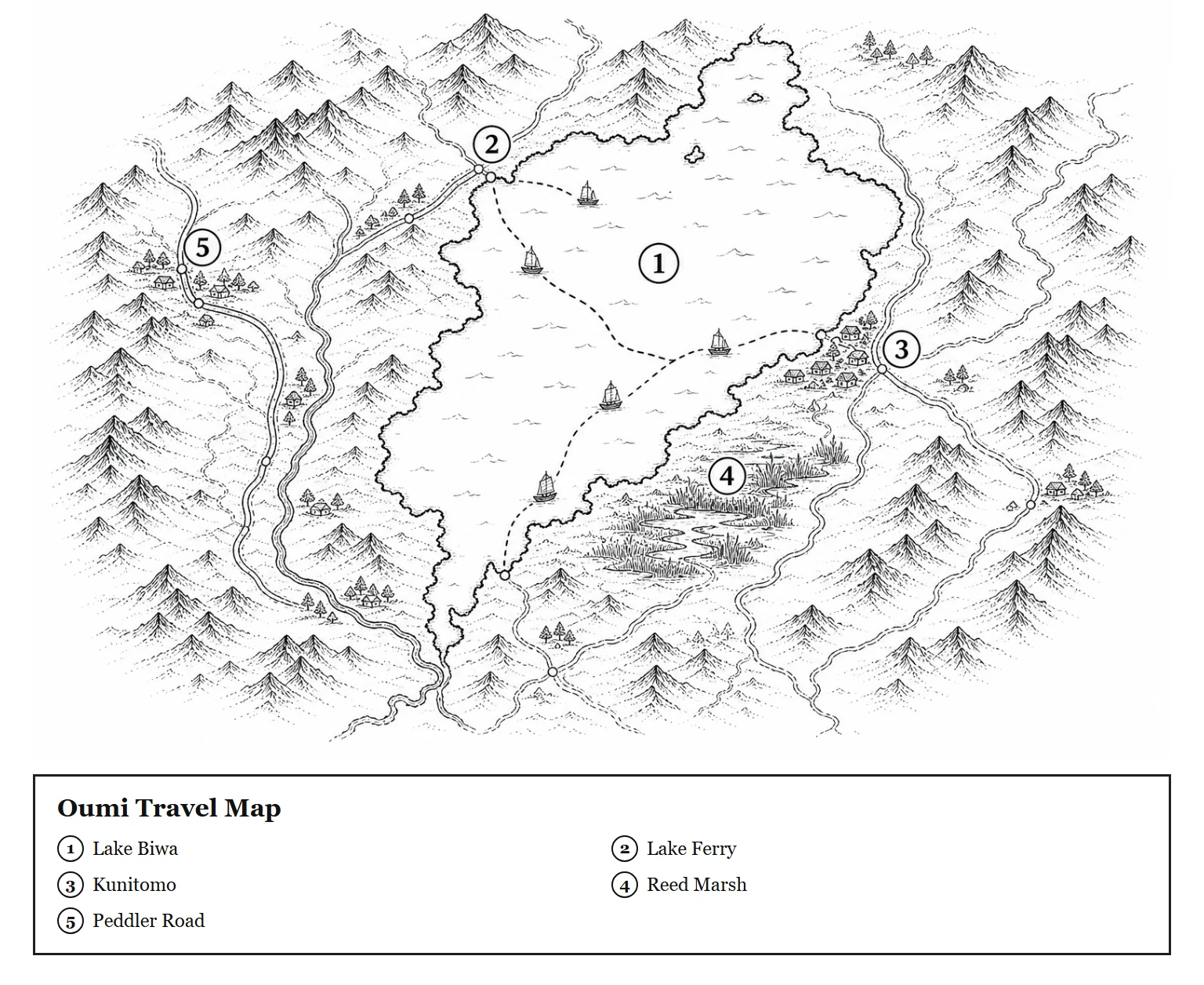
#The Road — A Sea Beyond the Pass
From Pinto's diary — the day I left Miyako (Kyoto).
I set out from Miyako before daybreak. The eastern exit of the capital is a pass. Dark though it was, the road was crowded — a column bearing rice and salt and dried fish went down to the west, and a column bearing empty backs went up to the east. The Tongue said, "The capital's morning meal is being carried in on those backs even now."
At the crest of the pass I saw water. I stopped. It was a sea — I nearly wrote sea. The water filled the space between the mountains and stretched endlessly to the north, its far edge mingled with the sky.
"I had heard this country was an island, yet is there another sea inside the island?"
"It is not a sea but a lake. They call it Biwako (琵琶湖)," said the Tongue, and he smiled. "There is an instrument called the biwa. They say that seen from above it resembles that instrument."
I made to ask who it was that had looked down upon it, and then let it go. The names of this country are, if you press them, a thing you lose at.
The Sword, rarely, opened his mouth first. "If you can see the far shore it is a lake. If you cannot — take care." When I looked north, sure enough there was no far shore.
I came down the pass, and in less than half a day reached a harbor on the water's edge. It is called Otsu (大津). I began to count the masts and — as when I counted the islands the day I came ashore — gave it up. At the wharf rice-bales of the north country and timber of the mountains were unloaded, and salt and cloth and the goods of Miyako were loaded on. Unlike us, the people of this country do not load great cargo onto carts. But here there is no need to load them — the lake is the cart.
Along the water's edge the sound of hammers carried. It was not from one place. Smithies, boat-wrights, coopers — the sound of striking carries far across the water. The Tongue pointed to the north. "To the north of the lake there is a village that makes teppo. If the Nanban gentleman should see it — he will find it interesting." That smile snagged in my mind.
At the evening tray came fermented fish. They said it was the lake's crucian buried in rice and let to ferment, but the smell — I set it down honestly — made me pinch my nose. The Tongue ate two slices and the Sword ate four. I ate one slice, and reached for a second. The two of them laughed. It is not faith alone that is exchanged at every harbor.
At night I watched the boatmen drink. They poured the first cup and — without drinking — poured it into the water. When I asked why, they said it was "the lake's share." There is a palace (宮) beneath the lake, they say. A tale I was told. That I set it down even so is because the wine poured out was no small amount. A merchant looks at where another spends his money and measures the fear of that land by it.
At dawn the fog erased the lake whole. The boatmen did not hurry. Within the fog the sound of an oar rowing could be heard, but the boat could not be seen. No one looked that way. I alone looked.
I set it down in my ledger. What feeds Miyako is not the fields but this water. A single lake feeds a whole country. This I saw.
#The Land of Fact — The Lake as a Road
Biwako is a water that lies in the very middle of this country. It is the largest lake in this country, they say — ask where the second is and no one could answer at once, so it seems to be a size with no second to set beside it. To the south the mountains of the far shore seem within reach of the hand, and to the north it is open like a sea. To go round the shore on foot takes many days, but a boat with a good wind joins north and south in one day — the sense of ri (里) I leave to the Glossary & Weights and Measures, and here I set down only one thing. From Miyako to this water is one pass, less than three ri.
That nearness fixed this land's fate. The eastern sea-road (the Tokaido) and the eastern mountain-road (the Tosando) meet on the southern shore of the lake and enter Miyako, and the cargo that comes and goes by the northern land-road (the Hokurikudo) crosses the passes north of the lake and is unloaded at the harbors on the water's edge. The rice of the north country, the horses and iron of the eastern country, the timber of the mountains — most of the heavy things bound for the capital float at least once upon this water. So it is by the tales I was told, and what I saw is that the wharf of Otsu is busier than any market in Miyako. The Tongue, pointing to this lake, called it "the throat of Miyako." Hold the throat and the head bows, as is the way, and so over these harbors on the water's edge — Otsu to the south, Nagahama (長濱) to the north — the lords' reckoning never ceases, they say.
The water of the lake becomes a river at the southern end and slips out. At its river-mouth there is a great bridge. That bridges are rare on the great waters of this country I set down in Roads and Travel, but here there is one — there are bridges too important to be cut. The people of this land say, "He who holds the bridge of Seta (瀨田) holds all under heaven." At first I took it for an exaggeration about a single bridge. Looking at the map, I revised my thinking — an army entering Miyako from the east, whether it crosses the lake or goes round it, must in the end pass this river-mouth.
The water's edge is rich. On the eastern shore a plain broad to a rarity in this country spreads out and rice grows well, and the fish of the lake sell at Miyako prices as fast as they are caught. The reeds become roofing and blinds, and the medicinal herbs of the mountain foot become the back-load of the herb-seller — of the mountain of herbs I set down separately later. The villages of the water's edge know no lean year, they say. A tale I was told — only, that I saw no starving face on this shore is what I saw.
Only, the lake has less patience than the sea — so says the boatman. When the wind drives down off the mountains, water that had been calm overturns in the time of one meal, and the fog comes down regardless of season and erases road and water together. The boatmen give each wind a name, and call the name to decide whether to set out or not. Unlike us, the sailors of this country learn the names of the winds before the tides.
#People and Customs — The Carrying-Pole and the Hammer
At every place where road and water meet a market stands, and the market shapes the people. There is a saying the people of the neighboring provinces have about the people of Omi — that they are quick at reckoning. It is a saying half of envy and half of admiration, and both halves are true.
The men of this land trade with a single pole borne on the shoulder. It is called the carrying-pole (天秤棒) — a pole with the load split and borne at both ends. On one end they bear light, dear things like medicinal herbs and cloth and needles, walk into an unfamiliar province, and when all is sold they buy the goods of that district at that end and bear them home. Once going, once returning — they see a profit twice on one road. The people of this land say, "With one carrying-pole you walk all under heaven." As a merchant I set it down — it does not mean one's capital is a single pole. It means that with one pole they will go on their own feet to see the market of any province. We merchants count from the ship and the storehouse, but they count from the road.
I heard this saying too. The people of this land say, "Good for the seller, good for the buyer, and good for the world — only then is it trade." At first I took it for a temple's sermon. Having walked half a day alongside one peddler, I revised my thinking — he goes again every year to the same villages. To cheat once is to close not one village but a whole road. It is a reckoning that credit is itself capital, and it seems that when a thing begun as reckoning becomes a custom it turns into a proverb like that.
In the villages of the water's edge the sound of hammers dwells. Boat-wrights, coopers, smiths, and the teppo artisans of the north — skill being itself the wealth of the house, father hands it to son and master to disciple by hand. The secret is in the hand, not the mouth, they say. That one article passes in turn through the hands of several houses is also a habit of this land's workshops, and that tale I tell at length in the next section.
And on this water's edge there is a custom I have not seen elsewhere. Of the fish that come in the first net, one is put back. On the stone basin of the water's edge are laid, each season, cucumbers and the first grain — who eats them no one says. The children learn, before they learn to swim, this first — not to answer a voice that calls from the water at night, not to follow a light upon the misted water. We would have called it the devil's work and sent for a priest. The people of this land call it a neighbor and set aside its share. And — perhaps for that reason — on this water's edge fewer people go under the water than elsewhere, they say. A tale I was told. What becomes of a village that has cut off the share, no one told me. They only turned the talk aside at the sight of my questioning face.
#The Land of Turmoil — The Sound of Hammers and the Mountain Gate
Everyone wants to hold the throat of all under heaven. On every water's edge that holds the lake a castle stands — the lake serves as a moat — and on the highways the footprints of armies never dry. But the weight of this land is not the number of castles. It is two sounds. The sound of hammers on the northern shore, and the sound of sutra-chanting from the mountain to the southwest.
I set down the sound of hammers first. To the northeast of the lake, not far from Nagahama, there is a village called Kunitomo (國友). The whole village is one workshop. The artisans are bound into a confederation called a guild (座) and move as one body, and the outsider before the gate — I — was let inside only after waiting half a day.
I set down what I saw inside. A house that strikes the barrel, a house that bores the hole, a house that assembles the mechanism of spring and gear, a house that trims the stock — a single teppo passes in turn through the hands of ten houses. Our artisans count it a pride that one man makes a thing from beginning to end, but these count it a pride to grind their own one task all their lives and to lose to no one at that one thing.
I took up one finished piece. I had heard it was a copy of our goods — and it is a copy, true. The teppo entered this country 40 years ago, beginning, they say, from a few pieces a Nanban ship put ashore. Yet this one in my hand was lighter than ours, the barrel straight, and the finish — loath to admit it, my brush stops a while — better. When our artisan makes a hundred pieces, all hundred differ. The hundred pieces of this village are a hundred brothers measured by the same rule (尺).
I asked an old artisan, "Did you learn by looking at the Nanban goods?" The old man answered without stopping his hands. "The first two years I copied, the next two years I corrected, and after that I made our own." Then he looked up at me. "What do the Nanban ships bring aboard these days?" I could not answer at once. That a merchant was stopped by being asked about goods — that day was the first.
I copy out just as it stands what I set down in my ledger that night. Abandon the thought of selling teppo to this country. Sell the raw material of gunpowder, the thing they cannot yet make, the next article. There is only one way to trade with people who copy your goods and make them better — to make the next thing before they do. And that night, for the first time, I was not certain we could.
Before I left the village I saw another thing. In a corner of the workshop a young journeyman set a doll down on the floor. There was the sound of a spring being wound, and then the doll, holding up a teacup, walked over on its own feet and stopped before me. When I took the cup the doll stopped too, and when I set the empty cup back it turned and walked away. They call it karakuri. Seeing me half-risen from my chair, the artisans laughed. The hammers of this village do not make weapons alone.
And at the place where the tour ended there was a door. A door they did not open. By the tale I was told — beneath the ground there is a separate workshop into which only the elders of the guild pass, and what they make there is not for sale. A soldier-doll that walks of itself, a teppo that fires again and again without loading — the tales are many and those who have seen are none. By a merchant's reckoning I set down only one thing. If what is shown is this much, what is not shown is what kind of article?
Editor's note: The inside of that door Pinto only stood and looked at — the underground workshop and the prototypes — is held by the Kunitomo Guild entry of the canonical Powers of the Sengoku. The Law of arms is not in this volume — the tale of masterworks and swordsmiths and workshops is the part of the Record of Famous Blades.
The sound of chanting is to the southwest. Between Miyako and the lake stands Mount Hiei (比叡山). Seen from a boat, roofs are set into every mid-slope of the mountain, and when the sun goes down lanterns climb the mountain in a line. The whole mountain is a temple, and the whole temple is a castle — I set it down thus and have nothing to add. The warrior-monks of the mountain gate (山門) bear, in place of spears, long lances with a curved blade, and boats flying the banner of the mountain gate go up and down the lake. What those boats examine is not the toll but the cargo, they say — searching for what must not be carried, the goods said to be born of yoma. A tale I was told. What the mountain gate does on the Miyako side I set down in Observation 5 — Kinai, so here I set down the mountain itself alone. That mountain, seen from the lake side — whether it was a lamp guarding the capital or an eye looking down upon the capital, looked different by the weather of the day I saw it.
Last, I set down a young scholar I met at an inn. He had been watching over my shoulder at what I was writing, and in place of an apology showed me his own notebook — and there I was written down. The height of the Nanban man, what he ate, his habit of writing. That a writer should be written was a first, and I ended up laughing. He asked about the Nanban way of reckoning the stars and the art of medicine, and in return I asked about yoma. He said, "To fear and to know are different." When I asked where he learned it he laughed and did not answer. I heard afterward that somewhere in the mountains there is a school that treats yoma as books, and that the mountain gate calls that school heresy. So the village of hammers and the school of books and the mountain of scripture stand around one lake eyeing one another sidelong — but since the lake is the livelihood of all three, nothing has yet come of it. A tale I was told.
#The Land of the Uncanny — The Neighbors Beneath the Water
The customs of the water's-edge villages I set down before. Here I set down, as I was told, at whom those customs are aimed.
There are the children of the water. Those small things said to be on every riverside and every pondside of this country — they love cucumbers and love wrestling, and in the water there is no one who can match them — live in this lake too, they say. Which is to say they are not Omi's alone. Only, in other lands they learn first the charm to drive it off, and on this water's edge they learn first the greeting that keeps on easy terms with it. The cucumber of the stone basin is that greeting.
And there is the palace. It is that palace into which the boatmen pour the first cup. At the deepest part of the lake there is a palace beneath the water, and each season the palace's messenger comes up over the water, they say — said to be a soft-shelled turtle the size of a man, or a great carp bearing a lantern on its back. If you meet it, bow; answer only the words it asks; and if it bids you follow — here the boatmen's words divide. Some say that if you follow you can never return, and some say an old man who followed and came back used to live in that village. That old man thought he had stayed three days beneath the water, but on land three years had passed, and the treasure he received and brought back turned to ash when it met the sunlight of the land. Since the words divide I set down both. Why no one looked back at the sound of an oar rowing in the misted dawn — that I knew only after I heard these tales.
To the northeast there is a mountain of medicinal herbs. It is called Mount Ibuki (伊吹山). The herbs of the mountain foot are good enough that the apothecaries of Miyako name them and buy them, but over the reason for that goodness the words divide — some say the mountain's poisonous air raises the herbs, and some say it is the garden of a mistress who dwells deep in the mountain. The herb-gatherers walk in twos, and go no farther in than where the stream gives out. If they see a white thread strung like a bridge between tree and tree, that day they come down with an empty back-load, they say. When I asked about people who went deep in, the villagers did not say "died" but said "gathered up." A mistress who collects the fair things and the strong things — having said that much, they all closed their mouths. A tale I was told. I did not enter that mountain.
Last, I set down what I heard at Kunitomo. When I marveled at that doll that carried the tea, the old artisan said, without smiling, that it is an old saying of this country that a soul dwells in a tool that has lived a hundred years, and since the karakuri is an article that brings that hundred years forward by its spring — into a thing made too well, a "guest" enters. So the artisans of this village deliberately leave the last gear one bit loose, they say. So that it will not become a vessel fully complete — so that there is no seat to come in and sit upon. What I saw was one loose gear, and what I heard was the reason for it. Unlike us, the artisans of this country fear that their own skill might go too far.
Editor's note: What lies beneath the lake this volume does not fix — only, that the canonical chronicle has named "the Biwako abyss" as one candidate for a rift to the Spirit Realm is worth setting down. And whether, despite the loose gear, something has dwelt within — whether a karakuri that thinks for itself truly exists — is answered by the canonical autonomous automaton. Pinto, in the end, never met one.
I crossed the bridge of Seta and turned in onto the eastern sea-road. The tale of that road I set down in Observation 7 — Tokai.
#At the Table
Scene Tool. Only this section is a GM scene tool.
The scenes of Omi stand upon four stages. The workshop — craft and secrets, the door not shown. The lake — the road upon the water and the palace beneath it, fog and storm. The water's-edge village — the old balance in which people and the uncanny share out their portions. The mountain gate — the shadow that looks down upon the lake. One stage is enough for one scenario, and the moment two stages overlap — when a workshop's article sinks into the lake, when a mountain-gate boat puts in at a water's-edge village — the story stands up of itself.
The vanished journeyman. The Kunitomo Guild quietly seeks a man. A young mechanism-journeyman who fits the gears and springs has vanished along with one scroll of drawings. The reward is generous and the conditions two — that neither man nor article be harmed, and that no one know. At every landing of the lake another party seeking the same man catches the eye (whose money it is — the harbor's merchant league, the hand of some daimyo, or something stranger — the GM decides). And the journeyman himself did not flee to sell. After the thing he assembled with his own hands moved by itself in the night, he is on his way to sink it in the deepest part of the lake.
The cargo the lake returned. A storm swallowed a cargo boat. Seven days later, the cargo chest that had been aboard came up at the water's edge — the binding cord, the lacquer, even the paper inside, dry. The village does not lay a hand on it. "What the lake has settled the reckoning of and returned," they say. The owner of the cargo seeks someone to come and open the chest. Whether the inside of the chest is as it was when it left, what has been lost — or gained — the GM decides. Better still to decide first what was loaded in that chest when it left.
The water's edge whose share was cut off. A newly appointed official forbade the water's edge's "share" as superstition — the first cup, the first fish, and the cucumber of the stone basin all gathered up and turned to tax. Within half a month the nets come up torn, and at the night water's edge a voice calling for a child is heard. The village wishes to undo this quietly — above all so as not to catch the eye of the mountain gate's patrol boats. The work of soothing the anger of the old neighbor and the work of keeping that matter from being recorded as "corruption" in an outside ledger are two different tasks, and the party comes to bear both.
The encounter tendencies are held by the canonical Lands of the Sengoku — this region is a land of water and spiders. If you need incidents to roll on the road, open Incidents of the Road; for the practicalities of landings and lodging and barriers, Roads and Travel.
I came to this country to sell — yet here on this lakeshore, for the first time, I saw something I wished to buy and carry home.