#The Narrator — the Nanban Brush (南蠻の筆)
Contents
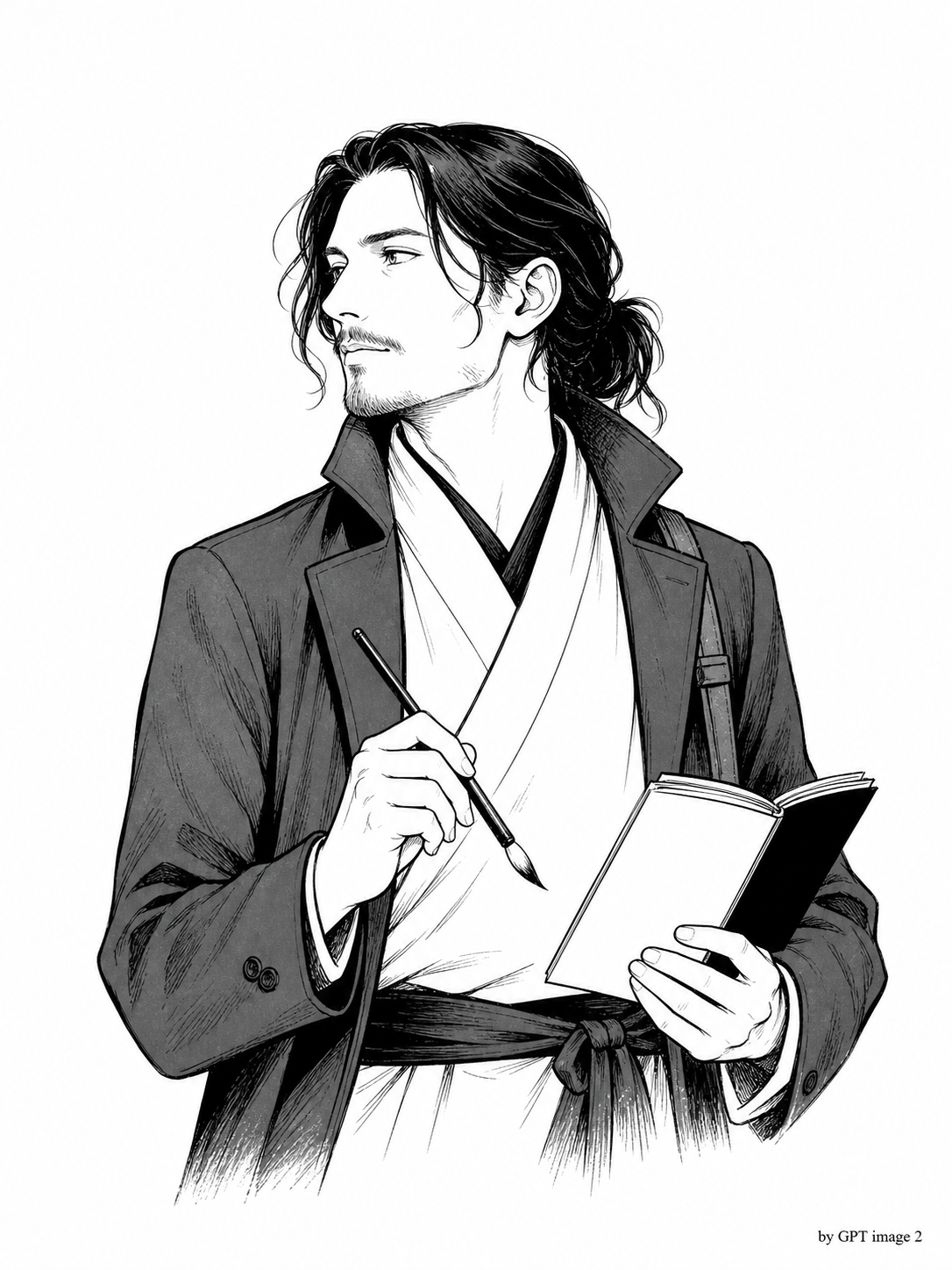
Authority. The main text is Fiction-Only — the record of one outsider, in which fact, rumor, and misunderstanding are mixed. The narrator can be wrong, and that gap belongs to the GM. Only §4 "The Narrator at the Table" is Scene Tool. This volume has no Law — if you need numbers, go to the canon
co. The promise of this whole book is in About This Book.
#The Road — The Diary of the Eve of Landfall
From Pinto's diary, the first leaf of the first volume.
The wind had died. The ship dropped anchor, and they say we go ashore tomorrow morning on the tide. Unable to sleep, I light a lamp and open my ledger. I wrote "ledger" — but from today I will call it a diary.
First I record myself. A record becomes worth believing only when it first makes plain who is doing the writing. I am Duarte Pinto, agent of a Nanban (南蠻) trading house, a merchant a few years past forty. The task my house gave me is one — to see this country's silver and goods with my own eyes, and write back what can be bought and what can be sold. As a child I learned this country as Jipangu (the name our old maps gave Japan). The island with roofs of gold. Coming here — before I have even set foot on land — the first thing I learned is that the map was wrong. There is not one island but hundreds, and not one country but sixty-some, split apart and at war with one another, they say. A tale I was told. From here on I will confirm it with my own feet.
In the afternoon the interpreter (通事) came up on deck and taught me a handful of this country's words. A young man born in Sakai, his skill in passing between our tongue and theirs is like acrobatics on a rope. He asked me not to write his name, so in my diary I will record him as "the Tongue (舌)." "Do not say you have come to buy silver," said the Tongue. "Say you have come to see. Before a man who has come to buy, the price rises; before a man who has come to see, the price falls." Unlike us, the people of this country are less wary of seeing than of buying, he says. A good country. As for seeing, I have confidence.
Toward dusk I watched the ronin I had hired as a guard sit at the gunwale and wipe his sword. A warrior who has lost his lord is called a ronin in this country — written with the character for "wave," the Tongue told me. When I asked his name, the man, without taking his eyes off the blade, said only, "The price of a name is charged separately." So he is "the Sword (刀)." The Sword speaks little, costs much, and is the first to wake at night. For a guard, those three suffice.
The captain laughed behind my back. "Going to see silver? Silver is piled up in the harbors too." I answered, "I go to see the mountain that yields the silver, and the people who use it. The silver of the harbor is silver already counted by someone else." The captain laughed louder, but a merchant knows — a number someone else has counted is not worth half its value once you copy it into your own ledger.
I heard that the teppo entered this country 40 years ago. That item, which our ships carried over, changed this country's wars, and ever since, the eye that looks upon a Nanban man has become half curiosity, half wariness. I cannot fire a teppo. The only things I can handle are pen, abacus, and scale. Whether that will protect me, or rather make me look more suspect — I will know from tomorrow.
Last, I set down a promise. In this diary I record what I saw and what I heard separately. What I saw, I write as "this I saw"; what I heard, I write as "a tale I was told." Just as a merchant is ruined if his ledger is false, the one who records is ruined if the record is false. I did not come this far to be ruined.
Tomorrow, I go ashore.
Editor's note: The report Pinto sent to his house departed for the Nanban lands, and what remained in our hands was the diary he wrote on the road. It is said there were places here and there where report and diary recorded the same matter differently — which of them is the truth, this book does not decide.
#1. Who He Is
| Item | Record |
|---|---|
| Name | Duarte Pinto |
| Byname | the Nanban Brush (南蠻の筆) — given by the people on the road, who saw him writing something everywhere he went |
| Standing | Agent of a Nanban trading house. His trade is market research — seeing silver and goods and writing reports |
| Age | Middle-aged, a few years past forty |
| Arms | None. Pen, abacus, scale, ledger — and one hired Sword (a ronin) |
| Speech | Japanese by way of the interpreter. By the later journey he handles haggling and greetings with his own mouth |
| Faith | A Kirishitan who keeps a cross in his breast — but not a padre's faith, a merchant's faith |
The Nanban man this country knows usually comes with the teppo. Those who handle gunpowder, ignore armor, and overturn the outcome of a pitched battle from 200 paces away — Pinto is outside that common notion. He is not one who shoots but one who writes. A Nanban man going about marked with the smell of ink instead of matchcord both protected him and made him look twice as suspect.
What he crossed over into was an age 40 years after the teppo had arrived. Nanban goods had already gone from novel things to fearful things, and in the streets the eye that found a Nanban man a novelty and the eye that shunned him were mixed together. Pinto's journey was a walk between those two eyes. In one village children swarmed to touch his beard; at one barrier he spent half a day unpacking and displaying his cargo — both scenes are recorded in the diary of the same region, the same month.
Why did he walk? The first answer is simple — because he was told to. His house wanted a list of the mountains that yield silver and the markets where silk sells. But the diary stops being a list before it crosses the first region. A man who came to see silver saw the people who mine it; seeing people, he saw what those people fear; and in the end he saw the whole country. The report was sent to his house to the last — only the diary grew steadily thicker.
On faith, the man himself wrote most briefly. "I am not a padre. The cross is in my breast, and I pray on storming nights. I did not come to spread it but to see it." There are many records of his obtaining a bed at a temple and bowing his head before a shrine — a merchant's faith, after all, is a thing that exchanges at every harbor.
#2. The Journey — From Landfall to Terminus
Pinto's road uses sea and land half and half. Landing at Saikai (Kyushu), he goes east by boat and foot along the Seto Inland Sea coast, crosses the sea to traverse Shikoku, crosses the sea again to the mountains of Kii — and from there he mostly walked. His companions were three: the interpreter "the Tongue," the ronin "the Sword," and porters who changed at every harbor and pass. At best six or seven ri a day — if the load was heavy or a river had no bridge, even that he could not make. He spent two winters on the road. For a sense of ri (里) and cho (町), keep the Glossary & Weights and Measures at hand.
Editor's note: The pace of Pinto's party is the speed of foot travel bound to porters, barriers, and bridgeless rivers. The travel days in the canonical Trade Rules are a Law based on express couriers and merchant-caravan dispatch, so even where the two numbers differ, they belong to the same world.
The sketch of the journey is as follows. The ten observation chapters of this volume follow this order exactly.
| Order | Land stayed in | Road | A line from the diary |
|---|---|---|---|
| Observation 1 | Saikai | Landfall — the western harbors where Nanban ships arrive | "The gate of this country opens to the west." |
| Observation 2 | Sanyo and Sanin | East along the northern shore of the Seto Inland Sea | "They clamor that this country's silver is one in three of the world's. A tale I was told." |
| Observation 3 | Shikoku | Across the sea, traversing the island | "The pilgrims circle the island like a ring. Why they circle — there are several tales I was told." |
| Observation 4 | Kii | Across the sea again, into the mountains of the peninsula | "The mountains are deep, and gods are said to dwell there. For three days I heard nothing but the sound of rain." |
| Observation 5 | Kinai | Miyako (Kyoto) — the center of the realm | "The capital was half ash and half market. This I saw." |
| Observation 6 | Omi | The country of the lake | "A single lake feeds a whole province." |
| Observation 7 | Tokai | The eastern sea-road | "The better the road, the more often armies pass." |
| Observation 8 | Hokuriku and Shinetsu | The north country — the snow highway and the mountain provinces | "When snow erases the roads, people memorize the roads." |
| Observation 9 | Kanto | Over the mountains into the broad plain | "Where the plain is broad, horses grow fast, and where horses grow fast, war grows fast too." |
| Observation 10 | Ou | Terminus — the north | "Here the road ended. What ended was my legs, not this country." |
Pinto did not tread every road. The tales of lands his feet did not reach, like the interior of Sanin, remain in the diary only as hearsay (傳聞) beginning with "I could not take that road," and each observation chapter carries that wording over as it is.
#3. The Method of Record — What Was Seen and What Was Heard
The §The Road placed at the head of each of the ten observation chapters is an excerpt from this diary. The notation-promise Pinto set for himself on the eve of landfall lives on in the diary to the end, and the prose of this volume follows that promise too.
- What was seen — written as "this I saw." "As I saw it, the people of this country keep the sword closer than their clothes."
- What was heard — written as "a tale I was told." "I could not take that road. Only, sailors of three ports spoke the same name."
- Us and them — set up by a short contrast. "This custom is strange to us, but to them it is the beginning of courtesy."
- When accounts diverge — both are recorded. "Since the merchant's account and the monk's account differ, I set down both."
But a promise does not make a record complete. Pinto recorded his own limits too. The first is speech — he heard this country's words through the interpreter. "The Tongue does not lie. He only shaves the corners. Where the shaved corner was, I will never know." The further into the journey he went, the more he caught and recorded speech with his own ear, without passing through the interpreter — that is why the grain of the record is a little closer to the raw in the later chapters.
The second is numbers — being a merchant he loved numbers, and being a merchant he inflated them. Of a certain lord's storehouse he writes: "I heard it exceeds five hundred thousand koku — I did not count it myself." Among the Nanban people there was, it is said, a jest: "When Pinto speaks, halve it before you listen." This, too, is a tale I was told.
Editor's note: There are places here and there in the diary where the seen/heard notation breaks down — nights when the narrator was exhausted, or ill, or gripped by fear. Whether to read such places as fact or as phantom, the table decides.
#4. The Narrator at the Table
Scene Tool. Only this section is a GM scene tool. Three ways to bring Pinto to the table as an NPC.
#The Recorder on the Road
On any highway, in any harbor, under the eaves of any temple — the party can meet a Nanban man writing something. When he sees the PCs, he asks, listens, and writes. In a village seeing an outsider for the first time, his merely sitting there becomes a scene. Eyes gather, children gather, and after that an official comes. The PCs who were in the same place share in those eyes.
#The Client
A guard request is the most natural frame for a travel scenario. "The Sword" has left his post — wounded, vanished, or raised his price. Pinto looks for a Sword to go with him to the next region, the next harbor. The pay might be silver, might be a Nanban good, might be a page of his diary. If you need an incident to roll on the road, open Incidents of the Road.
#The Informant
His diary might already hold the place names, rumors, and people's names the PCs are looking for. But — as with this whole book — fact and misunderstanding are mixed in that record. Which sentence is the truth, the GM decides. Even a sentence written as "this I saw."
#On Numbers
He gives none. If you really must have them, borrowing the canonical scholar or merchant class template is enough. If Pinto comes to need combat numbers, the scene has already drifted somewhere he never intended — he flees, hides, pays a price, and if he survives, that night he records the matter.
A man who came to count silver ended up recording a whole country.