#Overview of the Japanese Archipelago (日本列島總論)
Contents
Authority. The main text is Fiction-Only — the record of one outsider, in which fact, rumor, and misunderstanding are mixed. Who the narrator is, is in The Narrator — the Nanban Brush; the promise of this whole book is in About This Book. Only §5 "At the Table" is Scene Tool. This volume has no Law — if you need numbers, go to the canon
co.
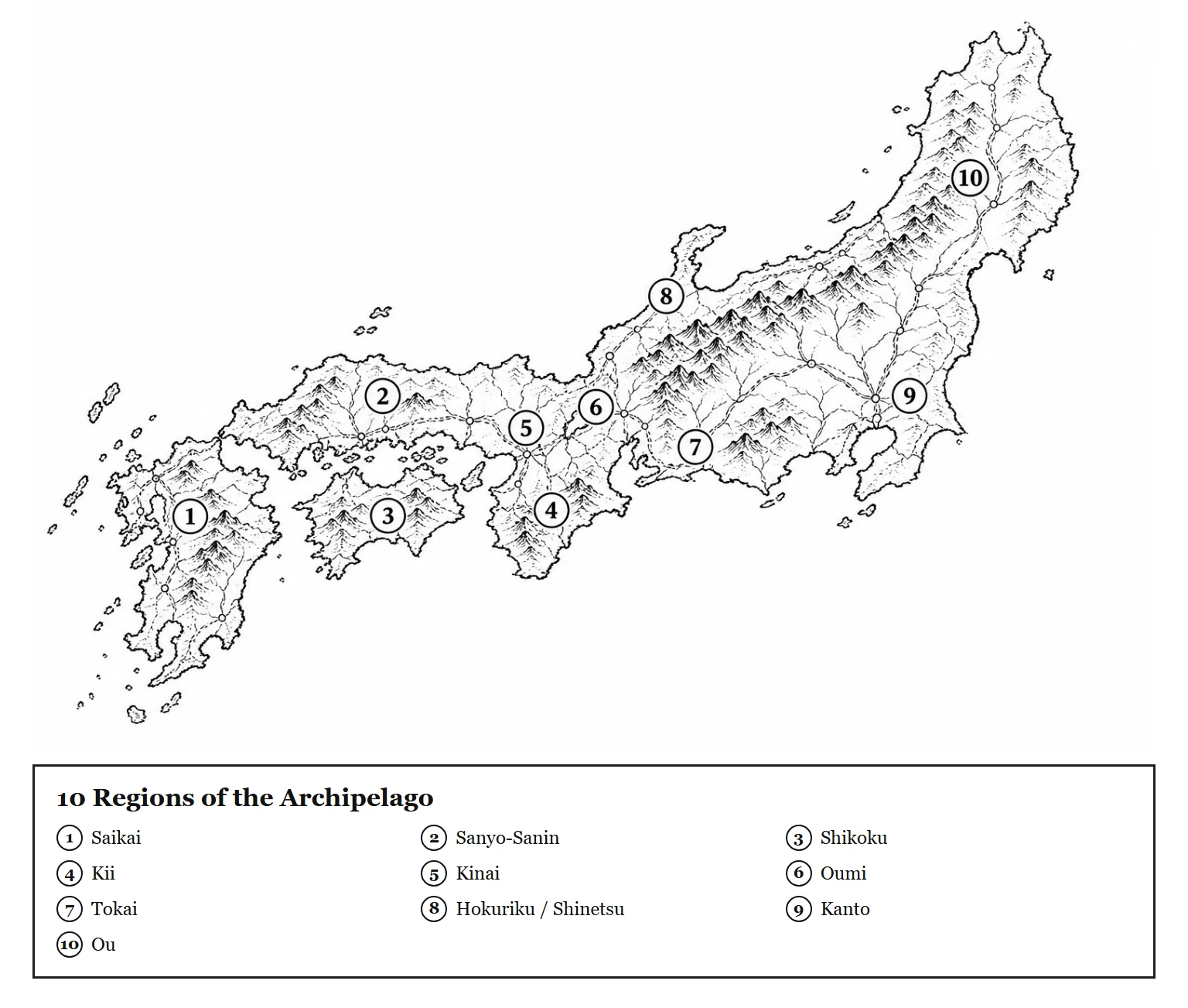
#The Road — The First Japan Seen from the Sea
From Pinto's diary — the day land came into view.
The wind was good, and we ran straight for three days. Before daybreak, I woke to the cry of "Land!" Without time even to throw on my coat, I went up on deck.
At first I thought it was cloud. Something blue lay long upon the horizon, but when the sun rose I saw that it was all mountain. The mountains rise straight out of the sea. Our country's coast slopes gently down toward the sea, showing fields and vineyards, but this country's coast has sea and mountain meeting with no haggling between them. No plain is in sight. No field is in sight. Mountain, and again mountain.
"Is all of that mountain?" I asked, and the captain laughed. "All of that is the country."
The interpreter — the young man I have decided to call "the Tongue" in my diary — leaned on the railing and added a word. "Among the mountains, the plains are hidden. Each plain has its lord, and each lord his castle. That the country is split into sixty-some is half the fault of the mountains." That the mountains divide the country I heard then for the first time, and over two years I would confirm it on foot.
While the ship rounded the coast, I began to count the islands and gave up at forty. A small island beside a great one, a rock beside the small one — a place marked with a single dot on the map splits into dozens when you draw near. A man who draws maps, I note, will not go hungry in this country.
The ronin I had hired as a guard — "the Sword" — stood at the prow and watched the mountain range a long while. "Good mountains," he said, opening his mouth first for once. When I asked why, "Plenty of places to hide." Whether those words were a guard's blessing or a warning, I do not yet know.
I remember that the maps of my childhood marked this country as Jipangu (the name our old maps gave Japan) and drew roofs of gold upon it. No gold is in sight. Only green. But a merchant must trust the green before his eyes over a golden rumor — a rumor has a different price at every port, but a mountain is a mountain seen from any port.
I record what I learned today. This country is made of mountain and sea, and people live in the gap between them. This I saw — though it is something seen yet from afar.
#1. The Land of Fact — A Country of Mountains
From here on it is not a diary but a reckoning. Not the impression of one before landfall, but the accounting I set down, ordered, at the terminal harbor after walking two years.
Seven of every ten of this country's land is mountain, they say. A tale I was told — but now, having walked two years, I found no reason to discount the saying. Roads bend to avoid the mountains, and a bent road makes a day short. Dragging a load, six or seven ri a day — for a sense of ri (里), I leave it to the Glossary & Weights and Measures. And the mountains do not bend the roads alone. Cross a single pass and the speech changes, the pass-paper changes, the lord's banner changes. The mountains have split the country finely into sixty-some. The matter of passes and barriers I record separately in Roads and Travel.
The remaining three are plain, and the plains are this country's strength as a state. Unlike us, the people of this country do not measure land by breadth. They measure it by the number of mouths the land feeds in a year — a unit called koku (石), the amount of rice one grown person eats in a year. A broad plain means much rice, and much rice means many soldiers and much tax. Plain = rice = army. So the war-map of this country is, in short, the map of the plains. The old plains around Miyako (Kyoto), a few rich plains east of them, and the great plain at the eastern edge — on that great plain I walked forty ri and met no pass. This I saw. Whose that plain becomes is, I was told, one of the great wars of this country.
Along this country's back runs the spine of the mountains, north to south and long. That spine divides a single country in two. The side facing the southern sea has, at every summer's end, a great wind that comes up from the sea to strip the roofs and capsize the boats — and because it comes every year, the people of this country count it not as a calamity but as a season of the calendar. The side facing the northern sea has, every winter, snow piling higher than a man's height. The Tongue said, "With a single mountain between, one side is dry and the other is buried." There are, in effect, two countries within one country — the country of summer and the country of winter.
The four seasons are as distinct as if cut with a knife. We count the seasons by farming, but they count the seasons by flowers. In spring they gather beneath the blossoming trees and drink wine; in autumn they climb the mountains to see the colored leaves. At first I thought it an idle custom, but later I came to see it otherwise — the more a country cannot promise tomorrow, the more earnest is today's flower.
I record the disasters. The ground of this country shakes from time to time. The old men I met on the road each remembered the great shaking of his own district — in one district the castle walls came down; in another, a mountain slid down and dammed a river, they say; at one seashore the water drew back and returned like a mountain, they say. All of it a tale I was told. But unlike us, the people of this country build their houses knowing they will fall. We build a house to last a hundred years out of stone and plaster, but they build out of wood and paper. When it falls — they weep. And after weeping, they build again. Quickly. At Saikai, where I first landed, I saw a mountain sending up smoke — this I saw. There are several districts, too, where the ground puts out boiling water. What we would call the devil's cauldron and shun, they soak their bodies in, and heal the weariness and sickness of the road.
Last, the sea. Half this country's roads are upon the water. Rice, salt, timber, silver — everything heavy goes by boat. A boat riding a fair wind covers in a day what is three or four days by land. Yet not every sea is the same sea. The inner sea between the islands — the Seto Inland Sea — is calm as a lake, and boats string along it in lines, but the outer sea is rough, and even sailors choose their season to put out. In the southern sea there flows, I heard, a great current, black and swift — ride it and you are fast, go against it and it is for nothing. A tale I was told. And this country's sea has its sea-barriers. It means there are those who take a toll for passage upon the water too, and that tale I record in the Sanyo and Sanin chapter.
Editor's note: The "great shaking" Pinto recorded is not the event of a single particular year. The old men of this country each remember the shaking of their own district, and that memory becomes, in effect, the chronicle of that district. If you need the memory of a shaking at the table — which district, how many years ago, the GM may decide. The traditions of shaking handed down in each region I have scattered through the several regional chapters.
#2. People and Customs — The Temperament the Land Shaped
The land shapes the people. Over two years I met, within a single country, three kinds of people different from one another, and I saw too that they regard one another as half strangers.
The people of the plain live beneath the lord's banner. They grow rice, pay tax, and when war comes they have nowhere to flee in the middle of the plain. Perhaps for that reason the people of the plain are sharp at reckoning and careful of speech. Where the plains gather, a market stands, and where the markets gather, a city stands — the people of Miyako and Sakai reckoned faster than the merchants of any port of our country. This I saw. That tale I tell in the Kinai chapter.
The people of the mountain live a different reckoning. Charcoal-burners, woodcutters, hunters, the ascetics who walk the mountains — they read the mountain's weather before the lord's banner. I said that crossing a single pass changes the speech, but for the people of the mountain, the far side of the mountain is truly another country. And they revere the mountain as much as they fear it. They bow on entering the mountain, and bow on leaving. The mountain-wardens of our country told us to beware of wolves, but the mountain people of this country told us to beware of much more — and the tale of that much more becomes serious from the Kii chapter onward.
The people of the shore read the sky. As folk who live by net and oar, they have many names for the wind. Where our sailors swear by the names of the saints, the sailors of this country swear by the names of the wind. There is a separate way to bury one who has died at sea, and a separate way to receive what comes from the sea — and I, an outsider, was received in that way too. That the eye that looks upon an outsider differed at every port is worth recording separately.
And there is the country of winter, the people of the snow. In the districts that face the northern sea, the roofs are steep as a blade's edge — built so that the snow slides off. When the snow falls the village becomes an island, and the people take half a year's food and half a year's work into the house and shut themselves in. They do not shut themselves in to play — they weave, they do fine handiwork, they make what they will sell in spring. Because the winter is long the hands are deft, the Tongue said. The tale of that district I tell in the Hokuriku and Shinetsu chapter.
Of the far north there are more tales I was told. That land is rough but broad, and were the plains all tilled, they say, it would feed several more countries. I went as far as that edge — and saw winter before I saw the plains. The reckoning of the north is a reckoning no one has yet finished.
#3. The Land of Konsei — Spirit-Vein and Terrain
The monks and onmyoji of this country believe the land has blood-vessels. They call them spirit-veins (靈脈). Along the mountain ranges, along the great rivers, an unseen force flows, and where that vessel rises near the skin of the earth there are spirit-mountains (靈山) and spirit-springs, they say. Ask why the great shrines and the old temples stand on that spot of all spots, and the answer that came back was always the same — the spot was there first, and the building was raised after.
Unlike us, they do not raise the house of god in the midst of the people. We raise the church in the heart of the village, in the spot the bell's sound reaches. They raise it where the people give out — a mountaintop, behind a waterfall, the place where the road ends. At first I thought it foolish. If the god is far, will not the prayer be far too? Now I hold my judgment back. For over two years of walking, there were many nights when I had the thought that, where the people give out, there truly is something.
I record what I saw. In place after place I saw sacred ropes wound about the boulders and the old trees on the crest of a pass. I saw that, as dusk came on, the porters would stubbornly put off crossing the pass — they would not listen even when I named twice the price. I saw the whole party quicken its step in silence when passing an old battlefield. And there are passes where the air changes. This is what I felt — and that I cannot write it down as what I saw galls me.
I record what I heard. The people of this country say that beside the world there lies overlapped another world called the Spirit Realm (靈界), and that at the places where war and death and wrath have piled up, its gate opens. And the places where the gate opens readily, they say, have a terrain in common. Deep mountains. Old passes. Misty waters. From the people of three districts that can never have met one another I heard the same three things. To put it in a merchant's habit — if you hear the same market price at three ports, that price you may believe.
Editor's note: Pinto remained half in doubt of the word spirit-vein to the end, but the three terrains he recorded — deep mountains, old passes, misty waters — overlap exactly with the canon's grain of the Spirit Realm interface. Which boundary is thin in which region, see Lands of the Sengoku and the several regional chapters of this volume.
#4. The Land of the Uncanny — Where the Road Breaks Off
Trace the places in two years of diary where tales of yoma are set down, and there is one thing in common. They are all where the road breaks off. A riverbank where the bridge has washed away, a pass blocked by snow, a ferry where the fog has settled, a mountain trail collapsed by a landslide that forced us to turn back — the tale always began there. Yoma dwell where the road breaks off. Or — it may be that the road breaks off where the yoma dwell. Which it is I could never settle, and I set it down unsettled. Which land what thing dwells in, I record together with that land in the ten observation chapters.
#5. At the Table
Scene Tool. Only this section is a GM scene tool.
In a travel scenario the first enemy is not yoma but the land. A river with no bridge — turn back, swim, or pay the ferry's asking price? A pass that is closing — push over it before the heavy snow, or wait out the spring in a village? A great wind that pins down a port — what happens at that port during the three days of being stranded? Terrain forces a choice on the party even without numbers. Here lies the reason this volume carries no Law — the land is heaviest when used not as a roll but as a fork in the path.
And you may use Pinto's observations as tools just as they are. When you wonder where to send a yoma out, look at the map — where the road breaks off is the place of the encounter. For regional tendencies, the encounter tendencies of Lands of the Sengoku; if you need an incident to roll on the road, Incidents of the Road; for the practicalities of barriers, lodgings, and river-crossings, open Roads and Travel.
A country seven-tenths of which is mountain — people live in the remaining three, and the tales live in the seven.