#Sanyo and Sanin (山陽山陰)
Contents
Authority. The main text is Fiction-Only — the observation of one outsider, in which fact, rumor, and misunderstanding are mixed. Only "At the Table" at the end is Scene Tool. This volume has no Law (法) — if you need numbers, go to the canon
co. The promise of this whole book is in About This Book; the one who wrote this diary is in The Narrator — the Nanban Brush.
The old provinces covered — the Sanyodo (山陽道): Harima (播磨), Mimasaka (美作), Bizen (備前), Bitchu (備中), Bingo (備後), Aki (安藝), Suo (周防), Nagato (長門) / the Sanindo (山陰道): Tanba (丹波), Tango (丹後), Tajima (但馬), Inaba (因幡), Hoki (伯耆), Izumo (出雲), Iwami (石見), Oki (隱岐). The master table joining provinces and chapters is held by the cross-reference table.
The journey — before is Observation 1 — Saikai, after is Observation 3 — Shikoku. In this chapter the narrator goes east along the northern shore of the Seto Inland Sea, and bends the road once, greatly, to visit the mountain of silver.
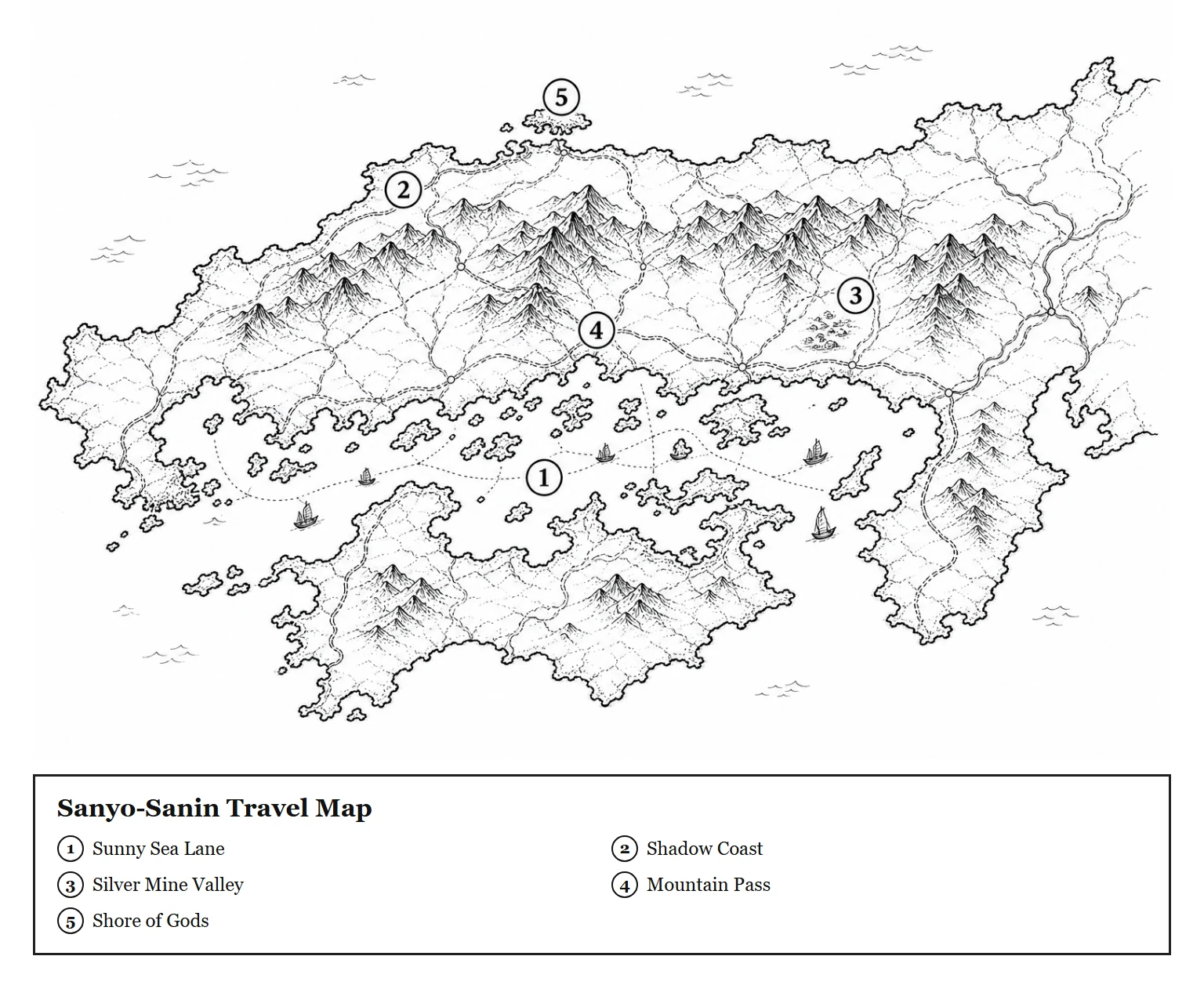
#The Road — The Pass Crossed from Sun into Shade
From Pinto's diary — the second day since I left the great road and turned in toward the silver mountain.
Two days ago, I left the great road. The Sanyo road goes straight east, but the mountain that yields silver lies in the mountains to the north, they said. The Tongue tried to stop me for three days, and the Sword, saying nothing, bought two more pairs of straw sandals. That was the answer of the two men.
I set down the sea of the morning I departed. The inner sea was, that day too, like a lake. So many sails floated that I counted to forty and gave up, and the alleys of the harbor were the market, and the alleys of the market were the harbor. It was a shining sea. I bore that shine on my back and stepped into the valley.
In half a day the sound of the harbor cut off. All that was audible was the sound of water, and the soundless sound of charcoal-smoke rising.
In the village below the pass, hiring new porters, a man called the price double. When I said it was dear, the man answered, "Beyond the pass is another country." When I asked whether the lord was different, he shook his head. "The sky is different."
On the crest of the pass there was a cairn of stones. The porters each added a stone, and the Sword too added a stone in silence. In place of adding, I make do with writing this instead — the merchant's stone is a letter.
From the crest I looked back. It was sun. The sea was shining like silver leaf. I looked ahead. Cloud had settled down like a roof, and the grain of the dark mountains ran on endlessly beneath it. The sky of the same hour was split in two. This I saw.
"Sanyo (山陽) means the sun of the mountain; Sanin (山陰) means the shade of the mountain," said the Tongue. Unlike us, the people of this country write poetry (詩) onto their maps. And that poetry was exact.
On the road down, rain began. Whether it was rain or fog I could never tell apart in the end. On the slopes of the shade side they do not tell the two apart, said the Tongue.
On the roofs of the first village on the shade side, stones were laid. It was for the wind, they said. In winter the wind comes like a blade from the northern sea. At the harbors of Saikai the children swarmed to touch my beard, but in this village one old man looked at me a long while and then only lowered his head. Not to ask is the courtesy of this district, they say.
I obtained a night at the hearth of that old man's house. A single bowl of soup and a single bowl of silence. When I tried to pay, he waved his hand, and the Tongue, in my stead, set a pinch of salt on the hearth-edge. That was accepted.
At night the Sword was sitting by the doorway, so I asked what he was listening to. "The wind has changed," the Sword said. "From here on the sea is to the north."
The next day I reached the mouth of the silver mountain. A single mountain was wholly ringed with palisade and gate. The line going up was loaded with rice-bales and salt and charcoal, and the line coming down with small, heavy-looking coffers — there is no need to write what they held.
At the barrier at the mouth I stood half a day. A Nanban man before a silver mountain is suspicion itself. The Tongue, sweating, told me, "Here, do not say you have come to see. They say that with silver, to see is at once to steal." The words that protected me in the harbor bound me in the mountain.
I record what I learned today. On the road of sun I was a merchant. On the road of shade I am an outsider suspected from the start. The same man was changed by a single pass — as the same country is changed by a single pass.
#The Land of Fact — The Sea of Sun, the Sea of Shade, the Mountain of Silver
#The Sea of Sun — The Seto Inland Sea
On the Sanyodo the road goes alongside the sea. No — the sea is the road itself. The inner sea is calm as a lake, the islands are a number you give up counting, and the harbors are strung like beads, one for each day's sea-passage. Rice and salt and iron and silver — everything heavy goes by this sea. Half the heavy cargo bound for Miyako (Kyoto) passes through this sea, I was told. A tale I was told, but seeing the bales piled up at every harbor, there is no reason to discount it.
Yet this sea deceives men with a gentle face. In the narrow channels between island and island the tide flows like a river, and that river flows backward every half-day. A boat that does not know the tide rows half a day in the same place and is where it started — the boat I was on did so. The difference between the one who knows the channel and the one who does not is the price of this sea, and the tale of those who take that price I record below. The haggling over flags itself I have already recorded in Roads and Travel.
#The Sea of Shade — Sanin
The spine of the mountains divides the country into the country of summer and the country of winter, I recorded in the Overview. This region is the place where that saying comes true at its narrowest width — within one pass, the width of a few days if you walk well, the sea of sun and the sea of shade stand back to back. The sense of ri (里) I leave to the Glossary & Weights and Measures.
The northern sea was already ashen in the autumn I saw it. The harbors were small and tucked away, and the boats were few. When winter comes the sea closes, they say — the wind capsizes the boats, the snow erases the road, and the village lives alone until spring. A tale I was told. I also heard that on the shore toward Inaba there is a place where sand has formed a mountain — a mountain heaped by the wind, they say, so I can only guess at the force of that wind.
The great road of Sanin runs long, east and west, along that ashen coast. I could not walk it all. Having gone as far as the silver mountain and turned back down by the road of sun, the tales of Izumo and the country east of it are all hearsay (傳聞) in this chapter — so I record them, sifted.
#The Mountain of Silver — Iwami
A single mountain yields the silver of all the realm. It is the silver mine (銀山) of Iwami they speak of, and going to see it, it was not the skeleton of empty words. A village rides whole upon the mountainside, and smoke rises from every valley. There is a method of parting out silver with lead, they say — the stone that comes from the gallery passes through that fire and becomes silver, and the silver is laid in coffers, goes down the mountain, and is put aboard a boat at a small harbor. Go west and it is Hakata (博多); go east and it is Sakai (堺), I was told. That it goes beyond that too is a thing I, being a merchant, am wary of writing — for our trading house is that very "beyond."
At every harbor there is a reckoning they clamor over. They clamor that this country's silver is one in three of the world's. A tale I was told. By a merchant's habit I halved it before I listened — and even after halving, it was not a number that fell short as the reckoning of the load one mountain bears.
The girdle of the silver mountain is a country within a country. The palisade rings the mountain, there is a barrier at every gate, and the cargo going in and out is weighed both coming and going. I went no further than the market street at the mouth, and did not reach the inner gate and the gallery. So half of this mountain is what I saw, and half is what I heard from the mouths of the miners.
#People and Customs — Islanders, Miners, the Wordless Fishing Village
The people of the island. The islanders of the inner sea call the sea their field. The children learn to swim before they walk, and the grown folk memorize the tide like the seasons of the calendar. Our sailors long for the land, but the people of this sea find the land cramped — born on an island and grown old on a boat, they go to the land only to be buried, I heard it said. When boat and boat pass each other, they raise their oars to each other in show, and that is a greeting and a sign that says "I am a boat you know," they say. An unfamiliar boat catches the eye before any greeting — to be unfamiliar in this sea is, in itself, a kind of standing.
The miners. The market at the mouth of the silver mountain was a small Miyako. The miners' wages are generous, and what they spend is more generous still. I saw men spend all they earned in a day on that same night — this I saw. The reason I guessed before asking, and confirmed by asking. The dust of the gallery piles up in the chest, and a miner past thirty is rare, they say. A tale I was told. The mines of our country send convicts to dig, but to this mountain people gather on their own feet. The silver calls them. When they enter the gallery they bow at the small shrine-stand at the mouth, pour out a measure of lamp oil and a mouthful of wine and leave it, and then go in. "The mountain takes as much as it gives" is the miners' reckoning, they said.
The fishing villages of Sanin. The villages of the shade-sea are sparing with words. They lay stones on the roofs, and in autumn they hang fish and radish beneath the eaves to dry, and that preparation for winter is the whole of autumn. They give you a bed without asking, and when you leave they do not ask where you go. At first I meant to write that they were cold. After staying three days I write it over — the warmth of a district of long winters comes not as words but as the depth of the soup-bowl. Unlike us, the people of this district do not do their kindness in words.
#The Land of Konsei — The Castles of the Sea, the Eyes That Silver Gathers
#The Castles of the Sea — The Navy
At the mouth of every channel where the tide flows like a river, a castle stands upon a rock-island. The stone wall comes down to the water's edge, a landing like a cave through which boats pass in and out is bored beneath the rampart, and the eye of the watchtower looks down upon the channel. When our boat passed beneath it I gripped the railing and looked a long while — this I saw. The castle of the land guards the plain, but this castle guards the channel. No — it owns the channel.
The masters of that castle the sailors called the Murakami (村上). Three houses that use one name live divided across three islands, I was told. They sell flags to passing boats, and to a boat that flies the flag they attach an escort and a channel-pilot. The pilot who came aboard our boat was an old man of few words, but at the mouth where the tide divides he told us with a single gesture to change the beat of the oars, and the boat slipped out as though sliding. That single gesture is half the price of the flag, I set it down. Call them pirates and they show the sword; call them masters of the sea-road and they bring out wine — this is a tale I was told. Only, that the name by which our captain called them differed in the harbor and out upon their sea, that I heard myself.
Editor's note: The Murakami is a name of tradition that Pinto heard from the sailors, a proper name used only within this volume. This house is not in the canon's roster of powers — who holds the sea's barriers, and whether the three houses are on good terms or bad, the GM may decide at each table. You may also decide that the hand of an existing power — say, a secret stake of the Sakai Guild — reaches that island. In the empty space that does not collide with the placement of powers in Lands of the Sengoku, these castles stand.
#The Eyes That Silver Gathers — Contention
At an inn at the mouth of the silver mountain I heard the speech of Sakai and the speech of Omi (近江) and the speech of Hakata at one hearth. None of them said what they had come to see, and for that very reason it was plain what each had come to see. What does a man of the country that makes the teppo come to a silver mountain for — when I asked the Tongue, the Tongue, in place of an answer, pointed to my ledger. The right answer. Silver is half of every good, and so it is half of the teppo too.
The lord who holds the mountain is not great, I was told. But over what is behind him there was much talk. The great houses of the western provinces contend for the castles on the road that leads to the silver mountain, they say — each time a castle changes masters, the road by which silver goes down the mountain changes. A tale I was told. What I saw is this. On the highway of sun the footprints of armies were frequent, at one ferry the boats were all requisitioned and we were held three days, and ronin were asking the road toward the silver mountain as eagerly as I was.
A mountain that yields silver calls the sword. This one line is the conclusion of my ledger written in this region.
#The Land of the Uncanny — The Month When the Gods Gather
#Izumo — The Month Without Gods, the Month With Gods
I could not take that road. Izumo is a land that lies still further east of the silver mountain, many days along the shade coast. Only, since three men who can never have met one another — a sailor, an innkeeper, a medicine-seller — told the same tale, I set it down by a merchant's law. If you hear the same market price at three ports, that price you may believe.
Each year when the tenth month comes, the gods of the whole country leave their own seats empty and gather at the great shrine of Izumo, they say. And so the other districts call that month the "Month Without Gods (神無月)," and Izumo alone calls it the "Month With Gods (神在月)," they say. When I asked what they do once gathered, they said they settle the bonds (縁) of the year — who is to be joined to whom, and what is to reach which village. If the gods of the whole country gather in one seat and haggle over bonds, that is a market of the gods. As a merchant, I wanted unbearably to see that market, and I want to still.
In the other districts the Month Without Gods is a careful one, they say. There are districts that put off weddings, and districts that put out the shrine lamps earlier than usual, they say. That only one house-guarding god remains and all the rest depart, or that there are gods that do not depart — from here on the words of the three men diverged, so I record only that they diverged.
#The Slope of Yomi
This is a tale a medicine-seller from the direction of Izumo told me. Somewhere in that land there is a slope called the Yomotsuhirasaka (黃泉比良坂), they say. It is the threshold where the country of the living and the country of the dead meet, they say. Long ago the mother of the gods died and went to the country below, and the husband-god went down to seek her, saw what he ought not to have seen, and fled out, blocking the slope with a great boulder — the boulder is still in that place, and people do not pass beside it after the sun has set, they said.
The medicine-seller told me one more thing. On that slope, if you call the name of one who has died, he comes as far as the far side of the boulder, he said. "If you hear an answer, leave without looking back." When I asked what it is that answers, the medicine-seller took his fee for the medicine and rose. A tale I was told — and a tale I could hear no more of.
Editor's note: Both the gathering of the gods and the slope of Yomi I moved over just as the tradition Pinto heard. The actual seats and reckoning of the gods are held by the Record of the Sacred, and the proper tradition (本傳) of the mother-god who went down to Yomi and the husband-god who blocked the slope is in The Imperial Gods — Izanagi and Izanami. The place the canon mostly points to when it speaks of the things of Yomi is toward the thin boundary of the north (the Ou region of Lands of the Sengoku), but the canon has never said there is only one gate — whether to roll this slope as a living threshold or to set it as an old gate long since closed is the GM's.
#The Shrine Where the Cauldron Cries — The Memory of an Oni
Returning down by the road of sun and passing the borders of Bizen and Bitchu, I stopped at an old shrine. At that shrine they boil water in a cauldron and divine fortune and misfortune — they hear the god's answer in the length and shortness of the sound of the cauldron's crying, they say. I heard that cauldron cry. It was not the sound of wind nor the sound of fire. This I heard — this once I will not write "a tale I was told."
By the words of the shrine folk, beneath that cauldron is buried the head of an oni. An oni by the name of Ura (溫羅) built a castle in this district long ago and carried off people, but a prince who came from Miyako shot him with a bow and cut him down, they say. The severed head, even buried in the earth, would not stop crying, so they shut it beneath the cauldron, and that crying became the divining of today — from here on it is a tale I was told. One pass beyond there is still the ruin of an old mountain castle called the "Castle of the Oni," they say, and the people of this district speak of that oni less in fear than as an old war of their own district. When I told them the tale of the oni mountain of the north, the old man of the shrine shook his head. "That one is a living oni, and our oni is a finished oni." Why the head of a finished oni still cries, no one explained to me.
#The Something in the Gallery
This is a tale I heard from the miners, with wine in them, at the market at the mouth of the silver mountain.
In the deep galleries, now and then, there is a knocking from beyond the wall, they say. To knock once means the lode is near, and to knock twice means abandon the spot and come out, they say — a crew that, hearing two knocks, stayed out of greed, the cave-in took away, they said. I heard too that there are galleries where the lamp-flame settles blue, and I heard that at the end of the deepest gallery a sacred rope is hung, and beyond it they do not dig. The first lode of each year they leave untouched, for the master of the mountain, they say. When I asked what that "master" is, the miners looked at one another, and the oldest of them emptied his cup and said, "The one who knocks."
Since I could not enter the gallery, this section is all a tale I was told. Only one thing I saw — that old miner's left hand had but three fingers, and he never knocked on the table with that hand.
Editor's note: To the something in the gallery this volume gives neither name nor data. Whether to set the knocking as the omen of a cave-in or as the master of the mountain, and whether the two are the same thing, is the table's from the start. If you come to need a form, borrow and pare one from the Yoma Variant Index, and the material for the oni side is in Oni, Tengu, and Yoko Lines.
#At the Table
Scene Tool. Only this section is a GM scene tool.
Silver is a magnet. The scenarios of this region are drawn by silver. The escort of a coffer of silver going down from the mountain to the harbor, the ronin who lie in wait for that road and the someone who hired those ronin, the eyes of each guild (座) sizing one another up at the inn at the mouth — negotiation and infiltration and escort are all on the three-day road over which a single coffer of silver passes. When the value and weight of silver come to be needed for a roll, use as it is the reckoning of silver coin held by the canonical Detailed Economy.
Use the navy not as combat but as haggling. The castle on the rock-island is not a place to strike but a place to enter and talk — the price of the flag, the channel-pilot, and one thing money cannot buy (a rumor, the passing-over of a single person without asking). If a fight breaks out upon their sea, let the party feel first that the tide and the channel are all on the other side. With the single situation of a boat that has entered the narrow channel without a flag, the scene already stands.
The Month Without Gods is a clock. When the tenth month comes the villagers believe the god of their own district has left its seat empty — whether the charms lose their power, or whether something truly enters the empty seat, the GM decides. It serves well as a half-month hourglass. A village that holds out until the god returns, a road that opens only in that month, a thing that moves only in that month.
Do not open the slope of Yomi; have them knock. The slope is heaviest when used not as a gate but as a threshold — the one who calls, the thing that answers, the taboo against looking back. The proper tradition and data of what comes from beyond the boulder are the part of the canon and the Record of the Sacred, and this chapter holds only the night before that threshold. If you need a small incident to roll on the road, open Incidents of the Road.
Five jobs you can pick up on the road.
- The silver escort — guarding the three-day road from the silver mountain to the harbor. The night before departure, the seal of one coffer has been changed — who, and with what, made the swap?
- The boat without a flag — the flag of the boat the party is on is revealed to be a forgery. Dragged to the castle on the rock-island, before the master of the sea-road the haggling over the price of one boat begins.
- The depth of the gallery — the deepest gallery has been closed. The lord wants it opened before the warlords come, and the miners say they will not cross the sacred rope. Go down and — from beyond the wall, twice, it knocks.
- The village of the Month Without Gods — the tenth month, and something tries the fence of a village whose shrine is empty, night after night. Half a month until the god returns. The village would buy that half-month from the party.
- The request of the slope — an old mother hires the party. To take her to the slope of Yomi, she says, and call her dead son's name just once. If the voice that answers is not her son's — the only ones who can tell her so are the party.
On the road of sun I counted silver, and on the road of shade I counted the names of gods — which ledger is the heavier, I could never in the end reckon.