#Shinseiki (神性記)
Contents
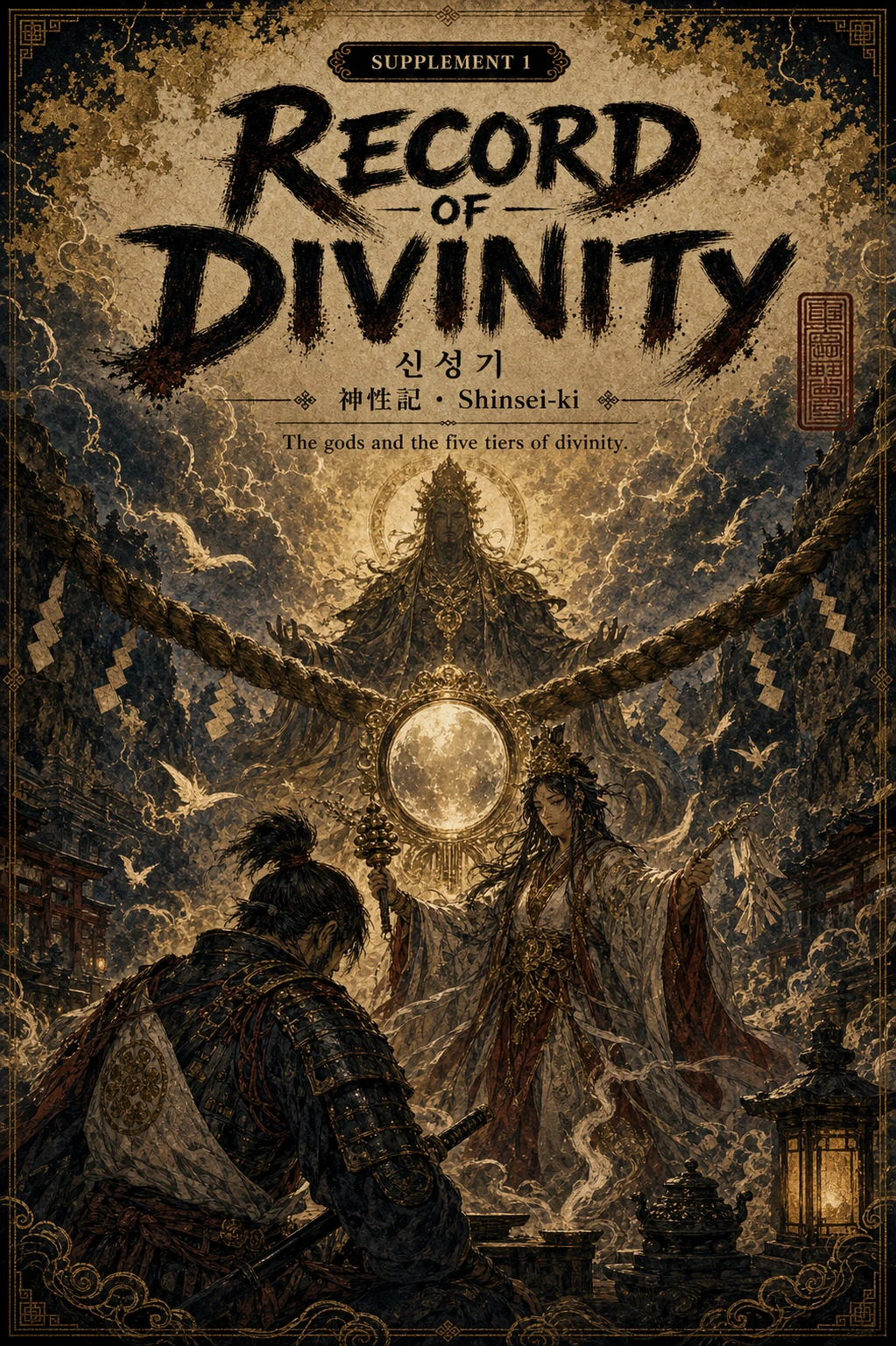
Campaign Module + Data Catalog — fc01 internal only. This supplement carries a separate numeric system called Divinity (神性) that can be layered onto transcendent beings appearing as "gods," along with data on the major gods of Japanese mythology, a limited set of outside gods, unique Divine Artifacts and Sorcery, and scenario seeds. In case of conflict with the main edition (
co) and the expansions (ex1·ex2), the main edition takes priority.
Series specification:
../co/co-99-meta/co-99-03-fc-spec.md
#Scent — Every God Is a God Only Within Its Own Domain
"Every god is a perfect success at what it can do, not a being for whom anything is possible."
The small god who guards the fire in the corner of a kitchen, and Amaterasu who lights the sun at Ise Grand Shrine — these two are within the same system. They differ in scale, but their nature is the same. Within their own place they are distinct; outside their own place they are merely ordinary beings.
This supplement holds every god of Japan under those five roofs — Lesser (微) · Minor (小) · Middle (中) · Great (大) · Imperial (皇) — from the corner of a kitchen to the center of the heavens.
#Meta Card
| Item | Value |
|---|---|
| Series | fc (Focus Series) Volume 01 |
| Title | Shinseiki (神性記) |
| Nature | World-building material (Japanese mythology) + small rules module (Divinity) |
| Expected Reader Time | About 1 hour |
| Dependency | co required / ex2 compatibility optional |
| Authority | Campaign Module (Divinity system) / Data Catalog (god statistics) / Scene Tool (operation) |
| Main Edition Version Requirement | co >= 1.2 |
| Current Version | v1.5 (fc01-VERSION) |
#Production and AI Notice
| Item | Content |
|---|---|
| Creator | Shellman |
| Inquiries and Feedback | X (formerly Twitter) @ds62hg, @trpg_ds62 |
| Generative AI Usage Notice | A substantial portion of this material was produced with the assistance of generative AI (LLM) during the planning, drafting, sentence-editing, and proofreading processes. The GPT Image 2 model was used during the image generation process. Final editing and responsibility for publication lie with the creator. In the event of domestic or international legal changes regarding AI-assisted works, the relevant laws shall apply. |
| License | Unless otherwise noted, distributed under CC BY-NC-SA 4.0. |
#One-Line Description
This supplement treats everything from the small kitchen god of a shrine to Amaterasu Omikami within one system. The name of that system is Divinity (神性). It is orthogonal to dan (段) and can be layered on top of any class data.
#Reading Order (GM)
- What This Supplement Is (5 min) — why "real gods" are a separate system.
- Design Notes (10 min) — the separate-necessity principle, dual structure, omnipotence ban.
- The 5 Divinity Ranks (5 min) — Lesser, Minor, Middle, Great, Imperial.
- Domains (10 min) — what can and cannot be done.
- Mechanics (10 min) — checks, combat, depletion.
- Japanese gods — Index → start from the rank you need.
- The rest is for reference.
Shortest path: read only 1–5 and the Divinity rules run right away. God data can be read just before the encounter.
#Section Contents
#00. Meta
fc01-00-00-index.md— This document.fc01-00-01-about.md— Identity, boundaries of use, the separate-necessity principle.fc01-00-02-design-notes.md— Design decisions and their rationale.
#01. Divinity Rules — Short and Bold
fc01-01-01-divinity-ranks.md— The 5 Divinity ranks (Lesser, Minor, Middle, Great, Imperial).fc01-01-02-domains.md— The domain system and the omnipotence ban.fc01-01-03-mechanics.md— Checks, combat, depletion, return.
#02. Japanese Gods
fc01-02-00-index.md— Genealogy chart, relationship web.fc01-02-01-koshin.md— Imperial Gods (Divinity 5): Amaterasu, Izanagi, Izanami.fc01-02-02-taishin.md— Great Gods (Divinity 4): Susanoo, Okuninushi, Inari, Hachiman, Tsukuyomi, and others.fc01-02-03-chushin.md— Middle Gods (Divinity 3): the major Seven Lucky Gods, Tenjin, Kumano, Sanno.fc01-02-04-shoshin.md— Minor Gods (Divinity 2): village ujigami, ubusuna gods.fc01-02-05-bishin.md— Lesser Gods (Divinity 1): kitchen gods, gate gods, dosojin.fc01-02-06-minor-divinities.md— Minority divinities within Japan: Ainu kamuy, Ryukyu utaki, Buddhist divinities, Kirishitan saints.
#03. Outside Deities
fc01-03-00-foreign-index.md— narrative of their advance, relation to Japan, rules of application.fc01-03-01-foreign-entries.md— Cthulhu / Zeus, Hades, Apollo, Heracles / Odin, Thor, Loki / Surya.
#04. Additional Divine Artifacts and Sorcery (not in co·ex2)
fc01-04-00-divine-regalia-and-rites.md— each god's unique Divine Artifact + kotodama, divine oracle, contract rite.
#05. Scenario Seeds
fc01-05-00-sample-scenarios.md— 5 pieces. The hidden ujigami, Hachiman on the battlefield, a Tatari-turned Inari, the Kirishitan Holy Mother, the southward advance of kamuy.
#99. Appendix
fc01-99-01-cross-reference.md— boundaries and priority against existingco·ex2elements.fc01-99-02-not-in-scope.md— declaration excluding mythic-class yoma.
#Summary of Usage Principles (Must Remember)
- To act as a "god" in a campaign, use arahitogami / Tatarigami (
coclasses). - Divinity is only for when there is a "separate necessity" — when layering a divine attribute onto another class, or when a god is a supporting character or background.
- Divinity is layered onto any dan. A 1-dan Commoner + Divinity 1 is possible. A 10-dan samurai + Divinity 3 is possible.
- Divinity is special only within its domain. Outside the domain, the class stays as is.
- Mythic-class yoma (Jormungandr, Yamata no Orochi, etc.) are not handled here. See
fc01-99-02-not-in-scope.md.
#Connections to Other Volumes
| Volume | Connection |
|---|---|
co | The baseline for arahitogami, Tatarigami, celestial, Divine Artifact, and Faith rules. |
fc04 | Reference when treating Tenman-Tenjin, Onmyodo, and Heian shrine and court faith together. |
fc06 | Reference when connecting divine encounters to thought, faith, and Three Ways and Six Hearts RP. |
fc08 | Reference when distinguishing the boundary between gods and yoma, Tatari-turned beings, and cases of yoma deified. |
ex3 | Reference when treating the structure by which the Edo shogunate manages and conceals shrines, temples, and minor gods. |