#Sando Shinkyo (三道心鏡) — Comprehensive Overview
Contents
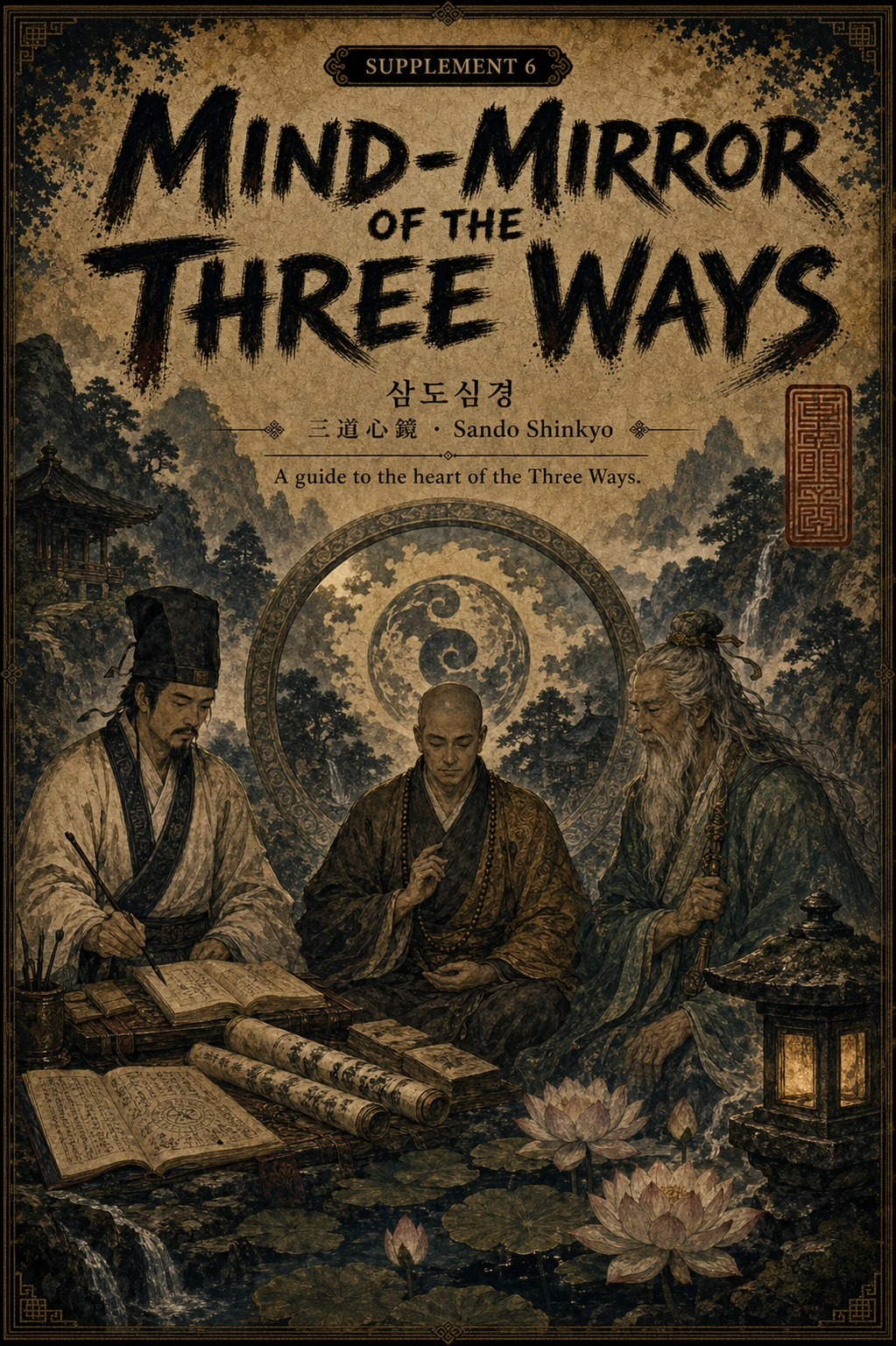
Fiction-Only + RP Guide. This volume adds no new rules. There is no new Sorcery, no new school, no new class, no new data card. It is a commentary for better speaking and playing the faith, Three Ways and Six Hearts, and classes of
cothat already exist.
Series specification:
../co/co-99-meta/co-99-03-fc-spec.md
#Opening Words
The blade of the Sengoku era did not come out of empty air.
The one who gripped the blade thought of his lord. That was the word of Confucianism (儒). He recited sutras for the dead. That was the word of Buddhism (佛). He sought the one breath in which the blade-tip does not tremble. That was the word of Zen (禪). He entrusted his body to the flow of mountain and star and wind. That was the word of xian (仙).
At the table of Konsei Reiyotan it is the same. When a samurai speaks of loyalty, when an esoteric monk speaks of compassion, when a shugenja speaks of austerity, when a Pure Land Monk speaks of the nembutsu, when an onmyoji speaks of the principle of nature — behind those words lies an old stratum of thought and faith.
This volume is a book for reading that stratum.
#Introductory Fragment — Four People Before the Mirror
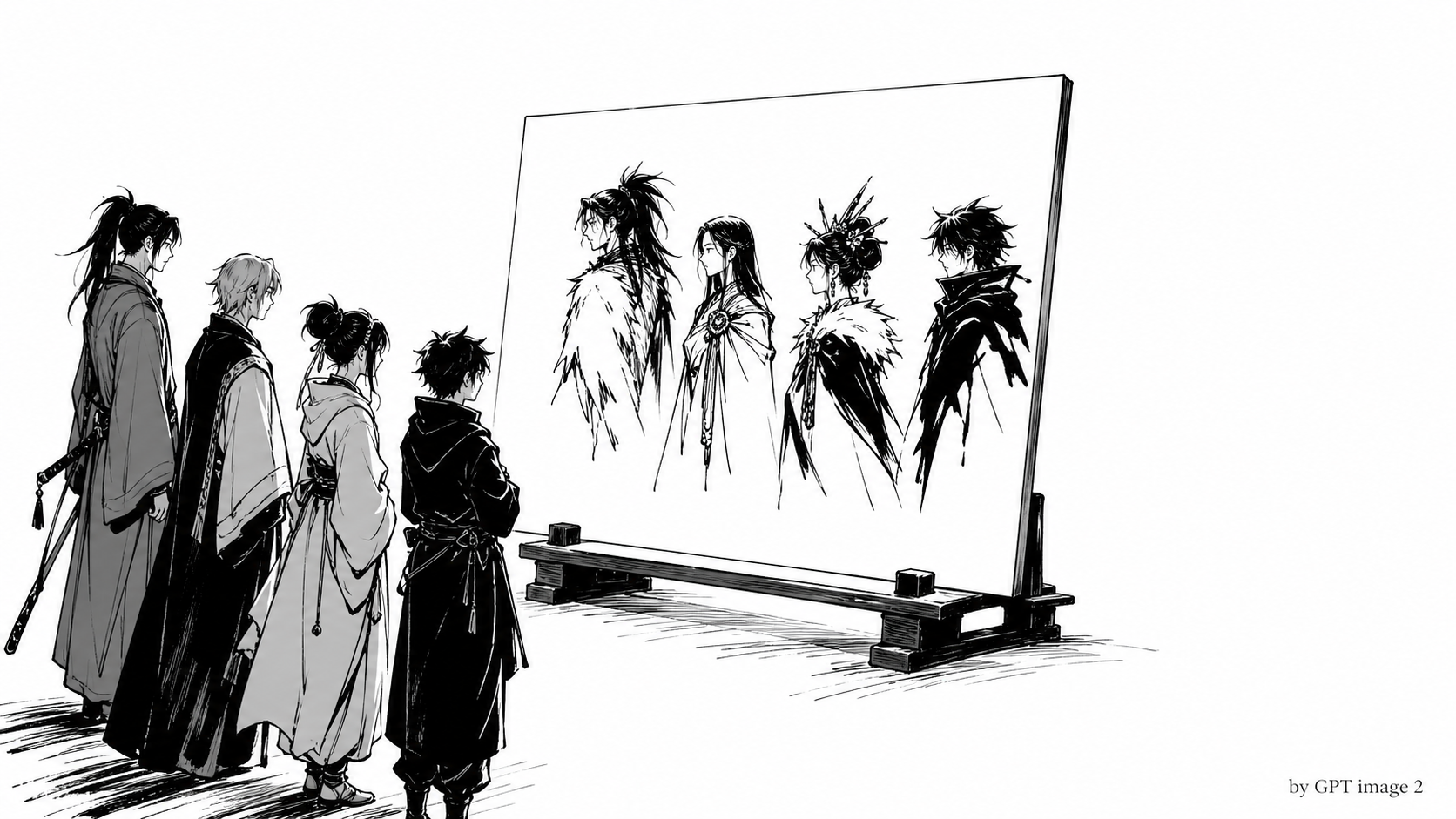
On a rainy night, four people gathered in the guest room of an old temple. The samurai dried his wet order document and laid it on the tatami, the monk turned his prayer beads one by one, and the ronin gazed at his cold teacup. The hermit who had come down from the mountain left the window open a little and was counting the stars between the clouds.
"The order is plain," said the samurai. "I was commanded to empty the village and break the bridge."
The monk raised his head. "Beyond the bridge there are still people who have not even held a funeral. An order is the word of the living, resentment is the word of the dead. Which of the two will remain longer?"
The ronin turned his teacup. "When there are many words, the blade comes late," he said quietly. "But today it seems all right to come late. I still cannot see who the enemy is."
The hermit laughed. "It is not a person who breaks the bridge. The river is already changing its course. The stars and the water say the same thing, yet only humans say things different from one another."
In the bronze mirror set at the center of the room, the four faces were reflected together. No one could look straight at his own face. That night, the Sando Shinkyo gave no answer. It only showed, for each, with what words he would endure his own choice.
#Meta Card
| Item | Value |
|---|---|
| Series | fc (Focus Series) Volume 06 |
| Title | Sando Shinkyo (三道心鏡) |
| Character | History · worldbuilding commentary + RP support |
| Subject | The Confucianism, Buddhism, Zen, and xian thought of Japan from the Sengoku to the Edo period |
| Dependencies | co recommended / parallel reading with fc02 recommended |
| Authority | Fiction-Only + RP Guide |
| Relationship with the main volume | Commentary support for Three Ways and Six Hearts and the Faith of the Sengoku |
| Current version | v1.5 (fc06-VERSION) |
#Production and AI Notice
| Item | Content |
|---|---|
| Creator | Shellman |
| Inquiries and Feedback | X (formerly Twitter) @ds62hg, @trpg_ds62 |
| Generative AI Usage Notice | A substantial portion of this material was produced with the assistance of generative AI (LLM) during the planning, drafting, sentence-editing, and proofreading processes. The GPT Image 2 model was used during the image generation process. Claude Code and Codex were used for the Japanese and English translations. Final editing and responsibility for publication lie with the creator. In the event of domestic or international legal changes regarding AI-assisted works, the relevant laws shall apply. |
| License | Unless otherwise noted, distributed under CC BY-NC-SA 4.0. |
#Scope Declaration
This volume covers the following.
- Real history: how Confucianism, Buddhism, Zen, and xian thought operated in Japan from the Sengoku to the Edo period.
- Konsei Reiyotan standard: how, in a world where yoma are real, this thought takes on a more direct meaning.
- RP support: how to enrich the Three Ways and Six Hearts, the religious classes, and the speech and choices of samurai, scholar, kuge, and Commoner.
This volume does not cover the following.
- additional Sorcery
- additional schools
- additional classes
- new combat values
- historical-paper-style precise verification
#An Important Distinction — Zen (禪) and xian (仙)
The Three Ways and Six Hearts of co take Confucianism (儒), Buddhism (佛), and xian (仙) as the roots of the Three Ways. Among them, the xian of the Way of Mystery (玄道) is 仙, that is, the lineage of Daoism, Shinto, and natural spirituality.
The Zen treated separately in this volume chiefly means 禪, that is, the practice culture of Zen, zazen, and no-mind. Zen is historically one current within Buddhism. Therefore the Zen (禪) of this volume, while being inside the Way of Emptiness (空道), often borders on the language of no-mind (無心), Truth (眞), and the Way of Mystery (玄道).
This distinction is important.
| Character | Reading | Meaning in this volume | Relationship with the co Three Ways and Six Hearts |
|---|---|---|---|
| 儒 | Ju | Confucianism · Confucian learning · Neo-Confucianism · loyalty-filial-piety-rites | the root of the Way of Rites (禮道) |
| 佛 | Butsu | Buddhism in general, including Pure Land, esoteric, and Shugendo | the root of the Way of Emptiness (空道) |
| 禪 | Zen | Zen, zazen, no-mind, the practice language of warrior culture | inside the Way of Emptiness + contact with no-mind · Truth |
| 仙 | Sen | Daoism · Shinto · natural spirituality · the xian-like worldview | the root of the Way of Mystery (玄道) |
#Structure of the Book
#00. Meta
fc06-00-00-index.md— this document.fc06-00-01-about.md— the purpose and use of this book.fc06-00-02-terms.md— the Sando Shinkyo glossary.
#01. Era and Map
fc06-01-01-era-map.md— from Sengoku to Edo, the flow of thought.fc06-01-02-real-and-fiction.md— the difference between real history and Konsei Reiyotan.
#02. The Four Currents
fc06-02-01-confucianism.md— Confucianism: the language of order, loyalty and filial piety, politics.fc06-02-02-buddhism.md— Buddhism: the language of suffering, compassion, Exorcism.fc06-02-03-zen.md— Zen: the language of zazen, no-mind, form.fc06-02-04-three-teachings-in-daily-life.md— the Three Ways in daily life.fc06-02-05-xian-and-gendo.md— xian (仙): the language of the xian, Daoism, the Way of Mystery.
#03. RP Commentary
fc06-03-01-confucian-rp.md— Way of Rites RP: the words of loyalty and Hegemony.fc06-03-02-buddhist-rp.md— Way of Emptiness RP: the words of compassion and Void.fc06-03-03-zen-rp.md— Zen RP: between no-mind and Truth.
#04. Konsei Reiyotan Operation
fc06-04-01-three-ways-six-hearts.md— Three Ways and Six Hearts interpretation support.fc06-04-02-religious-classes.md— religious-class RP support.fc06-04-03-gm-scene-tools.md— GM scene tools.
#99. Closing Words
fc06-99-00-closing.md— when returning to the table.
#Connection with Other Volumes
If fc02 is a book that broadly illuminates the people and folkways of the Sengoku era, then fc06 is a book that digs into what those people believed to be right.
fc02 Sengoku Folkways | fc06 Sando Shinkyo | |
|---|---|---|
| Center | era · people · yoma | thought · faith · heart |
| Character | Scent (香) reading material | Scent + RP support |
| Rules | none | no new rules |
| Main use | the mood of the era | Three Ways and Six Hearts · class RP · NPC motive |
| Question | "What kind of place is that era?" | "What does that person believe?" |
| Volume | Connection point |
|---|---|
co | The standard for the Three Ways and Six Hearts, faith, and religious-class RP. |
fc02 | Reference when reinforcing the people and folkways of the Sengoku era with the language of conviction. |
ex3 | Reference when treating the Edo Confucian order, temple registration, and the language of status and law. |
fc07 | Reference when the same Three Ways and Six Hearts lean toward the dark side and the way of evil. |
fc08 | Reference when treating how the desire of yoma, ghost stories, and human belief mesh together. |
#One-Line Invitation
"Before you take up the blade, ask what that blade serves."
The mirror that reflects the heart gives no answer — it shows only the hand that took up the blade, clearly.