#Hokuriku and Shinetsu Observation (北陸·信越見聞)
Contents
Authority. The main text is Fiction-Only — the record of one outsider, in which fact, rumor, and misunderstanding are mixed. Only "At the Table" at the end is Scene Tool. This volume has no Law (法) — if you need numbers, go to the canon
co. The promise of this whole book is in About This Book, and the one who wrote this diary is in The Narrator — the Nanban Brush.
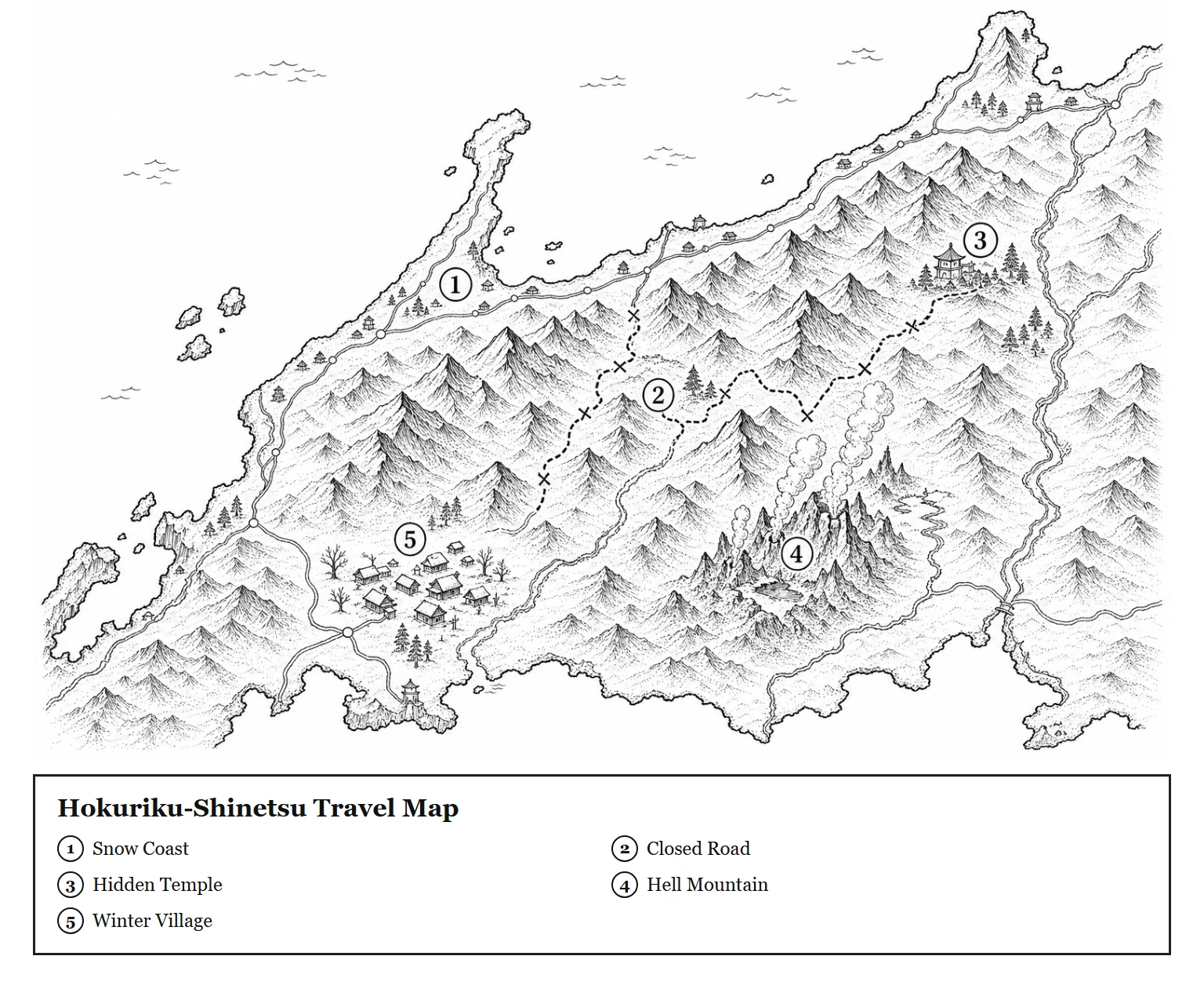
The old provinces covered — the Hokuriku Road (北陸道): Wakasa (若狹) · Echizen (越前) · Kaga (加賀) · Noto (能登) · Etchu (越中) · Echigo (越後) · Sado (佐渡) / the Shinetsu highlands: Kai (甲斐) · Shinano (信濃) · Hida (飛驒). The three mountain provinces belong, by the old road system, to a different road, yet the narrator's feet bound them by the mountain range — the proper table of assignment is held by the Cross-Reference Table.
#The Road — First Snow
From Pinto's diary. Forsaking the eastern sea-road and turning north — the day I crossed two passes.
From morning the sky was low. The clouds had come down to the mountain's waist. The Tongue looked long at the sky, then said. "It comes today."
"The rain?"
"No. The winter."
It came while we were climbing the pass. At first I took it for ash. From the ashen sky white crumbs fell and settled on my sleeve, and as I made to brush them off I stopped my hand. The crumbs had shape. Needle-like branches, six of them, stretching out from the center like a star. While I peered in with a merchant's habit of examining goods — it turned to water and was gone.
It was snow. Having lived past forty by some years, I touched snow for the first time. In my country snow was the white cap of a far mountaintop. That it came down from the sky and settled on a man's sleeve, I did not know.
I made to write that it was beautiful. Just then I saw the steps of the porters quicken. None looked up at the sky. All walked looking down at the road — like people trying to take into their eyes the road while it was still there.
In half a day the reckoning of the world changed. The border of road and field was erased, the border of road and brook was erased, and at last the road itself was erased. I asked the Tongue. "Where has the road gone?"
"It is gone," answered the Tongue. "In this land the road is not there until spring."
Entering the village below the mountain, the people were driving poles into the roadside. They were poles twice a man's height. When I asked the reason, they said that when the snow piles higher than a man's height, only the tips of the poles remain. From pole to pole — that, they said, is the road of winter.
An old man of the village lent me a thing shaped like a bear's footpad. They are footwear that bind bent tree-branches to the feet, and worn, one sinks less into the snow. I fell three times in ten steps, and the children held their bellies under the eaves. It seems the spectacle of an outsider sinking into the snow had become this village's first game of winter.
The Sword hated the snow. When I asked the reason, he was short in the manner of the Sword. "The footsteps die." To a guard, snow is — a curtain that erases the sound of what approaches.
By the hearth the old man said. When the snow comes in earnest the village becomes an island. They lay in half a year's stores and half a year's firewood, and watch over one another's roofs and endure till spring. "It is not that we are shut in. We shut." While the Tongue carried the words over, the old man made the gesture of barring a door.
Unlike us, the north people of this country do not count winter as a season of rest. Winter is a sea that must be crossed. All through autumn they load their cargo, and with the first snow they raise anchor.
I set it down in the ledger. When snow erases the roads, people memorize the roads. They drive poles into the memorized road, and when even the poles are buried — they bar the door and wait for spring.
What I learned today is this. In this country there is a season when the road dies. This I saw.
#1. The Land of Fact — The Half-Year of Snow, the Roof of the Mountains
Forsake the crowded highway of Tokai and turn north, and there is the northern land-road — the Hokuriku Road. In the Overview I set down that within one country there is a country of summer and a country of winter, and here is that country of winter. Between the northern sea and the spine of the mountains a narrow, long land is wedged, and from Wakasa to Echigo the provinces are strung in a single line. Behind their backs are the Shinetsu highlands — Kai and Shinano and Hida. I set down that 7-tenths of this country's land is mountain, and the chieftains of those mountains are gathered here. I heard those who travel the roads call this range the roof of Japan. The word roof is right — snow piles on the northern slope of the roof, and that snow decides the whole of this chapter.
Snow rules the half-year. The houses were built to suit that half-year — roofs raised like a blade to shed the snow, thick pillars like a ship's keel, deep eaves. When the snow tops the eaves the people dig snow-tunnels between house and house to pass to their neighbors. To bring down the snow from the roof is, in this land, a daily task like cooking rice — a lazy roof caves in before spring comes. The reckoning of the road too had to be learned anew. A column that makes six or seven ri (里) a day on bare road, on a snow-road counts it a good day to fill two or three ri — the sense of ri and cho (町) I leave to the Glossary & Weights and Measures.
In place of the land-road being buried, this land uses the sea. Cargo-boats string the northern coast from harbor to harbor going down. The rice and cloth of Echigo, the fish and salt of Noto, the paper of Echizen are loaded on boats and reach the harbors of Wakasa and Echizen, and from there cross a pass to the lake of Omi, and from the lake go to Miyako (Kyoto). The cargo of the north country I saw in the market of Omi came by this road. Only, this sea-road too has its season — the north wind of winter makes them haul the boats up onto land, so the autumn harbor of the north country is crowded like a storehouse before winter. This I saw.
I set down one line for each province. Wakasa is the kitchen of Miyako — the fish of those small harbors crosses the pass through the night, they say, and comes up onto the morning table of the capital. Echizen makes good paper. The latter half of my diary is set down on Echizen paper — not what I saw, but what I wrote. Noto is a peninsula like an arm thrust out into the sea, with many good harbors where cargo-boats put in to escape the wind. Etchu is a province where, just behind the fields, a great mountain stands at once — the tale of that mountain I set down later. Echigo is the snow country even among snow countries, and the cloth woven within that snow is white and tough and sells far.
Off Echigo, Sado floats. From of old it is, they say, an island of exile to which highborn offenders are sent. And there is a rumor that gold comes out of it — only, the value of the rumor as each harbor named it was all different. When the value of a rumor is all different, a merchant closes his purse. I did not cross. The winter sea barred it — and had it not barred, to put out a boat carrying only a rumor is not trade. A tale I was told, all of it.
The mountain-side provinces live a different reckoning. Shinano is a province of high fields and passes, where the roads of all four quarters cross — the fields being narrow the rice is little, but the road-junctions are many and there is the profit of the junctions. Kai is a basin ringed by mountains, where the fields are rich and the horses good, I heard — I could not take that road. Hida is the province where the mountains are deepest — that tale too I only heard, so I set it down in the chapter of people.
#2. People and Customs — People Who Work Shut In
The snow falls fairly. So the work too is shared fairly — a saying of the people of this land. The turn for bringing down the snow from the roof, the duty of cutting the pole-road open again, the charge of watching over the roof of an old man left alone, are fixed by the law of the village. Unlike us, the north village of this country becomes a single boat each winter — for if one man is lazy, all sink.
A shut-in hand does not idle. Through the half-year shut by snow, every house weaves at the loom, twists rope, carves wood, makes paper. What is sold in spring is made in winter. In Echigo they spread the cloth woven in winter over the late-winter snowfield to bleach it, and the cloth on the snow grows white little by little in the sunlight — this I saw. That the snow bleaches the cloth I came to know only on coming to this country. That the winter being long the hands are deft, the Tongue had said early on, but only on coming to this land could I weigh the weight of those words.
Of Hida — I could not take that road. Only, the tale that the carpenters who built the great temples and great mansions of Miyako came from Hida I heard from the people of three lands that could never have met one another. A province so deep in the mountains that it has no rice-paddies raises a man's hands into fine craft, and sends out those hands to make its living. When the mountain cannot feed the man, the mountain raises the man's hands — a reckoning worth setting in the ledger.
In the mountain winter there are those who hunt. They band together and enter the winter mountains to take beasts, and while they are in the mountains they cast off the village tongue and use a separate mountain tongue, they say. It is because the things of the mountain can make out a man's speech, they say. A tale I was told — but that those who use the mountain tongue live in the mountains and come back longer than any of the lowland is a thing worth working out by reckoning.
I saw, too, those who chase gold. In the harbor of Echigo were men rolling dice while they waited for the spring boat — men meaning to cross to Sado. I heard too the tales of those who wander the mountains seeking a vein of gold. The gold of the mountain becomes the rumor's before it becomes the lord's. And rumor sells faster than the miner.
#3. The Land of Konsei — A Country Held by the Common Folk
Hearing that I was entering a country with no lord, I hid my purse deeper than usual. I took it for a land with no law. At the mouth of Kaga there was a barrier. There was a toll too. Only, the one who collected wore prayer-beads instead of a sword, and above the gate hung, in place of a lord's crest, a banner bearing the name of the Buddha — 南無阿彌陀佛. This I saw.
I set down the tale I was told. In the west of this country, by a great river near Miyako, there is a fortress that is at once a temple and a castle — Ishiyama Honganji — and there is a great monk there called the Shonin. The teaching that whoever calls on Amida Buddha goes to paradise came out of that temple, and twenty years ago that teaching raised the common folk. It did not take long for the wave to reach the north country. A north-country domain that drove out its daimyo a generation after the uprising — so say the people on the roads of Kaga. On the lord's castle, they say, the temple's banner was raised.
A country held by the common folk, I was told. Going and asking — the folk said it was the Buddha's country, the temple's monks said it was the country of the congregation, and the old man of the marketplace only laughed. It is not that there is no one who rules. It is that there are many who rule. I saw the temple's monks and the heads of the congregation and men in warrior's garb seated on one floor hearing a suit — this I saw. Unlike us, in this country those who drove out the lord take over the lord's work just as it was. There were those who said the toll had grown light, and those who said only the name of the toll had changed — I set down both.
The market stood, and the price of rice did not differ greatly from the neighboring provinces. The hammer-sound of the artisans who make armor did not break off either — the armor of Kaga, they say, sent its name far. Even with no lord, armor sells. For war is everywhere. Only, one strange reckoning of this country is worth setting down. The body is in the north country, but the head is beside Miyako — on the roads of Kaga I saw the columns of donations and documents going to the western fortress-temple, and I heard that the commands coming from the west decide the great matters of this country.
Editor's note: The base of the Ikko-ikki is not Kaga but the riverside fortress-temple Ishiyama Honganji — the data of the power and its troop types, and the war with the Kagura domain, are held by the canonical Powers of the Sengoku. Kaga is the domain whose daimyo that wave drove out, and whether the floor of consensus that Pinto saw will hold on from here is decided by the table.
In Shinano I met a different kind of presence. The lord of Kai and the lord of Echigo fought several times and drew several times on a riverside field of Shinano, they say — a tale I was told. Both names were spoken of like tigers, and that two tigers cannot live on one mountain was the reckoning of the people of this land. What I saw was the column of banners crossing a far ridge, and the village that shuts its mouth at the sight of those banners. Beside a war that does not end, the price of horses and the price of rice rise together — a market-rate I set down as a merchant and would not wish to set down as a man.
And there is gold. Around the rumor of a mountain where gold comes out, always the same faces gather — those who would dig, those who would collect, those who would block. There is no mountain that is no one's. For the moment the rumor goes round, it becomes everyone's.
#4. The Land of the Uncanny — The Mountain Where a Hell Lies
Look south from the fields of Etchu and a white mountain stands like a wall. They call it Tateyama. That there is a hell within that mountain, the people of this land say as if it were nothing. A whole valley is boiling, they say — pools boil, yellowed smoke leaks from the cracks in the rock, and birds flying above it fall. Tales of having seen the dead in that valley are common in this land. The hell is not a place one goes to in death, but a place one can walk to. I could not climb it — the winter mountain has no road, and had there been a road, I would not have had the legs. So this is a tale I was told. Only, at a village temple an ascetic spread out a painting and showed it to me — a single mountain drawn whole, with a boiling hell at its foot and paradise at its peak, held in one painting. We bury hell beneath the ground and do not look up at it, yet the people of this country give hell an address and — go to worship at it.
I heard too the tale of the women's rite. Since this mountain does not admit women, on a fixed day of the year the women cover their eyes and cross a bridge laid with white cloth, they say. This side of the bridge being hell and the far side the Pure Land, while they cross over the cloth the sins of the one who crosses are washed away, they say. When I asked the reason for covering the eyes, the ascetic answered — because what is seen while crossing differs from person to person. I chewed on that answer for some days.
Editor's note: On the list of candidate sites for the Spirit Realm rifts the canon reckons (the Timeline), Tateyama is not. Whether that boiling valley is truly a mouth that opens onto somewhere, or merely a picture that faith has painted — the canon does not decide, and this volume does not decide. Whether to use this mountain as a thin place is the GM's.
I heard one tradition too from the Hida side, where the mountains are said to be deepest. In a great shaking in my father's day a mountain caved in and buried a castle in a valley whole, and a lake was born overnight on the stopped-up river, they say — a tale I was told. That the roofs are still there as they were beneath that water, every one who told it lowered his voice.
The tale of the snow-woman was at every hearth. On a night of blizzard, before one who has lost the road a woman in white robes appears, they say. Beautiful enough to chill the flesh, she calls one to come near — and the one who goes does not return. Now and then, taking pity, she lets one live and sends him back, but on the condition, they say, that he not speak of what he saw that day. So this tale has no witness. That there is no witness is itself the proof, the old man by the hearth said. By a merchant's reckoning it is a logic hard to take down — but to the sound of the blizzard knocking at the door that night, I too in the end did not answer. This tale is in every land where the snow falls, they say. Only, as deep as the snow, here the tale too is deep.
At Zenkoji in Shinano I saw the opposite thing. The principal image of that great temple is a hidden Buddha (秘佛), they say, and none can see it — not even the abbot can see it. And yet, no, because of that, people come from all over the country. Being a temple whose gate is open without distinction of rank and to women too, beggar and highborn sit in one row on the floor. I joined the column groping its way round the pitch-black corridor beneath the main hall — they say that to touch the lock on the wall in the darkness is to be bound in karma to the principal image, and the outsider's hand too touched that lock. This I saw — is what I cannot write, for nothing was visible. We doubt even the god whose face we have painted and enshrined, and they do not doubt a Buddha they have never once seen. The people of this land say that, dragged even by an ox, once in a life they go to Zenkoji.
From the courtyard of Zenkoji I saw the mountains to the east. When the snow withdraws I will cross those passes and go down to the broad fields. When the fields are broad the war too is broad, said the Tongue — that reckoning I will make in the next chapter.
#5. At the Table
Scene Tool. Only this section is a GM scene tool.
Winter isolation is a closed room. A village shut by snow is in itself the stage for a sealed-room scenario — no one can come, no one can leave, and until spring there are only the people (and the not-people) within it. The clock is sufficient with stores and firewood and the depth of the snow, and no numbers are needed — so long as the party does not know what is outside the door. What waits at the joints of the snow-road is held by Village, Road, and Mountain Yoma, and the face of the snow-woman is in The Faces of Yoma.
A country held by the common folk is used as a question. A domain without a daimyo is a social stage of a different cast for the party — suits are heard on the floor of a temple, leave to pass hangs on the congregation's consensus, and whether the party's employer is one welcomed in this land becomes a question from the start. For the data and the situation of the Ikko-ikki open the canonical Powers of the Sengoku; for the famed armor of Kaga, Masterworks.
The infiltration of the gold mountain begins with a rumor. Sado is a closed box — the boat that enters is another's, the boat that leaves is another's, and in winter there is not even that boat. It is for the GM to decide, beginning with whether the gold is truly there. Even if the rumor is false the scenario stands — for those who staked money on a false rumor are already on the island.
The advance through snow is decided by the mountain. Give a circumstance that forces a winter pass to be crossed — a barrier about to close, pursuers, a message that comes too late in spring — and attach a guide who has memorized the road. The moment the guide is lost, the master of the scene turns into the mountain. The materials on the road (barriers, fords, lodging, night-roads) are in Roads and Travel; if more incidents are needed to roll, open Incidents of the Road.
Five hooks.
- First Snow and a Race — one load must be carried over the pass before it closes. The load is heavy, the sky is low, and one who would slow the party is within the column.
- The Village Without Smoke — not a single thread of smoke rises from the village at the end of the pole-road. Go in, and a meal is laid out in every house — long since gone cold. Snow records footprints, and erases them too.
- A Suit in the Buddha's Country — in Kaga the party's employer is caught in a suit. On the floor that judges sit a monk and the congregation and a warrior, and before the verdict a witness from an outside province is needed — before the road closes.
- Crossing the White Bridge — a woman asks for escort as far as the cloth-bridge rite of Tateyama. She means to go and see her dead in the valley. Someone does not wish her to arrive — one of the living, or not.
- The Man from the Golden Island — a man said to have fled from Sado holds in his breast the proof of a vein of gold. Those who would buy and those who would seize and those who would shut his mouth come in turn. Whether the proof is real — there is no harm in deciding at the last.
Snow can only erase the road — the one who has memorized the road, it cannot erase.