#Kanto Observation (關東見聞)
Contents
Authority. The main text is Fiction-Only — the observation of one outsider, in which fact, rumor, and misunderstanding are mixed. Only "At the Table" at the end is Scene Tool. This volume has no Law — the master table of this land's powers, yoma, and major events is held by the canon Lands of the Sengoku. The promise of this whole book is in About This Book; the one who wrote this diary is in The Narrator.
The old provinces covered — Sagami (相模) · Musashi (武藏) · Awa (安房) · Kazusa (上總) · Shimousa (下總) · Hitachi (常陸) · Kozuke (上野) · Shimotsuke (下野) — Izu (伊豆) I looked at apart, with Observation 7 — Tokai.
#The Road — The Price of a Single Pass
From Pinto's diary. Several days since I left the land of snow and came down south.
From the mountain provinces I came down again to the eastern sea-road. A road once trodden is shorter the second time. It is not the road that changed but my own legs.
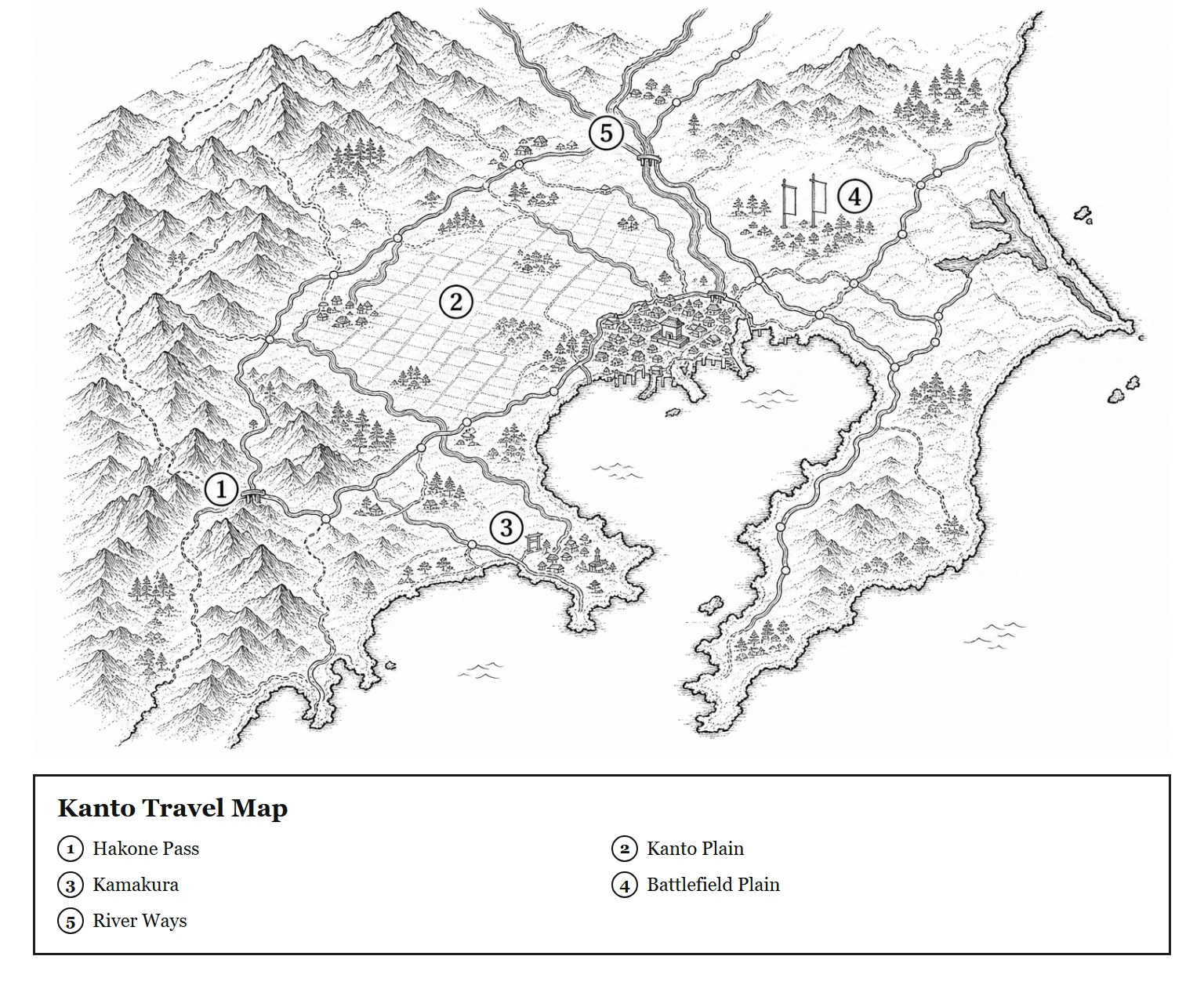
Today I crossed Hakone (箱根). More than a pass it has the shape of a mountain seated again atop a mountain — half a day to climb, half a day to descend — and here I paid again the reckoning of this country, that one great pass devours a whole day.
Atop the pass there was a lake. It was the mouth of a mountain that long ago spat fire, said the Tongue. The water was black as ink, and though the wind passed over it the wrinkles were slow to smooth out. This I saw.
As I warmed myself by the fire at the lakeside, the Sword opened his mouth. "From here on it is the land of the sword."
It is rare for the Sword to open his mouth first, so I stopped my brush. "In the west, too, they all went about wearing swords." When the Tongue carried it over, the Sword shook his head. "In the western provinces the sword is courtesy. In the eastern provinces the sword is livelihood. It cuts in even on settling the bounds of a field, on dividing a waterway, on a marriage."
"Are you a man of the eastern provinces?" The Sword answered after a long while. "There was a time I was." I asked nothing further. People on the road do not ask one another's histories.
On the way down the fog lifted, and below my feet I saw the sea and — a great town seated clinging to the sea. Odawara (小田原), they said. Whether the castle held the town or the town held the castle, from above I could not tell apart.
"That castle has never fallen, they say," said the Tongue. "The wall surrounds the whole town, so those inside, they all say, would not starve through ten years of siege." Who had counted out those ten years I did not ask. A tale I was told.
I lodged a night in the town. In the market the neighing of horses was more than the sound of silk, and those wearing swords were more than those holding brushes. This far it is still a town of the sea — the sound of haggling at a harbor resembles itself in every country.
From the next day on, the plain began.
At first I set down a good plain. On the third day I set down a plain without end. On the fifth day — I set down a plain that resembles the sea, and after that I set nothing down. Land where no mountain can be seen I walked for the first time, having come to this country.
Unlike us, the people of this country do not build a great city in the middle of the plain. In my homeland, where a plain is this much, a tower and a cathedral stand at its center. Here, the farther toward the middle of the plain you go the sparser the people grow, and the villages climb up onto knolls to sit, avoiding the water.
The Sword grew more talkative after we entered the plain. On a certain knoll he gazed a long while at a troop of mounted warriors vanishing over the horizon. I resolve not to set down that face.
In the evening I open the ledger and set down. Where the plain is broad, horses grow fast, and where horses grow fast, war grows fast too. If there is one who asks the price of this plain — reckon it not by the price of grain but by the price of the hoof.
#The Land of Fact — A Plain That Resembles the Sea
#A Broad Plain, a Rough Plain
That 7-tenths of this country's land is mountain I have already set down. As for where the remainder of that reckoning gathers, half of it is here. Kanto is the broadest plain I have seen in this country, and the people bind these eight provinces together and call it the warrior land.
Only, broad and tamed are two different words. Unlike us, on this country's plain the ground where reeds stand is wider than the ground that has been turned over. If the plain around Miyako (Kyoto) is woven with paddy-dikes as if measured with a rule, the Kanto plain has paddy and marsh and reed-field and scrub-wood mixed like the dappling of a great beast. Walk it and you know — the road does not join village to village, but joins dry ground to dry ground.
#A Land Whose Master Is Water
The reason is water. Several great rivers flow through this plain, and the foremost is the Tonegawa (利根川). The river comes down from the northern mountains, winds about the plain as it pleases, and enters the sea at the southern inlet. When the great water comes year by year the river changes its road, and last year's paddy becomes this year's marsh. That the villages sit on knolls and the shrines sit a step higher than they is for this reason. The master of this plain is not the lord but the river — the lord might change, but the river does not stop its reckoning.
So in the inner part of the plain the boat takes the place of the road. Flat boats poled with a pole pass between marsh and marsh, and the boatmen, since the waterways change year by year, do not draw a map but commit it to memory. When I asked how many days it takes to cross the plain, the boatman answered, "That depends on the rain" — the most honest milestone in this country. For the sense of ri (里) and cho (町), keep the Glossary & Weights and Measures at your side.
At the inlet where the river meets the sea there is a fishing village called Edo (江戶). It is a small village where only the sound of boats being hauled among the reeds is heard. Yet I set down a line in the ledger — every waterway there is gathers into this inlet, and that no great town stands here is strange to me. The land has already set out a market, but the people have not yet come, is the shape of it. This is what a merchant's eye says, so if the reckoning is wrong, blame my brush.
#Horses and Iron
In the north of the plain, at the mountain foot of Kozuke (上野) and Shimotsuke (下野), there are pastures (maki). On slopes without even a fence horses are loosed in droves, and the colts grow up taking the wind of the plain. The horses of this land are thicker of shin and fiercer of temper than the horses of the western provinces — the horse-trader counted that not a flaw but a price. Half of the name "warrior land" is supplied by these pastures.
In the mountains iron comes forth, and so do the things that go into gunpowder, I heard. The mine and the kiln being the lord's, they were not shown to the outsider, so I only guessed at that reckoning from the sound of hammers on the smiths' street. A tale I was told.
In winter a dry wind drives down from the northern range onto the plain. The mountains take all the snow, and onto the plain comes only the wind. What that wind carries with it — I set down in the chapter of the Uncanny.
#People and Customs — A House-Style on Horseback
#The Bando Warrior
The eastern warrior the people of Miyako call coarse-boned (bukotsu). It is a word used to mean rough, but having come and seen, it is less rough than old. As our nobility stands by its genealogy, the warrior houses of this land stand on horseback — what a father hands to a son is, before the deeds to a domain, the bow and the saddle. I heard it said that a child is seated on a horse's back before it can even walk, which must be exaggeration, but a good exaggeration. In the yard of one mansion I saw a child of six or seven shoot at a target from atop a running horse. One of three shots struck, and at the two that missed no one laughed. This I saw.
Courtesy too resembles the horse. When I gave here the greeting I had learned in Miyako, I was laughed at for its length. The eastern greeting is short, the reckoning swift, and a price once set was not discounted. Unlike us, these people count the dressing-up of words a shame, and count short words trustworthy. As a merchant — there is no delight of haggling, but in exchange it is a land with little fear of being cheated.
At Katori (香取) in Shimousa (下總) there is, they say, an old shrine that enshrines the god of the sword. There is a sword-house (kenke) that learns the sword before that god, which the warriors of the eastern provinces visit without grudging the long road, they say — I could not take that road. A tale I was told.
#Kamakura — The Dead Capital
On the coast of Sagami is Kamakura (鎌倉). Long ago — some hundreds of years ago, they say — the warriors of this country first held the realm in their own hands and set up a government called the shogunate (bakufu). That government collapsed long ago, and the Kamakura of today is a town that lives only on the memory of having been a capital.
Miyako was half ash and half market. Kamakura is half grave and half shrine. Among the foundation-stones of a collapsed temple-site a field had been set, and an old man hoeing said, "This was a great prayer-hall long ago," and then hoed again. The town is dead but the road is alive — the warriors of the eastern provinces come on pilgrimage without cease. To them this town is not a ruin but a proof. Proof that a warrior, too, can hold the realm.
In the middle of the pilgrimage is Tsurugaoka Hachimangu (鶴岡八幡宮). Hachiman is the god of war, they said. The day I went happened to be a festival rite, and I saw the rite of galloping a horse at full speed while shooting and shattering three targets in turn — they call it yabusame (流鏑馬). Each time an arrow shattered a target the priest raised a cry, and the warriors answered so that the ground rang. What we offer in our cathedral as prayer sung in song, these people offer with hoof and arrow. This I saw.
Toward the coast a great Buddha sits in the open. Cast in bronze, its seated height was about the mast of our ship. Originally it dwelt within a prayer-hall, but after the great water came in and took the house away, they say, the Buddha alone remained. Of the Buddha, roofless and taking the rain, the Tongue said, "Having lost its house, it still sits so, and the people of the eastern provinces believe all the more."
#The Land of Konsei — The Plain of Banners
Where the plain is broad, armies enter. If the war of the western provinces is a narrow war disputing castles and passes and water-gates, the war of Kanto is a broad war where several thousand horse collide head-on in the middle of the plain, they say. I did not see a pitched battle (gassen) with my own eyes, and I count not having seen it a blessing. What I saw is its edge.
I once passed a village on the eve of a pitched battle. The village was quiet, but the manner of its quiet was strange — the storehouse was empty, in the yard there was a pit freshly capped with earth (the place where rice was buried, the Tongue whispered), and the young women and the children were not to be seen. The headman said he had sent them to the mountains. And then he had bound up in advance two matching sets of tribute of the same goods, so that he could offer it whichever of the two armies won. Unlike us, the common folk of this land treat war like a natural calamity (tensai) — since it cannot be stopped, they let it pass through.
To the tail of war, trade attaches. There are traders who follow the army about and sell rice and straw sandals to the camp, there are those who gather up armor and swords on the field where the fighting has ended and sell them — and there are those who gather up people, they say. The one taken away cannot return until a ransom is paid. This I set down, unable to bring myself to ask further. A tale I was told.
Of banners I set down only briefly. Several great banners stand on this plain, and not one of them has yet covered the whole plain. The master of that castle of Odawara — the one that has never fallen — is but one among those banners. The names of the banners I do not set down. Half of them will have changed before I leave this country.
There is one more name I do not set down. The castle lords of Kanto fear the wind. At night they check the bar of the castle gate twice, set the watch in double, and even so by daybreak the ledgers vanish from the storehouse — on such a night the people roll the name Fuma (風魔) only inside their mouths. Those who bear the name of the wind move in the dark, is the meaning. When I asked the Tongue further, he refused to interpret for the first time. "That name is not a thing to be said twice." A tale I was told — and a tale I resolved to hear no further.
At a few villages by the river I heard a familiar invocation. The banner of that Ikko (一向) I had seen in the north country had put down roots at the waters of this plain too. Villages chanting to Amitabha in the middle of the warrior land — with what eye the lords regard those villages was plain to see, without my needing to ask.
#The Land of the Uncanny — The Night of the Plain
The night of the plain is different from the night of the mountains. The night of the mountains is a night when you do not know what has hidden, and the night of the plain is a night with nowhere to hide. When the sun goes down, darkness covers to the plain's end in a single sheet, and far off the lights of the villages float like the lamps of the sea. What crosses the darkness between those lights — this chapter is that tale.
In the mountains that ring the plain there live oni (鬼), they said. The villages at the mountain foot ring themselves with stockades and hang a bell in the watchtower, and when I asked whether it was for brigands the headman answered, "If it were brigands we'd be lucky." On a night when there is something coming down from the mountain they strike the bell, and when the sound of the bell is heard the neighboring village raises torches — the villages of the plain become one another's lamps in this way. The bell I saw, and what the bell calls I only heard.
In the dry wind of winter there is a sickle mixed in, they say. Walking the road, your shin splits without your even knowing you were cut, and strangely the blood comes late and the pain comes late too. The people called it kamaitachi (鎌鼬) — the work of a weasel bearing a sickle. The weasel I did not see, and the wound I did see. The seen and the heard lie one over the other upon a single wound, so I set down both.
There is also a thing that cries in the night sky. When a cry that is neither bird nor beast is heard from within the clouds, the villagers shut their doors and set down on paper the direction the cry came from. The nue (鵺), they said — that cry is the foresound of some ill thing, so if you set down the direction, the calamity passes you by. There was also a tale that in the marshlands a giant thing resembling an ox appears — the gyuki (牛鬼), they called it, and the boatmen shrank even from putting the name of that marsh to their mouths. Both are tales I was told.
And on this plain, there is a thing that arises because it is a field of pitched battle, they say. When the fighting ends, the winning side departs and the losing side lies down. The bones left on the field, the gathering hands being too few — they call one another night by night. When bone calls bone and they gather like a mountain, a giant thing in the shape of a man rises and walks the plain gnashing its teeth. The gashadokuro, they said. Hear that gnashing of teeth, and the bones of the hearer know it first. I did not hear it. Not having heard it, this time too I count a blessing.
Editor's note: The working of the nue, which announces what is to come by its cry, is in Beasts, Objects, Places — Yoma; the gashadokuro, where ungathered bones rise, is in Onryo, Wraiths, and Curses. The sound Pinto did not hear is there.
#The Headless God
The greatest faith of this plain was in neither temple nor shrine. It was in the small graves atop the embankment.
Some hundreds of years ago, in this eastern province a warrior rose against the court of Miyako and proclaimed himself a New Emperor (新皇), they say. Taira no Masakado (平將門) — the fighting did not last a year, and his head was sent to Miyako, but the head, on its own feet, no, on its own wings, flew through the sky and returned to the eastern provinces, is the tale. At each place the head came to rest a grave was set and a shrine was set. Near the inlet of Edo too there is one such grave, a knoll in the middle of the reed-field, and the fishermen went round their boat-route just to offer it sake.
Seen from the court, he is a traitor. Seen from the eastern provinces — I set down as it was the words of the old boatman the Tongue carried over. "The lord of Miyako takes from us, and that lord had his head cut off for us." The same man is a criminal's name in the west and a god's name in the east. This discord, I set down, is the warriors of this land themselves — what Miyako calls coarse, these people call pride.
The grain of that faith is double. One who carelessly tears down a grave or passes over it takes harm, they say — lightning, a fall from a horse, sickness in the house — so they enshrine it in fear, and at the same time the warriors going out to a pitched battle pour sake at that shrine. Being a god that knows what a losing fight is, he does not cast off the prayer of the one who loses, they say. Fear and reliance sit together upon a single knoll. A tale I was told — only, in no village did I hear it differently.
Editor's note: The life of the headless god — the first rebellion of the eastern provinces and the single year of the "New Emperor" — is in The Dawn of the Warrior; the place the flown head left in the onryo culture of Heian is in Aristocratic Yoma — Living Spirits and Onryo. What this volume sets down is only as far as how that tradition is enshrined in the eastern provinces now — what truly exists beyond that faith is decided by the table.
#The Dream of the Dead Capital
I also heard the night-tale of Kamakura. The warriors of the collapsed shogunate — because that government ended in blood, they say — process through the old town on nights without a moon. When the sound of armor scraping is heard, the pilgrims prostrate themselves at the roadside and wait for the procession to pass, they said. If the Kamakura of day is the warriors' proof, the Kamakura of night is the price of that proof. Both the holding of the realm and the losing of the realm one has held do not, in this country, end in death.
At the northern end of the plain the mountain range begins again. Beyond that mountain is the north — a land where the road ends, and even the people of the plain spoke of what lies beyond it in the manner of hearsay. My diary too now goes to learn that manner.
#At the Table
Scene Tool. Only this section is a GM scene tool.
The master table of the Kanto campaign is held by the canon. The placement of powers, the tendencies of yoma, and the ten scenario hooks of d10 — from the oni coming down from the mountains, to the secret order of the Fuma, to the choice on the eve of a pitched battle — are in Lands of the Sengoku. This volume adds only the margins that table left empty, the three scenes at the edge that Pinto walked. For small incidents to roll on the road, open Incidents of the Road.
Under the Eight-Width Banner (Kamakura). The onryo procession of the dead capital has been soothed year by year by the yabusame of Tsurugaoka Hachimangu — so the priests believe. But this year's archer has vanished on the eve of the festival rite. Did he flee, was he abducted, or did the procession take him first? The time left until the rite is a single day. The party comes to find the archer, or to set up someone to mount the horse in his place, or to watch what becomes of the Kamakura of a night without the rite.
The Embankment of the Headless God (Masakado faith). A newly appointed magistrate has ordered the traitor's shrine atop the embankment torn down — a command beyond reproach by the court's code. The village stands in the way with hoes, saying "that lord guards the embankment," and from the night the demolition began the river's water level has been rising for no reason. The party is called in as mediator. Whether the faith is real, whether the river is chance, what circumstance keeps both magistrate and village from yielding — only this is certain, that neither tearing down nor guarding the shrine is a thing that can be done with the sword.
The Field of Gleaning (the edge of a pitched battle). The pitched battle is over, and the party is hired not for the fighting but for what comes after — as guard to a merchant going to pay the ransom of villagers dragged off in the tail of the army. Crossing a plain where the routed stragglers wander, haggling in the tent of those who reckon people like goods, they learn on the spot that the number falls one short of the promised count. The road that resolves by fighting and the road that resolves by reckoning are both open, and both exact a price.
The plain is broad, and broad as it is, it remembers long — the sound of the hoof, the banners, and the bones left ungathered.