#Chapter 3 — Checks and Combat
Contents
The moment you draw your blade, everything comes down to a single check. Cutting down a foe, keeping your balance on a collapsing bridge, enduring a yoma's Sorcery — two 10-sided dice decide it. This chapter is the spine of the game, standing on those ten branching possibilities.
If the first two chapters drew the world and your place in it, this chapter handles the dice and blade set in your hand. Starting from a single line of the check formula, through the rhythm of range, the economy of Energy, and the weight of wounds, you learn in order how combat flows.
#3.1 The Check — 2d10 and the Double's 4 Branches
#The Basic Check Formula
Every action of yours is resolved with this one line.
2d10 + attribute modifier + (proficiency bonus) >= target number- 2d10: two 10-sided dice rolled at once and summed. Range 2–20, average 11. Because it is a bell curve, results near 11 come up most often and the extremes are rare.
- attribute modifier: the attribute relevant to that action (-3 to +3).
- proficiency bonus: the proficiency-tier bonus of the relevant skill (-2 to +3; a Saint auto-succeeds).
- target number: the difficulty the GM sets, or the target's Defense.
If the sum of the two rolled dice plus the modifier is at or above the target number, it is a success. On a bell curve, a +1 modifier carries more weight than a +1 on a flat die — at the success/failure boundary, +1 makes about an 8–10% difference in success rate. Your result changes in proportion to what you invested in attributes and proficiency.
Target-Number Reference Table:
| Difficulty | Target Number | Success at modifier 0 | Typical expert +3 |
|---|---|---|---|
| Very Easy | 5 | 94% | 99% |
| Easy | 7 | 85% | 97% |
| Moderate | 9 | 70% | 90% |
| Standard | 11 | 55% | 79% |
| Hard | 13 | 36% | 64% |
| Very Hard | 15 | 21% | 45% |
| Extreme | 17 | 10% | 28% |
| Impossible | 19 | 3% | 15% |
Every target number is placed on the odd grid above (5/7/9/11/13/15/17/19). The Standard is 11, and an actual expert with the attributes and proficiency feels the "Typical expert +3" column.
In every numeric calculation in this game, round to nearest (0.5 rounds up). No exceptions. When a fractional result arises, round it at once and move to the next calculation.
The final modifier applied to a single check must remain within -10 to +10. After all bonuses and penalties are calculated, treat values above +10 as +10 and values below -10 as -10. Tracked stack counts and narrative consequences remain; only the actual check value is clamped to this range.
Source: co-03-03 §basic check · target-number reference table · rounding · modifier-sum cap · co-03-01 §2d10 basic check
#The Double — The Crossing of Fate
If the two dice point to the same face, a double triggers. The chance of occurrence is 10% (1-1, 2-2, … 10-10 = 10 of 100 combinations). The double combines with the check's success/failure and branches four ways.
| Double | Check | Result | Effect |
|---|---|---|---|
| Same face | Success | Critical Hit (会心) | 2 Wounds reduced, or a special effect |
| Same face | Failure | Fumble (失着) | Defenseless imposed on the actor, weapon breakage, etc. |
| 10-10 (sum 20) | Success | Heavenly Mandate (天命) | See the decisive-moment table (d100). A dramatic great success. |
| 1-1 (sum 2) | Failure | Karmic Retribution (業報) | See the fatal-blunder table (d100). A dramatic great failure. |
On average a double comes up once every 10 rolls. It can burst several times in a single combat, and this gives combat its rhythm of tension. Heavenly Mandate (1%) and Karmic Retribution (1%) may come up only once or twice, if at all, across a whole session, so they carry great weight when they do.
Critical Expansion: some specialties, Relics, and expansion rules specify Critical Expansion. When this effect is in play, a successful check whose two faces differ by exactly 1 (
[8,7],[4,5]) is also treated as a Critical Hit. This is not a basic check rule but a separate effect that applies only to a unit that has it. The basic Surprise Attack grants only +2 to the first attack check, and the Critical Hit rule changes only when the text separately specifies an automatic Critical Hit, as with the shinobi 3rd-dan specialty[Surprise Attack].
Example: You roll a katana horizontal cut against target number 11 and the two dice come up [7,7]. Sum 14 + Courage +2 = 16 ≥ 11, a success, and since they are the same face it is a double → Critical Hit. You shave off 2 Wounds, not 1. Had that same [7,7] failed against a very heavy foe (Defense 17) at 14+2=16 < 17, then, being same-face + failure, it is a Fumble — you yourself become Defenseless.
Source: co-03-01 §double (雙目) · Critical Expansion · co-03-05 §Critical Hit · Fumble
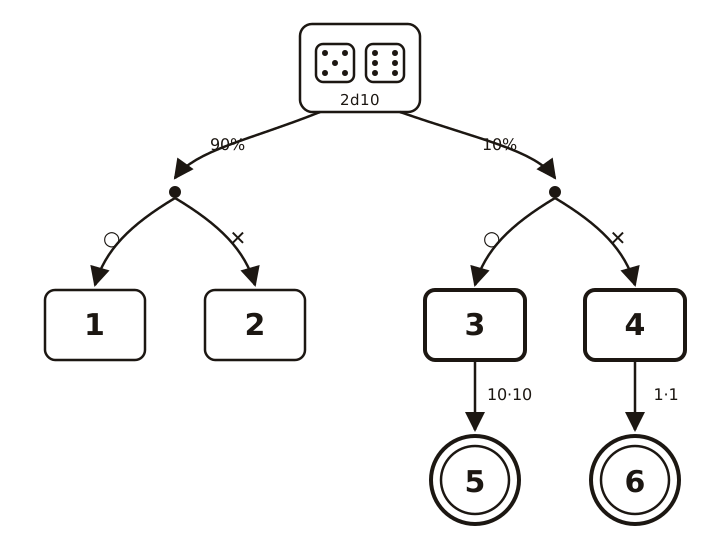
| Number | Meaning |
|---|---|
| 1 | Non-double success |
| 2 | Non-double failure |
| 3 | Double + success = Critical Hit |
| 4 | Double + failure = Fumble |
| 5 | 10-10 success = Heavenly Mandate |
| 6 | 1-1 failure = Karmic Backlash |
#Fate Intervention — The One Who Bends Heaven's Luck
A character with the [Fate (運)] attribute may, immediately after rolling 2d10, adjust the value of one d10 by ±1.
- Uses per combat: as many as the Fate modifier. But even if the Fate modifier is below 1, at least 1 use is guaranteed (Fate +3 → 3 uses, Fate +1 → 1 use, Fate +0 → 1 use, Fate -1 → 1 use).
- The d10 value must stay within 1–10 (you cannot drop a 1 to 0 or raise a 10 to 11).
- Usable only on your own roll (not on another's roll).
Fate is also used as is in luck checks, chance discoveries, hunches at a crisis, and the post-combat life-or-death check, so low Fate pays its price outside combat and after you fall.
| Situation | Fate Intervention | Result |
|---|---|---|
| Sum 12, target number 13 | +1 to one d10 | Sum 13 → success |
| 4-5, check succeeds | Adjust 4 to 5 → 5-5 | Double formed → Critical Hit |
| 3-3, check fails | Adjust one 3 to 4 → 3-4 | Double undone → Fumble avoided |
| 9-10, check succeeds | Adjust 9 to 10 → 10-10 | Sum 20 double → Heavenly Mandate |
Fate Intervention is not "luck" but resolve. The choice of whether to spend or save the Fate resource is present at every moment.
Example: You roll [4,5] (sum 9), and the check succeeds but is not a double. Spend 1 point of Fate to adjust the 4 to a 5, and it becomes [5,5] (sum 10), forming a double — and being success + double, it becomes a Critical Hit. 2 Wounds, not 1.
Source: co-03-01 §Fate Intervention (運命介入) · co-03-02 §Fate (運)
#3.2 Attributes and Skills
#The Six Attributes
Six qualities define you. The base range of modifiers for PCs and ordinary characters is -3 to +3 (for yoma, heroic spirits, and bosses, the value stated by their grade or template takes priority, and +4 or higher is used where needed), assigned at character creation and rising +1 each even [dan].
| Attribute | Combat core | Derived value |
|---|---|---|
| Courage (勇) | attack modifier, Breakthrough, Fear resistance | — |
| Finesse (技) | initiative order, precise actions | max Energy = 10 + Finesse |
| Physique (體) | Overload resistance, heavy-armor adaptation | Wounds = 3 + Physique |
| Wisdom (智) | Sorcery power, terrain reading | command Energy: 1 Energy if Wisdom +2 or higher, else 2 Energy |
| Presence (美) | morale rousing, negotiation | Domination aura: if Presence is positive, add that much (Presence +2 → Domination +2) |
| Fate (運) | Fate Intervention, luck and life-or-death checks | intervention uses: as many as the Fate modifier (at least 1) |
Courage is the axis of melee to-hit (2d10 + Courage + proficiency >= Defense), Breakthrough, and Fear resistance. Finesse sets max Energy and initiative order — an initiative +N correction is a value added only to the count of the first breath at the start of combat, and does not actually raise Energy. Physique governs Wounds, Overload resistance, and heavy-armor adaptation; Wisdom, squad-order cost and Sorcery; Presence, the Domination aura and negotiation; Fate, the Fate Intervention seen above.
Example: A shinobi with Finesse +2 has a max Energy of 10+2=12. A ronin with Physique +1 has Wounds of 3+1=4. A scholar with Wisdom +2 drops their squad order from 2 Energy to 1 Energy.
Source: co-03-02 §overview · Courage · Finesse · Physique · Wisdom · Presence · Fate
#Skills Overview
If attributes are quality, skills are training. They go in the "proficiency bonus" slot of the check formula, with a value set by proficiency tier.
| Proficiency tier | Bonus |
|---|---|
| Novice | +0 |
| Trained | +1 |
| Licensed | +2 |
| Master | +3 |
| Saint | auto-success |
Beyond adding to a check, a skill unlocks maneuvers. When the relevant weapon skill reaches Licensed (3 points) or higher, that weapon's licensed techniques open (e.g., the uchigatana's One-Flash), and when you learn a school, the skill's licensed and secret-art maneuvers are replaced by the school's own maneuvers. The detailed list and allotment of skills is covered in Chapter 5, Character Creation.
Source: co-03-03 §basic check (proficiency bonus) · co-03-07 §weapon licensed techniques · school system
#3.3 Energy and Breath
#Energy — Action Resource and Time
Energy is the game's time. You descend from high-count Energy to low, and in that flow you and the enemy cross paths.
- max Energy = 10 + Finesse
- Each time you execute a maneuver, you spend Energy.
- The higher your remaining Energy on the count timeline, the sooner you act.
- Reset to maximum at the start of each round.
Wearing heavy armor cuts your max Energy — heavy armor -1 Energy, heavy plate -2 Energy. This penalty is offset by as much as your Physique (體) modifier (heavy armor -1 Energy + Physique +1 → penalty 0).
Example: A samurai with Finesse +1 has a max Energy of 11. Wearing heavy armor (-1 Energy) with Physique +0, the effective max Energy becomes 10. At the start of each round it returns to this value.
Source: co-03-04 §the dual role of Energy · co-03-05 §Defense (heavy-armor Energy penalty)
#One Breath — The Limit of Continuous Execution
When your count comes, you may pick and combine several maneuvers at once. The limit of this continuous execution is one breath.
- Base limit = Energy 5. The sum of Energy of all maneuvers combined in one breath must not exceed this value.
- What you can pick within one breath: attack techniques, defensive-technique reservations, [Kata], movement maneuvers, squad orders, declaring/releasing a stance.
The limit is extended by specific effects. Different sources accumulate; effects of the same name do not stack.
| Source | Effect | Condition |
|---|---|---|
| Speed (dedicated skill) Licensed | one breath +1 (→6) | dedicated skill Speed 3 points |
| Speed Master | one breath +2 (→7) | dedicated skill Speed 4 points |
| esoteric monk "Asura" (7th dan) | one breath +2 within the Core Zone | Core Zone only |
| wildlander "Kamuy Descent" | one breath +2 during Descent | 1 round only |
| swift-strike armor | one breath +1 (→6) | Defense 11 |
The official balance cap is 7. Values from 8 through 10 are reserved for exceptional peaks such as Descent, Wandering Relics, Renown, or scenario special effects, and 10 is the absolute cap. After stacking different sources, discard any excess above 10. The Overload threshold follows the current limit after applying the cap (a swift-strike wearer's Overload threshold is one breath > 6).
Breath-Combination Examples:
| Strategy | Maneuver combination | Energy sum |
|---|---|---|
| Balanced offense/defense | uchigatana horizontal cut (2) + horizontal cut (2) + parry reservation (1) | 5 |
| Mobile strike | dash (3) + ninjato thrust (2) | 5 |
| Core-Zone melee | kodachi rapid slash (1)×3 + emergency dodge reservation (1) | 4 |
| Overload | zanbato Horse-Cut (3) + Rising Cut (3) | 6 → Overload |
Source: co-03-04 §one breath (一呼吸) · one-breath extension · co-03-07 §2.7 (one-breath limit bonus)
#Overload — When You Exceed the Limit
If the Energy spent within one breath exceeds the current limit, Overload triggers (base limit = 5).
Check: 2d10 + Physique (體) - excess >= 11
| Result | Effect |
|---|---|
| Success | The maneuver is carried out. For the very next 1 breath only, the limit shrinks to 3. |
| Failure | The maneuver is carried out. This round's remaining Energy is all destroyed + Defenseless. |
Overload always forces the maneuver itself through — success or failure, that reckless motion is accomplished. What is decided is the price for it.
Example: Combining zanbato Horse-Cut (3) and Rising Cut (3) to spend 6 Energy exceeds the limit of 5 by 1. With Physique +1, you roll 2d10 + 1 - 1 (excess) >= 11. If [6,6] (sum 12) comes up, 12+1-1=12 ≥ 11 is a success: both techniques are carried out, and only the next one breath narrows to a limit of 3. Had it failed, both techniques still go out, but all of this round's remaining Energy vanishes and you become Defenseless.
Source: co-03-04 §Overload (過負荷)
#The Absolute Floor of Energy Cost
Every maneuver's execution cost is at least 1 Energy. No bonus can break this floor. The calculation order is final Energy = base Energy + sum of all penalties - sum of all bonuses, and if the result is below 1, raise it to 1 Energy.
There are exceptions to this floor — the firing of a reserved defensive technique (already paid), releasing a stance (a free action), an always-on [aptitude], a [Kata] maneuver whose effect text specifies "0 Energy," Energy received via a scholar's Energy transfer, and an action a shikigami/puppet takes with its caster's Energy. Expressions like "free," "no cost," or "instant" that are not on this list are not 0-Energy maneuvers.
Example: dagger thrust (1) + Core-Zone bonus (-1) = 0, but the minimum 1-Energy floor catches it and it becomes 1 Energy (in exchange, Combo Fatigue is eased, which is covered in §3.9). yari thrust (2) + Core-Zone penalty (+1) − Takenouchi-ryu Licensed (-1) = 2 Energy.
Source: co-03-04 §Energy-cost handling Rule 1 · Rule 2 · explicit-exception summary table
#3.4 The 3 Stages of the Round
Combat proceeds through the repetition of a round called the round (間合). One round passes through three stages.
① round start → ② count progression → ③ lull → (to ① of the next round)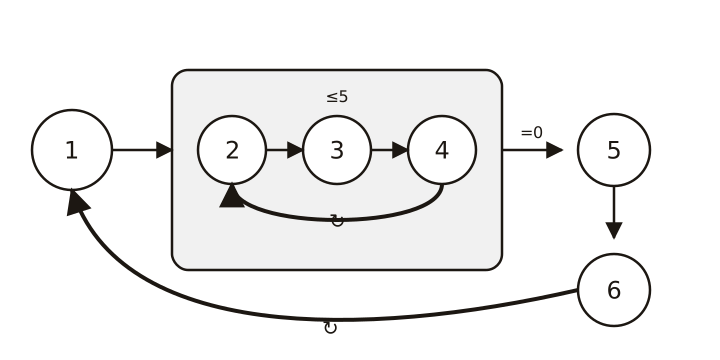
| Number | Meaning |
|---|---|
| 1 | Round start — reset Energy to maximum |
| 2 | Count progression — highest Energy acts |
| 3 | Execute one breath — default limit 5 |
| 4 | Spend Energy and reorder |
| 5 | All combatants reach Energy 0 |
| 6 | Resolve the lull, then enter the next round |
#① Round Start
- Everyone's Energy is reset to maximum (carried-over Overload penalties and the like are reflected at this point).
- A stance being maintained continues to be maintained.
#② Count Progression
The count descends from the highest Energy downward.
- Count start: it begins from the highest Energy among the combatants.
- Initiative correction: an
initiative +Nis added only to the count of the first breath at the start of combat (not to actual Energy). When the first breath ends, remove it and revert to the original Energy minus that breath's expenditure. - The current count: a unit whose current Energy is at or above that value executes one breath.
- Ties: Finesse (技) descending. If Finesse is also equal, allies go first.
- Breath execution: combine maneuvers within one breath (base limit 5) — attack techniques (attack A/attack B), defensive-technique reservations, [Kata], movement, declaring/releasing a stance. If the total exceeds the limit, Overload.
- Energy reduction: it drops by as much as was spent. The next count goes to whoever holds the highest remaining Energy of all.
- Reaction: even when it is not your count, if you have remaining Energy and a reserved defensive technique, you can react between the enemy's breaths.
- Repeat: until everyone's Energy reaches 0.
Alternation is not strict (it is not "A→B→A→B"). Because whoever has the highest Energy at that moment acts, if one unit's Energy is far higher, it can take several breaths in a row — this is the highest-Energy-acts rule.
Example:
Genzaburo (Energy 11, uchigatana):
  count 11 → horizontal cut (2) + horizontal cut (2) + parry reservation (1) = 5 → Energy 6

Oni (Energy 10, iron club):
  count 10 → heavy blow (3) → at Genzaburo
    → Genzaburo: has a parry reservation → executes parry at 0 Energy
  Oni Energy 7

Kuro (Energy 12, ninjato):
  count 12 → stealth move (3) + surprise strike (2) = 5 → Energy 7
  count 7 → reverse-grip slash (1) + reverse-grip slash (1) + emergency dodge reservation (1) = 3 → Energy 4
Kuro takes one breath at count 12 with Energy 12, and after dropping to Energy 7, takes one breath again at count 7. Whoever has higher Energy moves that much more often.
Source: co-03-06 §the structure of the round · ② count-progression detail · co-03-04 §count progression
#③ The Lull Phase
When everyone's Energy reaches 0, it enters the lull.
Automatic handling:
- Energy is reset to maximum at the start of the next round (Overload penalties apply at this point). The lull itself does not restore Energy — recovery happens at the next ①.
- Defenseless is released.
- All reservations dissolve.
- "N rounds" limited-maneuver counts reset (including the 0-Energy [Kata] 2-per-round counter).
Upkeep maneuvers (no Energy cost): only upkeep-type specialties/techniques may be executed. entertainer "Battlefield Flower" (recover 1 Wound or 1 Cohesion), onmyoji shikigami redeployment, teppo reloading, and so on.
Environmental variables (GM ruling): yoma intrusion (d100 encounter table), battlefield changes (fire, fog, collapse, etc.).
Source: co-03-06 §③ the lull phase · co-03-04 §count progression
#Reservation and Improvisation
A defensive technique can be readied in advance. "This breath, I hold my blade in a parry stance" — that is a reservation.
If you declare a reservation of a defensive technique within your own breath, you prepay the Energy.
| State | Defensive-technique execution cost |
|---|---|
| Reserved | 0 (already paid) |
| Improvised reaction | 1.5× the base (round to nearest) |
- Dissolution: at the start of your next breath. At the end of the round.
- Uses per firing: a reserved defensive technique is consumed after firing 1 time. To use the same defense again, pay the improvised-reaction cost, or reserve the defensive techniques separately in your breath and pay Energy for each.
- A reservation is a defensive technique attached to a weapon (katana parry, yari check, etc.). With no weapon, there is no defensive technique to reserve (except Unarmed Combat's "push-out").
1.5× always rounds to nearest: parry reservation 1 → improvised 1.5 → 2. check reservation 2 → improvised 3.0 → 3. reservation 3 → improvised 4.5 → 5 (0.5 rounds up).
Example: This breath you have reserved a parry (1 Energy prepaid). When the oni delivers a heavy blow on its count, the reserved parry fires at 0 Energy. Had you not reserved it, using that same parry as an improvised reaction costs 1.5× of 1 = 2 Energy.
Source: co-03-04 §reservation (豫約) · co-03-07 §defensive techniques (reservation/improvisation cost)
#3.5 Attack and Damage
#The Attack Check
For a melee attack, the to-hit check is itself the damage check.
2d10 + Courage (勇) + proficiency >= target's Defense- Success: hit → 1 Wound reduced (base).
- Double + success (Critical Hit): 2 Wounds reduced.
- Failure: miss.
- Double + failure (Fumble): Defenseless, etc.
There is no damage die. On a hit, Wounds drop right away with no separate damage roll. The attack check is itself the damage check.
Even the same "attack" has two axes per weapon — a katana horizontal cut (Courage, standard) and a thrust (Finesse, [Pierce 2]) are different maneuvers, and the choice between them splits by situation. The Critical Hit of a special weapon differs: the zanbato/nodachi, which is one weapon under two aliases, has a Critical Hit of 3 Wounds; a teppo's Critical Hit = 2 Wounds + Pierce (1 Wound to the foe behind as well).
Example: Against a light-armor ashigaru at Defense 11 (Minion base 9 + light armor +2), you roll a katana horizontal cut (Courage +2, Swordsmanship Trained +1). [6,5] (sum 11) → 11+2+1=14 ≥ 11, a hit, and not being a double, 1 Wound reduced. Had that same check been [6,6] (sum 12), 12+2+1=15 ≥ 11 is a hit and, being a double, a Critical Hit → 2 Wounds. If the light-armor ashigaru has 1 Wound, it dies instantly on either a Critical Hit or an ordinary hit, but against a Veteran-grade foe with 2 Wounds, this difference splits life from death.
Source: co-03-03 §attack check · co-03-05 §Wounds · Critical Hit · co-03-01 §no damage roll
#Defense-Bypass Tags — [Pierce] · [Direct]
Every weapon's and technique's defense-bypass effect is written in the three families [Pierce], [Direct], and [Incorporeal]. The check formula always keeps the single form 2d10 + modifier >= Defense, and the tag sets how that Defense is cut.
The target's Defense is computed as base Defense + armor/shield add-on + other bonuses (stance, Barrier, terrain), and then the tag is applied. Base Defense by grade is Mob 8 · Minion 9 · Veteran, Elite, Lord-grade, PC 10, and armor add-ons are light armor +2, heavy armor +4, heavy plate +6, shield +1.
[Pierce N]— ignores N points (or all) of Defense derived from armor and shields. No effect against an unarmored foe. The floor is the target's base Defense (even if armor drops to 0, the flesh's defense remains).[Direct N]— ignores N points of Defense other than armor and shields (evasion, stance, Barrier, terrain, blessing). Armor/shield protection remains as is. The floor is base Defense + armor/shield add-on.[Incorporeal]— bypasses Defense itself (ignores physical Defense). It is exempted on a sliding scale according to the defender's Exorcism-training tier. The details belong to the Exorcism rules (GM / expansion domain).
Judging principle: if that Defense bonus comes from physical protection like steel, bone, or scale, it is armor-classed (Direct does not apply); if it comes from technique, Sorcery, faith, or terrain, it is non-armor-classed (Direct applies).
Separately from this, Defense -N (no brackets) is not an attack's Pierce but a state/debuff imposed on the target (poison, curse, restraint, weakening). It cuts final Defense itself by N points for a set duration, and during that time every attacker benefits. The floor is 2. [Break] is an equipment-damage support effect that makes permanent, until repaired, the armor reduction of a [Pierce N] written alongside it, and it triggers only when the executing equipment's grade is at or above the target equipment's grade.
Example: Using an uchigatana thrust [Pierce 2] against a heavy-armor foe (Defense 14 = base 10 + armor +4) shaves 2 points from the armor add-on, making it 12. Using that same thrust against an unarmored foe (Defense 10) leaves it at 10 as is, since there is no armor to shave — Pierce shines the thicker the armor and is meaningless against bare flesh. Using a shuriken precise throw [Direct 2] against a heavy-armor foe (Defense 16 = 10 + armor 4 + stance 2) that has taken the Immovable Formation (stance +2) erases the stance +2 to lower it to 14, while the armor +4 remains.
Source: co-03-05 §defense · Pierce system ·
[Pierce N]·[Direct N]·Defense -N·[Break]
#Bonus Stacking (§2.7)
The rule for when several bonuses overlap on a single check.
| Kind | Rule |
|---|---|
| attack bonus | summed from all sources (attribute + proficiency + stance + faction trait + …). Ex: +3+2+1+1 = +7. |
| Defense bonus | armor base value + specialty/stance bonuses summed. But for the same source, the highest only. |
| Domination bonus | unit base value + stance/specialty bonuses summed. |
| same type | cannot stack. The same value (Defense, attack) coming from the same tag ([stance], [aptitude], etc.) counts only the highest one. |
| different type | can stack. A [stance]'s Defense +2 and an [aptitude]'s Defense +2 are different types, so they sum. |
| same-name effect | only 1 time even from two sources ("Fear immunity" from two places is still 1 time). |
| one-breath limit bonus | different sources accumulate. The official-balance recommended cap is 7; the absolute cap is 10. |
Because you can maintain only one stance at a time, the Defense/attack bonus coming from a stance is naturally only one, too.
Example: If a samurai with Courage +3, Swordsmanship Licensed +2, and faction trait +1 gains attack +1 from a maintained stance, the attack bonus sums all sources to 3+2+1+1 = +7. On the other hand, two [stance] Defense +2s apply only one, since only one stance is maintained at a time.
Source: co-03-07 §2.7 bonus-stacking rules
#3.6 Defense · Evasion · Counter
#Weapon Defensive Techniques
Each weapon has its own defensive technique. Reserved, the firing cost is 0; improvised, it is 1.5× the base (round to nearest).
| Weapon | Defensive technique | Effect | Reserved / Improvised |
|---|---|---|---|
| katana | parry | 2d10 + Finesse + Swordsmanship >= enemy attack. Nullifies on success. | 1 / 2 |
| yari | check | attack check against a foe entering the zone. On a hit, halts movement instead of damage. | 2 / 3 |
| zanbato/nodachi | Blade-Body Block | 2d10 + Physique >= enemy attack. Nullifies on success. On a defense Critical Hit, seal the enemy weapon for 1 round. | 2 / 3 |
| dagger | emergency dodge | 2d10 + Finesse >= enemy attack. Nullifies on success. Even on failure, damage -1 Wound (minimum 1). | 1 / 2 |
| teppo | none | — | — |
| Unarmed Combat | push-out | after the foe's attack, forcibly move the foe to an adjacent zone. | 2 / 3 |
| shield (手盾) | shield block | 2d10 + Finesse >= enemy attack. Nullifies on success. Keeps worn Defense +1. | 1 / 2 |
A defense check usually compares 2d10 + Finesse to the enemy attack's total to-hit, and if the defense roll is at or above the enemy's to-hit, it succeeds (an active-parry type such as parry or cross-block adds the weapon's skill + Swordsmanship here, blocking better). The emergency dodge is special — even on failure it reduces damage by 1 Wound (minimum 1 — it will not drop to 0), a safety-net against large hits.
Example: The oni put out a total to-hit of 15 with a heavy blow. You fire the parry you reserved at 0 Energy, and 2d10 + Finesse + Swordsmanship = [9,8] (sum 17) + Finesse +1 + Swordsmanship +2 = 20 ≥ 15 succeeds, fully nullifying that attack. Had you rolled a dagger emergency dodge and failed at [3,4] (sum 7) + Finesse +1 = 8 < 15, the dodge itself fails, but damage is eased by -1 Wound, so a 3-Wound attack lands for only 2 (the floor is 1, so a 1-Wound attack still lands for 1).
Source: co-03-07 §defensive techniques · co-03-04 §reservation (firing structure)
#The Other Side of Defenseless — Situations Where You Cannot Evade
There are moments when you cannot use a defense. The target of an enhanced Surprise Attack (move + attack from outside) can use neither a reserved nor an improvised defense against that attack. Nor can you use an evasion- or counter-type defensive technique while Defenseless (§3.8). A defense holds when your stance still stands.
Source: co-03-06 §Surprise Attack (enhanced Surprise Attack) · co-03-05 §Defenseless
#Counter — The One-Flash Model
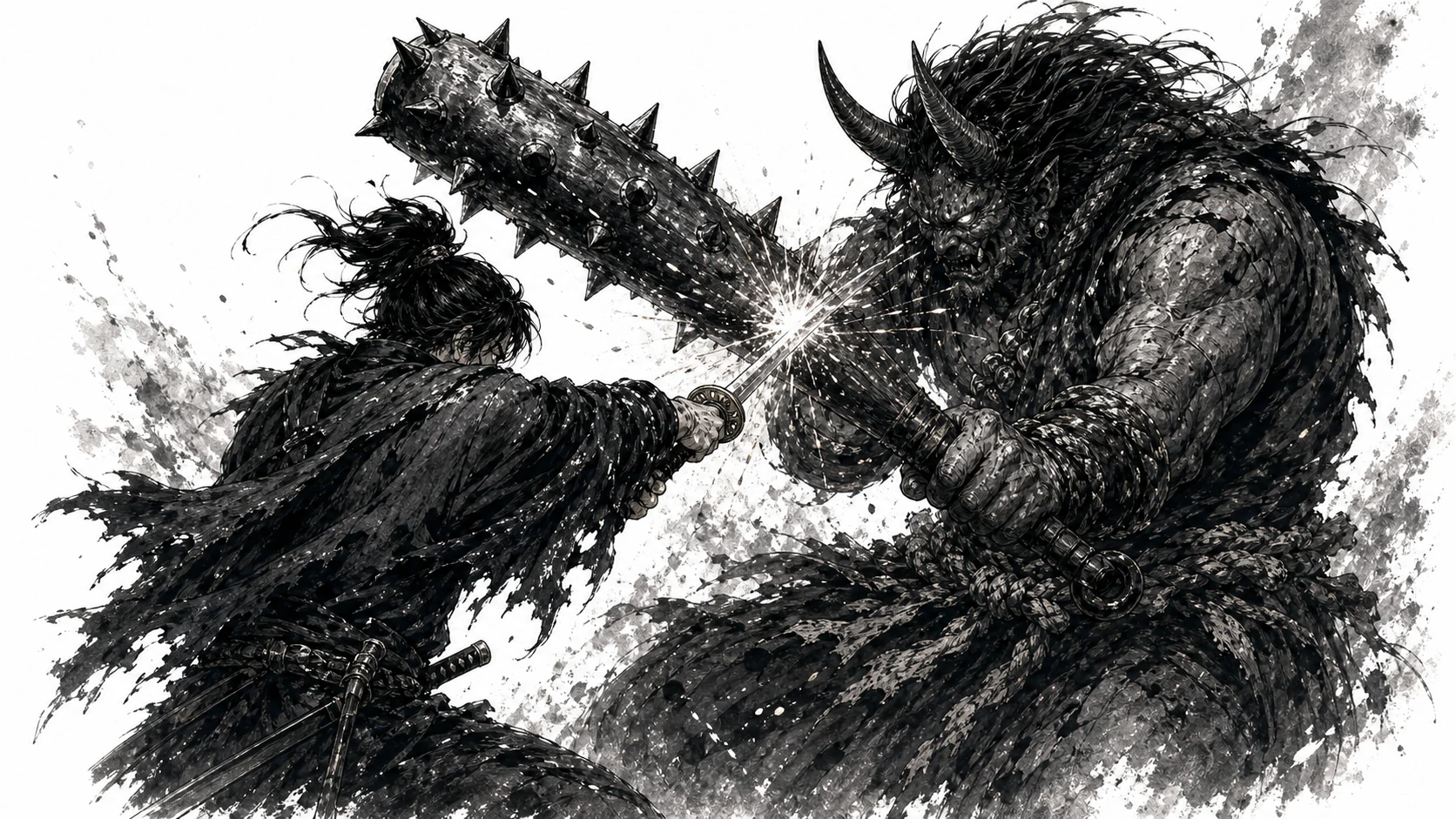
Returning a nullified attack right back is the counter. That benchmark is the uchigatana licensed technique One-Flash (一閃).
One-Flash (一閃): 3 Energy. On the next blow taken (including when damage was nullified by defense or evasion), an automatic counter
2d10 + Courage + Swordsmanship. Offense and defense as one.
The expansion (ex2) defines the counter uniformly atop this model. A "counter" is a counter check made immediately, continuing the same blow taken, right after nullifying a melee attack with a defensive technique (parry, evasion, etc.). Its firing structure follows One-Flash by analogy, firing atop a reserved defense. A 0-Energy counter holds only when a school specifies it, and in that case the 2-per-round cap (the 0-Energy [Kata] cap) applies as is.
A school's counter bonus applies its conditional clause exactly, without missing it — Single-Strike Bind performs defense and counter at once with Defense +2 + counter +3; Single-Blade Sever is only for a counter after defense with attack +4 and Critical Expansion; Taiji Sword-Dance is Energy 0 on a counter.
Example: A Swordsmanship-Licensed samurai reserves One-Flash with an uchigatana (3 Energy prepaid). When the oni delivers a heavy blow at to-hit 15, you nullify it with the reserved parry at [9,8] (sum 17)+Finesse +1+Swordsmanship +2=20 ≥ 15. Right then One-Flash's automatic counter bursts, and you roll 2d10 + Courage + Swordsmanship = [7,6] (sum 13) + Courage +2 + Swordsmanship +2 = 17 against the oni's Defense 12, a hit, returning 1 Wound.
Source: co-03-07 §weapon licensed techniques (One-Flash) · ex2-10-01 §uniform counter definition (Single-Strike Bind · Single-Blade Sever · Taiji Sword-Dance)
#3.7 Tags and the 0-Energy Cap
If weapon techniques come from items, specialties are classed into four types — [Kata] · [aptitude] · upkeep · [stance].
| Type | Nature | Example |
|---|---|---|
| [Kata] (型) | An active maneuver. Fired by spending Energy within a breath. | duel declaration, shikigami command |
| [aptitude] (素養) | Passive. An always-on gain by learning it. | Wind Blade, Tough |
| upkeep (整備) | An action for the lull phase only. | Battlefield Flower |
| [stance] (構え) | A maintained passive. Once declared, it persists until released. Only 1 at a time. | Immovable Formation, spear-wall |
The core of a [stance] is that only one is maintained at a time. You cannot maintain "Immovable Formation" while maintaining "the Stance of the Draw" at the same time. Changing stance is a tactical decision, and releasing a stance is a free action (0 Energy).
#The 2-Per-Round Cap on 0-Energy [Kata]
Some specialties, schools, and Prestige effects let you use a [Kata] maneuver at 0 Energy. Such effects carry the following automatic limit.
- Automatic grant of 1 per round: granted automatically even without a stated limit in the text.
- Total cap on 0-Energy maneuvers per round = up to 2 (summed even from different sources).
Relevant examples: samurai [stance] Guard Posture (automatic counter), onmyoji [Tactic:Kata] shikigami command (squad-order cost waived), a 0-Energy [Kata] that separately pays a gold, faith, or conditional cost, and the 0-Energy counter of some Prestige specialties (Sword Saint, etc.). A caster's control action for a shikigami/puppet also shares this cap of 2 — even with several units, the caster's control is at most 2 times per round.
Example: A samurai fired Guard Posture's (0-Energy [Kata]) automatic counter once this round. Firing yet another 0-Energy [Kata] effect this same round is the second use (the second of the cap of 2). A third 0-Energy [Kata] cannot be used any more this round; from the next round, after the counter resets at the lull, you can use two again.
Source: co-03-07 §4 specialty classification (Kata · aptitude · upkeep · stance) · co-03-04 §Rule 3 (0-Energy active maneuvers) · unit autonomy and proxy actions
#3.8 Wounds · Incapacitated · Defenseless
#Wounds — The Weight of Injury
There is no health score in this world. You are measured by "how many mortal wounds can you take and still stand."
- If an attack breaks through Defense and hits → 1 Wound reduced (base).
- Critical Hit → 2 Wounds reduced.
- Special weapon/specialty → 2 or more Wounds (specified individually).
- Reaching 0 Wounds → incapacitated.
| Grade | Wounds | Derivation |
|---|---|---|
| Mob | 0 | instant death on declaring an attack |
| Minion | 1 | fixed. A hit = instant death. |
| Veteran | 2~3 | fixed value (scenario setting) |
| Elite | 3~4 | fixed value (scenario setting) |
| Lord / PC | 3 + Physique (體) | can grow. Physique +2 → 5 Wounds. |
The Wounds of a PC and a Lord-grade is 3 + Physique. With Physique +2 it is 5 Wounds — enduring five mortal wounds.
Example: A ronin PC with Physique +1 has Wounds of 3+1=4. Taking a Critical Hit (2 Wounds) twice, it goes 4 → 2 → 0 and becomes incapacitated. On the other hand, with ordinary hits (1 Wound) only, it withstands four.
Source: co-03-05 §Wounds (戰力) · Wounds by grade
#Incapacitated and the Life-or-Death Check
- 0 Wounds → incapacitated. Cannot act, removed from the zone (falls).
- If a Lord (主) is incapacitated, that faction's squad Cohesion -1 (loss of commander).
- Whether one dies is judged after combat ends:
2d10 + the higher of Physique (體) or Fate (運) >= 11; success → survives, gravely wounded; failure → death.
The last redoubt of Fate Intervention is here — you can make the very to-hit check of the attack that would bring you to 0 Wounds miss, via Fate Intervention. "Escaping a mortal wound by heaven's luck" is the most dramatic use of Fate.
Example: After combat ends, roll the life-or-death of the fallen ronin (Physique +1, Fate +0). The higher of Physique and Fate is Physique +1. 2d10 = [5,7] (sum 12) + 1 = 13 ≥ 11, a success → gravely wounded but survives. Had it been [3,5] (sum 8) + 1 = 9 < 11, it is death — but if you saved Fate, you can intervene on this roll too.
Source: co-03-05 §incapacitated (戰鬪不能) · co-03-02 §Fate (post-combat life-or-death check)
#Defenseless — Showing Your Back
Defenseless is the most dangerous state on the battlefield.
Imposing conditions: Fumble (double + failure), Breakthrough failure, Core-Zone exit failure, Overload failure, being the target of an enhanced Surprise Attack, and the effects of some specialties and Sorcery.
Effects:
- Any maintained [stance] is released at once.
- Defense -4.
- Cannot declare a new [stance], reserve a defensive technique, or use an evasion- or counter-type defensive technique.
Release: automatically released when your next action begins. If a lull comes first, released at the lull. Since Defenseless is an already-fixed result, you do not roll a separate resistance check.
Example: A samurai made Defenseless by a Fumble (base Defense 10, no stance) has its Defense take -4, dropping to 6. The enemy rolls its attack check against this lowered Defense, and until the samurai's next action begins, the samurai can neither reserve a defensive technique nor evade.
Source: co-03-05 §Defenseless (無防備)
#3.9 Combo Fatigue
If you deliver melee attacks in a row within the same breath, from the fourth strike your body tires.
- From the 4th strike a penalty accumulates on the to-hit check. The standard (not a short weapon) grows as 4th strike -2, 5th strike -3, 6th strike -4 ….
- If the short-weapon Core-Zone bonus applies, the penalty weakens by one tier — when a short weapon (dagger/tanto/kaiken/makiri/Unarmed Combat/bare hands/kodachi/ninjato) has entered the Core Zone, the -1 Energy bonus is blocked by the minimum 1-Energy floor, but in exchange Combo Fatigue is eased to 4th strike -1, 5th strike -2, 6th strike -3 …. A short weapon does not get faster in the Core Zone — it tires less.
- The staff and the vajra are of the staff family, not short weapons, so this easing does not apply. The bow and teppo are ranged, so their use in the Core Zone is inherently limited.
The esoteric monk's [aptitude] "Seal of Shura" shaves an additional -1 off the Energy of a Core-Zone melee attack. Even when the two sources overlap, as with an esoteric monk who entered the Core Zone with a short weapon, effects of the same name do not stack, so the Combo Fatigue easing applies only -1 (it does not accumulate to -2).
Example: With a kodachi (rapid slash, 1 Energy) you cut four times in one breath in the Core Zone. If it were standard, the 4th strike's to-hit would take -2, but since the kodachi is a short weapon and it is the Core Zone, it is eased and takes 4th strike -1. Through the third strike there is no penalty, and from the fourth 2d10 + Courage + Swordsmanship you subtract -1.
Source: co-03-04 §Rule 4 (the short weapon's Core-Zone bonus) · co-03-05 §Wounds (Combo Fatigue reference)
#3.10 Ten Things People Often Get Wrong
These are the points a table gets wrong most often in its first few sessions. Every one is a restatement of a rule already taught in this chapter — when in doubt, come back here.
- How many times does a reserved defensive technique fire? It is consumed after firing 1 time. To use the same defense again, pay the improvised cost (1.5× the base, round to nearest), or reserve it again on your own next breath.
- Does receiving first-strike +N increase your Energy? No. It is a value added only to the count of the first breath at the start of combat. Once the first breath ends it disappears, and you revert to your original Energy minus what you spent.
- Does Energy recover in the lull? No. The lull is the stage of upkeep, release, and reset. Energy returns to its maximum when the next round begins.
- If you strike a bare-bodied foe with
[Pierce 2], is Defense reduced? No.[Pierce]cuts only Defense derived from armor and shields. It has no effect on an unarmored foe. - Is a technique marked "instant" or "free" a 0-Energy technique? No. Only cases where the effect text specifies "0 Energy" and the exception list in §3.3 escape the floor of a minimum 1 Energy.
- Can you maintain two stances at once? No. Only one [stance] is maintained at a time. To declare a new stance you must first release the previous one (releasing is a free action).
- If you fail the Overload check, is that technique cancelled? No. The technique is carried out whether you succeed or fail. What differs is the price — on a failure, all of this round's remaining Energy vanishes and you become Defenseless.
- Is there a resistance check against Defenseless? No. Defenseless is an already-decided result. It is released automatically when your next action begins (or in the lull, if the lull comes first).
- If the two faces differ by 1 (
[5,6]), is it a Critical Hit? Not under the base rules. Only a unit with a specialty, relic, or expansion effect that specifies "Critical-Hit expansion" is treated that way. - A Critical Hit came up, but the weapon lists a special Critical Hit? The specific entry takes precedence over the base (2 Wounds) — the zanbato/nodachi, one weapon under two aliases, has a 3-Wound Critical Hit, and a teppo's Critical Hit adds Pierce on top of 2 Wounds.
Source: all restatements of sections in this chapter — §3.4 (reserve · lull), §3.4 (first strike), §3.5 (Pierce), §3.3 (Energy floor · Overload), §3.7 (stance · 0 Energy), §3.8 (Defenseless), §3.1 (Critical-Hit expansion), §3.5 (special Critical Hit).
#Summary
- Check:
2d10 + attribute + proficiency >= target number. Standard target number 11. Round to nearest always; final modifier range -10 to +10. - Double (same face, 10%): success→Critical Hit (2 Wounds), failure→Fumble (Defenseless). 10-10 success→Heavenly Mandate, 1-1 failure→Karmic Retribution. Fate Intervention adjusts one d10 by ±1 (per combat, as many as the Fate modifier, at least 1).
- Energy = 10 + Finesse, reset each round. The one-breath limit is base 5, official recommended cap 7, and absolute cap 10; exceeding the current limit triggers Overload (
2d10 + Physique - excess >= 11). Every maneuver costs at least 1 Energy. - The 3 stages of the round: ① start (Energy reset) → ② count progression (highest Energy acts) → ③ lull (upkeep, reset). Reserved defense = 0 Energy, improvised = 1.5×, round to nearest.
- Attack:
2d10 + Courage + proficiency >= Defense. Hit 1 Wound, Critical Hit 2 Wounds, no damage die.[Pierce]= armor only,[Direct]= non-armor only,Defense -N= debuff. Bonus stacking is §2.7. - Defense · counter: weapon defensive techniques such as parry and emergency dodge. The counter is the One-Flash model (fired atop a reserved defense); a 0-Energy counter has a cap of 2 when a school specifies it.
- [Kata]/[stance]/[aptitude]/upkeep 4 types. A stance is 1 at a time. A 0-Energy [Kata] has a cap of 2 per round.
- Wounds = 3 + Physique (PC/Lord). 0 → incapacitated, life-or-death after combat by
2d10 + max(Physique,Fate) >= 11. Defenseless = Defense -4 + cannot defend. - Combo Fatigue: from the 4th strike, to-hit -2 accumulating (a short weapon's Core Zone eases it to -1).