#People of the Land — Ainu, Ryukyu, Emishi, Kumaso
Contents
This document belongs to front. The descriptions of culture, faith, and life written here are a respectful introduction to the real (Reference), while the passages entangled with the Spirit Realm and yoma are fiction of this setting. That boundary is marked within the text. The Scent (香) is Fiction-Only.
The promise, written again. These people are not monsters. They are not mystical savages, nor a vanished legend. The descendants of the Ainu and the Ryukyu are alive today, and their culture is carried on today. This issue treats them upon the single stage of the Sengoku period, but does not stuff them into the past tense. The premise that the game's wildlander carries on this bloodline does not mean using those people as a tool — it means not forgetting them.
#Brief — The Archipelago Was Not Yamato's Alone
The archipelago we call "Japan" was, from the start, neither a single country nor a single people. When the emperor sat in Kyoto and the Yamato court drew a line saying "from here to there is our land," outside that line there were already people who had lived there from long before. And that line was pushed outward, slowly but endlessly.
At the northern edge were the Ainu, those who call themselves "human." In the southern sea was the Ryukyu (琉球), who built their own kingdom between Yamato and Ming (明). Between them, to the northeast, were those whom Yamato called Emishi (蝦夷); to the south of Kyushu were the Kumaso (熊襲) and the Hayato (隼人). The canon wildlander is the surviving bloodline of these peoples — or their last living witness (co wildlander).
This document introduces the four branches of people in turn. Game numbers are in 02 and 03. Here we speak only of who they are.
#Commentary — Ainu
The description in this section is a respectful introduction to the real Ainu culture. The wildlander class of this setting takes this culture as a motif, but does not bring the Ainu themselves on stage as game enemies or yoma.
#Kamuy — The Divine Dwelling in All Things
In the Ainu worldview, kamuy is less a "god" than something closer to "a being possessing a spirit (靈), come into this world as a guest." The bear and the owl, fire and house and mountain and river, the wind — even pestilence is each its own kamuy. A kamuy was thought to live in the form of a human in the other world (Kamuy Mosir), and to come into this world (Ainu Mosir, "the land of humans") wearing the form of a bear or an owl like a garment.
So for the Ainu, the hunt was not mere killing. To take a bear was to welcome the bear kamuy arriving bearing the gift of meat and fur, and the hunter's duty was to host that guest courteously and send it back well to the other world. Take only and never send back, and the kamuy will not come again.
#Iomante — The Sending-Back Rite
The rite in which this worldview is most condensed is iomante, the "sending rite." It commonly takes the bear kamuy as its object. After a cub is raised carefully in the village for a time, the rite sends its spirit (靈) back to Kamuy Mosir. Feast and song and prayer accompany it. From the outside it may appear cruel, but the heart within it is gratitude and a sending-off — "you came well, go well. Please come again."
Treatment in this issue. The canon wildlander technique iyomante (co wildlander dan 5) comes from the name of this rite (iomante and iyomante are two transliterations of the same rite). This issue writes "iomante" when referring to the rite, and "iyomante" when citing the canon technique name — the spellings differ, but it is the same word. This issue recommends not narrowing it to only a battle cry. For a wildlander PC, iomante can be a rite of the heart that sends back what was killed — even a yoma struck down. Bring out that texture and the wildlander grows deeper.
#Yukar — The Epic That Flowed Mouth to Mouth
The Ainu did not place writing at the center of their culture. In its stead there was yukar — long oral (口碑) epics carrying meter. A hero's adventure, a kamuy's origin, the beginning of the world were all sung as yukar and flowed from mouth to mouth. It was not rare to spend a whole night reciting one to its end. The one who sang was, in effect, a library.
When a wildlander "sings the song of kamuy alone in the mountains" (co wildlander Scent), that song carries on the very texture of this yukar. When a wildlander dies, that song too vanishes — it is not merely the death of one person, but a book vanishing for want of an ear to hear it.
#Motifs — The Patterns That Ward Off Evil
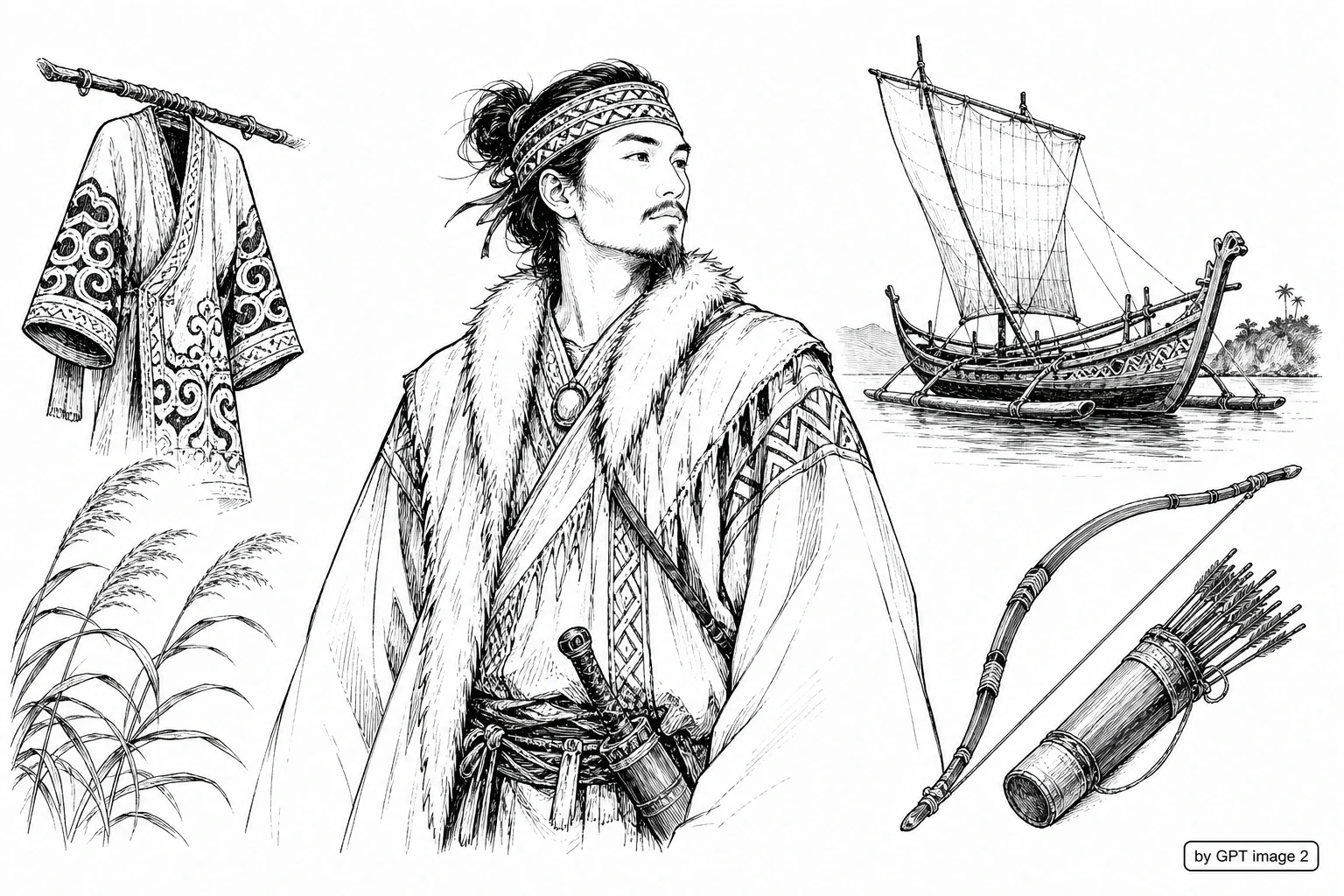
The clothing and tools of the Ainu are carved with distinctive motifs that weave together spiral and thorn shapes. Moreu (spiral) and ayus (thorn) are representative. These patterns are not mere ornament; they carry the meaning of keeping bad things from seeping into the body — laid especially thick at the collar, cuff, and hem, the places where something enters or leaves the body. The pattern was, in effect, a kind of Barrier.
The patterned regalia in this issue's
03 gearmoves this texture into the game. But take care not to flatten it into "magic armor." The true essence of the pattern is a promise between people and kamuy, not a numeric bonus.
#Commentary — Ryukyu (琉球)
The Ryukyu Kingdom was an independent kingdom that truly existed contemporaneously with the Sengoku period. It was neither a part of Japan nor a wildlander tribe. This section introduces that separate civilization. (However, if the stage is set after the 1609 Shimazu (Satsuma) Invasion, the Ryukyu is nominally a kingdom but placed under Satsuma's influence — a point where the texture of "independence" changes.)
#A Kingdom Upon the Sea
The Ryukyu was an independent kingdom that stood at the southern end of the archipelago, in the area of present-day Okinawa. The Ryukyu Kingdom, unified around 1429, set its royal castle at Shuri (首里) and prospered through intermediary trade linking Ming (明), Japan, Joseon, and Southeast Asia. On one side it offered tribute to Ming, and on the other it kept ties with Japanese powers as well — a country of diplomacy surviving between two giants. The kingdom's power lay not in force of arms but in ships and words (言辭).
From the viewpoint of Sengoku-period Japan, the Ryukyu is a conduit beyond the sea-lanes of Saikai (西海), through which foreign goods and information flow in. Those from the Ryukyu, or who came and went there, know news beyond the sight of Yamato warrior houses.
#Noro — The Faith of Women
What stands out in Ryukyu faith is the tradition in which women take charge of the rites. Women priestesses called noro (祝女) presided over the rites of village and kingdom. At its foundation was onarigami — the belief that a sister spiritually guards her brother. When a man takes up the blade, what guards his back is a sister's prayer, they held. From the time of King Sho Shin (尚真王, late 15th to early 16th century), when the royal government's central authority was put in order, the kingdom-level supreme priestess Kikoe-Ogimi (聞得大君) held an authority second only to the king. Not political power, but the summit of the priestess-and-rite hierarchy.
In this setting, a wildlander of Ryukyu origin (or a figure who also follows the Shrine Keeper line) can be drawn as one possessing a spirituality of a different texture than the Yamato miko. A person whose weapon is bond (緣) and prayer rather than the blade.
#Indigenous Martial Arts — The Way of Bare Hand and Tool
The Ryukyu had an indigenous bare-handed martial art (te, 手) and a weapon tradition originating in farm implements and everyday tools. These later grew into several branches, but at the Sengoku-contemporary point they are still a rough indigenous martial art before any establishment. This issue does not pin it down to the formalized form of later ages, leaving it only at "the way of a southern island that fights with bare hand and everyday tool."
In game terms, the Ryukyu indigenous martial art shares a texture with the canon wildlander's Hand of Kamuy (co wildlander dan 1) — a fight that does not end even when the weapon is taken away. If detailed martial-arts data were to be placed at all, it would be the domain of the Unarmed Combat school line (ex2-13), but this issue leaves it only as a rough indigenous martial art before formalization and adds no new school.
#Commentary — Emishi/Ezo (蝦夷)
"Emishi/Ezo" was an exonym (他稱) by which the Yamato court called the people outside. It does not mean that they themselves called themselves so.
Emishi (蝦夷) is the name the ancient Yamato court used to refer to the unsubmitting people of the northeast (the Ou, 奧羽 area). The same characters were in later ages read Ezo, broadly referring to the northern land and people (including the Ainu). What matters is that this was not a single unified ethnonym, but a loose appellation by which the court grouped "outside us."
The court and the Emishi clashed for long ages. In the wars of the 8th–9th centuries, the Emishi leader Aterui is said to have frustrated the court's great armies many times — that the canon wildlander's sample character bears the name Aterui comes from this. He surrendered in the end and is said to have been executed. A defeated one's name, left only in the victor's record.
By the time of the Sengoku period "Emishi" is already an old word, but in the deep mountains of Ou (奧羽) there were still people who had not assimilated into Yamato culture. The loneliness of a wildlander becoming "the last person of a vanishing world" (co wildlander Scent) is the loneliness made by this long history of assimilation.
#Commentary — Kumaso/Hayato (熊襲・隼人)
These two are names that appear mainly in ancient records. By the Sengoku period they had long since assimilated into Yamato, and this issue treats them only as the distant roots of the wildlander.
In southern Kyushu, in ancient times, there were people called Kumaso (熊襲) and Hayato (隼人). Yamato myth depicts them as fierce and valiant (剛勇) ones who stood against the court. The Hayato were later incorporated into the court and, in court rites, took charge of an apotropaic sorcerous cry mimicking the bark of a dog (狗吠) that drives off evil, and of a ritual dance with shields (Hayato-mai, 隼人舞) — even after being subjugated, they left their own color within the rites.
The Kumaso and Hayato are, in the Sengoku period, closer to an old memory of the south than a living separate group. Still, if a wildlander from southern Kyushu says "my bloodline is that of the Hayato," it is an act of a rough seaside person of Saikai (西海) calling up the oldest pride within themselves.
#Scent — The Last Song
What follows is fiction of this setting.
In the mountains of Ou (奧羽), where snow has piled knee-deep, an old man sits before the hearth. He is the last person in this valley who knows the song of kamuy. The village scattered long ago — assimilated, or starved, or departed. What remains is that one alone.
Every night he recites the yukar. There is no one to listen. The fire kamuy of the hearth listens, the owl kamuy of the eaves listens, the mountain kamuy beyond the dark listens — so he believes. When the song ends, he pours sake into a small vessel and offers it to the fire. The gesture of sending back what was received. The smallest form of iomante.
When someday he dies, the kamuy of this valley lose the mouth that would call their names. This he knows. So all the more, tonight too he sings. Not to keep from being forgotten — but to keep from forgetting. That is the heart at the deepest place of the wildlander, and the one thing this issue wishes, in the end, to convey.
Now that we have known the people, we look to the other paths of the wildlander who carries on this bloodline. →
02 The Other Paths of the Wildlander