#Things Held in Hand — A Wildlander's Small Goods
Contents
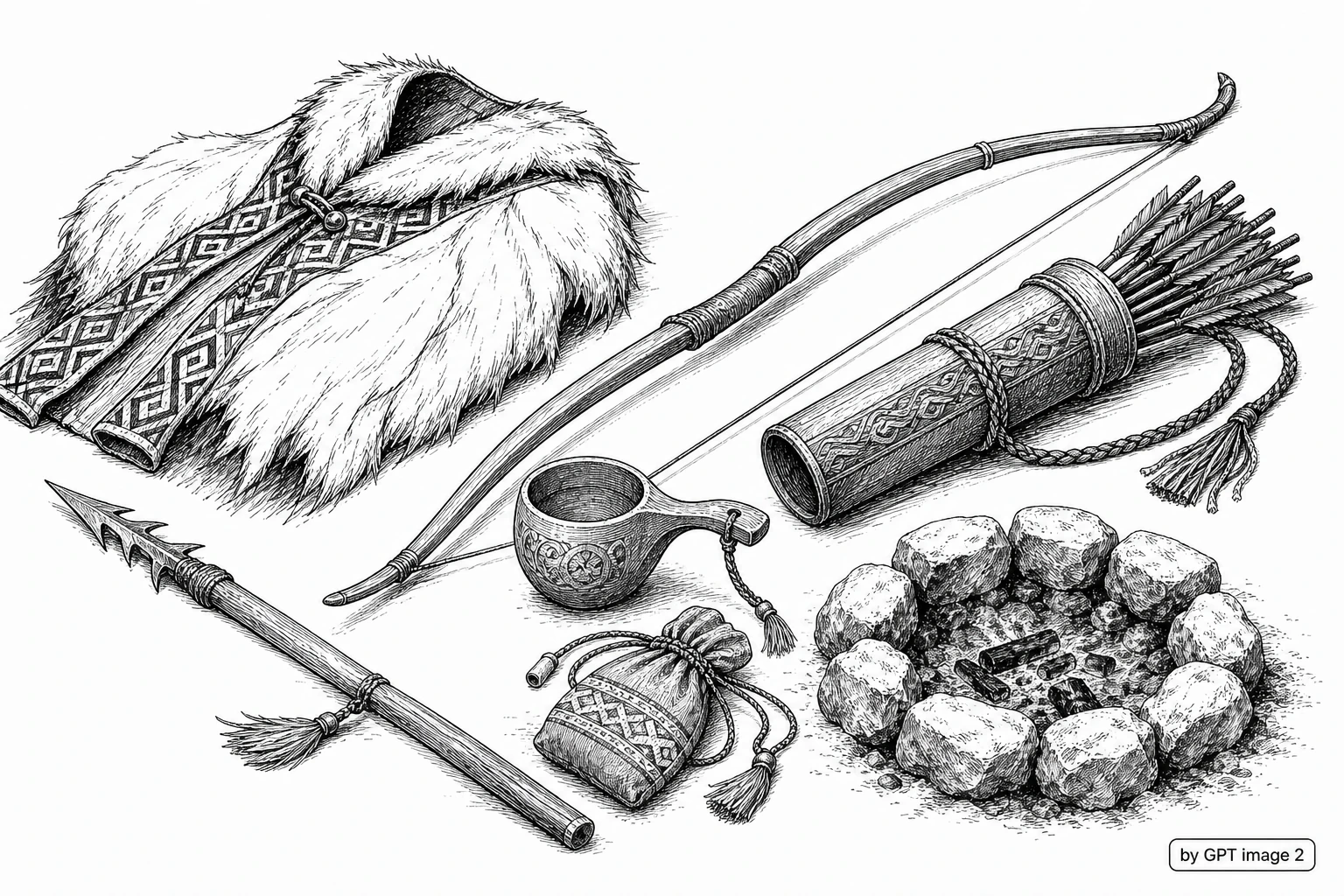
This document belongs to front. All the small goods below are Variants of
co-99-01, used only when the table adopts them. This issue adds no new weapon — the wildlander's main weapon, the makiri (short blade), already exists in canon, so it is cited only and not reprinted here. What is carried here is not weapons but the stuff of daily life and ornament (regalia) — the small things that show a person's grain.
Cultural context first. Before these things are "combat items," they are the everyday life of a culture. Keep the game effect light and write first what the thing is. If you want a stronger effect, let the GM forge a masterwork grade directly (co-07 masterwork format); this issue presents only the basic grain.
#Data — Cited from Canon (Not Reprinted)
| Small Good | Where | Notes |
|---|---|---|
| makiri — Emishi short blade | co-07-01 Weapon Catalog | The wildlander's main weapon. Techniques such as hunting cut, skinning, wild instinct are all in canon. This issue does not reprint them. Remember that the makiri is at once a weapon and a household tool for skinning hides, carving wood, and preparing food. |
| fist · Unarmed Combat | co Wildlander · skill list | The wildlander's other true self. As in canon. |
On the classification of the makiri. The makiri is originally the name of an Ainu utility knife, and canon's grouping of it as an "Emishi short blade" is an in-game convenience — read it together with this issue's "Emishi ≠ Ainu" distinction in
01.
#Data — Ornament and Daily Life
The following are not weapons. Combat bonuses are small or none, and most touch on narrative, atmosphere, and non-combat checks. Prices are set generally low to match the scale of a wildlander's living (the standard in the skill list follows canon).
#Patterned Regalia (文樣意匠) — Warding Patterns
Garments, headbands, and tools carved with patterns like the Ainu moreu and ayus (01). Not decoration but a promise that keeps evil things from seeping into the body.
| Item | Value |
|---|---|
| Category | regalia (unarmed) |
| Effect | +1 to save checks against yoma mental and Curse-type effects. Applies when rolled with Hardiness or Fighting Spirit, GM discretion. More a narrative mark than a number — enemies and NPCs recognize "that one is a protected person." |
| Price | 0.5 gold (free if made yourself, takes time) |
Do not treat this as a "magic talisman" (
01). The true nature of the pattern is a promise between people and kamuy, and the bonus is only a small shadow of that promise. You can also bring out the grain that patterns must not be copied carelessly — appropriating another household's or village's pattern is rude.
#Inau — Carved Prayer
A branch of willow or the like, shaved thin to produce curled shavings, a medium of prayer offered to the kamuy. Closer to a messenger between gods and people.
| Item | Value |
|---|---|
| Category | ritual implement (unarmed · consumable) |
| Effect | If you set up an inau and offer sake during upkeep or a lull, it gives narrative justification to the next iyomante or Sending Back (02)-type action on the spot (GM discretion +1, or an automatic-success staging). Only the one who made it can set it up properly. |
| Price | free (carved yourself. a knife and time) |
An inau is not a thing to be bought and sold. Because the act of carving is itself prayer, it is good to hold a beat on the scene of the wildlander PC carving it themselves.
#Hide Gear (皮裝) — A Second Skin
Clothing and footwear sewn from bear and deer hide. Not armor but the daily-life kit that endures the bitter cold. The canon wildlander wears no armor (co Wildlander) — hide gear fills that place.
| Item | Value |
|---|---|
| Category | clothing (non-armor) |
| Effect | No Defense modifier (it is not armor). Instead, +1 to Survival checks in bitter-cold and snowstorm environments, and ignore 1 step of the cold-persistence penalty. No Infiltration or relocation penalty. |
| Price | 0.5 gold (or hunt and tan it yourself) |
The wildlander's true armor is the Blessing of Kamuy (co Wildlander dan 5), not hide. Hide gear wards off the cold, not the blade — bring out that distinction.
#Bone-and-Stone Kit (骨石具) — Forgotten Handcraft
Bone needles, stone knives, obsidian flakes, birch-bark vessels. The product of handcraft that lives even without iron in a land where iron is scarce (Ou specialty: obsidian).
| Item | Value |
|---|---|
| Category | tool bundle (unarmed) |
| Effect | No lack-of-tools penalty on Survival support checks such as camping, mending, and cooking. Even in an ironless environment (captivity, shipwreck, deep mountains), the wildlander keeps a state one step better than bare hands. |
| Price | free (gathered from the land and made by hand) |
The true value of this bundle is not a number but situational immunity. In disarmament, shipwreck, and confinement scenarios, it lets the wildlander remain a person who "had nothing taken away."
#Data — One-Line Summary Table
| Small Good | Category | Core Grain | Price |
|---|---|---|---|
| makiri | (canon weapon) | weapon and household tool. cites co-07-01 | [see co-07-01] |
| Patterned Regalia | regalia | +1 Curse/mental save, narrative mark | 0.5 gold |
| Inau | ritual implement | justification for the sending ritual | free |
| Hide Gear | clothing | wards the cold but not the blade | 0.5 gold |
| Bone-and-Stone Kit | tool | self-reliance even where there is no iron | free |
We have now seen even what is held in hand. Having known the people, known the other paths, and known the daily life — the wildlander is now not a word in a single box but a whole person.