#Match and Mortal — The Bout, Death, and Those Who Watch
Contents
This document belongs to front. The distance/guard/hit-location engine is in
02. Here that engine is knotted differently according to what is staked (sparring/shinken shobu) and who is watching (the lord's presence), and fc03 swordmasters are loaded on top of it.
#Rule — Sparring Match (對鍊·試合) [Variant · duel]
A wooden sword or fukuro shinai, or a live blade with sundome (stopping just short of contact). It is a duel where no one dies.
- Win/loss: End it on the first valid strike (ippon), or in a sanbon shobu (best-of-three bout) the first to take two wins.
- Wounds: Do not deduct them (or stop at Wounds 1). The bout is decided by guard and the valid strike — the one move that breaks (collapses) the guard and steps in is itself the ippon.
- Hit location: By a valid-strike check without actual injury. Cleanly touching the face (men), torso (do), or wrist (kote) is an ippon.
- Use: Dojo training, full licensure (menkyo kaiden) certification, dojo yaburi (a sparring match by agreement), the basic form of a gozen jiai (match before the lord).
#Rule — Shinken Shobu (眞劍勝負) [Variant · duel]
A live blade. Wounds, injury, and death are real.
- Resolution: Wounds 0 = incapacitated (usually death). The [Direct]/Critical Hit round right after the guard breaks becomes the decisive blow. The canon Survival check after Wounds 0 (
2d10 + the higher of Physique or Fate >= 11, success = survive gravely wounded) is rolled the same way in a shinken shobu too, but since it is a live-blade 1:1, the second's coup de grace or the domain's disposal can override that result, and the GM may at their discretion skip the Survival check (treat it as instant death). - Weight of a round: In issoku itto, taking the half-step first + Critical Hit + hit location — it can end in one breath. A shinken shobu is not long.
- Injury: Persistent as in
02. Even the winner may lose a wrist or arm and limp for life. - After: An inquest, domain disposal, and a katakiuchi chain follow.
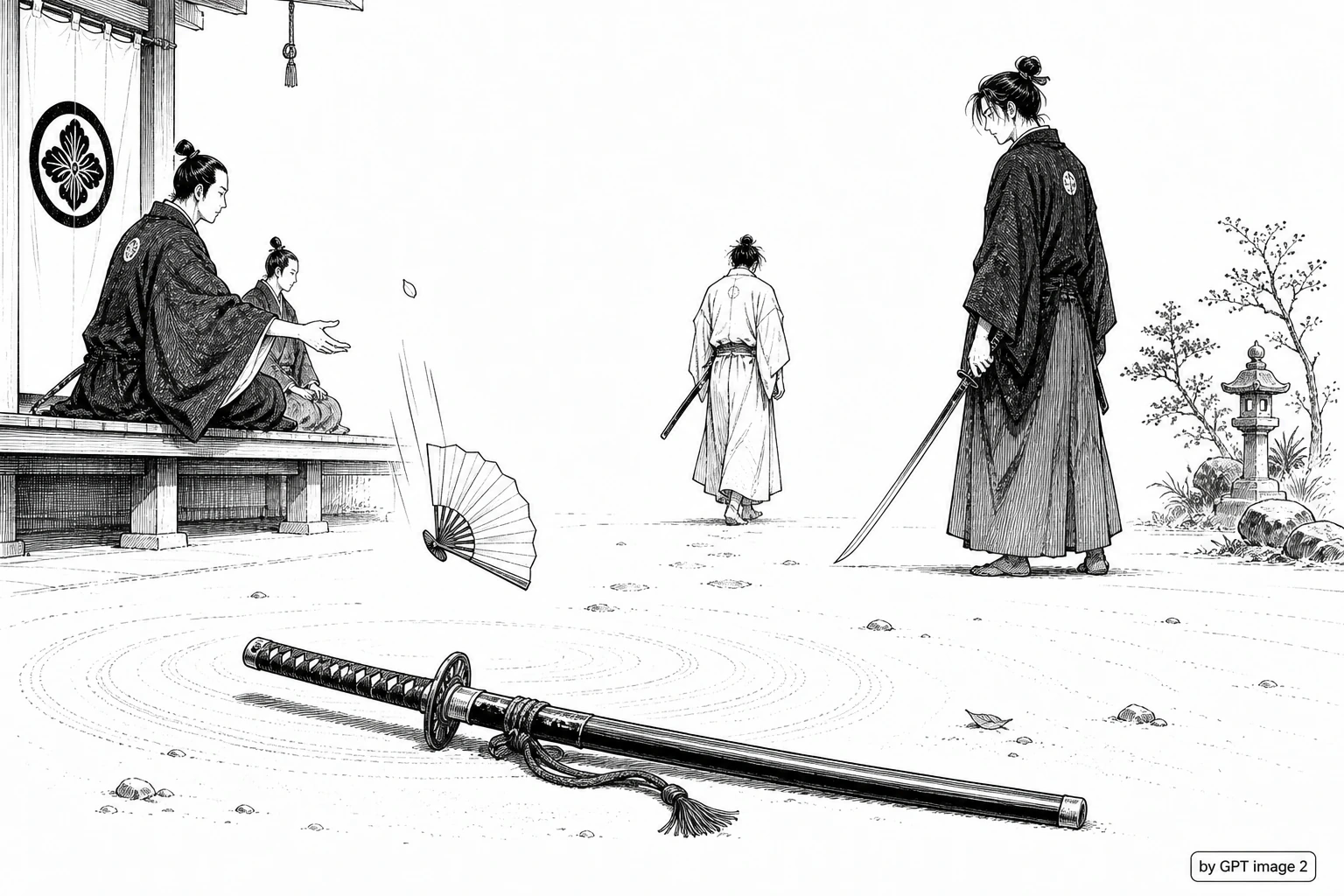
#Rule — The Match Before the Lord and Those Who Watch: Regard [Variant · duel]
A duel before a lord and the crowd does not end merely by winning. How one won divides the hearts of those who watch. This is handled with a regard (心氣) track (limited to scenes before the lord and a crowd).
- Regard starts at neutral (0) and rises or falls according to the manner of the duel. The GM adjusts it with each move of the duelists.
| Raises Regard | Lowers Regard |
|---|---|
| A beautiful round, a bout with no excess | An ugly toppling win, a dragging brawl |
| The mercy of stopping with sundome (even in a shinken shobu) | An unnecessary coup de grace, excessive severing of a body part |
| Formal etiquette, greetings, mettle | Skipping etiquette, taunting, cowardice (hidden weapon, eye-gouging, Surprise Attack) |
Bearing befitting a Renown Title (on a Renown-Title display 2d10+Presence+Bearing success, regard +1; on a Critical Hit/exceptional success, +2) | Shaming or killing the lord's favorite or kin |
- Outcome matrix:
| Bout | Regard | Result |
|---|---|---|
| Win | Up | Total victory — reward, recruitment, Renown Title |
| Win | Down | Win and yet lose — disposal, an order to commit seppuku, exile, loss of favor |
| Loss | Up | An honorable defeat — keep your life and even gain recognition |
| Loss | Down | Total defeat — lose both life and name |
The end of shigurui. The cruelest truth of a match before the lord is this — two swordmasters cripple each other, and even if one finally wins, a single word from the lord turns that victory to ash. "The interest is gone." Being seen well is harder than winning. When PCs stand before the lord, the GM should show this matrix in advance — only by knowing what is staked do they know what can be lost.
#Note — Loading fc03 Swordmasters onto the Duel Engine
Moving the Lord-grade swordmaster sheets of the fc03 Chronicle of Japanese Swordmasters onto this engine takes three lines.
- Grant guard — Give a Lord-grade swordmaster a guard maximum = 5 + (the higher of Finesse or Wisdom) (Master/Tatsujin tiers get a +2~3 modifier). Deeper still through the sheet's stances and signature techniques.
- Assign the signature technique's ideal range — Map each swordmaster's signature technique to an
02ideal range. E.g.: Monohoshizao frontal = far range~issoku itto, tsubamegaeshi = issoku itto. - Stances and rounds as is — Use the [stance], [Kata], Energy, and limits of the fc03 sheet exactly as canon, and read only the position (zone) as 間.
#Example — Sample Shinken Shobu: Ganryujima (Musashi vs Kojiro)
The 4th month, 13th day, 1612, Ganryujima (near present-day Shimonoseki), arranged by the Hosokawa house of Buzen Kokura. Kojiro's Monohoshizao (a long nodachi) dominates far range~issoku itto — the distance where you are cut before you can reach. How did Musashi break that 間? One round on the engine:
- Musashi comes late. Arriving well past the appointed hour — it shakes Kojiro's composure. Pre-start guard -2 (if before the lord, it also affects regard).
- Musashi's wooden sword. He carved an oar into a wooden sword (by common account longer than the Monohoshizao) — offsetting Kojiro's reach advantage with length (ideal range far range~issoku itto). By the rule "a longer 間 presses down a shorter 間" of [
02], the longer ideal range nullifies the "first Approach/first attack -2" that Kojiro's Monohoshizao frontal stance imposes on Musashi. - Far-range standoff → half-step. Kojiro takes a half-step to issoku itto aiming for tsubamegaeshi. Kojiro's Ganryu Licensed technique [aptitude] long-sword reach (reach advantage) normally grants a first-round initiative modifier +2 (fc03 Ganryu Licensed). But by the same
02"a longer 間 presses down a shorter 間" rule, the moment Musashi reverses the ideal range itself with his longer wooden sword, the reach advantage that the Licensed technique presupposes vanishes, so the +2 initiative attached to it no longer applies either — the two start at an Energy tie (13). Since initiative is not split by text alone, it is decided by a half-step contest roll (2d10+Finesse+Footwork) — Musashi takes that roll and takes that square (Kojiro, carrying the start guard -2, wavers). One breath ahead. - Tsubamegaeshi, a half-step short. Kojiro's 2-strike combo grazes Musashi's headband (hachimaki) — touching but a blade that did not cut through (only the guard is shaved). Because the first strike of tsubamegaeshi grazed only the headband and fell short of a "hit," the Critical Expansion window of the second strike did not open — this is the common account's "had it been one inch deeper." The longer wooden sword and the half-step taken first made that half-step.
- Musashi's blow. Same breath, stepping in he strikes the face (men). Kojiro's guard reaches 0 (break) → an opening, and Musashi's face attack resolves with [Direct 2] + a Critical Hit window (
02). One round.
Kojiro guard reconciliation (the steps below unfold the compressed single round of the 5-step narrative above into the
02guard table, surfacing all the way down to the feint and hit-location-threat events that the narrative recorded in shortened form. For demonstration brevity this reconciliation rolls from a base value of 8 (=5+Finesse 3, Wisdom 0) — the real Master Kojiro's guard maximum, per Note §1, adds the Master modifier +2~3 to reach 10~11, lengthening the Erosion steps that much more): start -2(→6) → losing the half-step contest streak -1(→5) → Musashi's 1 feint strike grazes home -1(→4) → issoku itto threat (hit-location threat) -1(→3) → allowing a Critical Hit to the stepping-in Musashi -2(→1) → the last feint just before stepping into the face -1(→0 break). The five deductions (half-step streak loss, feint, hit-location threat, Critical Hit, last feint) correspond 1:1 with the items of the02guard table, and the start -2 is a pre-combat modifier due to lateness (no. 1 above).
The common account is "a single wooden-sword blow to the head, instant death" (fc03). Seen on the engine it was one breath in which the reversal of the reach advantage + the seizing of the half-step + the broken guard overlapped. Ganryujima was decided not by the blade but by 間.
#Commentary — Using It as a Swordplay Gadget
- PC vs swordmaster: Demonstrate fc03's "how will you win" with this engine. Even a swordmaster you cannot beat head-on has a path to break the 間 and collapse the guard.
- PC vs PC: A sparring match between dojo fellow disciples or rivals. Build narrative without dying.
- Climactic ikkiuchi: During a pitched battle two generals slip out to face each other alone — switch to the "zoom in on one square" of front, then return to the pitched battle after the duel.
- Tie-ins: fc05 Record of Famed Blades (weapon ideal range/masterwork), ex2 Swordsmanship schools/fc03 new schools (signature techniques), zn04 hidden weapons (the price of cowardice/regard).
#Scent — One Sentence
"A swordmaster spends a lifetime learning how to win — but what is truly tested before the lord is how he sheathes the blade after winning."