#Scattered Fragments
Contents
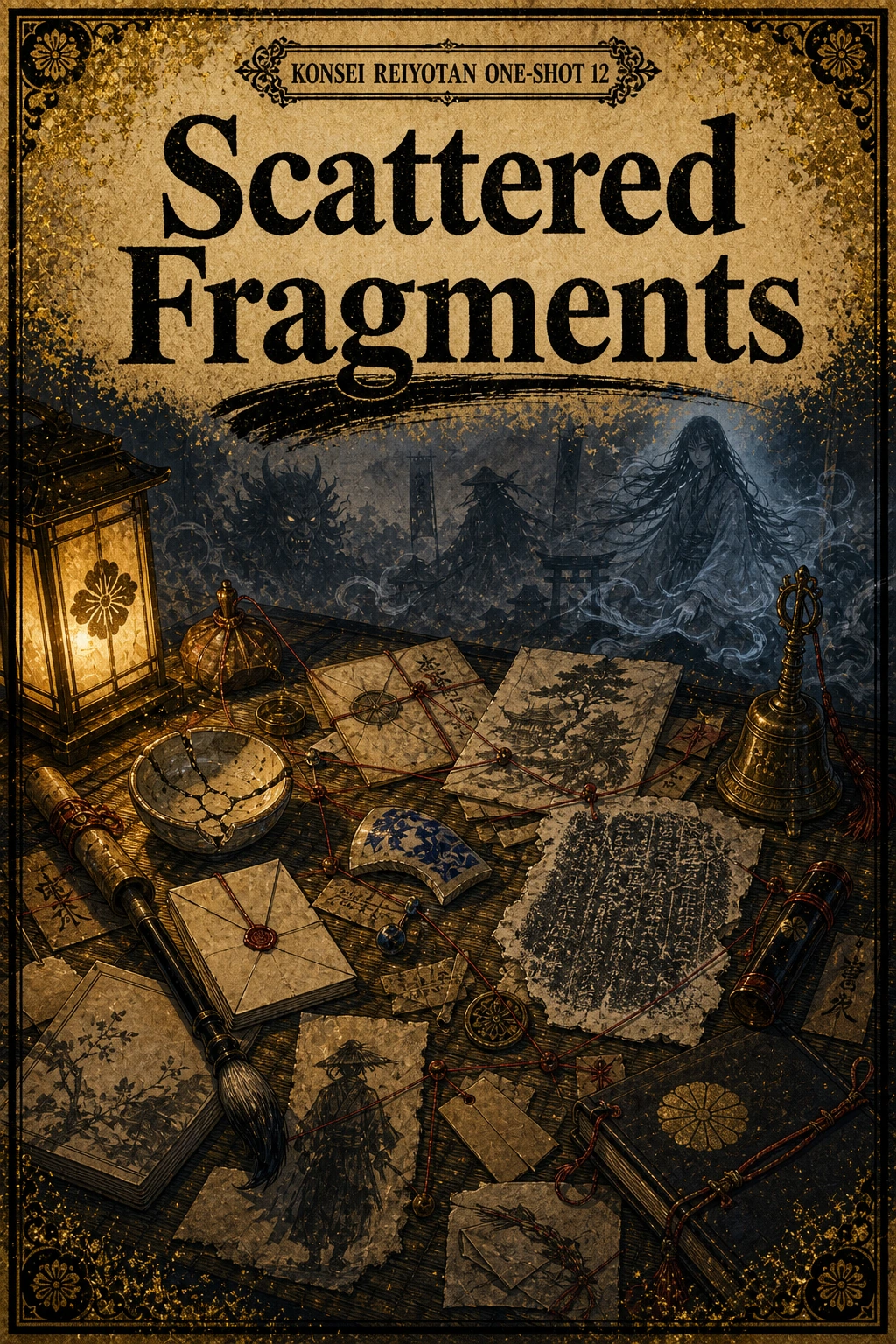
#Brief — What This Issue Is
This issue is not a rule engine. It is not a gazetteer, not a register, and not a clean archive. It is a box of things found in Konsei Reiyotan: rumors repeated at a ferry, letters that never reached the named hand, cuts on stone, ghost stories, neat official papers that are too neat, notes written in the margin of a map, object tags with no object left under them.
Most entries here are not complete. Many contradict one another. Some are lies, some are copying errors, some are jokes that became warnings, and some are true only because a table chooses to make them true. That is the point. A fragment is useful when it gives the reader a place to pull.
- Roadside Rumors — public speech, overheard and unreliable. (
01) - Undelivered Letters — private writing that became public by accident. (
02) - Inscriptions and Marks — things cut, pressed, scratched, sealed, or hidden. (
03) - Local Ghost Stories — village warnings and half-remembered night tales. (
04) - Official Papers — warrants, ledgers, registers, and memoranda with gaps. (
05) - Field Notes and Margins — travel notes, scholar scraps, map comments, and battle annotations. (
06) - Object Tags and Names — labels, inventory slips, found-object captions, and name lists. (
07)
#Commentary — Disorder as a Tool
Thesis. A good fragment does not answer the question. It teaches the table which question to ask next.
Do not sort these entries by truth. Sort them by pressure.
If three rumors mention the same bridge, the important fact may not be what happened there. It may be that three unrelated people all needed to talk about the bridge without naming the same person. If an official paper is clearer than the witness who wrote it, the paper may be the lie. If a ghost story changes every time it crosses a river, the change itself may be the route of the thing being hidden.
For this reason, the issue avoids clean categories such as "villain," "reward," or "solution." The entries are grouped only by the kind of surface that carries them: voice, paper, mark, story, office, margin, object. The GM or writer supplies the truth later.
#Meta Card
| Item | Value |
|---|---|
| Series | zn (one-shot series) issue 12 |
| Title | Scattered Fragments |
| Nature | A disorderly dossier of in-world texts for scenario hooks |
| Volume | 9 documents (front + 7 fragment families + closing fiction) · reading time about 43 minutes |
| Blocks (whole issue) | Brief · Commentary · Scent · Table · Note |
| Authority | Reference Only + Summary + Fiction-Only. No new mechanics, stats, or canonical facts |
| Dependencies | co-99-01 authority only; otherwise readable as setting texture |
| Core version required | co >= 1.2 |
| Current version | v1.5 (zn12-VERSION) |
#Contents
| Document | Type | Contents |
|---|---|---|
01 Roadside Rumors | Scent · Table · Note | Public speech, gossip, warnings, boasts, overheard promises |
02 Undelivered Letters | Scent · Table · Note | Petitions, apologies, accusations, invitations, debts, final notes |
03 Inscriptions and Marks | Scent · Table · Note | Scratched names, seal marks, gate cuts, talisman blanks, blade nicks |
04 Local Ghost Stories | Scent · Table · Note | Village warnings, children's rules, night tales, disputed hauntings |
05 Official Papers | Scent · Table · Note | Ledgers, warrants, clan memoranda, temple registers, missing-person lists |
06 Field Notes and Margins | Scent · Table · Note | Map notes, travel scraps, battlefield comments, scholar observations |
07 Object Tags and Names | Scent · Table · Note | Relic labels, tags, captions, name lists, inventory slips |
99 The Box With No Owner | Scent | A fiction-only coda about trying and failing to make the fragments behave |
Reading order: front → any body document. This issue does not require linear reading. In play preparation, choose one surface that matches the coming scene and pull three entries from it.
#Note — How to Use a Fragment
- Choose a fragment that irritates you. The best choice is not the clearest one, but the one that makes you ask "why would anyone write that down?"
- Name the pressure. Who benefits if the fragment is believed? Who is harmed if it is true? Who has kept it from being checked?
- Decide only one fact. Make one part true and leave two parts uncertain. A fragment becomes stronger when the table still has room to investigate.
- Attach a present-tense event. Someone is arriving tonight, a seal is breaking tomorrow, a witness is being transferred, a thing is being sold, a name is about to be crossed out.
- Let contradiction stand. If two fragments clash, do not repair them immediately. Contradiction is a map of human pressure.
The entries are written in short form so they can be copied into prep notes. A table may also roll a die against the rows, but the issue is not balanced as a random encounter table.
#Production and AI Notice
This issue is the 12th of the Konsei Reiyotan zn (one-shot) series. It intentionally avoids new checks, new attributes, stat blocks, weapon data, or formal scenario structure. Its function is to provide ambiguous in-world text surfaces for GMs, writers, and players to develop into scenes. The English edition is the source/canon text for this issue; Korean and Japanese editions are translations from this EN source.
A substantial part of this material was produced with the help of generative AI (LLM) in planning, drafting, prose tidying, and proofreading. GPT Image 2 was used for the image generation process. Final editing and the responsibility for publication rest with the creator.
Should there be changes to domestic or foreign law regarding AI-assisted works, those laws will be followed.
#Scent — One Sentence
"The box was not full of clues. It was full of beginnings."