#Tenka Goken (天下五劍)
Contents
Canon (fc05 internal) + Fiction-Only. Of the five blades of the Tenka Goken, this document writes the two that are listed (Dojigiri, Mikazuki) as links, and the three unlisted ones (Onimaru, Odenta, Juzumaru) as volume-only new data. All are placed as masterworks — even with a divine origin, this volume judges that they do not satisfy the conditions for elevation to Divine Artifact.
The fame of the Tenka Goken and the Divine Artifact judgment : Fame alone does not make a Divine Artifact. Applying
fc05-01-02 § The masterwork-and-Divine Artifact checklistto the five blades, all come out below three — masterworks.
#Opening Fragment — Why the Five Do Not Gather
The envoy proposed placing the five blades in one room. He said that if the Tenka Goken gathered in one place, war, yoma, and the unease of the people would all be stilled.
The old monk did not answer for a long while. He lit one lamp in each of five empty rooms. "Why not place them in one room?" the envoy asked.
"Because the word 'all under heaven' does not fit into a narrow room," said the old monk. "These five blades are not things that complement one another, but things that each illuminate all under heaven in a different way."
"Even so, would they not be stronger if gathered?"
The old monk pointed at the first lamp. "If you look only at strength, perhaps so. But the day all five gather may be not the day all under heaven settles into one, but the day all under heaven is shut into a single room."
Only then did the envoy understand. A scenario to gather the Tenka Goken is not a tale of collection. It is a tale asking whether the world can endure even when five authorities gather in one place.
#§ Scent — The Weight of the Five Blades
The Tenka Goken (天下五劍). The five summits of Japanese sword history. These five have never gathered in one place in history — one house holds one blade, one temple holds one blade, one shogunate holds two blades, and one blade was lost. If the five gather in one place, every tale of the Japanese blade enters a single scabbard — but that has never happened.
This volume provides data for these five. The balance of the data follows a single principle — all five are strong, yet their roles do not overlap. Dojigiri handles Shuten-doji, Mikazuki handles yoma in general, Onimaru handles dream-demons and royal authority, Odenta handles the house and healing, and Juzumaru handles purification and Buddhism. A single PC cannot wield all five — even if they did, the Nito-ryu slot and the Three Ways and Six Hearts conflict would stand in the way.
#§ Law — The Division of the Five
#The Role Table of the Five
| Blade | Era | Smith | Core role | Listed |
|---|---|---|---|---|
| Dojigiri Yasutsuna | Heian | Yasutsuna of Hoki | Shuten-doji / oni subjugation | co-07-02 |
| Mikazuki Munechika | Heian | Sanjo Munechika | yoma purification in general | co-07-02 |
| Onimaru Kunitsuna | Early Kamakura | Awataguchi Kunitsuna | dream-demon / royal-authority protection | New (this volume) |
| Odenta Mitsuyo | Late Heian | Miike Mitsuyo | house treasure / healing of illness | New (this volume) |
| Juzumaru Tsunetsugu | Late Heian | Aoe Tsunetsugu | Buddhist purification / prayer beads | New (this volume) |
#§ Law — The Two That Are Listed
#Dojigiri Yasutsuna (童子切安綱)
Follows the data of co-07-02. For this volume's additional commentary, see fc05-02-01 § Dojigiri.
#Mikazuki Munechika (三日月宗近)
Follows the data of co-07-02. The fact that it gives off a blue glow seems like a Divine Artifact — but the glow is in the blessing slot, not the devotion slot. Mikazuki is a masterwork.
#§ Law — The Three That Are Unlisted [New]
Canon — fc05 internal only. The three below are new data for this volume. When other fc/ex cite them, treat them as optional material.
#Onimaru Kunitsuna (鬼丸國綱)
#Scent — The Blade That Cuts the Dreams of the Hojo House
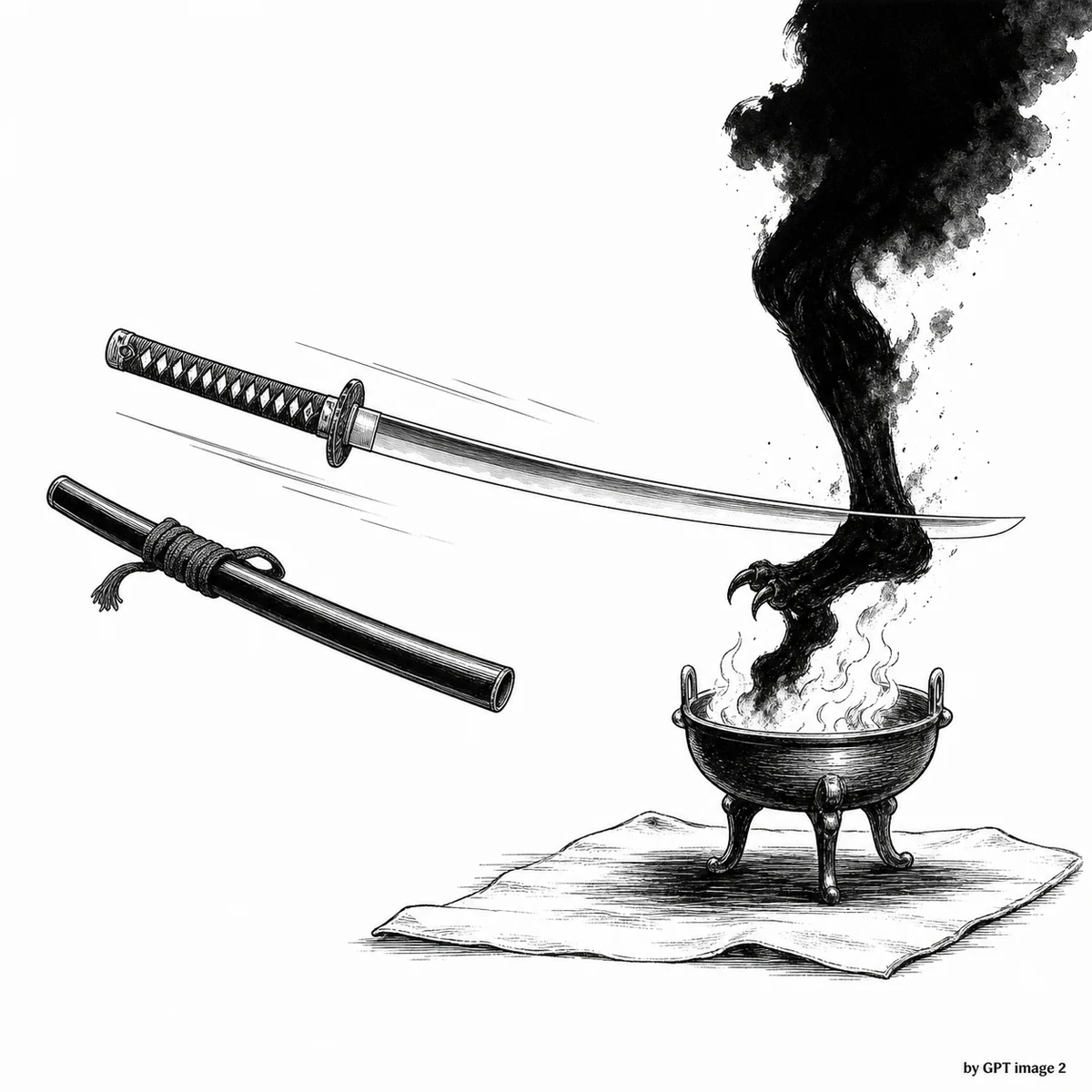
Tokiyori, the 5th Hojo regent of the Kamakura shogunate. Every night a small oni prowled his bedchamber and tormented him. Tokiyori slept with a single blade placed at his bedside — that blade, which was the work of Kunitsuna (國綱).
One predawn, the blade came out of its scabbard of its own accord. The blade slid to one corner of the sleeping chamber and — in a single stroke cut the leg of a small brazier, a leg carved with the form of an oni. After that day, Tokiyori no longer saw the small oni. The oni of the brazier had been the one entering his dreams and tormenting Tokiyori — the blade saw it, and cut in his stead the enemy Tokiyori could not see.
Thereafter that blade is called Onimaru (鬼丸). As the Hojo house scattered after the fall of the shogunate, the blade scattered too, and the account that it entered the Tokugawa house and the account that it was enshrined in the imperial house both stand.
#Law — Tachi Base + Masterwork Technique
Base technique: Same as the tachi. (Early Kamakura style — the uchigatana appears in the late Muromachi.)
| Technique | Type | Energy | Check | Effect | Limit |
|---|---|---|---|---|---|
| [Masterwork] Dream-Sever (夢斷) | Kata | 3 | 2d10+Courage+Swordsmanship+2 >= Defense | 2 Wounds. If the target is under the influence of a dream-demon, charm, or illusion, +2 Wounds + immediately dispel the illusion/charm. | round 1 |
Blessing [aptitude]: While equipped, immune to charm, fascination, and dream-intrusion effects. +2 to the illusion checks of allies in the same zone.
Curse [aptitude]: The blade moves of its own accord. Roll d100 at the start of each scenario. On 01–05, once during that scenario the GM decides 1 action of the PC by the blade's will (an action to cut the nearest illusion/charm/dream-demon enemy, using the PC's Energy).
Ownership condition: The recognition of a Hojo-house descendant, or the will to guard royal authority. One who has experience fighting charm, illusion, and dream-demons.
Acquisition scenario: A Kamakura-period scenario or exploration of Hojo-house ruins. A shogunate treasury. The imperial-house enshrined copy cannot be recovered (the approach itself is a diplomatic incident).
#Odenta Mitsuyo (大典太光世)
#Scent — The Blade That Keeps a House Alive
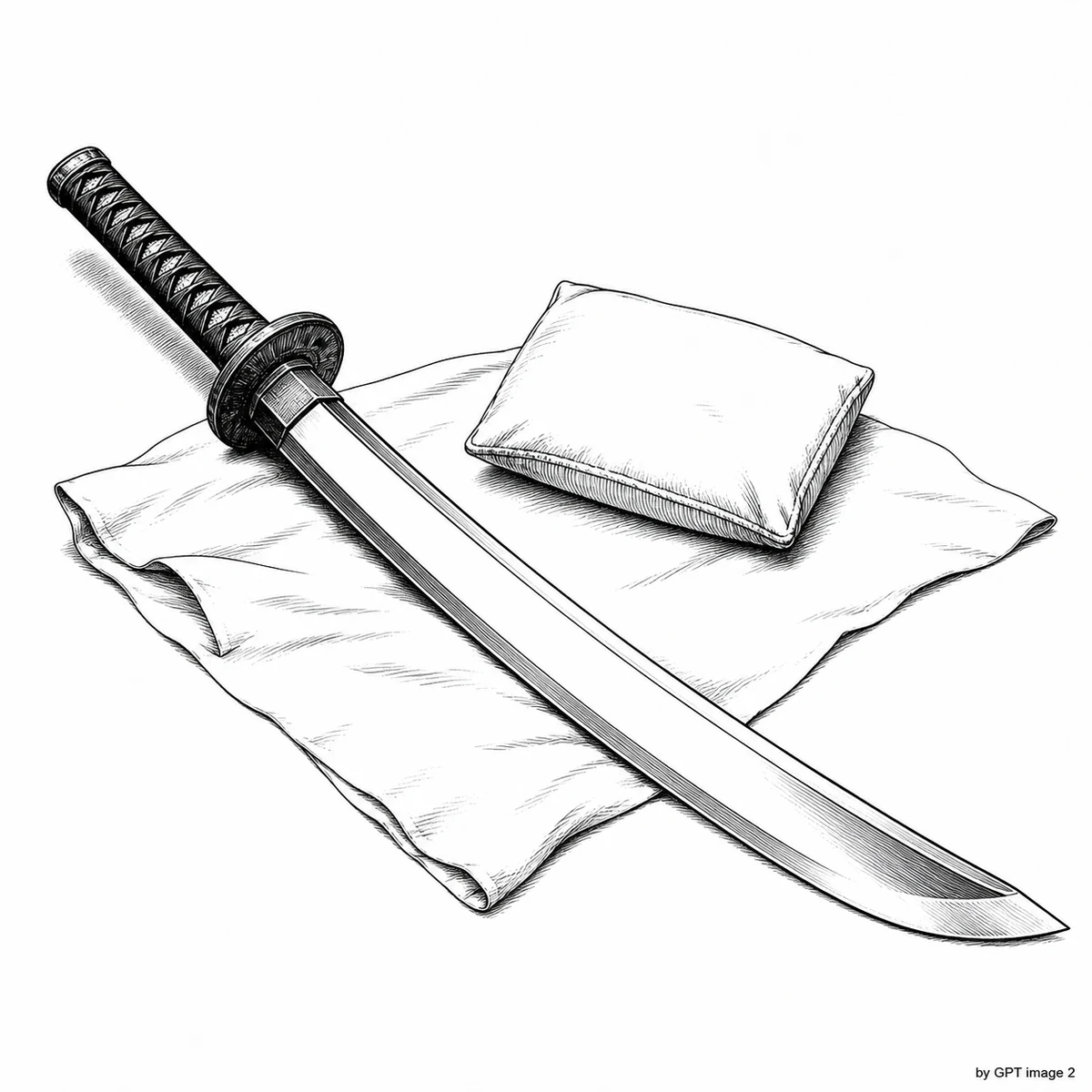
A family treasure kept for generations by the Maeda house. The work of the smith Miike Mitsuyo (三池光世). Its blade is long and thick. When the next head of the Maeda house fell gravely ill as a child, the mother would place this blade at the bedside — and the tale that the child would then revive continued across five generations.
The blade does not directly heal the illness. The blade binds the will, the lineage, and the name of the house into one place. When the will that the next head shall survive fills the whole house, the child revives. The blade is the vessel of that will.
The Maeda house once lent this blade to another house. The young heir of the house that borrowed it was ill. But that house's will to keep the child alive was weak — because politically it was more convenient for him to die. The blade did not work. The child died. After the Maeda house took the blade back, that house was extinguished within the next two generations.
#Law — Tachi Base + Masterwork Technique
Base technique: Same as the tachi. (Late Heian style.)
| Technique | Type | Energy | Check | Effect | Limit |
|---|---|---|---|---|---|
| [Masterwork] House-Pulse (家脈) | Kata | 3 | 2d10+Courage+Swordsmanship+2 >= Defense | 2 Wounds. After this breath ends, 1 ally in the same zone recovers 1 Wound (bearer's choice). If the ally who is healed is of the same house as the bearer, +1 recovery. | round 1 |
Blessing [aptitude]: When an ally in the same zone is in a state just before going down (Wounds 1 or less), that ally automatically recovers 1 Wound each lull. However, that ally must be one the bearer has RPed as taking responsibility for (family, comrade, servant).
Curse [aptitude]: It cannot be lent. If the owner lends or transfers the blade, the blade does not trigger its masterwork technique for that scenario. If the transfer is permanent, there is no effect until the new owner is recognized as the house (by bloodline or recognized succession).
Ownership condition: Maeda-house direct line / descendant, or Maeda-house recognition. One who has family or servants they can take responsibility for.
Acquisition scenario: A late reward for a Maeda-house retainer PC. Or the reward of an escort/rescue scenario commissioned by the Maeda house.
#Juzumaru Tsunetsugu (數珠丸恒次)
#Scent — The Blade of Prayer Beads
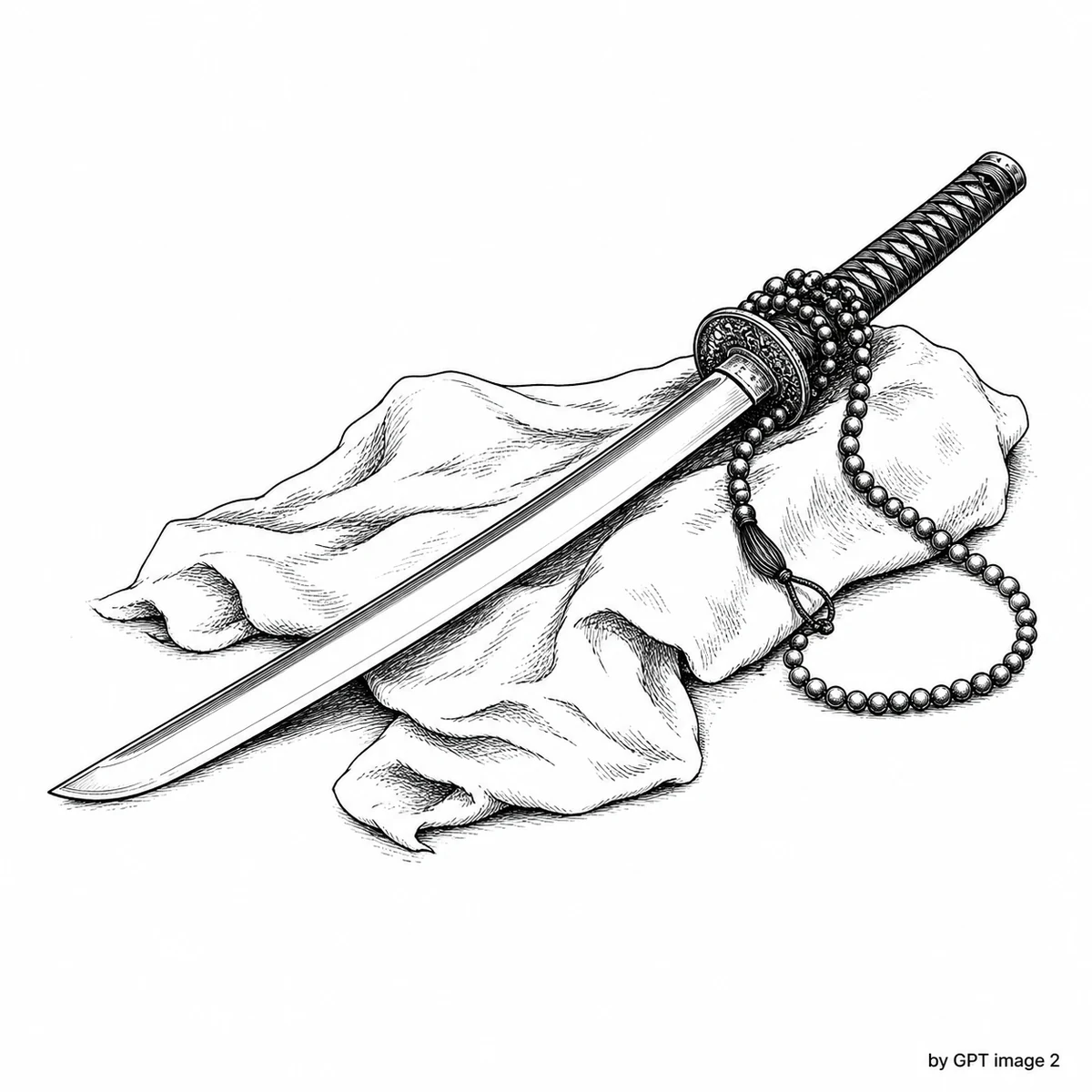
The guardian blade of Nichiren (日蓮), founder of the sect. The work of the smith Aoe Tsunetsugu (青江恒次). Prayer beads made of 108 small beads are wound around the hilt. The origin of the name.
Nichiren almost never used the blade. He was a religious man. Yet the blade was at his side — in the age of persecution, when an enemy aimed at his neck, the blade shook the prayer beads on its own hilt and made a sound. That sound shook the enemy's heart — and stayed the hand that would have swung the blade. Several of the tales of Nichiren's survival are said to be due to the sound of this blade's prayer beads.
After Nichiren's death, Juzumaru was enshrined at Mt. Minobu. In later ages it was lost once and recovered again. Brought to a place where a Spiritual Contamination Zone has taken hold, the prayer beads move on their own and purify it.
#Law — Tachi Base + Masterwork Technique
Base technique: Same as the tachi. (Late Heian style.) But the masterwork technique can be used without cutting — swing the blade but do not let the edge touch the target.
| Technique | Type | Energy | Check | Effect | Limit |
|---|---|---|---|---|---|
| [Masterwork] Pure Thought (淨念) | Kata | 3 | 2d10+Wisdom+Exorcism+2 >= Defense | 1 Wound + prayer-bead sound triggers: during the next 1 round, nullify the next activation of the zone's Spiritual Contamination Zone effect, any personal Spiritual Contamination condition affecting a target there, or any Curse or charm effect operating there. The prayer-bead sound triggers even on a miss (the effect activates, but no damage is dealt). | 1/round |
Blessing [aptitude]: +1 to Exorcism checks while equipped. Once at each lull, choose one Spiritual Contamination Zone in the same zone. Treat 1 round of its purification procedure (2d10 + Wisdom + Exorcism >= 15, requiring 3 rounds) as completed, but make the purification check normally.
Curse [aptitude]: Faith compatibility. If the bearer is not of Buddhist (Way of Emptiness 慈/虛) alignment, the masterwork technique Energy cost is +2 (that is, 5). If one who actively follows another faith (Way of Mystery / Way of Rites / Way of the Lord of Heaven) wields it, the blade does not respond (the masterwork technique cannot be used).
Ownership condition: A Nichiren-sect or Buddhist-tradition PC. Recognition from Minobusan Kuon-ji (身延山久遠寺) or an affiliated Nichiren temple. A PC of another religion can only carry it, not use it.
Acquisition scenario: A commission from a Mt. Minobu temple or a Buddhist-campaign reward. A lost-and-recovered scenario.
#§ Law — When the Five Gather in One Place (Optional)
If all five gather in one place — this volume places it as a campaign-grade event. The game-rule effects are as follows.
| Number of blades gathered | Effect |
|---|---|
| 2 blades | No displayed effect |
| 3 blades | Within the same scenario, automatically purify the Spiritual Contamination Zone near where they gather (box/altar/PC's hand). Each lull. |
| 4 blades | The above effect + the GM informs the PC of the location of the fifth blade by a vision (1 location clue). |
| 5 blades | Tenka Goken alignment — once within a scenario, all yoma in the same zone (including Lord-grade) have Defense -2. Masterwork-technique Energy of allies in the same zone is -1. Lasts 1 round. After the scenario the five blades scatter — one blade returns to the Spirit Realm, one blade is lost, or one blade departs to seek its next master. The alignment is only for a moment. |
GM note: A campaign in which the five gather in one place is an event in which every tale of the Japanese blade is bound to a single moment. Use it only as the climax of a single campaign. So that a PC squad cannot hold all five routinely, force the "scatter" effect above after the scenario.
#§ Law — The Boundary Between the Tenka Goken and Divine Artifacts
#Mikazuki and the Sword of Fudo
Mikazuki Munechika glows blue, and the co-07-03 § Sword of Fudo also catches flame. The two look similar but are separated as follows.
| Item | Mikazuki | Sword of Fudo |
|---|---|---|
| Devotion slot | None | Yes (Way of Emptiness / Way of Rites) |
| Always-applied Curse | None | Flame of wrath (at Wounds 2 or less, automatic Critical Hit / forced target) |
| Divine origin | The smith Sanjo Munechika | Fudo Myoo |
| yoma effect | Blessing +2 | Blessing +1 + immunity when devotion triggers |
A scenario variant that tries to elevate Mikazuki to a Divine Artifact like the Sword of Fudo is not recommended in this volume. It is strong enough as a masterwork.
#Dojigiri and the Sword of Susanoo
Dojigiri also cut down Shuten-doji, and the co-07-03 § Sword of Susanoo also cut down the Orochi. Both are blades that cut down a great yoma, yet one is a masterwork and one is a Divine Artifact. The difference:
| Item | Dojigiri | Sword of Susanoo |
|---|---|---|
| yoma that was cut | Shuten-doji (great yoma) | Yamata no Orochi (mythic grade) |
| Origin of the blade | Yasutsuna of Hoki (smith) | Susanoo himself — divine |
| Use | Later house treasure | Later shrine enshrinement |
| Masterwork / Divine Artifact | Masterwork | Divine Artifact |
The point: who made it is the first test that divides masterwork from Divine Artifact. The work of a human smith is a masterwork; the work of a divinity, or a blade a divinity used directly, is a Divine Artifact.
#Reference Links
- Masterwork Compendium
- Divine Artifacts
- Weapon Catalog
- Mikkyo Class
- Commentary on Existing Masterwork Arms
- Commentary on Existing Divine Artifacts and Realm Wandering Relics
- Heian / Genji / Heike Masterwork Blades
- Kamakura / Muromachi Masterwork Blades
- Smith Schools
The Tenka Goken is not five blades, but five ways of all-under-heaven.