#Observation 1 — Saikai (西海)
Contents
Authority. The main text is Fiction-Only — the record of one outsider, in which fact, rumor, and misunderstanding are mixed. Who the narrator is, is in The Narrator — the Nanban Brush; the promise of this whole book is in About This Book. Only "At the Table" at the end is Scene Tool. This volume has no Law — if you need numbers, go to the canon
co.
The old provinces (舊國) covered — Chikuzen (筑前) · Chikugo (筑後) · Buzen (豐前) · Bungo (豐後) · Hizen (肥前) · Higo (肥後) · Hyuga (日向) · Osumi (大隅) · Satsuma (薩摩), and the two islands of the sea — Iki (壹岐) · Tsushima (對馬).
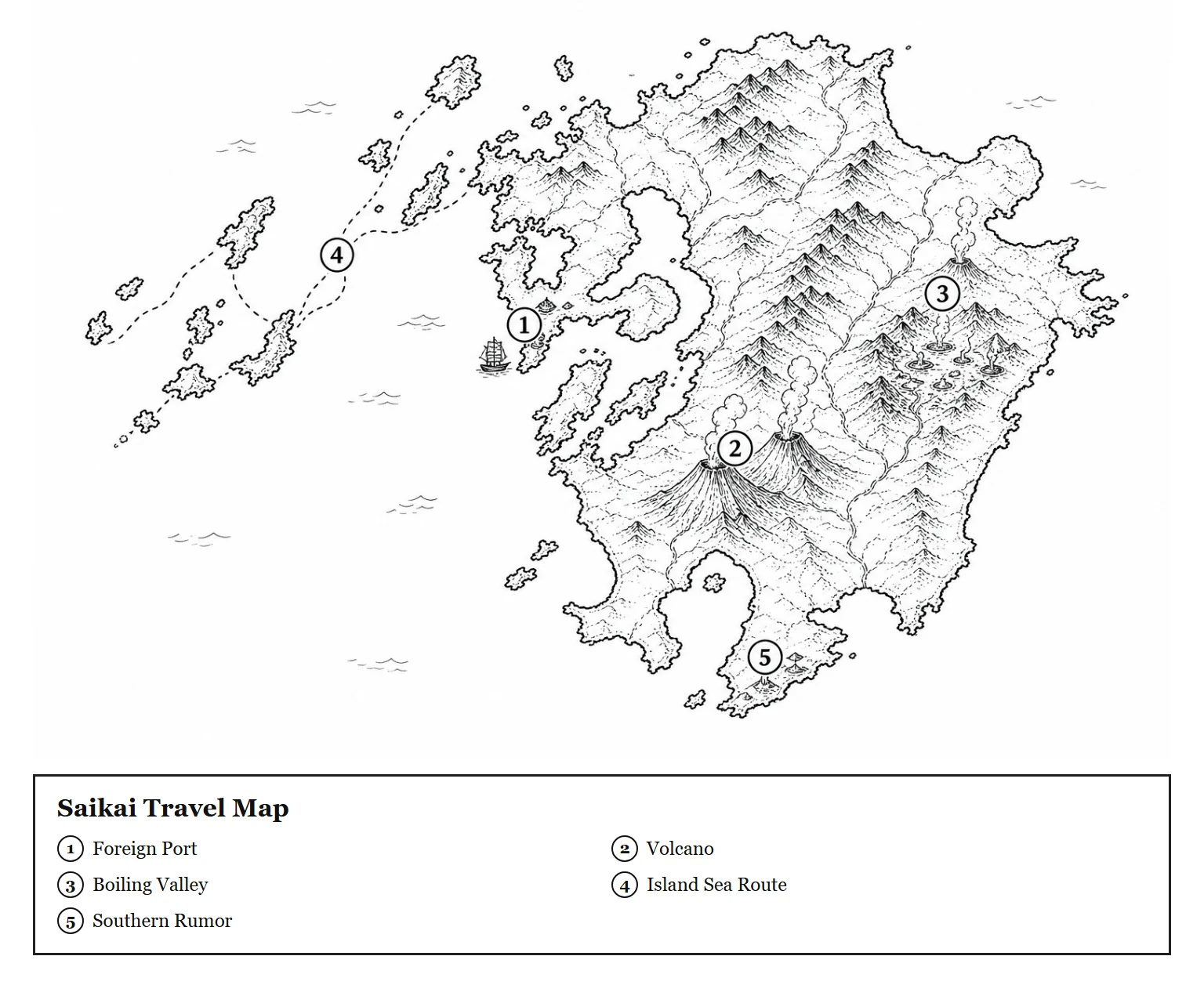
#The Road — The Day I Came Ashore
From Pinto's diary — Landfall.
The tide called us. Before daybreak the longboat was lowered, and I sat with the chest holding my ledger and scale clutched on my knees. With each stroke of the oar the harbor drew nearer — no, the smell of the harbor came first. Every harbor has its own smell. The wharf of my homeland smells of salt and spice, but this harbor was tidal flat and the smoke of burning wood, and beneath that something like a sweet scent was laid down. As I learned later, it was the incense burned at the temples.
We sailors call this harbor Firando (Hirado 平戶 in this country's tongue). Since I have come to this country, from here on I will set it down by this country's name.
Stepping onto the gangplank and down onto land, my legs swayed. The legs of a man who has been aboard ship more than two months distrust the land — though my head knew it was not the ground that swayed but I myself, it went on for a good while. That the first thing I did in this country was to stagger, I set down without hiding it.
People had already gathered on the wharf. Hands that had been mending nets stopped, backs that had been bearing loads turned, and the children pushed their way out to the front row. The bravest one child came up, touched my sleeve-cuff, and fled. The second child was the beard. From the third on, they seemed to have formed a line.
"Give them a smile," said the Tongue. "It is not that the beard is frightening, it is that it is a marvel. It is the grown-ups who turn frightened faster."
Sure enough the eyes of the grown-ups were split in two. Half looked at my chest — what has he come to sell — half looked at my face — what has he brought in tow. The eyes of the harbor reckon, and the eyes behind the harbor keep watch. For a reckoning learned on the first day, it is a reckoning worth its price.
Men wearing swords passed by. By twos, by threes — a long sword and a short sword layered at the waist, walking down the middle of the road. Unlike us, in this country the sword is not a soldier's tool but the garment of rank. Whose sword serves whom, the banner tells you, the Tongue informed me.
The merchant of this harbor, said to be the trading house's contact, came to meet me. As I made to take off my hat in greeting, the Tongue pressed my elbow. "Not the hat, the waist." I bent at the waist. The other bent more deeply. When I bent more, the other bent again. The greeting of this country is like a haggle, and the one who stops first becomes the higher — a tale I was told. I lost to the end. To lose in the first dealing is an old law of trade.
I passed through the market. On the stalls the cargo our ship had unloaded was already up — bundles of Chinese raw silk (生絲), glass beads, a single clock. The most people stood before the clock, but none were buying. "Because asking the price costs nothing," said the Tongue. A good market. A market where many ask the price is a living market.
And I saw silver (銀). At a money-changer's stall two men were weighing chips of silver on a scale. Silver cut to use — dull and heavy of light, silver from which the look of the freshly mined has not yet worn off. The scale in my chest seemed to tremble. A merchant's superstition — but a good superstition.
The Sword — I mean my guard — had not opened his mouth all day, but as he sat down on the floor of the lodging he said one thing. "Many swords for a harbor." When I asked what it meant, "It means the goods that sell are dear," he said.
When I lay down at night the floor swayed. Thinking it was my body, still in the habit of the ship, doing the swaying, I fell asleep. When I told the Tongue in the morning, the Tongue made a troubled face for the first time. "Last night — it really did sway a little."
I set it down in the first chapter. The gate of this country opens to the west. I came in by that gate. This I saw.
#The Land of Fact — Fire and Wind and a Boiling Valley
The people of this country call this great island and the sea around it Saikai — the western sea. It means west as seen from Miyako (Kyoto). I, on the contrary, came from the west, so to me this land is the first chapter of this country. I landed at Hirado, passed the old trading harbor of Hakata, and walked along the coast of Buzen as far as Funai in Bungo — being the pace of a column bound to cargo and barriers, it could not make more than six or seven ri (里) a day. The sense of ri I leave to the Glossary & Weights and Measures, and the practicalities of barriers and lodging to Roads and Travel.
#The Mountain of Fire
I first saw it on the pass-road crossing from Buzen into Bungo. Far off, above the inland mountain range, a pillar of smoke stood straight up — the clouds lie down before the wind, but it did not lie down. When I asked if it was a forest fire the Tongue shook his head. "The mountain is breathing." A mountain sending up smoke I saw that day for the first time. This I saw — and I set down too that the writing in my diary that night was larger than usual.
Deep in the interior there is a mountain called Aso (阿蘇), they say. Its summit is hollowed like a great cauldron, and inside that cauldron are villages and fields and roads. The saying that there is a country inside a mountain I took at first for the interpreter's error. A tale I was told — only, I heard it from three people separately, and the words of the three were the same.
Off the harbor at the southern end there is a volcanic island called Sakurajima (櫻島), and there are days when ash falls like snow, they say. When the ash falls, the people of that place go to market under umbrellas, and watch the direction of the wind to change which side they hang the washing, they say. People who go to market beside calamity — this, too, is a tale I was told. And one thing more, I set it down with a merchant's eye. The soil at the foot of the mountain of fire is black and rich. The reckoning that a good thing lies beside a fearful one is the same in every country.
#The Path of the Great Wind
This land is the path that, when the great wind of summer's end comes up from the sea, takes it first. Stones are laid on every roof of the harbor, and props for hauling boats up onto land are stacked at every wharf — this I saw. Unlike us, the people of this country count that wind not as a calamity but as a season of the calendar. When the month of the wind comes the boat-fare rises, and when the wind passes it falls. The price-list is in effect the calendar. I also heard a tale that once in some years the wind exceeds the harbor's reckoning — that boats came to rest atop roofs, and roofs floated on the sea. A tale I was told. The sailors laughed at the sight of my face as I listened, so by how much the price was inflated, only they know.
#The Boiling Valley
At the foot of a mountain not far from Funai in Bungo, there is a place where a whole valley sends up steam. The ground boils. Mud bubbles like porridge in a cauldron, one pool is red as blood, and from every crevice in the rock steam leaks and makes a whistling sound. The people of this country call it Hell (地獄) — and beside that hell they build villages and live. We would have called it the devil's cauldron and gone ten ri around it. They call it hell and then soak the sick in its water, and steam potatoes and eggs in its vapor and eat them. This I saw — and this I ate. As for the taste, I set down only that for a hell it was mild.
#The Harbor's Reckoning — Nanban Trade
From here on it is my own trade. I will strive to set it down without inflation — though it is the merchant who inflates most where it is his own trade.
The western harbor is not one but many, and each harbor has a different face. Hirado is the harbor where our ships and the Chinese ships meet. Funai, being the mouth of the inner sea — the Seto Inland Sea — is where cargo bound for Miyako changes ships. Kagoshima at the southern end is, I heard, the harbor of Ryukyu and the southern sea-routes — I could not get that far.
I set down what comes in. First is Chinese raw silk — this country loves silk, yet the thread it spins by its own hand is wanting. Next come teppo and gunpowder, glass, clocks, wine, rasha (woolen cloth), spices and medicines. I set down what goes out. Silver. And silver, and again silver — beside it are loaded swords and lacquerware, and the sulfur the mountain of fire gives forth. The ships of this country still cannot cross the far sea well, so it is our ships that carry between China and this country. That what each desires, with a single sea between them, should miss so cleanly is a merchant's dream — between a country of silver that wants silk and a country of silk that wants silver, we earn from both sides by rowing alone.
The haggle is done by three. I, and the other side, and the interpreter between us. The brush sets the price down to show before the mouth does, and a price set down is never made void. And when I asked where that silver comes from, the harbor's merchants named a mountain to the east. I will go to see that mountain — that tale belongs to the next chapter.
#People and Customs — Two Faces Inside the Gate
In the harbor I was a walking shop. Half a day over the pass, and I became a walking rumor.
The people of the harbor are used to the outsider. They do not start at the beard, they call a price, reckon the change, and if you do not buy they look to the next customer. Yet cross a single pass within the same province (國), and you come to a village seeing a Nanban man for the first time in its life. The children draw near, the grown-ups half-close their doors, and the old folk go to the temple — to fetch a charm. In one village, after I passed through, they scattered salt on the road, they say. A tale I was told — the Tongue hesitated a good while before he carried it over to me.
I saw, too, greed and fear living inside one person. A merchant who in the day asked the price of my glass beads took those beads to the temple in the evening and came back having had them smoked with incense. The price we haggled out the next morning — that because they were beads smoked with incense the price should be cut was his account, and that because they had even been smoked with incense the price should be raised was mine. Unlike us, the people of this country do not trouble to part what they wish to have from what they fear. They buy while fearing. They fear while buying.
Words have faster feet than goods. What we call bread they called bread in this harbor too. The teppo entered 40 years ago — and the words that crossed over together with the goods had already become the words of the market. I saw, too, a sailor with a cross hung at his neck and a sailor with a charm pasted to his hat rowing in one boat. Before the sea, faith does not lessen but multiplies.
In the northern sea there are two islands — Iki and Tsushima. I could not take that road. Only, at the wharf of Hirado I met sailors of those islands. They live between this country and the country across the sea, speak both countries' tongues, and took both countries' coins. Goods and words and rumors change ships at those islands. One man showed me a bolt of cotton that had come across the sea, and it was cloth of fine weave and honest reckoning — those who live in the strait hear only half of the law of either shore, but their scales, those alone they keep complete from both sides. That is the law of the island, they say.
#The Land of Konsei — The Gate by Which the Teppo Came
There is one reckoning I cannot leave out in setting down this land. That the teppo entered this country 40 years ago — and that the gate was precisely this western sea.
The tale I was told runs thus. A ship of our side reached an island in the south and sold teppo, and the young lord of that island paid a great price and bought two pieces, and had one learn the way of firing while the other he gave to the smith, bidding him make the same. The tale of 40 years ago is a tale I was told. But the gunfire that sounds every morning on the sand behind the harbor is a sound I heard. Now the forges of this land make goods learned from looking at our goods, and in the market by now their teppo are more numerous than ours. As a merchant I set it down with a wry smile — the one who sold the goods earned once, and the one who learned the way of making earns to the end. We earned once.
The road the Nanban goods travel begins here too. Cargo unloaded at the western harbor goes east up the inner sea to Sakai, and from Sakai climbs to Miyako. If these harbors are the gate, Sakai is the storehouse — and the masters of the storehouse have come out as far as the gate. The Sakai Guild (堺座), a confederation of merchants, is the thing. Their people are present at every harbor, and it was common for the price to be set before our cargo even touched land. It is we who crossed the sea, yet it is they who hold the price. Galled, I set it down; and as a thing to be learned, I set it down twice.
I must set down the tale of the outsiders too. In the harbor live folk like us, gathered together — sailors, merchants, and the padres. The padres handle not goods but faith. Among the harbor's lords there are, I heard, those who have brought in the Nanban god along with the Nanban goods, and that the temple's bell and the prayer of the new faith are heard together in one harbor is a sound I heard. That the air between the two is not always mild I felt, too, in one harbor — I set it down as what I felt, not what I saw.
In the fields behind the harbor the banners change often, they say. The lords of this great island have long warred with one another, and war still — only, because the harbor's lords know the profit of the sea, the fighting seldom comes down as far as the wharf, I heard. Seldom, that is, not never. On the very day I left Hirado, the porters' wages rose on a rumor that some border barrier had been closed.
Editor's note: The reckoning that the teppo reached the southern island 40 years ago agrees with the canonical chronicle — of Pinto's numbers, the most honest. And the canon calls this land the homeland of the outsider. A PC who sits at the table carrying Nanban craft or faith would have been born a gaijin and taken a first step somewhere in these harbors. The reckoning of this region's powers and produce is held by Lands of the Sengoku.
#The Land of the Uncanny — What the Sea Carries In
A stretch of the road from Hirado to Funai we went by boat. I set down the matter of that second night — still unable, even now, to decide on which side to set it.
The fog came down, and the boatmen all closed their mouths at once. Only the sound of the rowing remained. Then that sound too stopped — because the boat-master raised his hand. For a long while, beneath the boat something tapped the planking evenly. Tap, tap, tap. The waves do not tap like that — as for the sound of waves, I too had heard it for two months. The boat-master scattered a handful of rice over the gunwale, the sound ceased, and the fog lifted a quarter-watch later. There was nothing I saw that night. What I heard was — a sound. Under which promise I am to set this sentence down, I do not know.
After we came ashore, I bought the boatmen drink and set down the tales I heard. On nights when the sea-fog is thick there is a thing that rises up like a mountain on the surface of the water, they say — they call it the umibozu (海坊主). Though you see it, make no sound; though it questions you, do not answer; if it asks for a bucket, give it a bucket with the bottom knocked out, I was told. There are also, they say, those who died in the water who gather at the gunwale and beg you to bail the water — they call them funayurei (舟幽霊), and to them one hands a bottomless ladle. Sure enough, at the harbor's sundry shop a bottomless ladle was for sale. What I saw was not a yoma but a ladle — only, the ladle was real, and it was selling at every harbor. A merchant believes, more than the goods, the reason the goods sell. There was also a tale that if you see a shadow lying long upon the horizon, within a few days great water comes — that one they named the ayakashi. The sailors do not fight it. They read it — like the weather.
It is no different on land. At every cauldron of the boiling valley a small shrine stood. When I asked the old monk of a temple, he said the land has blood-vessels — it is that tale of the spirit-vein (靈脈) I set down in the Overview — and that in this land that vessel passes near the skin and boils. The mountain of fire too, the red pool too, are places where that vessel has grown hot, he said. In the Overview I set down, as places where there is something, three: deep mountains, old passes, misty waters. In this land I add a fourth — where the ground boils.
And there is the rumor of the south. This one is of a different grain from the other rumors, so I set it down apart. The old boatmen who had come up from the southern sea were making new taboos — that on a certain waterway they do not go out on the dark of the moon, that at a certain island they do not put in. Ask the reason and there is no answer, and what I heard instead of an answer was things like these. A fishing boat came back empty — the net hauled in, the meal half-eaten and left. An island arose where the birds do not cry. Up the black waterway of the south something comes climbing. The yoma of this country mostly have names — to have a name means it has long been seen. The thing of the south has no name. That a taboo is newly made means that something has newly come.
The old monk of the temple behind the harbor looked long at my chest, and with one word I close this section. "Nanban man — a ship does not carry only people and cargo." I carried that word over to my diary only some days later. To set it down at once — the tap, tap of that night was too near.
Editor's note: To the rumor of the south the canon has not yet given a name — it is the very spot Lands of the Sengoku marked down as "the unknown yoma coming up from the south." The hand that decides the name and the face is the GM's, and the quick road to dressing an existing yoma in a southern face is in the Existing-Yoma Variant Index. What the sound Pinto heard beneath the boat was — that same hand decides.
#At the Table
Scene Tool. Only this section is a GM scene tool.
A Saikai campaign is fastest begun at a harbor. The harbor is where requests gather — every ship comes in carrying a circumstance, and every circumstance has a cargo-owner. The themes of this land are four. Sea trade and the smuggling in its shadow, incidents stirred up by foreign goods, the tension between temple and new faith, and the first encounter with an unknown yoma. Whichever it is, if there is one outsider among the party the scene rolls of itself — as it was with Pinto, an outsider becomes an incident merely by standing there.
The Nanban ship that does not return. A Nanban ship on the southern route has passed its term by two months. The trading house seeks the ship, the lord seeks the teppo that were aboard, the padre seeks the people who were aboard — three requests point at the same ship but do not seek the same thing. And the inlet the drifting wreckage reached is, by the reckoning of the waterways, a place it cannot reach. If you wish to tie the cause to a sea yoma, the frame for a full sea battle and negotiation is held by the canonical The Silence of the Dragon Palace — if you wish to leave the cause as the nameless thing of the south, the longer it stays undecided, the longer it stays fearful.
The forbidden cargo. On one chest deep in the harbor's storehouse a lord's seal and a temple's charm are pasted together. The ship that unloaded it has departed, the one who said he would buy has not appeared, and the storehouse-keeper grows thinner night by night. Is the party hired to guard that chest, or to open it — better still if two requests come in at once for the same pay.
The shrine of the boiling valley. The cauldron that was hottest in the valley has begun to cool. The townsfolk welcome it, but only the old monk who kept the shrine beside the cauldron packs his bags. "That it boils means the lid is held down." If so, that it cools is — a tale that follows where the heat of the spirit-vein is leaking off to, and what is no longer held down beneath it.
The vanished interpreter. The one and only Nanban interpreter in the harbor has vanished. The Nanban merchant has lost his words and the lord's dealings have halted, and over what word the interpreter last carried over, three witnesses say three things. Since a man has vanished between words, one who knows how to walk between words must seek him.
The fisherman come from the south. A fisherman who drifted for some days has returned to his own inlet. To those who ask what he saw he does not open his mouth — only, since he returned, the dogs of that inlet do not bark toward the sea. When exactly they stopped barking, no one can say precisely. The first encounter with an unknown yoma is best begun without a yoma — there is no data, and the road for the day it becomes needed is in the editor's note above.
If you need small incidents to roll on the road, open Incidents of the Road; for the encounter tendencies and the reckoning of powers of this region, Lands of the Sengoku. The narrator's next step — east up the inner sea — is in Sanyo and Sanin.
The gate of this country opens to the west — that all that came in by that gate has been counted, no ledger anywhere records.