#Ou Observation (奧羽見聞)
Contents
Authority. The main text is Fiction-Only — the record of one outsider, in which fact, rumor, and misunderstanding are mixed. Who the narrator is, is in The Narrator — the Nanban Brush; the promise of this whole book is in About This Book. Only §At the Table is Scene Tool. This volume has no Law — if you need numbers, go to the canon
co.
The old provinces covered — Mutsu (陸奧) · Dewa (出羽) — two of them one in three of the mainland. Two provinces are a single world.
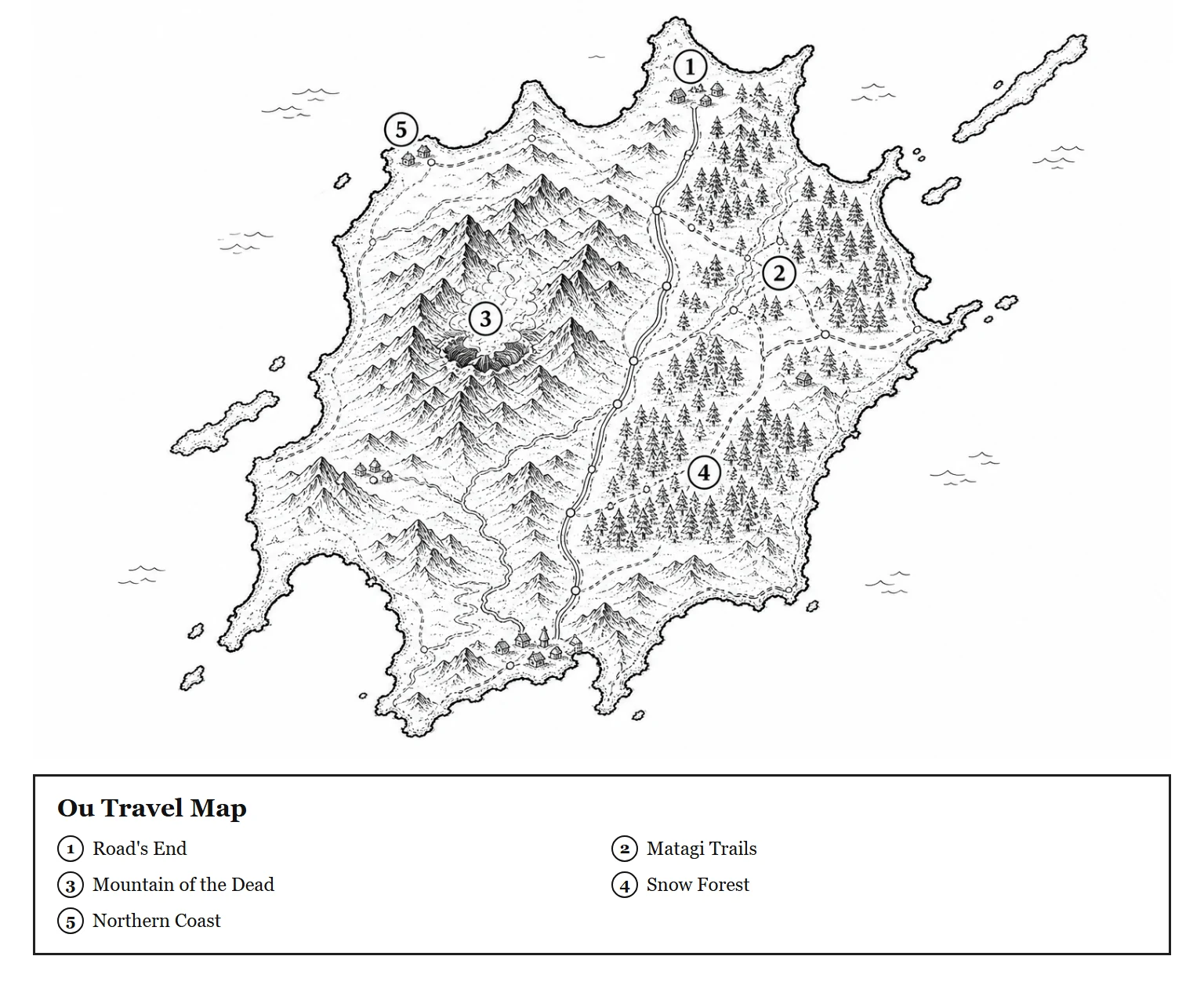
#The Road — The Narrowing Way
From Pinto's diary — the fifteenth day north, the wide plains behind me.
The road narrows. On the great road of the wide plains two mounted warriors could ride abreast. The road where the plains ended was one packhorse to one man. The road I walk now — to set it down as a road is to be generous to it. Grass growing in the middle of the road I see for the first time. It means feet that pass are fewer than the grass.
At the last market where the plains ended, the porters all set down their loads. Though I called twice the price, they would not lend a shoulder. "Northern loads are borne by northern shoulders." The head porter said so, and wrote on paper the name of a valley man who would bear the load in his stead. Not to buy a man but to be introduced to one — from here on, they say, that is the law of the haggle.
The post-stations vanished. In the south there was a station to change horses on every great road, and a price posted at every station. Here you ask a village for a horse. "You do not hire, you ask," said the Tongue. "You must not ask the price first. Here circumstance comes before price." I had entered a land where a merchant cannot ask the price.
Three days ago, at a hearth in a mountain village, I saw the Tongue stumble for the first time. The old woman of the house spoke long and slow, the Tongue asked again twice, and on the third he sat silent and only watched the fire. "It is the same country's tongue, true enough," the Tongue said after a long while. "Only — it seems the country I know ends here."
I set down a funny thing. In two years of walking I have picked up a fair deal of this country's tongue. Haggling and greeting and asking the way I do now with my own mouth. Yet that tongue carries only half here. For the first time in two years, the Tongue and I became the same outsider.
The Sword spoke even less. Instead his eyes grew busy. Each time we crossed a pass he looks long at broken dry branches and the tracks of beasts. Yesterday, rarely, he opened his mouth first. "The mountains of the south, it is men one fears; the mountains here —" He did not finish the end, and retied the cord of his sword's hilt.
The first snow came. In the south it would still be the month the autumn harvest ends. The snow buried the ankle in half a day, and the village folk looked at the sky and said this year it is late. This much, and late.
The snowy night I spent in a charcoal-burner's hut. The host did not start at the sight of us — he lives too deep to start. Without a word he raked the ash of the hearth and grew the embers, and stood our three pairs of wet straw sandals in a row by the fire. When I made to pay in the morning he waved his hand. "The price of lodging on a snowy day, the snow takes it." The Tongue, having carried it over, still gazed long at the words.
In the south I always walked knowing the name of the next village. Here you ask first whether there is a next village. Even hearing the answer that there is, whether it is one day or three to there, the snow decides, they say.
If anyone asks how far I go, I now answer: as far as where the road ends. At first it was an answer made in jest. Now it is the only answer left.
I count the paper. The sixth bundle is left the thickness of two fingers. Fitting. The country's end and the ledger's end come together — the journey of a merchant ought by nature to end so.
I set down what I learned today. From here on the road does not carry the man. The man carries the road.
#The Land of Fact — Two Provinces Are a Single World
This whole north is, by the old names, but two provinces. Mutsu (陸奧) to the east, Dewa (出羽) to the west. In the south there were days I crossed a province border twice in half a day, yet after I entered Mutsu I walked fifteen days and was still in Mutsu. The two together are one in three of the mainland, I heard — this time I do not suspect the reckoning of inflation. The legs that walked it are witness. We would have called a land this size a kingdom.
The law of this world is set by winter. Unlike us — if the people of the south begin a year with the rice-planting, the people of the north begin a year with the reckoning of snow. How many shaku of snow this winter will bring, that reckoning sets every value of the spring. The summer is short, and even the short summer is not to be trusted, they say. In a year when a cold white fog settles in off the great eastern sea, the rice does not ripen, and that autumn the granaries go empty. A tale I was told — but the face of the farmer who told it was not the face of one telling a rumor, but the face of one telling a debt.
The mountains are lower than the mountains of the south, they say, yet deeper. In the deep mountains of the south one could at least see the smoke of charcoal kilns. In the deep mountains here nothing can be seen. What covers the mountains is not the cedar standing straight as in the south, but a beech forest spreading its branches wide. In autumn its mast falls like rain and fattens the bear and the boar, and when the leaves drop the whole mountain becomes a grey sea. Into that sea the hunters go — their tale I set down later.
The seas are two, and different in nature. The western sea carries winter in — the cloud that comes off that sea snags on the mountains and heaps snow above a man's height on the Dewa side, they say. The great eastern sea is cold and rough, and the boatmen pick the season to go out. It is not a sea where boats line up as on the southern Seto Inland Sea. Unlike us, in this country's north the sea is less a road than a wall.
I must set down the tale of the gold. The maps of my childhood set this country down as Jipangu (the name our old maps gave Japan) and drew in a roof of gold. For two years I saw that roof nowhere, and had by now dismissed it as the dream of some old mapmaker — until, in an old town of the north, I saw it at last. Far in the past, they say, there was a capital of gold in this north. The gold of the north gathered to this town and made one whole capital shine, and that glory ended in war, they say. What remains now is a few temples, and one hall (堂) those temples keep.
A monk opened the door for me. It was a small hall — smaller than our country chapel. And within and without it was gold. The pillars, the walls, the buddha-image. In the winter light the gold did not blaze but lay sunken. What is enshrined within the hall is not only the buddha, they said — those who ruled that golden capital lie within it, dead. This I saw. The roof of gold was there. Only, what that roof covered was not a city of the living but the sleep of the dead. A man who crossed the sea seeking the gold of Jipangu has but one word to set down before that gold — and since it is not a reckoning for the ledger, I set it down in the diary.
The markets of the north are small but the goods run deep. Furs — bear, marten, fox. The mountain herbs the apothecaries of the south seek at a high price. And obsidian — a black, shining stone, that splits to an edge keener than a razor. The farther north, the more there were who used the edge of this stone in place of iron. The traders speak of a fourth good — the blessing of kamuy, they call it. When I asked the price, they said it is not a thing sold but a thing received. A market with a good that cannot be set down in the ledger is the first I have seen. The reckoners of the south say of this land that, if all its plains were tilled, it would feed several more provinces. A tale I was told — only, that reckoning leaves out the winter.
#People and Customs — The Law of Living With the Mountain
The hunting bands that take bear and deer in the mountains are called matagi (又鬼). In the village they live wearing the face of a farmer, and when they enter the mountain they live a different law. From the day they enter the mountain they cast off the village tongue and use the mountain tongue — they do not call rice rice, nor call bear bear. Because the god of the mountain is listening, they say. Our hunters get a beast by shooting it. They receive a beast from the god of the mountain — and so they fix the number they take beforehand and do not exceed it, and at the head of a bear they have taken they raise a rite to repay what they received. I saw matagi returned from the hunt lay a bear at the village mouth and bow to it. This I saw. A hunter bowing to a beast I saw for the first time, and having seen it — it seemed rather the one who does not bow who stood in need of explaining.
And there are the older masters of this land. Those who lived here before the Yamato people came — the people of the south called their forebears the Emishi (蝦夷), and their descendants now form tribes in valley after valley. The samurai call them Wildlander — a name written with the character for "field" (野), carrying not honor but contempt. Yet those I saw were no beasts of the field. They went the winter mountain without iron armor, took bear with a single small knife called a makiri and bare hands, and recited the name of every rock and rapid of their own valley. Unlike us, they do not say they own the land — they say they live with the land. I remember how long the Tongue cast about as he carried that word over.
Here is a thing to set down with care. The people of the south lump the people of the north together and call them all Emishi, and leave it there. But by what I saw and heard, beneath that name are many. There are the descendants of the Emishi long settled in this land — and farther north, across the sea, live other people called the Ainu. Their tongue and their living are not the same, they say. At a harbor at the northern end I saw a boat come from across the sea, and the furs and dried salmon and hawks it unloaded — the boat is what I saw, and their land across the sea is a tale I was told. An old man of the harbor said: "The southern gentry call us and them over there all by one name. That is the reckoning of a man who has not crossed the sea."
The descendants of the Emishi, and the Ainu across the sea, each in their own way revere what they call kamuy. The Tongue at first carried that word over as god (神), then three days later corrected himself. "To carry it over as god is to carry over only half." The Yamato god dwells in a shrine. The kamuy — dwells in the bear, in the fire, in the wind, down to a single vessel one uses, they say. All things of the world are guests come from the world over there, and when the hospitality is done they return to their own world. Whether the gods of the south and the kamuy are the same, the answer differed whether I asked a monk or asked an elder of a tribe. Only the answer that they are different was the same.
The southern half and the northern half live by different law even within the same town. A house that lives by the lord's writ and a house that lives by old custom use one well, and I saw too a house where at one hearth two gods take their meals apart. For two years I was often confused whether this country was one country or sixty-some countries, and coming to the north I add one more answer — whichever it is, it is not a country of the Yamato alone.
#The Land of Konsei — Where the Banners Do Not Reach
In the south the lord's banner changed each time I crossed a pass. Here the banners grew rare, and from one day on were not seen. In the south of Mutsu there are castles and small lords and barriers too — the law of the road I set down in Roads and Travel reaches that far. From north of there the village's law weighs heavier than the lord's, and the mountain's law heavier than the village's. Unlike us, the order of this country does not end cut clean as by a sword — it ends frayed like cloth. Through the frayed threads another world shows.
One side of that other world is the tribes of the Wildlanders. To each tribe one valley, one river. There is no great chief, they say — when a great matter comes the valleys gather and confer, and when it is done they scatter. They serve no lord, and no lord can say he rules them. In place of tax there is trade, and in place of law there are old covenants.
The other side is — the oni. Sixty years ago, they say, a king of the oni raised a mountain-fortress in the southern mountains. Since then the host of the oni grows year by year and reaches its hand north too, they say. A tale I was told — but on a mountain road I saw one village burned, palisade and all. This I saw. Asked whose doing it was, the porters of southern birth chose their answer, and the wildman hunters did not choose. The oni — so they answered, and thought it strange to be asked further. To them it was not a ghost-story but a matter of the border.
So there is in this north a front that does not exist in the south. The oni pushing north, and the tribes holding the valleys. The daimyo's armies are not there. It is the Wildlanders who raise the signal fires, and who pile cairns on the passes and keep the night. While the lords of the south war against one another's banners, in the land the banners do not reach men war against what is not man — of all the tales of war I heard in two years, this, they said, is the oldest war.
I set down one thing more. In the mountain range that leads from the wide plains into this land there is, I heard, a fortress. Not a lord's castle but a fortress kept by monks and sealers — what it bars is not men, they say. I could not see that fortress even from afar. Only, I saw that the porters of the pass would not so much as turn an eye toward that range after the sun was down. Though I called twice the price they would not go by the byways that way — twice in this country I have seen a porter refuse money, and both times the mountain was the reason.
Editor's note: That the mountain of the oni was raised is the "60 years ago" of the canonical chronicle, and the front along which that power pushes north is precisely the stage of this chapter. The grain of Ou's powers and yoma is held by Lands of the Sengoku; the fortress of the range, by Borderkeep of the Spirit Realm.
#The Land of the Uncanny — The Land Where the Boundary Is Thinnest
Everywhere in this country I heard tales of the uncanny (霊異). The tales of the south were mostly in dim places — where the road broke off, the night, the fog. The tales of the north are in broad day. The names I heard in the south as old tales are spoken here as the affairs of a neighbor. By the word of this country's monks, the boundary between the world and the Spirit Realm (霊界) is thinnest in this land. I do not know the measure (尺) by which a boundary is measured. Only this I know — the people of the south lower their voices when they tell such tales, while the people of the north tell them in the voice they use for talk of the weather.
On every evening bound by snow I gathered tales at the hearth. In the inner room of one house there dwells a thing in the shape of a child — while it stays the house thrives, and the house it leaves declines, they say. We would call a priest to drive out a thing lodged in a house. The master of this house, for fear it should leave, sets a tray each night in the upper seat. In the rivers there dwells a thing that drags down men and horses from beneath the water, and the children, even in summer, do not go near a deep pool (沼). And in the mountains there are — tall things one can carry over only as mountain-men, and there are valleys, they say, where if one who went in to gather mountain-greens does not return, they say the mountain took him and look no further. All are tales handed down in the villages of the north. None of them did I see — only, I saw the hand that sets the tray, and the foot that steps wide of the pool, and the silence that gives up the search.
I could not go to the three spirit-mountains of Dewa to the west. I could not take that road — the snow closed it first. Only, I met two pilgrims who had been around those mountains, and as the words of the two were the same, I set it down. To cross the three mountains in turn is a rite of dying once and being born again, they say. The white robe is a shroud, and to come down the mountain is rebirth, they say. And somewhere in those mountains, they say, there sit, in bodies that do not rot even after death, ascetics who cut off grain while living and dried and withered to become a buddha (仏). We too enshrine the remains of saints. But our saint lives and dies and becomes a saint, while the ascetic of this mountain dies while living in order to become a saint. The pilgrim who told this tale told it not as a dreadful thing but as a holy one — I have not yet closed the account between two minds.
There are old names. Names the valley folk do not lightly put on their lips, names that are neither of the Yamato gods nor of the buddhas. One of them I heard alike in three valleys far apart from one another — Arahabaki. The descendants of the Emishi bowed their heads at that name, and the Yamato monk waved his hand at it. The same name is to one side an old god, and to the other an old yoma. In a merchant's habit I set both down — only, there is one thing on which the three valleys spoke as one. That it is no legend. That the beings of the old tales of the south are here still awake.
The road ended at last on a mountain from which the northern sea is seen. The mountain of the dead — Osorezan (恐山), they call it. On a grey waste where the reek of sulfur stings the nose, steaming pits boil, and at their center lay a lake sunk white. On every slope without a single blade of grass small stone towers were piled past counting — towers piled by children who died before their elders, they said. Beside a fallen tower lay a pair of straw sandals someone had left. They were the size of a child's foot. This I saw.
At the foot of that mountain are blind mediums. The itako, they are called. When the bereaved come and ask, the medium shakes a bell and rubs a rosary and calls the dead in a long voice. I was at the place where a mother asked for a son who had been taken to the war in the south and died. The voice of the medium's chanting ran on for a while — and the voice changed. It was the speech of a young man. The mother, weeping, spoke with that voice of the harvest and a match in marriage and the affairs of a little sister. This I saw — and what it was I saw, I find in the end I cannot set down. Our church forbids the trading of words with the dead. What that prohibition seeks to bar I understood for the first time on this mountain — and what that prohibition takes away I understood for the first time too. I wished to stay longer in that place, and at the same time wished to leave at once. That the two minds were exactly half and half, I set down without shame.
On the road down the mountain an old medium said to me through the Tongue: "To borrow the power of the dead is to owe the dead a debt." And I add one tale I was told — there are mediums, they say, who do not stop at borrowing words alone. They borrow the blade-craft of a dead warrior, the sutras of a dead monk, and wear them upon their own bodies. The one who told that tale said that much and then lowered his voice and said no more. Nor did I ask further. In two years there are few times I gave up asking, and this is one of them.
Editor's note: The itako who carry words are an old living of the north. The one who went beyond it — the one who wears the arts of the dead — is held by the majin class of the canon. To bring it to the table, the GM's leave comes first.
Last, I carry over the heaviest record in this book.
From Pinto's diary — the road to the mountain of the dead, the third night in a valley village bound by snow.
This valley is a village of the descendants of the Emishi. Here I sat face to face with the oldest person I met in this country. The elder of the tribe. When I asked his age he only laughed. A young hunter who goes the markets of the south carried the elder's words over into a tongue the Tongue knew, and the Tongue carried it over to me. The words came to me through three mouths. They must have been pared three times on the way. What remained after the paring was this heavy.
Eighty years ago — when the elder was a child — the mountain changed, they say. The birds changed their paths, the bear abandoned its wintering bed, and things that did not answer though called in the mountain tongue walked the night ridges. The elders of the valleys gathered and conferred for three days, and the conclusion was short. The kamuy are wrathful. That things not alive were seeking a door. That the world of the living was growing thin.
The tribes sent men south. The elder's father was one of them. Bearing obsidian edges and furs as gifts, and granted the standing to carry the word of every valley. He was told to reach the castles and temples of the Yamato and tell them thus — the kamuy are wrathful. A door is opening. Stay your swords and hear.
The elder's father came back the next spring. Still bearing the bundle of gifts — unopened. "When the gift returns, the word has returned too." The elder said so and looked long at the fire. To the lords of the south it was the superstition of barbarians, and to the temples of the south it was a matter outside their own gate, they say. Among those who went as envoys there are some who never returned.
I asked — do you still think the south will hear. The answer came through two interpreters. "Eighty years ago the price of the warning was cheap. A packhorse-load of furs would have bought it. Now —" The elder opened his hand and shaded the firelight of the hearth. "Now a whole country given over would not be enough."
The elder watched me set it down for a long while, then asked. Why do you set it down. I answered — because, being a merchant, I cannot let a reckoning that does not balance stand. Eighty years ago this country received one warning for free and did not pay the price. How that debt swelled I saw, for two years, on every road of this country.
This diary is a ledger I promised to keep by setting apart what was seen from what was heard. This chapter is a tale I was told — heard through three mouths. Yet everything I saw in two years was evidence of this tale. So for the first and last time, I set the two markings down together. A tale I was told. And — this I saw.
Editor's note: The warning Pinto recorded is the affair of about the time the canonical chronicle sets down as "the beginning of the encroachment of the Spirit Realm." That the warning was ignored, even that the chronicle sets down in a single line. If you would bring the weight of that single line to the table — begin the campaign at the scene where the second warning arrives in the south.
#At the Table
Scene Tool. Only this section is a GM scene tool.
The grain of an Ou campaign the canon gave in four words — wildness, survival, antiquity, the boundary of the Spirit Realm. If the incidents of the southern chapters arose between man and man, the incidents of this land arise between man and what is not man. And before that there is winter — the closing pass, the cut-off village, the dwindling provisions. Let the snow test the party first, before the yoma come out. The powers of the region and the encounter tendencies are held by Lands of the Sengoku; the data of the beings in the hearthside lore, by Yoma of the Village, Road, and Mountain; the incidents on the road, by Incidents of the Road.
Places from this chapter worth drawing out and using:
- The second warning — the elder of the Wildlanders resolves, after eighty years, to send an envoy south once more. This time it is the party that bears the gifts. Who in the south hears, who scoffs, who tries to stop the envoy before he arrives.
- The front of the oni — a tribe of one valley holds a winter pass against a host of oni pushing north. The tribe is split over whether to borrow the swords of the Yamato — the party receives welcome and mistrust at one and the same hearth.
- The commission of the dead — the itako of Osorezan points to one of the party and says: "There is a soul that left words for you." Is the message carried a request, or a warning — or something else that borrowed the calling voice.
- The golden capital — the spies of a southern daimyo go north to dig into the legend of the old golden capital, and the party is hired as guide. What meets them in the ruin is not gold, but some old thing that keeps what sleeps with the gold.
- The frozen pilgrimage — the escort of an ascetic who bears a circumstance that compels him to cross the three mountains of Dewa in winter. The mountain is closed, and on a closed mountain the rite of death and rebirth becomes a thing taken to the letter.
And Pinto's diary does not end with this chapter. On the day he came down from the mountain of the dead, he set this down — "Here the road ended. What ended was my legs, not this country." What the man who turned his head south set down on the last page of the last bundle is in The Closing.
The south calls this land the end, and this land calls the south late.