#Observation 3 — Shikoku (四國)
Contents
Authority. The main text is Fiction-Only — the observation of one outsider, in which fact, rumor, and misunderstanding are mixed. Only "At the Table" at the end is Scene Tool. This volume has no Law — if you need numbers, go to the canon. The promise of this whole book is in About This Book; the one who wrote this diary is in The Narrator.
Old provinces covered: Awa (阿波) · Sanuki (讚岐) · Iyo (伊豫) · Tosa (土佐) — the master table of names and divisions is held by the cross-reference table. The previous chapter of the journey is Sanyo and Sanin; the next chapter is Kii.
#The Road — The Boat of White Robes
From Pinto's diary. The morning of leaving the harbor of Sanyo and crossing to the island.
When I boarded the boat it was full of white robes. Some twenty people, all dressed alike in white, sat in rows along the gunwale. I asked the Tongue, "Has there been a death? Who has died, that a whole boat is in mourning?"
The Tongue stifled a laugh. "They are pilgrims. People who circle that island. They are called henro (遍路)."
Unlike us, the people of this country wear the color white as the color of death. Yet by the Tongue's words, the pilgrim's white robe is indeed that very robe of death. They set out in the dress of one who is content to die on the road, he said. A journey set out upon after the preparations for death are made — for a long while I did not know in which column of my ledger I should record those words.
When the boat put out, the sound of bells began. Each pilgrim had a small bell fastened to his staff, and every time the boat rocked the twenty bells rang together. The Sword spoke with his eyes closed. "As long as that sound is made, there is no work for me." When I asked what he meant, he said that a bell is a sound that announces one's whereabouts both to living things and to things that are not living. One who means to hide does not fasten a bell.
The pilgrim seated beside me was an old man with all his teeth gone. When I asked how far he was going, the old man pointed toward the island and said only, "I circle." When I asked where he would arrive and be done, he said there was no place where it ends — that returning to the place he set out from is the whole of it.
I thought of the pilgrimage of our own country. Our pilgrim, reaching the tomb of a saint, weeps, prays, and goes home. The road exists for the holy place. But on this island there is no separate place of arrival — the road itself is the holy place. How does a step that circles the same place become merit? I do not yet know.
On the old man's sedge hat there were letters written. The Tongue read them for me. "Two go together — it reads dogyo-ninin (同行二人)." When I asked whether he had a companion, the old man said he had none. Then who are the two? "The Daishi," the old man said. "Though I walk alone, the Daishi walks with me."
I asked who the Daishi was. He was a great monk who long ago first made one circuit of this island, and even now he walks somewhere on the road, the old man said. How does a man long dead walk — instead of asking that, I held my tongue. A merchant does not disparage another man's stock-in-trade. All the more so if that stock is what keeps a man's steps from failing.
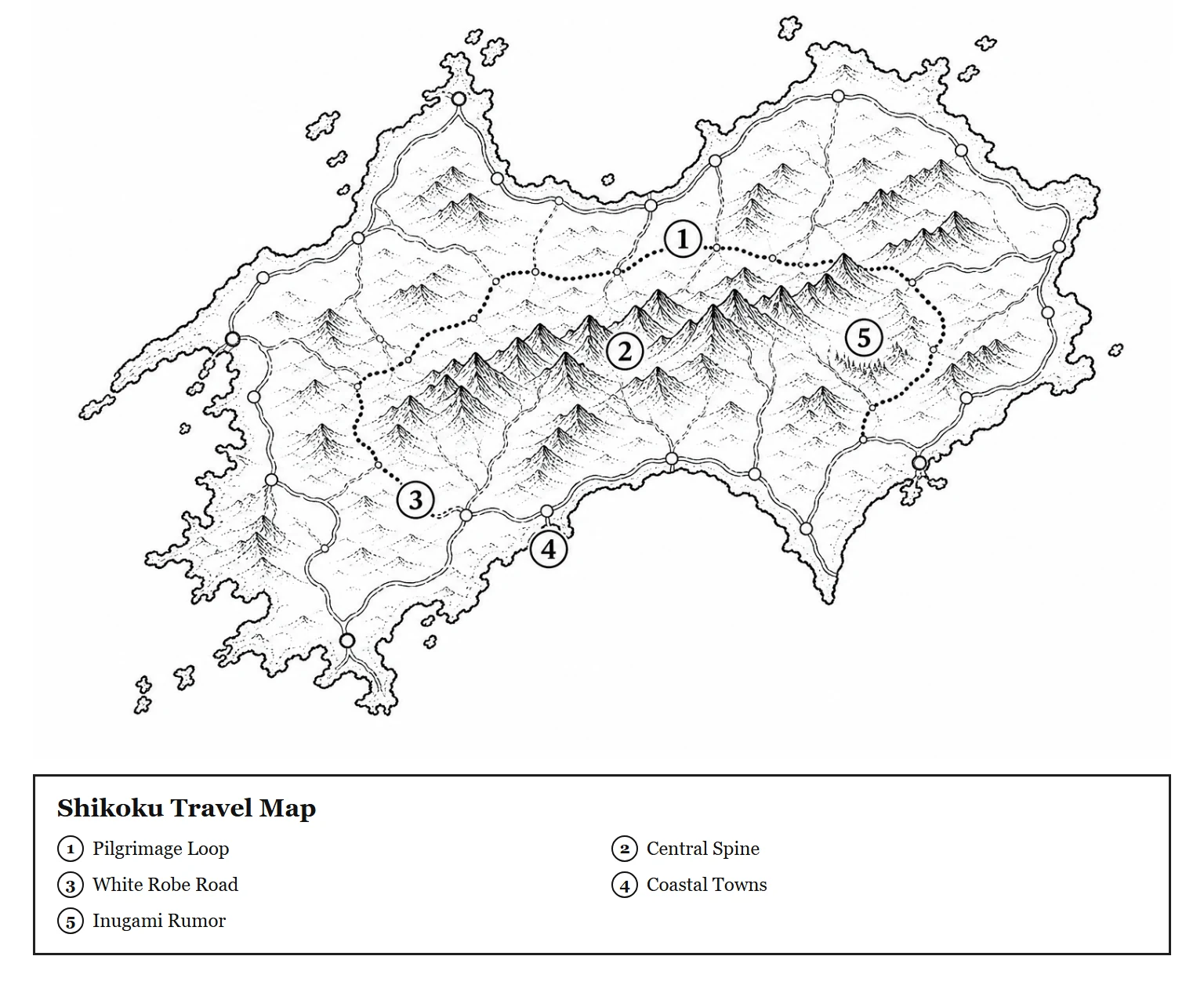
At midday the island came into view. Seen from afar the island was mountain all over. A mountain range like a blue spine cut across the center, and the provinces, they say, sit with their backs against that spine, each facing its own sea.
One of the sailors came to my side and, with the face of a man about to teach an outsider something good, said, "There are no foxes on that island." When I asked whether the fox was a fearsome beast, he shook his head. "The foxes could not cross over. The tanuki guard the ferry-crossings." Then he laughed at his own joke, but the end of the laugh was a little short.
Toward dusk I landed at the harbor of Iyo (伊豫). On the quay the pilgrims bowed toward the sea — at what they bowed I did not see — and, ringing their bells, scattered onto the road. Along the same road, in the same direction.
I record it in my ledger. The first impression of this island is twofold. An island whose center is blocked by mountains. And an island where, around the foot of those mountains, people in white robes circle like a ring. Why they circle — there are several tales I was told. I will write them down one by one.
#The Land of Fact — Four Provinces Set Back to Back
#An Island Whose Center Is Blocked by Mountains
This island has four old provinces. The four are not so much neighbors as strangers set back to back. The central mountain range is high and steep, so to go from one province to another one rounds by sea or crosses the mountains. One ri (里) of mountain road is worth three ri of field road — this I saw for myself, having walked it. For a sense of ri and cho (町), keep the Glossary & Weights and Measures at hand.
Though it is the same island, crossing a single pass changed the speech. The measuring-box changed too. That the measuring-box differs from province to province is so everywhere in this country, but that all four differ within a single island I saw here for the first time. For a merchant this is a border more accurate than a map.
| Old province | Position | A line from the diary |
|---|---|---|
| Iyo (伊豫) | West, Seto Inland Sea | Harbors and islands and old hot springs (湯). The province of sea-roads — the gate where I landed. |
| Sanuki (讚岐) | North, Seto Inland Sea | A sky stingy with rain. The people dig the earth to store the sky. |
| Awa (阿波) | East, a narrow channel | A mouth where the sea whirls. The province of indigo dye — the gate where I departed. |
| Tosa (土佐) | South, the great sea | A black great sea and straight-spoken people. The far side of the island's back. |
#Two Seas
This island has two seas. The northern Seto Inland Sea, being water cradled by islands, is tamed like a lake — boats come and go as though tilling a field. The southern sea of Tosa is a great sea with nothing at all to shield it. The very color of the water differs. If the northern water is blue, the southern water is black. The sailors of Tosa say that a black river flows within that sea — ride that river and the boat goes east as if flying; ride it wrongly and you never see land again. A tale I was told. Only, the sailors of three coves spoke of the same river.
At the eastern mouth of Awa the sea whirls. Through a narrow channel the waters of two seas come and go and strike against each other, and when the tide is right the cry of the whirlpool can be heard even from a boat. Cross that mouth and you are in Kii.
#A Dry Sky and a Dug Lake
Sanuki has little rain. The central mountain range takes in all the rain of the south, and only a dry sky comes over to the plain, I was told. The plains are broad but the rivers are short and hasty, so when rain falls it has all fled to the sea within half a day.
So the people dig ponds. Unlike us, the people of this plain in this country do not pray for drought to heaven alone but carve it into the earth. Every village has its pond, and the great ones are the size of a small lake. Ask who dug it and they answer, "my grandfather's grandfather" — on this plain a pond is a storehouse, a genealogy, and a rampart. Beside a pond there is always a small shrine that enshrines the god of water. The diggers were men, yet the god collects the rent, by my reckoning — so I wrote, and then, having heard a tale that in a drought year villages took up sickles against one another over a sluice, I erased that jest. On a plain where water becomes a blade, even a god must be set up alongside before the reckoning is done.
I record one thing with a merchant's eye. Count the number of ponds and you can reckon the rice of that plain. A plain with many ponds is a diligent plain, and a diligent plain is a fearful one. Wealth and fear had pooled in the same hollow.
#People and Customs — Those Who Circle and Those Who Stay
#The Road of the Ring
Along the outer rim of the island, temples and shrines are set like the knots of a cord. They are called reijo (靈場). The pilgrims tread those knots in order as they circle the island. When I asked how many there were in all, the answers were each different — the number counted at the temple differed from the number counted on the road, and even at the same temple it differed with each monk I asked. A ledger whose numbers are blurred makes a merchant uneasy. The strange circumstances of this reckoning I record later.
The pilgrim's dress is the same everywhere. White robe, sedge hat, bell, and staff. The staff they do not regard as a staff — they regard it as the body in which the Daishi walks with them. When the day's walk is done they wash the tip of the staff before their own feet and enshrine it on the floor. Unlike us, the people of this country carry the most precious thing in their hand, yet do not call it a tool.
There are pilgrims who die on the road too. The white robe was that very preparation from the start, he said. When one dies, he is buried by the roadside, the staff is thrust into the grave as a grave-marker, and the bell is buried with him. Walking the road, one passes the small burial mounds with a staff thrust into them several times in a day. At first I bared my head at each one, but from the third day on I could not count them and gave up. This I saw.
#The Hand Held Out
The roadside people of this island hold out to the pilgrim for nothing. A rice ball, straw sandals, a sleeping place under the eaves. The pilgrim who receives repays with one bow and a small slip of paper bearing his own name, and the master of the house pastes that slip to his doorpost. They believe the pilgrim's prayer will guard the house.
By our reckoning it is a losing trade. Yet the words of a village elder were these: "It is not given to a beggar. It is offered to the Daishi. For behind the pilgrim the Daishi walks." That is, these people are not giving alms but buying blessing — so to write it, the ledger balances; but when an old woman on a field-road in Sanuki held out a rice ball even for my share, the ledger did not balance. I was not a pilgrim, I wore no white robe, and by anyone's eye I was an outsider. When the Tongue tried to decline, the woman said, "You're a walking man, aren't you." This I received. On which teaching the faith of this island leans, the Buddhism commentary looks separately; but what I received that day, I set down, was something older than teaching.
#The People of Tosa
Even before crossing the mountains into Tosa there was a saying I had heard. "When you haggle with a Tosa man, do not name a price twice — the first price is the last price." Going and seeing, it was as I had heard. Their speech is straight and quick, and they count a roundabout manner as laziness. At a drinking-place the cup goes around, and a cup received cannot be set down before it is drained. I gave three nights to that custom before I could open my ledger again.
The warriors are half farmers. They stand a spear at the edge of the field and weed, and when summoned, they pull the spear and run, they say. A tale I was told — only, that a spear stood at the edge of the field, this I saw.
Their work on the sea is in keeping with that temperament too. The boats of Tosa go out onto the black sea and catch bonito. The catch is steamed and dried, and dried again until it hardens like a block of wood, and unlike us, the people of this country turn fish into stone and shave it with a plane to eat it. At first I laughed, and after being given the broth I withdrew the laugh. Light, imperishable, and fetching a price — it possesses all three virtues of the goods a merchant crosses the sea to seek.
#The Mountain Villages
People live within the central mountain range too. They are villages where the valleys are deep so the speech of the flatland does not reach, and salt is so scarce that a handful of salt does the work of coin. Between valley and valley, instead of bridges, bridges woven of vine connect them. Each time I set down my foot the whole bridge swayed like a beast — this I crossed. I had to cross twice, and the second time was no better.
The villages deep in the valleys have a tale that long ago people defeated in war buried their swords and stole in to hide. To dig and question is not the courtesy of the road, so I let it be. Only, I record this — that the tune of the song an old man of that village sang was, the Tongue said, closer to the melody of Miyako (Kyoto) than to the songs of the plain.
#The Land of Konsei — Those Who Hold the Road
#The Temples of the Ring
The temples that guard the reijo stand in strange places. They are far from one another, and the lineages of the teaching they enshrine are each different, yet bound by a single road they behave as one body. They are tied to no great temple-gate and to no lord, it is said. The man who harms a pilgrim finds the gate shut at every temple on the island, and that rumor circles the ring faster than a footstep.
The lords too do not touch the pilgrimage road. There is a folk-saying that the house of a lord who cut the road does not last three generations — a tale I was told. Whether by the virtue of the folk-saying or not, even in the midst of war the pilgrim passes the barrier without hindrance. With no document, with only sedge hat and bell. In this country the one road with no toll was this road alone. That the cheapest road is the road on which nothing is bought or sold is a reckoning a merchant set down at an apt moment.
#The Presence in Tosa
One tale I heard in Tosa. A single young lord is gathering up, one by one, the castles that were each their own in every valley. Those men who stand a spear at the edge of the field are his soldiers, they say. When that name came up at a drinking-place the voices of the company dropped a notch — and dropping, it was not a look of dislike. When I asked whether the road that circles the island might someday become that man's too, an old monk in the company set down his cup and said, "The road has never become anyone's. A lord is merely among the swift of the things that pass over the road."
#What the Road Enclosed
Why do they circle? As promised, I record the tales I was told.
The pilgrims' answer is uniform — to pile up merit, to walk with the Daishi. But from the old monks of the temples I heard a different tale. There was a time, long ago, when evil things swarmed on this island. At that time the Daishi — or someone before the Daishi, this part differed with each teller — drove knots into the rim of the island and joined them into a road, encircling the island in one round. The road itself is the fence, the kekkai (結界), they say.
The knots were eighty-eight, they said. There I heard the reason the answer was each different when I asked the number of temples — temples burn and move, so the reckoning changes, but the knots do not change, they said. Eighty-eight is not the reckoning of the road but the reckoning of the kekkai. When I asked what had fixed that number, the monk only laughed.
The fence lives by footsteps, they also said. If those who circle cease, the kekkai cools — and so even in a lean year the village feeds the pilgrim. It was an old monk of Awa who said that the hospitality is not human feeling but the repair of a rampart. Only, what that fence wards off, the words diverged. There was one who said it was a fence that penned in the things of the mountains so they could not come out, and one who said it was a fence that warded off the things across the sea so they could not enter the island. Inside and outside were exactly opposite, yet both were certain of their own words, so I set down both.
My reckoning as a merchant is this — taken as a tale made up by temples that cannot eat unless the road lives, the reckoning is clean. So I wrote, and meant to close the matter. But there was one night in the mountains when, from across the valley, I heard a long crying sound. It was the cry of a beast, the Sword said, and I nodded, and the two of us were both without words for a good while afterward. That night alone, I wanted to bet on the side of the fence.
Editor's note: Whether the saying that the pilgrimage road is a kekkai is true, half true, or the trade-cunning of temples trying to keep the road alive — this volume does not decide. This island falls within none of the six regions of the canonical Lands of the Sengoku — empty land belongs to the GM. Few places are as good to begin a campaign as a pilgrimage road with a single knot gone dark.
#The Land of the Uncanny — The Island of the Tanuki
#The Island the Fox Could Not Cross
I heard the sailor's joke again all over the island. It was, as it turned out, no joke. Around Miyako I had heard a tale that foxes bewitch men and enter the houses of the powerful, but the people of this island speak of foxes as of another country's tale. On this island there are no foxes — whether the fox could not cross, or the tanuki did not let it cross, differed with each teller — and the tanuki holds that place instead.
#The Way to Haggle with a Tanuki
The tanuki of this island deceives, but does not rob — for the most part, so they say. It loves wine, loves rhythm, loves a wager. If on a moonlit night the sound of belly-drumming is heard, the custom is not to enter that mountain. A tanuki whose feast has been disturbed bears a long grudge, they say.
Between village and tanuki there are agreements. A village that sets out the first cask of wine of the autumn festival at the forest's edge; a village that winds a new straw rope around the stone at the bridgehead each year — in return for that payment the tanuki withdraws its pranks on the night road, and in one village, they say, it sees the bridal procession off as far as over the pass. A tale I was told. A broker at one harbor used the phrase "a tanuki debt" — one who is in a tanuki's debt, until he repays it, finds that whatever reckoning he makes the last digit does not come out right. The broker said it as a jest, yet while he said it he did not laugh.
In Sanuki there is a tale that an old tanuki of a mountain called Yashima (屋島) is the chief of the island's tanuki. When some great matter befalls the island, the tanuki gather on that mountain to confer, they say — while the country of men is split into sixty-some and at war, the country of the tanuki is one, the Tongue added as a jest.
I record what I saw too. From beneath the floor of a certain temple a tanuki looked at me a long while. To write that it was not the eye of a beast would be an exaggeration, so I write only that, for a beast, it was an eye long in its reckoning. That night a coin's weight on my scale fell a fun short, and the next morning it was a fun over. The temple's monk, instead of an apology, said this: "A guest fond of reckoning has stayed, so the other side, too, must have wished to try a reckoning once."
Editor's note: The position and numbers for bringing this island's tanuki to the table are held by the canon, the tanuki entry of the Yoma Variant Index, and the Yoma of Beasts, Objects, and Places. If Pinto's record is right — these are not creatures to cut down but to haggle with.
#Inugami — That Which Rumor Bites
A tale I was told in Tosa. In a certain house the spirit (靈) of a dog dwells, and it bites whomever a person of that house has hated or envied. The one bitten falls ill for no known reason, sees phantoms, and behaves like a dog, they say. Such a house is called a house possessed by an inugami (犬神).
And the people single out such houses. When a marriage talk is exchanged, they first probe each other's family history, and with a house that hears such talk they do not make a marriage-alliance, nor share a well. A register no one knows who set down is passed from mouth to mouth in the village.
I record what I saw. I did business with a house that hears such talk. Because the other brokers shunned it, the price was cheap — I set it down as a merchant's shameful honesty. That house's dried bonito was the best I bought on the island, the reckoning was accurate, and the tea was warm. That house's dog was one, old, and did not bark.
I did not see an inugami bite a person. I did see rumor bite a person — that the daughter of that house had had three marriage matches broken, I heard in a place where she was not present. In our country too there are women called witches and driven out of the village. Having crossed this much sea, the way that men sort out men was alike. When men do not know the cause of an illness, they make up a house that has a cause — this one line I cannot classify under either what I saw or what I heard. I just set it down.
Editor's note: To the GM who brings the inugami into a scenario. The blade of this material is not the yoma but the rumor. Whether the house truly commands something, or someone commands the rumor — the table decides the answer, but whichever answer it is, do not let it end with "it was that house's fault." The name inugami is in neither the canon nor the Yoma Variant Index — it is a tradition this volume receives and records for the first time, and if a shape and numbers become truly necessary, borrow and pare from the curse type of the Vengeful Spirit, Undead, and Curse line. What Pinto saw in that house was not a monster but people whose price had been cut.
#That Which Circles the Same Road
On the night of the pilgrimage road too the sound of a bell is heard. The village people do not open their doors to a bell-sound at night — only, some houses set out a single bowl of rice outside the door. It is a pilgrim who died on the road finishing the road he could not complete, and, unable to receive the hospitality of the living, he takes only what is outside the door and goes, they say.
At a pass in Awa I saw again that toothless old man I had met on the boat. We had changed boats and horses, and the old man must have gone on his own feet, yet the old man was ahead of us. As I moved to draw near and greet him, the Tongue caught my sleeve. The old man turned the corner and vanished, and the sound of the bell remained for a good while after. This I saw — so I would like to write, but it was dusk and I was weary. This sentence alone I set down between the two columns.
The pilgrims are not startled by such tales. One of them said to me, "A ring has no end, does it. What is strange about a man who could not see the end walking on."
#At the Table
Scene Tool. Only this section is a GM scene tool.
The theme of this island is "the ring." The ring of pilgrimage, the ring of the rumor called the kekkai, the dead finishing the same road. The tale of Shikoku rolls better as a circle than as a straight line — what has changed when the party returns to the place it set out from is the question of this island. For minor incidents to roll on the road, open Incidents of the Road.
Pilgrim escort. It is an island with a law of the road that one does not touch the pilgrims. So there is a fugitive disguised as a pilgrim, an escort that can move only by the pilgrimage road, and a pursuer who must get around that law. Whether the white robe the party escorts is a true pilgrim becomes a scene from the start.
The knot gone dark. A single reijo has emptied — burned, the head priest dead, or the temple having taken a lord's side. In the villages of that stretch the nights begin to change. Whether the rumor of the kekkai is true, the GM decides — even if it is not true the village's fear is true, and the work of raising the knot again is paid either way. If you need a framework for resolving a social scene, borrow the canonical Non-Combat Rules.
Tanuki politics. The passage of a pass, the haggling of a market, a lost object — on this island any of these can be rolled as a haggle with a tanuki. What a tanuki takes in payment is not coin. Wine, rhythm, face, and secrets. The numbers and variants are held by fc08.
The inugami marriage talk. A marriage talk stands between two houses of Tosa, and within three days a rumor begins that one side is a house possessed by an inugami. The one who hires the party may be the side that means to protect the marriage talk, the side that means to break it, or a third party trying to find the source of the rumor. Whether the dog spirit truly exists, the GM decides — but trace back the road on which the rumor arose and at the end there is always someone's reckoning, and to bring that reckoning to light is the conclusion of this incident. The level at which this is handled is held by the Editor's note of "The Land of the Uncanny."
The presence in Tosa. The young lord gathering up the castles of the valleys buys swords and buys brushes too. Escort, envoy (使者), sea-road escort on the black sea — good to use as a client, and better still to use as a pond for drawing a campaign out long. This volume gives him no name — that name is fixed at your table.
A road with no place to arrive does not end, and a road that does not end becomes a fence — a tale I was told. Only, this once, I set it down in the column of what I believe.