#People and Arts — The Stage of the Sengoku Era
Contents
This document belongs to the front. The figure descriptions below are Fiction-Only — accounts that render real history through the lens of this setting, not check values. The values for using them as NPCs are set by the GM based on
co.
#Brief — A Map of the Stage
The arts of this era split into two. Arts composed while seated and arts shown while standing.
The seated side — renga, waka, chado, kodo, ikebana — belonged to warriors, the court nobility, and great merchants. These are arts of letters, eye, and rank, so the act of composing is handled as a non-combat check of Wisdom (co-03-09), and the refinement of presenting it on the spot is handled as Presence + Bearing.
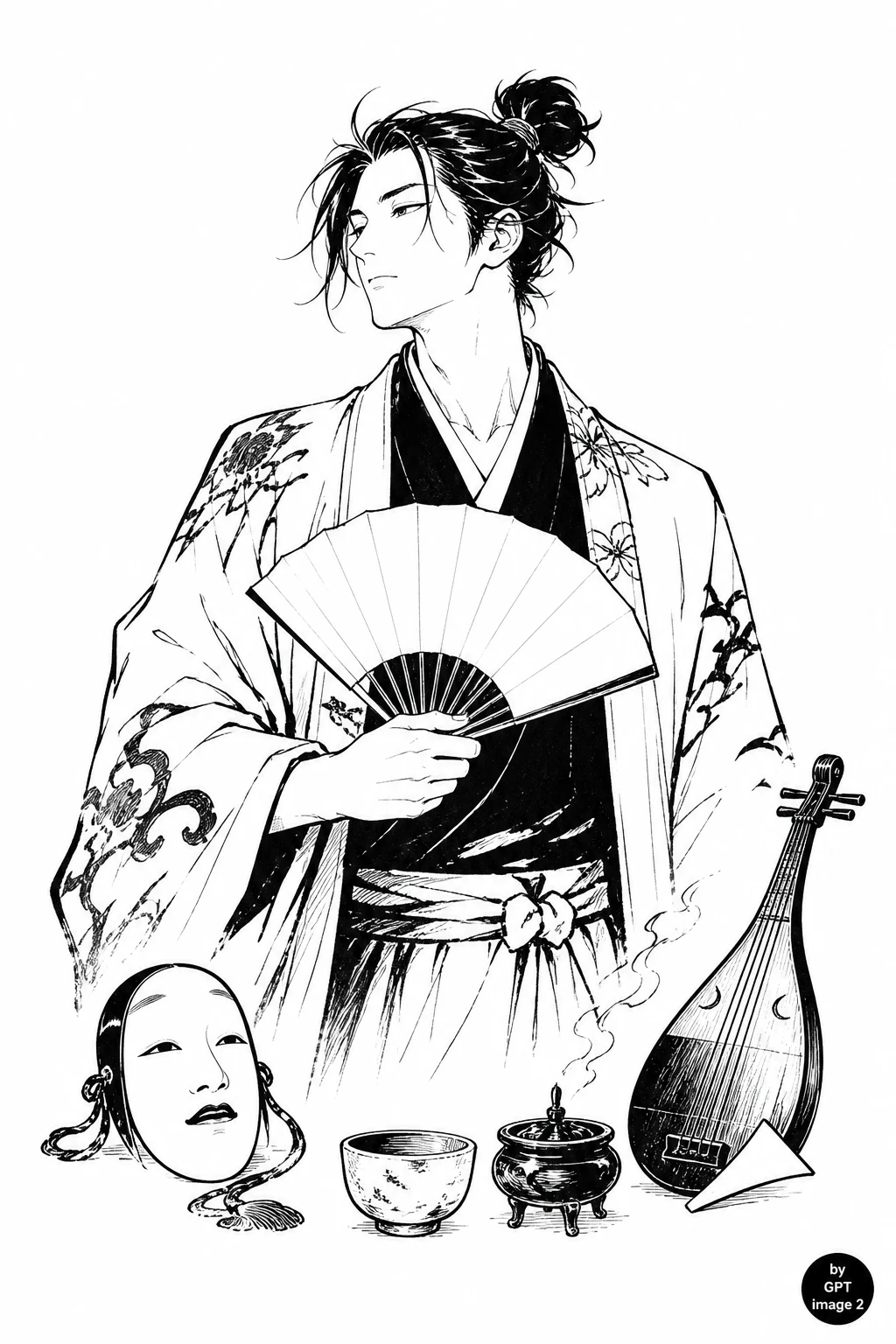
The standing side — noh, kowakamai, the dance of the shirabyoshi, the tales of the biwa hoshi, the new dances of the makeshift stage — belonged to commoners and daimyo alike. These are arts of body and voice, handled as a performance check of Presence + Bearing (02).
And beneath all these stages — the Spirit flows. A requiem song soothes the onryo, the Heike recitation calls the dead warriors, and a single song sung wrong wakes a sleeping yoma. In this world, art is not mere pleasure but another door opened to the Spirit Realm.
#Table — Survey of Forms
| Form | Kanji | Mode | Check Axis | Spirit Realm Contact |
|---|---|---|---|---|
| noh / sarugaku | 能·猿楽 | masked song-and-dance theater | Presence+Bearing | Calls ghosts and gods onto the stage (mugen noh). Requiem, summoning |
| kowakamai | 幸若舞 | narrative dance | Presence+Bearing | Dances the tale of a dead warrior. Requiem of the warrior houses |
| chado | 茶の湯 | hospitality / rite | composing Wisdom / serving Presence+Bearing+[Negotiation] | At the seat of one cup, the heart opens. A stillness like a Barrier |
| renga / waka | 連歌·和歌 | verse | composing Wisdom / reciting Presence+Bearing | Hides fate in a line and writes it down. Prophecy close to divination |
| kodo | 香道 | incense judging / play | judging Wisdom / seat Presence+Bearing | Reads the presence of another world by scent. Connects to the scent of yoma |
| ikebana | 立花 | flower arranging | Presence+Bearing | The flower form later broadly called ikebana. Stands cut-off life in one place. Offering |
| painting / wall-panel painting | 障壁画 | painting | Presence+Bearing (sustained production is Wisdom) | The Kano school legend that what is painted comes alive |
| shirabyoshi dance | 白拍子 | male-attire dance | Presence+Bearing | A dance overlapping the shrine and entertainment tradition. Can be staged as one bloodline with the miko |
| biwa / Heike | 琵琶·平家 | story performance | Presence+Bearing | Calls and consoles the dead of the Heike, and at times calls them forth |
| new dance (kabuki) | 歌舞伎踊り | unconventional dance | Presence+Bearing | A seat that breaks taboo. The spirit of the kabukimono dwells there |
The bracketed skill of the check axis (e.g.
[Negotiation]) is a supporting skill the GM may add according to the nature of the seat. The base axis of every performance check is Presence + Bearing.
#Scent — Accounts: The Masters Who Lived in This Era
Editor's note: The following renders a tale that an old impresario of a certain troupe spilled at a drinking session. The names are all real, but whether the Spirit Realm passages were added by his mouth or are truly so — that gap belongs to the GM.
Sen no Rikyu (千利休, 1522–1591). A merchant of Sakai and the tea master of the realm. The wabicha he perfected cast off splendor and raised up a beauty found in want. Crawl in through the nijiriguchi of a narrow tea room barely two shaku wide, and even a sword-bearing daimyo becomes a mere guest. He was the chief tea master of the Lord of the Realm, yet in the end he received the order and cut open his own belly. — "If a single cup of tea trades a whole castle, is that seat not already a battlefield?" So the old impresario said.
The tayu of Kanze and Konparu. Of the four noh troupes (観世·金春·宝生·金剛), Kanze and Konparu received the patronage of the Lord of the Realm and entered the inner chambers. At their root is a man of a century before, Zeami (世阿弥). The Fushikaden (風姿花伝) he left speaks of the "Flower (花)" — that single moment that blooms in the audience's heart. In mugen noh, a wandering ghost takes the stage and dances its own grudge. Lowering his voice, the impresario said that in a true master's mugen noh — that ghost truly comes.
Lord Oda (公) and "Atsumori." That warlord who proclaimed Tenka Fubu loved to dance the kowakamai "Atsumori" (敦盛). "Man's fifty years, compared to the Geten (下天, the lower heaven), are as a dream —" The tale that he danced that one passage before setting out and mounted his horse already rose to the mouths of the commoners. The tale of the dead boy-warrior Atsumori is danced by another who will soon die.
Satomura Joha (里村紹巴) and a certain hyakuin. The foremost master of renga of the age. He consorted with warlords and led countless seats. The opening verse one warlord is said to have recited at the renga gathering of Mount Atago just before his rebellion — "Now is the time, the rain-falling (= ruling the realm) fifth month (Toki wa ima ame ga shita shiru satsuki kana)" — was unraveled again and again in later days (the double-meaning reading is unpacked in zn07). In this era, verse could be more dangerous than the sword.
Kano Eitoku (狩野永徳, 1543–1590). The genius painter of the Kano school. He painted the wall-panel paintings of Azuchi Castle and Jurakudai upon gold leaf. The lions of the "Karajishizu" (唐獅子図) fill an entire wall and, as if even that were not enough, snarl on. The Kano school has an old saying — the moment a master sets in the pupils of the eyes, the thing in the painting breathes once.
Izumo no Okuni (出雲阿国). At the tail end of the era, a makeshift stage on the Shijo riverbank of Kyoto. A woman dressed in male attire and danced an unconventional dance, swinging the sword she carried, and drew the people in. They called it "kabuki" (to tilt / to deviate). The old men of the Mugenshu say that in that dance they saw — the giddy souls of the dead kabukimono. (It is a spark that leads on to the Edo stage.)
#Street Entertainers — The Roots of the Class
The base occupations of the entertainer class lay not in the inner chambers but on the road and the riverbank.
- shirabyoshi (白拍子) — Female dancers who dance in male attire. Originating from the dance of divine possession, of one bloodline with the miko. An incarnation of Presence.
- biwa hoshi (琵琶法師) — The biwa of the blind. They call and console the dead of the Heike through recitation. What their fingertips sometimes wake, even they cannot see.
- kabuki fool / new dancer — People of the stage who break taboo. Giddiness and unconventionality are themselves the art.
- yujo (遊女) — People of the art who hold song, dance, poetry, and hospitality in one body. They read the human heart from the closest place.
How they stand on the stage and earn money is handled in
02 Performance and Profit, and what they hold as they stand is handled in03 Props.