#Roads and Travel (道と旅)
Contents
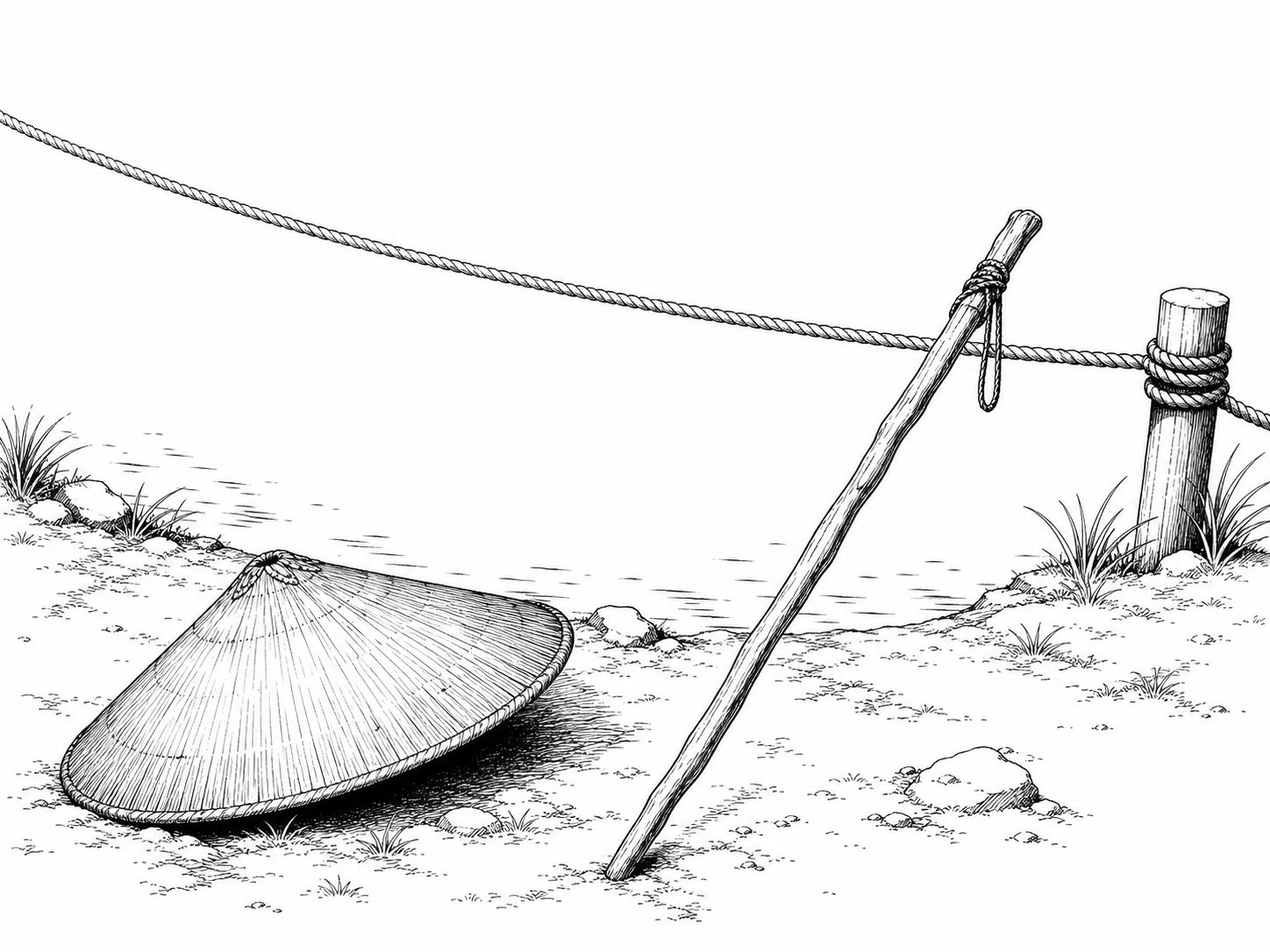
Authority. The main text is Fiction-Only — the observations of one outsider, in which fact, rumor, and misunderstanding are mixed. Only the "At the Table" at the end is Scene Tool. This volume has no Law (法) — if you need numbers for travel and trade, go to the canonical Trade Rules. The promise of this whole book is in About This Book; the one who wrote this diary is in The Narrator.
#The Road — The First Barrier
From Pinto's diary. The third day since leaving port.
Where the road climbed a hill, a palisade stood. In the middle of the palisade was a gate, and before the gate a line. Men carrying sacks of salt, a pilgrim with a bell, an old man leading an ox — and our party.
"It is called a sekisho (關所)," said the Tongue. "A gate of the road. From here on it is another lord's land, so we show our papers."
Unlike us, the gates of this country stand not on a city's walls but on the road. Since the country is split into sixty-some and they war with one another, the gates are that many too. A city gate bars the one who enters, but the gate of the road counts the one who passes.
When our turn came, the Tongue raised the pass-paper (過所狀) in both hands. It was the travel document the trading house at the port had obtained in advance. An official with a ledger read the document, and read me. He read my beard longer than the document.
He told us to unpack. When the chest was opened, an abacus, a ledger, and a scale came out. The official took up the scale.
"What is this thing used for?"
"It is used to weigh the weight of goods," the Tongue rendered.
"What does a Nanban man mean to weigh the weight of?"
The Tongue paused a moment, then answered at length. What he rendered I do not know. The official laughed for the first time, and set the scale down.
The Sword, before the gate, wound a cord about his own hilt. A bound sword, they say, takes one breath longer to draw. When a soldier gave him a doubting eye, the Sword said, "A guard who fights the gatekeeper is no guard." That one word opened the road better than two spears.
The Tongue paid the toll. Then, separately, he pressed something wrapped in paper down beside the clerk's sleeve. Later I asked. "Is that a tax too?" "No. It is the price of shortening the wait."
When we came out of the gate the sun had slanted low. Crossing a single hill had taken half a day. Looking back, the line had grown longer than in the morning. The Tongue said, "Today is a fast one."
I record it in the ledger. A barrier of this country has two prices — the price written in the ledger, and the price not written. Only the one who pays both comes out of the gate before the sun sets. This I saw.
#The Land of Fact — The System of Roads
#The Five Kinai and Seven Roads
The people of this country count the whole country by roads. The five provinces that cradle Miyako (Kyoto) they call the Kinai (畿內), and from there seven branching roads stretch to the ends of the country. Together they are the Five Kinai and Seven Roads (五畿七道) — an old administrative division of the officialdom (官), and at the same time the names of the highways (街道) walked on foot even now. The Tongue first taught it to me at the gunwale, and all through the journey I asked after the roads by these names. Unlike us, when the people of this country are asked where they are from, they answer not with the lord's name but with the names of the province and the road.
| Road | Reading | A note from the diary |
|---|---|---|
| 東海道 | Tokaido | The eastern sea-road. Keeping the sea on the right, it goes to the eastern plains. It is the most crowded road. |
| 東山道 | Tosando | The eastern mountain-road. Threading the mountains to the northern edge. The longest of the seven, they say. |
| 北陸道 | Hokurikudo | The northern land-road. To the countries of snow. In winter, I heard, the road is erased. |
| 山陰道 | Sanindo | The shaded-mountain road. The coast on the northern-sea side. In the end I could not walk it through. |
| 山陽道 | Sanyodo | The sunlit-mountain road. East and west along the northern shore of the Seto Inland Sea. The first great road I trod. |
| 南海道 | Nankaido | The southern sea-road. Across the sea to the islands and the peninsula. It is also the pilgrims' road. |
| 西海道 | Saikaido | The western sea-road. The western islands where the Nanban ships land. Where my journey began. |
The ten observation chapters of this volume are laid out following this division. Landing from the western sea-road, I walk the sunlit-mountain road east, pass through the islands and peninsula of the southern sea-road into the Kinai, cross the eastern mountain-road and the eastern sea-road and the northern land-road, and over a broad plain set down my brush in the north — the order of the chapters is the order of the roads. The sketch of the journey is in the The Narrator chapter, and the master tables of which chapter each of the sixty-some provinces falls into are held by the Region Cross-Reference and the Sixty-Odd Provinces List.
#The Road in Practice
If two people carrying loads can step aside and pass each other, it is a good road. A great highway is broad enough for two mounted warriors to ride abreast, and a mountain trail barely admits one person and that person's shadow. The surface is earth. When it rains the road becomes a bowl of porridge. Stretches paved with stone are rare — about the entrance of a temple or the reach of a great pass. Unlike us, the roads of this country scarcely know the cart — loads go on the backs of people and the backs of horses, and the road is cut to fit the breadth of those backs.
And then the mountains. 7-tenths of this country's land is mountain, I heard. The road cannot avoid the mountains and crosses them by passes, and a single great pass eats a whole day.
The distance of a day is this. A light, quick foot makes eight ri (里) a day, and a party carrying loads is fortunate to fill six or seven ri — for a sense of ri and cho (町), keep the Glossary & Weights and Measures at hand. From Miyako to the eastern threshold, a quick foot is a fortnight, and a party bound to loads and barriers and rivers, like ours, ran past a month. This I walked.
Editor's note: The days in this volume are the felt sense of foot travel bound to porters, barriers, and bridgeless rivers. The travel days in the canonical Trade Rules are campaign figures reckoned on a different premise (Sakai–Nagasaki is set down as a sea route), and even where this volume's felt sense and its numbers differ, they belong to the same world. The reckoning at the table follows the canon.
#The Barrier — The Gate of the Road
A barrier looks at three things. Papers, load, face. As for papers, the pass-paper, the travel warrant, and the like are written out variously by temples and trading houses and lords, and which paper passes at which gate is the living knowledge of interpreters and porters. What they seek in the load is weapons and, in time of war, rice and iron — and, by a tale I was told, the person who must not leave. A barrier bars the woman of a household the lord holds hostage from slipping across the province border, they say. As for the face — as my own face was, an outsider becomes an inquiry merely by standing there.
What one pays is also three. Tax, the thing wrapped in paper, and time. I set out to write the toll's sum in the ledger and gave up — it differed by lord, and at the same gate it differed by month. The one thing I could write was this. On a road with many gates, trade dries up.
#The River — Water Without a Bridge
Bridges are rare over the great rivers. Two reasons I was told. The ferryman said the floods carry the bridges off every year, and the ronin said the lord deliberately does not build them — because the river serves as a moat to bar enemy soldiers. Since the ferryman's word and the warrior's word differ, I set down both.
How one crosses, the water decides. If it is shallow, one wades the ford — the load borne on the head, and the short-statured borrowing the shoulders of the tall. If it is deep, a ferry. Where the current is fierce and a boat cannot even be floated, the riverside folk carry people across on their shoulders. People become the bridge, in effect, and the fare is set by that day's water level. After rain, one waits days for the water to fall. That is why the inns of the riverside villages love the rain — because the rain binds the traveler in place.
#The Bed for the Night — As Many as the Number of Stations
Unlike us, the temples of this country double as inns. Give alms and they lend even an outsider a floor, and the evening on a temple floor — the seat where pilgrims, peddlers, and ronin gather at one hearth — was where I heard rumor more accurate than the rumor of the market. In the ports and the market streets there are houses that take money and put one up. The good house is rare, and the common house is beside the horse's manger. Where there is not even that, one borrows a farmhouse barn, and where there is not even that, one lights a fire and sets a watch and sleeps in the open.
In short, there are beds as many as the number of stations. The daimyo's procession uses a temple's whole main hall, the merchant uses the gallery, the pilgrim uses the eaves, and the fallen use the sky.
#The Sea-Road — The Moving Barrier
For a heavy load the sea is faster. A cargo boat rounding the coast covers in a few days, with a good wind, a distance the land party takes a fortnight to make. At every port the manner of bringing a boat alongside and the speech of the haggling differ, and the seamen count the ports as countries.
But the Seto Inland Sea is a different sea. Its islands are several hundred, its channels narrow, and its tide runs like a river. A boat that enters without one who knows the channels — by a tale I was told — does not return. What holds the mouths of those channels is the suigun (水軍). At first I heard them called pirates. Going and seeing, they were nearer to gatekeepers. They sell to passing boats the right of escort and passage. Pay the price and they give a small flag, and fly that flag at the mast and no boat of that sea lays a hand on you, and at the mouths where the tide divides they even attach a pilot. They are not those who live by plunder, but those who live by the price of not plundering. The land's barrier is on the sea too, in effect — but the gate of the sea moves. That our boat bought a flag and haggled half a day over the price, this I saw, and the tale of their islands and fortresses I set down in Observation 2 — Sanyo and Sanin.
#People and Customs — The People on the Road
The road is a rare seat in this country where the stations mingle as one. To look at the faces on the road is to have seen the blood of the country circulate, so I set down a line for each face I met.
| Face | A line from the diary |
|---|---|
| Peddler | What he carries on his back is the whole of the shop. He is the village's news, and the village's scale. |
| Pilgrim | White robe and bell. Ask where he goes and he names a god; ask where he came from and he laughs. |
| Nun | Mendicant nuns who walk the road asking alms with a song. There are more of them on the road than in the temples. |
| Courier | Light of body, a single letter. The fastest thing on the road is not the horse but these men. |
| Daimyo's procession | The road empties, and people prostrate themselves. I tried to make do with taking off my hat — the Tongue pressed down on my back. |
| Ronin | Sword at the hip, no stipend. Hired as a guard he is a comfort; unhired he is a terror. |
| Wandering entertainer | A blind musician sings tales of old wars. Those who weep to hear are the warriors. |
Among these, the lives of those who live outside the world's fence — the ronin, the wandering entertainer, and the people of still lower seats — are looked at separately in The Fallen — People Who Live on the Road. If you meet them on the road, you need remember only one thing. The people on the road do not ask one another's history. Not asking is the courtesy of the road.
#The Land of Konsei — What War Brings to the Road
The rumor of war arrives ahead of the traveler. When the rumor arrives the border barrier closes, and before the closed gate a party piles up. The army guards a bridge or cuts it — either way, to the traveler it is the same thing. A highway an army has passed dies for a while. The rice fields are trampled and the villages empty, and what the villagers fear, they say, is not the army but those who come trailing at the army's tail. A tale I was told.
When a great road closes, the price of the mountain trail rises. The guide's fee rises, the mountain village's bed rises, and the price of rice beyond the pass rises. Where the road is cut, a gap in the going price arises, and where there is a gap in the going price there is one who goes in to feed on the gap. As a merchant I record it as margin. As a man I would wish to record it by another name.
Money, too, does not cross the roads well. Each time it crosses a border the money weakens — copper coin is taken selectively from place to place, and silver is weighed out by weight in use. So my scale is the most suspect thing at the barrier and the most honest thing at the market.
#The Land of the Uncanny — The Night Road
The day of this country ends with the sun. Unlike us, the people of this country reckon the night road not as a matter of sloth or haste but as a reckoning of life. When the sun slants low, every person on the road quickens the step in the same direction — toward the nearest light. That the step quickens, this I saw.
The tale I was told for the cause is all of a piece. The yoma (妖魔) of the night road wait at the joints of the road — the pass, the crossroads, and the bridge. The tale that at a pass, however far you walk, you return to the same village. The tale that if you ask the way at a crossroads, the road answers — and so, even lost, you do not ask. The tale that if you answer the thing that speaks to you on a bridge, you never cross the river in the end. The porters add a stone to the cairn at a pass's mouth, and before a bridge they bow twice and cross. When I asked the cause, the Tongue said, "It is insurance that costs nothing."
The trade in talismans is good too. At temples and shrines they sell a paper talisman called an ofuda, and the Tongue stuck one inside my hat as well. "Does it have any effect?" "There are those who say it does and those who say it does not. Only, the price is cheap, so the reckoning works out." For a merchant's theology there is nothing to fault, so I left it as it was.
What I saw on the night road I do not set down in this chapter. The night of each land is set down separately in each observation chapter. The one thing I will set down here is this. In this country, the knowledge of the road is not the knowledge of distance but the knowledge of where one must stop.
Editor's note: What waits at the pass, the crossroads, and the bridge, and how to roll it as a scene, is in Yoma of the Village, Road, and Mountain. What Pinto could not see is there.
#At the Table
Scene Tool. Only this section is a GM scene tool.
Reduce travel not to days but to joints. The scene of departure — one scene on the road — the scene of arrival. For the scene on the road, choosing just one of this document's materials (barrier, river, bed, night road) is enough. If you need an incident to roll, open Incidents of the Road; if you need the canon's encounter table, use the trade events of the Trade Rules.
The barrier is a social obstacle. It is not a fight but a scene of choosing which of a threefold cost — papers, money, time — to pay with. To a party without papers, a party hiding its standing, a party with something in the load that must not be shown, a single barrier is the same as a single dungeon door. If you want to reduce it to a single roll, just borrow the judgment frame of the canonical Non-Combat Rules as it is — this volume does not set the Target Number or the figures.
River and weather are a clock. Waiting on the water level of a bridgeless river makes time pressure and gathers the bound party at the inn — rumor, fellow lodgers, and haggling are born there.
Do not force the night road; have them choose it. Give a circumstance under which they cannot arrive before the sun sets, and let the party choose the night road of itself. What waits at the pass, the crossroads, and the bridge is held by fc08.
The one who asks the fast road is a merchant, and the one who asks the safe road is a person of this country — I had to ask both.