#Sengoku Fudoki (戦国風土記) — Overview Index
Contents
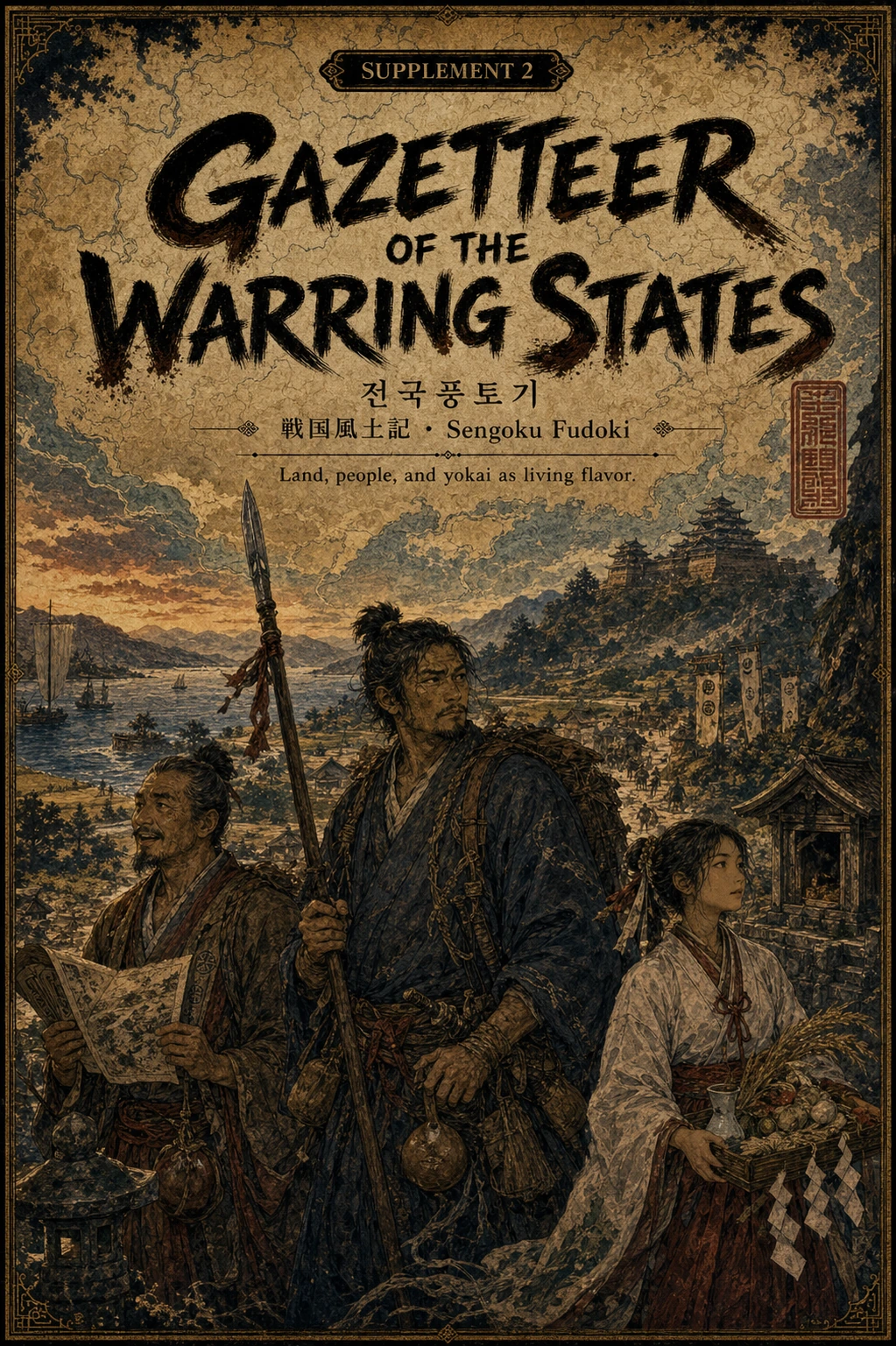
Fiction-Only. This volume is a book to be read. There are no check tables, no numbers, no technique slots. Material for a single breath outside the session.
Series specification:
../co/co-99-meta/co-99-03-fc-spec.md
#Opening Words
This book is a book for those who have never lived through the Sengoku era.
At the Konsei Reiyotan (混世霊妖譚) session table, while dice roll and swords clash, someone asks — just what kind of era was that, anyway? How did a samurai's day pass? An ashigaru (足軽) came from the fields — where did he return? What did the old woman do when a yoma entered the village in the night?
This volume does not answer these questions with numbers. What answers is the scene. The light falling on a samurai's tatami floor at dawn, the count of breaths an ashigaru takes as he grips his spear, the peach branch gripped in the hand of someone who has come face to face with a yoma — things like that.
Because this is a book to be read, do not consult it for checks. The rules are in the main co and ex volumes. This volume is writing to layer the world one stratum deeper behind those rules.
#Meta Card
| Item | Value |
|---|---|
| Series | fc (Focus Series) Volume 02 |
| Title | Sengoku Fudoki (戦国風土記) |
| Subtitle | Overview Index |
| Nature | Pure Scent (香) reading material — no Law (法) |
| Volume | 16 documents (15 main text + 1 glossary) · reading time 60–100 min |
| Dependency | Can reference co / readable independently without co |
| Authority | Fiction-Only (world-building supplement) |
| Main Edition Version Requirement | co >= 1.2 (for reference) |
| Current Version | v1.5 (fc02-VERSION) |
#Production and AI Notice
| Item | Content |
|---|---|
| Creator | Shellman |
| Inquiries and Feedback | X (formerly Twitter) @ds62hg, @trpg_ds62 |
| Generative AI Usage Notice | A substantial portion of this material was produced with the assistance of generative AI (LLM) during the planning, drafting, sentence-editing, and proofreading processes. The GPT Image 2 model was used during the image generation process. Claude Code and Codex were used for the Japanese and English translations. Final editing and responsibility for publication lie with the creator. In the event of domestic or international legal changes regarding AI-assisted works, the relevant laws shall apply. |
| License | Unless otherwise noted, distributed under CC BY-NC-SA 4.0. |
#Structure of the Book
#Meta
- 00-00. Index — This document.
- 00-01. About This Book — The identity and purpose of this volume.
#The Companion Glossary
- 00-02. Terms and Measurements Glossary — A small companion reference to keep at hand while reading this volume. Brief explanations of Sengoku-era Japanese terms for time, distance, weight, currency, social status, weapons, and more.
#First — Time: What Was the Sengoku Era? (3 documents)
Tracing the long winter-like era that bore the name Sengoku (戦国).
- 01-01. The Name of an Era — Sengoku
- 01-02. When War Became Everyday Life
- 01-03. From the Night the Spirit Realm Opened
#Second — People: Who Lived Through That Era? (5 documents)
Seeing the faces of those who walked through that era. A different day for every social status.
- 02-01. Samurai — Those Who Polish Their Blades Each Morning
- 02-02. Ashigaru — Fields by Day, Spear by Night
- 02-03. Commoner — Farmers, Merchants, Artisans
- 02-04. Outcastes — People Who Live on the Road
- 02-05. Holy Orders — Monks, Onmyoji, Miko
#Third — Yoma: What Are Yoma? (4 documents)
The single point where this world differs from the main edition. The fact that yoma exist.
- 03-01. What Are Yoma?
- 03-02. The Night of Encountering Yoma
- 03-03. The Faces of Yoma
- 03-04. Why Yoma Exist
#Closing Words
#How to Read (Recommended)
- Read before session preparation, a little at a time — one or two chapters (章) at once. No need to read cover to cover.
- Do not consult during the session — it is not a check table. It breaks the flow.
- Read immediately after the session — good for extending the lingering mood of the scene just finished.
- No need to memorize after reading — if an impression remains, that is enough.
#Relationship with the co Main Edition
This volume is a supplement to co-02-lore (world-building). It is not duplication or replacement.
co-02-lore | fc02 this volume | |
|---|---|---|
| Purpose | Defining world rules | Conveying world atmosphere |
| Style | Explanation | Narration · perspective |
| Scent · Law | Scent + Law together | Scent only |
| When used | Reference during session | Reading outside the session |
| Volume | Core compressed | Scenes and anecdotes |
When both volumes are read together, the world becomes more three-dimensional.
#Connections to Other Volumes
| Volume | Connection |
|---|---|
co | The baseline for the basic Sengoku world and all rules. |
fc04 | Reference when tracing the archetypes of Sengoku yoma tales back to the Heian period. |
ex3 | Reference when comparing how the same material is concealed and urbanized in Edo after the Sengoku. |
fc06 | Reference when reinforcing what Sengoku people believed and what words they used to justify their choices. |
fc08 | Reference when giving concrete form to the ecology, desires, Spirit Realm gates, and tale-variant transformations of Sengoku yoma. |
#A One-Line Invitation
"On an evening when the clash of swords grows distant, open this book."