#The Sixty-Odd Provinces List (六十餘州一覽)
Contents
Authority. This list is Summary — a table that sets in order the names and kanji of the old provinces, their assignment to the Roads (道), and the place of the chapters in this volume. Where name and division look different from the narrator's main text, follow this table and the Cross-Reference Table. Only the "narrator's line" column is borrowed from the narrator's diary, so in it fact and rumor are mixed. Only §2 "At the Table" is Scene Tool. This volume has no Law — if you need numbers, go to the canon
co. The promise of this whole book is in About This Book.
#The Road — The Reckoning of Names
From Pinto's diary — after the road had ended, in a winter lodging of the north.
Snow has fallen three days now. The road is over, and they say the ship will not sail until spring, so there is no cause for haste. We merchants, when a year's trade is done, bar the storehouse door and count the stock. I have finished one country. So today I resolve to count this country's stock.
By the hearth I asked the Tongue. "How many are the provinces of this country, all told?" The Tongue began to count on his fingers, then gave it up. "Sixty-six, they say. Some, adding the two islands of the sea, count sixty-eight." "Then it is sixty-eight. A ledger does not leave out the islands."
The Tongue called the names in the order of the old system. From the five provinces of the inner land, in the order of the seven branching roads. I took them down, and beside each name set one line. The names of lands I had been to came back as scenery — the sound of a blade being whetted, the smoke of burning salt, the sound of rain I heard three days running. The names of lands I had not been to came back as rumor — the words of sailors, the words of pilgrims, the words of traders bent on cutting the price.
At two names the brush stopped. One was a mountain province east of Miyako. "There," the Tongue said, choosing his words for once, "is where the road does not let the tales out." Then the Sword — a man who in two years had not so much as named his own home — added one word from across the hearth. "Not asking comes cheaper." I set down only what I heard, and passed to the next name.
The other was an island I had passed on the boat. The day we crossed to Shikoku, a land that hung the whole half-day off the left of the prow. "Can one enter into the ledger a land one's foot has not touched?" the Tongue asked. "One enters it. Only, one writes 'seen, no more.' The dearest column in a ledger is the empty column, and the next dearest is the false column."
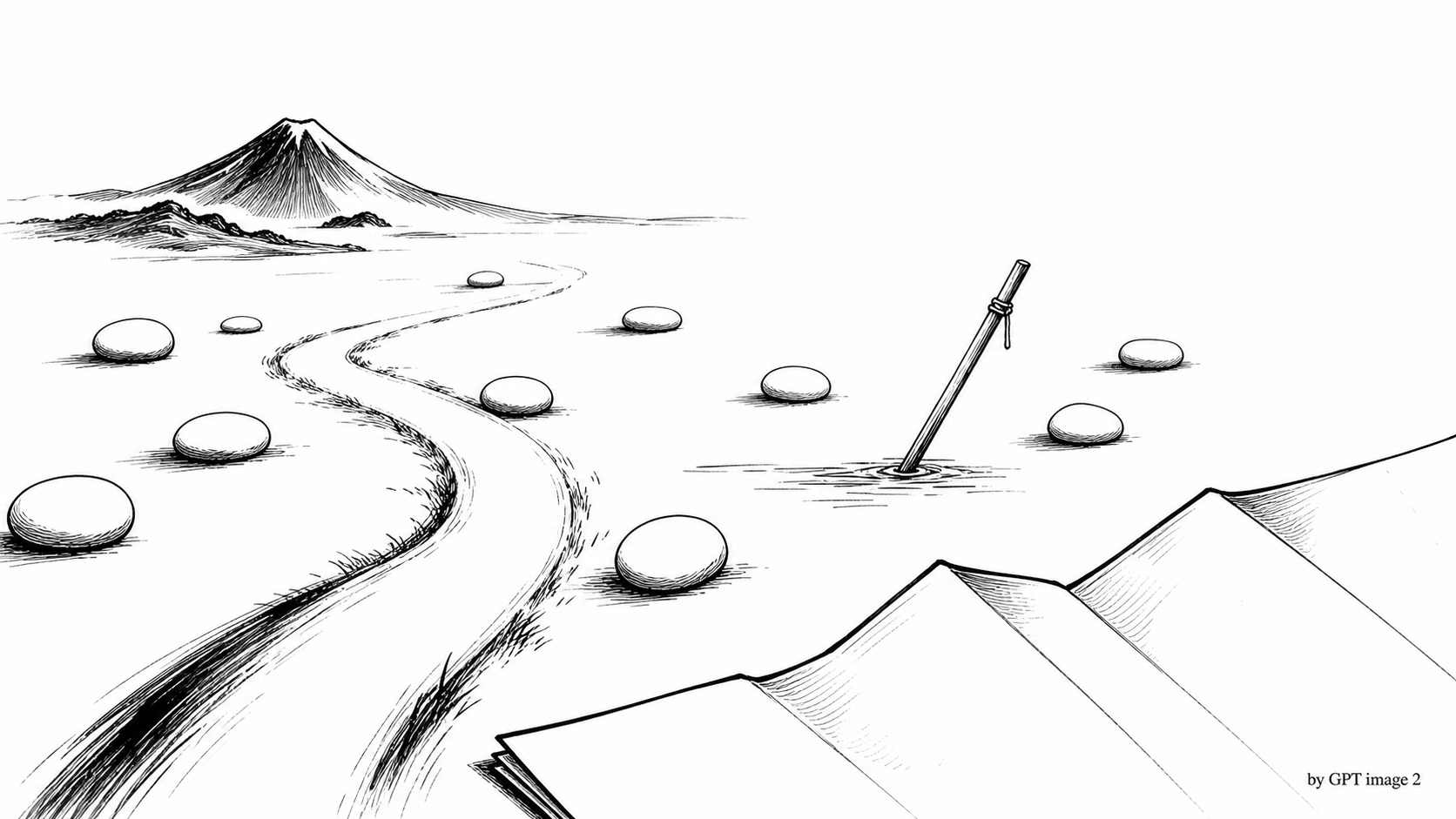
Late in the night all sixty-eight lines were filled. It came to two leaves of paper. The Tongue, peering at them, laughed. "The price of two years' walking is two leaves of paper?" "No country fits onto two leaves of paper," I answered. "What fits is only the name. But a name is a gate — the gate is small, yet the house behind the gate is not small."
While I wait for the ink of the last line to dry, I set this down. There is no merchant who knocks on all sixty-eight gates. But neither is there a merchant who chooses a gate without a list.
Editor's note: This list is a transcription of two leaves found folded at the very end of the sixth bundle. The "narrator's line" is just as it stood on those two leaves, and the few lines that were blank the editor filled by borrowing from other passages of the diary — which lines are the borrowed ones is not recorded. Only the names and divisions have been set right after the old system, so where the table differs from the narrator's main text, trust the table.
#1. The List — Sixty-Six Provinces and Two Islands
The old system divides the whole realm into the five inner provinces and the seven branching Roads. The kanji of the Roads are set down here once only — Kinai (畿內), the Tokaido (東海道), the Tosando (東山道), the Hokurikudo (北陸道), the Sanindo (山陰道), the Sanyodo (山陽道), the Nankaido (南海道), the Saikaido (西海道). The chapter in this volume column is the observation chapter in which that province appears — there are places here and there where the narrator's steps run counter to the order of the old roads, and that reckoning is held by the Cross-Reference Table.
| # | Province | Kanji | Road (道) | Chapter | The narrator's line |
|---|---|---|---|---|---|
| 1 | Yamashiro | 山城 | Kinai | Observation 5 | The province of the capital. Half ash, half market — this I saw. |
| 2 | Yamato ◇ | 大和 | Kinai | Observation 5 | The province of the older capital. Now the temple bells open the morning. |
| 3 | Kawachi | 河內 | Kinai | Observation 5 | River and low fields — the back garden of the capital's table. |
| 4 | Izumi | 和泉 | Kinai | Observation 5 | The province of Sakai. The sound of the scale beats the sound of the waves. |
| 5 | Settsu | 攝津 | Kinai | Observation 5 | The mouth where the cargo of the inner sea comes up onto land. A great temple at the river-mouth holds out like a castle. |
| 6 | Iga | 伊賀 | Tokaido | — | I could not take that mountain road. Folk who walk without a sound live there, I was told. |
| 7 | Ise ◇ | 伊勢 | Tokaido | Observation 7 | The province of the shrine. The whole country longs to walk this road once in a lifetime. |
| 8 | Shima | 志摩 | Tokaido | Observation 7 | A small province of saw-toothed coast. The women go to the bottom of the sea on a single breath. |
| 9 | Owari ◇ | 尾張 | Tokaido | Observation 7 | The fields are broad and the roads gather — a storehouse the armies covet. |
| 10 | Mikawa | 三河 | Tokaido | Observation 7 | A province of hard little castles. The warriors are famed for their patience, I was told. |
| 11 | Totomi | 遠江 | Tokaido | Observation 7 | The east-west road passes between a great lake and a sandbar. |
| 12 | Suruga | 駿河 | Tokaido | Observation 7 | The province of the great snow-clad mountain. A thing greater than that mountain I have never seen. |
| 13 | Izu | 伊豆 | Tokaido | Observation 7 | A peninsula thrust out into the sea. Valleys where hot water wells up are many, I was told — I went only as far as its mouth. |
| 14 | Kai | 甲斐 | Tokaido | Observation 8 | A basin whose walls are mountains. The horses are good, and the rumor of gold runs deeper than the mountains. |
| 15 | Sagami | 相模 | Tokaido | Observation 9 | A province where the old warrior capital sleeps by the sea. |
| 16 | Musashi ◇ | 武藏 | Tokaido | Observation 9 | Walk and walk, still fields. The reed-grown inlet village is yet small of name. |
| 17 | Awa | 安房 | Tokaido | Observation 9 | The sailors' province at the southern end of the plain. The outer sea is fierce. |
| 18 | Kazusa | 上總 | Tokaido | Observation 9 | The seaward half of the plain. The horses are good and the tidal paths are tangled. |
| 19 | Shimousa | 下總 | Tokaido | Observation 9 | A marshy plain where a great river lies down as it pleases. The road sinks often into the water. |
| 20 | Hitachi ◇ | 常陸 | Tokaido | Observation 9 | The northern gate of the plain. An old god who enshrines a blade looks out to sea, I was told. |
| 21 | Omi ◇ | 近江 | Tosando | Observation 6 | One lake feeds one whole province — this I saw. |
| 22 | Mino ◇ | 美濃 | Tosando | Observation 7 | The gate where mountain and plain meet. He who holds this gate measures east and west, I was told. |
| 23 | Hida | 飛驒 | Tosando | Observation 8 | A province of deep valleys. The timber is straight and the carpenters famed. |
| 24 | Shinano | 信濃 | Tosando | Observation 8 | A province of high fields. At every pass a road forks, and the horses walk better than the men. |
| 25 | Kozuke ◇ | 上野 | Tosando | Observation 9 | A windy province of plains. Horses and mountain castles are many. |
| 26 | Shimotsuke | 下野 | Tosando | Observation 9 | The province of the great northbound road. A holy seat upon a mountain is famed, I was told. |
| 27 | Mutsu ◇ | 陸奧 | Tosando | Observation 10 | Alone, the worth of several provinces of the mainland. Walk a fortnight, still the same province. |
| 28 | Dewa | 出羽 | Tosando | Observation 10 | The west of the north, where snow goes over a man's height. Three mountains are themselves gods, I was told. |
| 29 | Wakasa | 若狹 | Hokurikudo | Observation 8 | A small bay that supplies the capital's kitchen with fish. A single pass joins sea and kitchen. |
| 30 | Echizen ◇ | 越前 | Hokurikudo | Observation 8 | The mouth of the north-country highway. The rice is plentiful and the paper good — the paper I bought and tried. |
| 31 | Kaga | 加賀 | Hokurikudo | Observation 8 | A land where the common folk are said to have driven out the daimyo and rule themselves — a tale I was told. |
| 32 | Noto | 能登 | Hokurikudo | Observation 8 | An arm thrust out into the sea. The smoke of burning salt lies down on the sea-wind. |
| 33 | Etchu | 越中 | Hokurikudo | Observation 8 | There is a hell deep within a great mountain, they say. The folk at the mountain's foot did not speak of it in jest. |
| 34 | Echigo | 越後 | Hokurikudo | Observation 8 | A long, white province. When winter shuts the door it does not open until spring, I was told. |
| 35 | Sado | 佐渡 | Hokurikudo | Observation 8 | An island of exile. The talk of gold had reached the mainland before the island itself. |
| 36 | Tanba | 丹波 | Sanindo | Observation 2 | At the back of the capital. With much fog and many passes, the road darkens early. |
| 37 | Tango | 丹後 | Sanindo | Observation 2 | A bay of the northern sea. A sandbar said to be like a bridge laid across the sky is there, I was told. |
| 38 | Tajima | 但馬 | Sanindo | Observation 2 | A province in the mountain's shade. Iron comes from the mountain and hot water wells from the valley, I was told. |
| 39 | Inaba | 因幡 | Sanindo | Observation 2 | A coast of sand dunes. The old tale of the white hare I heard twice. |
| 40 | Hoki | 伯耆 | Sanindo | Observation 2 | A province where a great mountain stands high alone. In winter the wind is master, they say. |
| 41 | Izumo | 出雲 | Sanindo | Observation 2 | For one month of the year, the gods of the whole country gather here, they say. |
| 42 | Iwami | 石見 | Sanindo | Observation 2 | A mountain that yields silver. This province's silver is one in three of the world's, they clamor — a tale I was told. |
| 43 | Oki | 隱岐 | Sanindo | Observation 2 | A far cluster of islands of banishment. I could not see them even across the sea. |
| 44 | Harima | 播磨 | Sanyodo | Observation 2 | The gate by which one enters the capital from the west. Castles stand in a row along the highway. |
| 45 | Mimasaka | 美作 | Sanyodo | Observation 2 | A province of basins between the mountains. The road bent away, so I heard only the rumor of hot water. |
| 46 | Bizen | 備前 | Sanyodo | Observation 2 | The sound of whetting a blade is louder than the sound of the market. |
| 47 | Bitchu | 備中 | Sanyodo | Observation 2 | An inner plain along a river. A shrine where a cauldron cries to foretell fortune is there, I was told. |
| 48 | Bingo | 備後 | Sanyodo | Observation 2 | A harbor province where ships wait for the tide. The waiting becomes a trade. |
| 49 | Aki | 安藝 | Sanyodo | Observation 2 | A shrine that floats on the sea when the water rises — this I saw. |
| 50 | Suo | 周防 | Sanyodo | Observation 2 | There is a town called the capital of the west, I was told. |
| 51 | Nagato | 長門 | Sanyodo | Observation 2 | The western end of the mainland. Through a narrow strait the ships stand in line. |
| 52 | Kii | 紀伊 | Nankaido | Observation 4 | The mountains are deep, and gods dwell there, they say. I heard only the sound of rain three days running. |
| 53 | Awaji | 淡路 | Nankaido | — | The island-gate between Kinai and Shikoku. Seen from the boat, no more; my foot did not touch it. |
| 54 | Awa | 阿波 | Nankaido | Observation 3 | A strait where the sea boils in a whirl. The mountain road is more tangled still. |
| 55 | Sanuki | 讚岐 | Nankaido | Observation 3 | A sky stingy with rain. The people dig ponds in the fields to stand in for the sky. |
| 56 | Iyo | 伊豫 | Nankaido | Observation 3 | An old hot-spring harbor. Sailor and pilgrim ease their bodies in the same bath. |
| 57 | Tosa | 土佐 | Nankaido | Observation 3 | A province of the outer great sea. At the tale of the dog god the people lower their voices. |
| 58 | Chikuzen | 筑前 | Saikaido | Observation 1 | The province of Hakata. The ships of the continent and our ships meet in the same market. |
| 59 | Chikugo | 筑後 | Saikaido | Observation 1 | A plain a great river raises. The inner storehouse of the western island. |
| 60 | Buzen | 豐前 | Saikaido | Observation 1 | The western gate into the inner sea. An old great shrine is the gatekeeper. |
| 61 | Bungo | 豐後 | Saikaido | Observation 1 | The harbor our ships enter most deeply. A rare land where the cross is no strange sight. |
| 62 | Hizen | 肥前 | Saikaido | Observation 1 | A province where the harbors are strung like beads. The place where I first set foot on this country's soil. |
| 63 | Higo | 肥後 | Saikaido | Observation 1 | A mountain breathes and sends up smoke — this I saw. |
| 64 | Hyuga | 日向 | Saikaido | Observation 1 | A coast facing the side where the sun rises. The land where the gods first came down, I was told. |
| 65 | Osumi | 大隅 | Saikaido | Observation 1 | A province with a mountain of fire standing offshore. The island where the teppo first arrived is in that sea too, I was told. |
| 66 | Satsuma | 薩摩 | Saikaido | Observation 1 | A hardy province at the southern end. The Ryukyu sea-route lies open — I could not get that far. |
| 67 | Iki | 壹岐 | Saikaido | Observation 1 | The first stepping-stone toward the continent. The ships go on, taking water and wind. |
| 68 | Tsushima | 對馬 | Saikaido | Observation 1 | The island that faces Joseon. The tongues of two countries mingle in one market, I was told. |
The marks and the blanks of the table read thus.
- ◇ — the ten provinces famed for the size of their storehouses. The people of this country count the size of land by rice — they call it kokudaka (石高), and the sense of the koku (石) I leave to the Glossary & Weights and Measures. Only, the ground for this mark is no more than the reckoning the narrator heard on the road ("more than five hundred thousand koku, I was told"), and he never counted it himself. There was talk, too, that into one northern province's reckoning a neighboring province's share creeps in. Either way — a matter that needs numbers is not this book's portion.
- — (no chapter in this volume) — Iga and Awaji. Two provinces that neither the narrator's foot nor any observation chapter of this volume reached. The one line of this list is all this volume sets down for the two, and the circumstance of their assignment is gathered by the remarks of the Cross-Reference Table.
- Lines whose assignment looks awry. Kai is, by the old system, a province of the Tokaido, but the narrator's steps bound it to the chapter of the mountains (Observation 8); Mino is a province of the Tosando, but the journey grazed the chapter of the eastern sea-road (Observation 7). The reckoning between the old roads and the ten chapters of this volume is held by the Cross-Reference Table.
#2. At the Table — A Province at Random
Scene Tool. Only this section is a GM scene tool — how to open the list above with the dice.
At a table on the road, one province comes to be needed on the spot — the home of a ronin met for the first time, the harbor where a rumor first began, the sender of a wrecked ship's cargo, the issuer of a pass found in a dead man's breast. At such a time, roll 1d100. 00 reads as 100.
| 1d100 | Result |
|---|---|
| 01–68 | The province of the same number (#) in the list — use its "narrator's line" as the first impression |
| 69–00 | A land even the narrator does not know — GM's free hand |
If "a land even the narrator does not know" comes up, you can roll again, or use it as it stands. A small island not on the map, a valley two provinces each claim as their own, an inlet whose name is set down differently in every ledger — all beyond the sixty-eight lines is yours. That the narrator does not know it means that no one set it down first.
Editor's note: The order of the table is not the narrator's but the order of the old system. Whichever province the dice choose, that province's true face is set by its observation chapter — or, for the two provinces that have no chapter, by your table.
The provinces shrank to sixty-eight lines, but the road did not shrink by a single line.