#Shokoku Kenbunroku (諸国見聞録) — An Outsider's Travelogue of Japan's Sixty-Odd Provinces
Contents
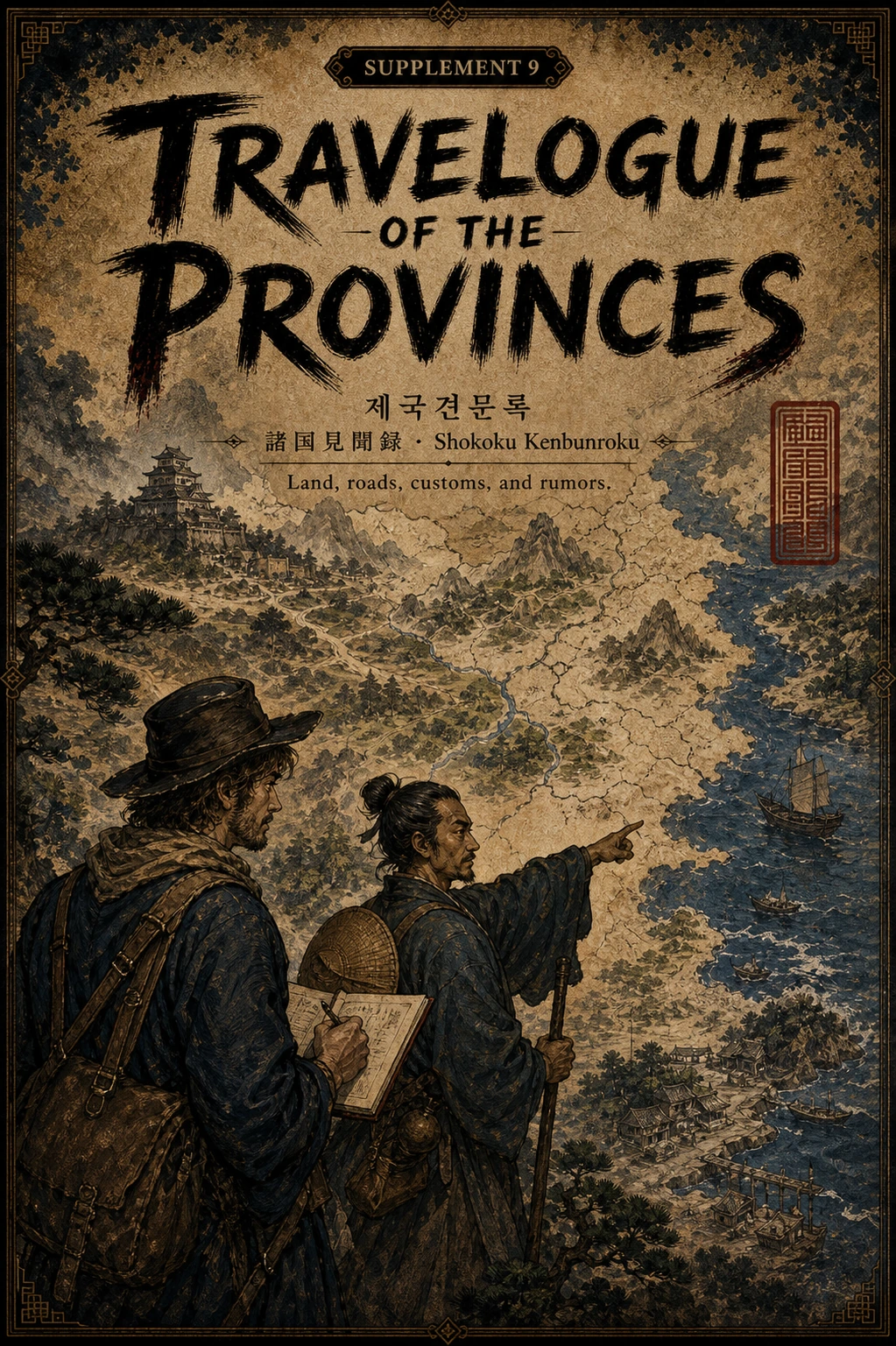
Authority. This volume is a book to be read. The entire main text is Fiction-Only — the record of one outsider, in which fact, rumor, and misunderstanding are mixed, and the gaps belong to the GM. Only the §At the Table at the end of each chapter is Scene Tool; the Region Cross-Reference and the Sixty-Odd Provinces List are Summary. This volume has no Law — there are no check tables, no numbers, and the dice of a check never roll once. The d10 and d100 in the appendix are dice for choosing a scene, not for a check. If you need numbers, go to the canon
co.
Series specification:
../co/co-99-meta/co-99-03-fc-spec.md
#Opening Words
This book is a book for those who have never set foot on the soil of this country.
At the Konsei Reiyotan session table, while the party sets out on the road, someone asks — but what lies beyond that pass? Which way does the road bend from Sakai to the capital? What do the people of this region eat, to what gods do they bow, and what do they fear once the sun goes down?
This volume does not answer these questions with a map. What answers is one man's footsteps. Duarte Pinto, agent of a Nanban (南蠻) trading house — the man called "the Nanban Brush" on the road — came down to this country to look at silver, and ended up seeing the whole country. From the harbor of Saikai (Kyushu) in the west to the last wharf of Ou in the north, spending two winters on the road, he kept one promise to the end: to write what he saw as "this I saw," and what he heard as "a tale I was told." This book is the six bundles of that diary, which an editor obtained and bound together.
Therefore the sentences of this book are worth believing, but must not all be believed. The narrator is an outsider, he heard this country's words through an interpreter, and, being a merchant who loved numbers, he inflated numbers in equal measure. That gap is not a flaw in this book — it is the door through which the GM enters.
Because it is a book to be read, do not consult it for checks. The rules are in the main co and ex volumes. This volume is writing meant to lay out a single layer of land behind those rules.
#Meta Card
| Item | Value |
|---|---|
| Series | fc (Focus Series) Volume 09 |
| Title | Shokoku Kenbunroku (諸国見聞録) |
| Subtitle | An Outsider's Travelogue of Japan's Sixty-Odd Provinces |
| Nature | One outsider's travel record — reading material of land and roads, no Law |
| Volume | 19 documents (3 meta + 2 overview + 10 observations + 3 tables/appendices + 1 closing) · reading time 160–170 min |
| Dependency | Can reference co / readable independently without co. fc02 and fc08 are optional references |
| Authority | Fiction-Only-centered (main text) · Scene Tool (each chapter's §At the Table) · Summary (cross-reference · list) |
| Main Edition Version Requirement | co >= 1.2 (for reference) |
| Current Version | v1.5 (fc09-VERSION) |
#Production and AI Notice
| Item | Content |
|---|---|
| Creator | Shellman |
| Inquiries and Feedback | X (formerly Twitter) @ds62hg, @trpg_ds62 |
| Generative AI Usage Notice | A substantial portion of this material was produced with the assistance of generative AI (LLM) during the planning, drafting, sentence-editing, and proofreading processes. The GPT Image 2 model was used during the image generation process. Claude Code and Codex were used for the Japanese and English translations. Final editing and responsibility for publication lie with the creator. In the event of domestic or international legal changes regarding AI-assisted works, the relevant laws shall apply. |
| License | Unless otherwise noted, distributed under CC BY-NC-SA 4.0. |
#Map Collection
| Map | Location | Use |
|---|---|---|
| Pinto's Travel Route | fc09-00-02-traveler.md | Shows the spatial relationships used by the chapter. |
| 10 Regions of the Archipelago | fc09-01-01-archipelago.md | Shows the spatial relationships used by the chapter. |
| Provinces and Gokishichido | fc09-99-01-province-list.md | Shows the spatial relationships used by the chapter. |
| Saikai Travel Map | fc09-02-01-saikai.md | Shows the spatial relationships used by the chapter. |
| Sanyo-Sanin Travel Map | fc09-02-02-sanyo-sanin.md | Shows the spatial relationships used by the chapter. |
| Shikoku Travel Map | fc09-02-03-shikoku.md | Shows the spatial relationships used by the chapter. |
| Kii Travel Map | fc09-02-04-kii.md | Shows the spatial relationships used by the chapter. |
| Kinai Travel Map | fc09-02-05-kinai.md | Shows the spatial relationships used by the chapter. |
| Oumi Travel Map | fc09-02-06-omi.md | Shows the spatial relationships used by the chapter. |
| Tokai Travel Map | fc09-02-07-tokai.md | Shows the spatial relationships used by the chapter. |
| Hokuriku-Shinetsu Travel Map | fc09-02-08-hokuriku-shinetsu.md | Shows the spatial relationships used by the chapter. |
| Kanto Travel Map | fc09-02-09-kanto.md | Shows the spatial relationships used by the chapter. |
| Ou Travel Map | fc09-02-10-ou.md | Shows the spatial relationships used by the chapter. |
#Structure of the Book
#Meta
- 00-00. Index — This document.
- 00-01. About This Book — The frame of the travelogue, how it differs from Sengoku Fudoki, and how to believe and how to doubt the narrator's record.
- 00-02. The Narrator — the Nanban Brush — The man who wrote the diary. The person, a sketch of the journey, the method of record. The voice of the whole volume is settled here.
#Overview — The Stage Called the Archipelago (2 documents)
Before the ten chapters of observation, the whole stage is seen once from afar.
- 01-01. Overview of the Japanese Archipelago — The terrain, climate, sea, and disasters of a land that is 7-tenths mountain, and the correlation between spirit-veins and terrain.
- 01-02. Roads and Travel — The five Kinai and the seven Roads, barriers and rivers and lodgings, and the road after the sun has set.
#Observations — From Landfall to Terminus (10 documents)
Exactly in the order of the narrator's steps. The later the chapter, the more his ears have opened, and the grain of the record is a little closer to the raw.
- 02-01. Saikai — Landfall — Mountains of fire and boiling valleys, the reckoning of a Nanban trade port, nameless rumors rising from the southern sea.
- 02-02. Sanyo and Sanin — The sea-route of the sunny side and the road of the shaded side, the reckoning of the Iwami silver mine, the legend of Izumo where the gods are said to gather.
- 02-03. Shikoku — An island whose center is blocked by mountains, the road where white-robed pilgrims circle like a ring, the legends of the tanuki and the inugami.
- 02-04. Kii — The forest of rain and the Kumano pilgrimage road, a city atop the mountains, the temples and villages that sell guns.
- 02-05. Kinai — Miyako (Kyoto), half ash and half market; Sakai, a city without a daimyo; temples that hold out like castles.
- 02-06. Omi — The lake as a road, peddlers with their carrying-poles, the hammer-sound of Kunitomo, the neighbors beneath the water.
- 02-07. Tokai — The busiest road and the Nobi plain, Ise Grand Shrine and Fuji, and three great banners.
- 02-08. Hokuriku and Shinetsu — The half-year when snow erases the roads, a domain that drove out its daimyo, a mountain that holds a hell and a temple of hidden Buddhas.
- 02-09. Kanto — The broad plain beyond Hakone, the dead capital Kamakura, the field of pitched battle and the headless god.
- 02-10. Ou — Terminus — The land where the road ends. The matagi and the descendants of the Emishi, the northbound oni, the mountain of the dead and the itako.
#Tables — The Exchange of Names (1 document)
- 03-01. Region Cross-Reference — This volume's ten regions ↔ the canon's six regions ↔ the old provinces (舊國). The standard for this volume's divisions and names.
#Appendices — Beside the Table (2 documents)
- 99-01. Sixty-Odd Provinces List — A one-line impression of the sixty-six provinces and two islands, an index into the observation chapters, and a d100 table for a random province.
- 99-02. Incidents of the Road — 3 kinds of d10 tables for incidents in transit, and regional seasoning tables. The only document in this volume made to be laid out whole on the table.
#Closing
- 99-00. Closing — The narrator's last diary entry and the editor's afterword. The shortest chapter in this volume.
#How to Read (Recommended)
- Before a session, one region at a time — read only the one chapter of the land where the next story will happen. Enter and leave that land together with the narrator, and that is preparation enough.
- During a session, keep it closed — the main text is not a check table. What is written with the standing to come up at the table is only the §At the Table at the end of each chapter and the Region Cross-Reference and Sixty-Odd Provinces List; and the appendix Incidents of the Road is, as a whole document, written with that standing.
- When choosing a campaign stage, read it through — this is the one time this book recommends a full read. Walk with the narrator from landfall to terminus, and usually some land speaks to you first.
- If ri (里) and cho (町) are unfamiliar — keep the Glossary & Weights and Measures at hand. All the lengths and distances in this volume use that reckoning.
- No need to memorize after reading — if an impression remains, that is enough. The details, the narrator always wrote down again.
#Relation to the Canonical "Lands of the Sengoku"
This volume is a supplement to the canonical Lands of the Sengoku (co-02-04). It is not a duplication or a replacement.
co-02-04 Lands of the Sengoku | fc09 This Volume | |
|---|---|---|
| What it does | Defines — fixes the regions, the powers, and the Law | Observes — one person's record of walking that land |
| Divisions | Six regions | Ten regions — subdividing and deepening the six, and supplementing the four seats the canon left empty |
| Gaze | The eye that sets the stage — from above | The eye-level of the road — one place at a time |
| Scent · Law | Scent + Law together | Scent only — no Law |
| Standing of the record | The standard — it is not wrong | The narrator can be wrong — even that gap is scenery |
| On conflict | The canon is always right | The one in error is always this volume — precisely, the narrator who saw or heard it so |
How the ten regions and the six regions overlap, and which chapter fills which seat of the canon, is handled entirely by the Region Cross-Reference. Where name and division diverge, follow that table; where the table diverges from the canon, follow the canon.
#Connections to Other Volumes
The relation to the canonical co was written in the section above. With the neighbors on the same shelf, the connections are these.
| Volume | Connection point |
|---|---|
fc02 | The pair of this volume — the axis of time and people. A campaign's "when" and "who" come from Sengoku Fudoki, its "where" from this volume. |
fc08 | Refer to it when giving substance to the nature, ecology, and data of the yoma that each chapter's §The Land of the Uncanny recorded by rumor alone. |
fc01 | Izumo, Ise, Kumano — refer to it when raising the rank of divinity at the seats of the gods before whom the narrator halted at the gate. |
ex3 | When the same roads became the Edo highways an age later — refer to it when comparing the next face of the same land. |
#A One-Line Invitation
"When you have read it, close it. When you have closed it, walk. When the road leaves the map — from there on, it is your own travelogue."
A table of contents is a harbor — whatever chapter you disembark at, that is your landfall.